A gas pool heater that bangs, knocks or bumps while it fires is usually short of water flow. Jandy, Pentair, Raypak and Hayward each tie that sound, or the boiling behind it, to low flow through the heat exchanger, and the first checks they list are ones an owner can make: the filter, the baskets, the pump speed and the valves.
Whining has more causes. Raypak's table names a thermostatic valve, debris, and scale, while Pentair puts a high-pitched whine down to the gas and air mixture. Heat pumps are a separate machine with separate sounds, mostly from a fan and compressor that start, stop and defrost on timers.
Every cause and fix below comes from installation manuals and troubleshooting guides published by Raypak, Pentair, Jandy, Hayward, Madimack and AquaCal, quoted with the model they cover. Sounds that belong to the pool pump itself, such as cavitation, squealing and pad vibration, have their own page: how to make a pool pump quieter.
Which pool heater sounds are part of normal running?
On a gas pool heater, a blower that runs before the burner lights and after it goes out is normal. On a heat pump, a fan turning while the compressor waits is a designed delay.
Hayward's Universal H-Series manual sets out the gas sequence. On a call for heat the control starts the blower and the igniter together, and "The igniter heat-up time is approximately 20 seconds", with the blower running a pre-purge cycle the whole time. A 4-second trial for ignition follows, and once the thermostat is satisfied, "The control operates the blower during a 30-second post-purge period."
Jandy's purge runs longer, since its LXi manual says "The fan will continue to run for 45 seconds after the burner shuts down."
If the burner fails to light, Hayward's control purges again and makes two more attempts before it locks out, so three ignition trials, each followed by a 30-second post-purge, come before the safety lockout Hayward describes.
Heat pump start-up delays
Each heat pump maker builds in a pause, and the fan often runs through it, but the delays printed in the manuals differ:
| Maker and model | What happens at start-up |
|---|---|
| Pentair UltraTemp | One minute to sense water temperature, then the fan starts, then "an additional 5 minute delay for the compressor to start" |
| Raypak TWPH and Crosswind | "the blower will run for 1-minute before the compressor" |
| Madimack InverELITE | The fan runs 1 minute before the compressor, and stops 1 minute after it |
| Hayward round heat pumps | "a 5 minute delay during which no operation will occur" |
| Hayward square heat pumps | A 3 minute delay, with the fan on straight away |
Hayward's heat pump troubleshooting guide explains the purpose: the delay "protects the compressor from short cycling." It also blocks a restart for 3 to 5 minutes after the heat pump reaches its set point or loses power. Pentair's UltraTemp guide lists a fan turning with no cool air from the top, and gives the "five minute safety delay" as the first cause.
Why is my pool heater banging or knocking?
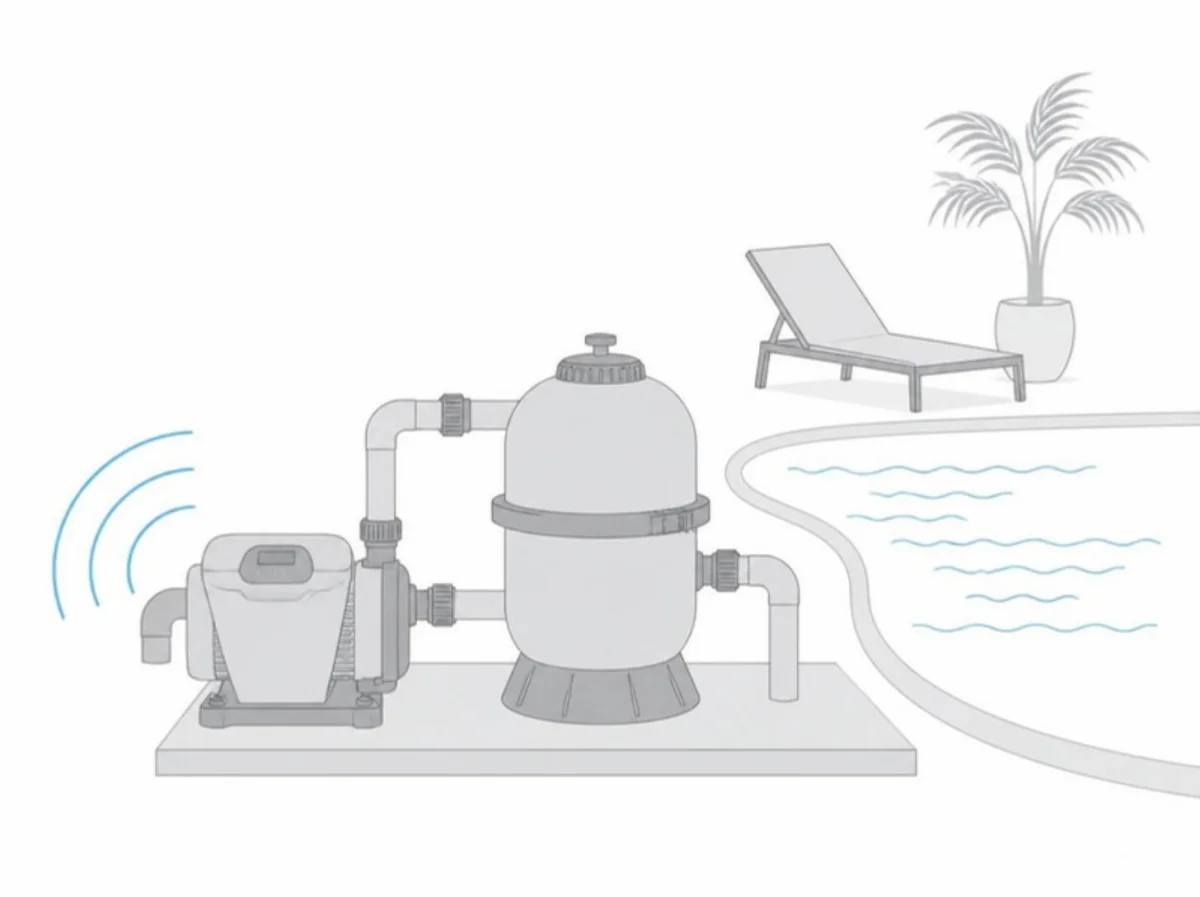
A gas pool heater bangs, knocks or bumps when too little water flows through its heat exchanger and the water inside boils. Jandy, Pentair and Raypak print the sound in their tables.
Hayward's guide warns about the same low flow without naming a sound.
| Manual | Symptom as printed | Causes listed |
|---|---|---|
| Jandy JXi | "Heater pounding or knocking" | "Water flow through heater too low.", "Failed Thermal Regulating Valve (TRV)." |
| Jandy LXi | "Heater pounding or knocking" | Water flow through the heater; the fix starts with a temperature rise check |
| Pentair MasterTemp 125 | "Boiling in heat exchanger." with "bumping" sounds | "Low water flow to heater.", "Heat exchanger plugged.", "Bypass valve stuck open.", "Thermal governor stuck closed." |
| Raypak 264B and 404B | The heater "makes banging noises or shuts off on high limit" | Too little flow on a two-speed or variable-speed pump's low speed |
The owner's share of the fix is the same in each manual. Jandy's JXi manual lists "Look for obstruction or closed valve in system.", "Variable speed pump set too low" and "Dirty filter or baskets". Pentair's remedy for low flow reads "Service pump and or filter."
Pentair's MasterTemp 125 guide gives a hands-on test after start-up. The outlet pipe should feel only slightly warmer than the inlet, and "If it feels hot, or if you hear the water in the heater boiling, there may not be enough water flow to the appliance." The manual then asks for a check that the filter is not plugged.
When the pump runs on low speed
A variable-speed pump turned down for quiet can starve the heater. Raypak's 264B and 404B manual says the low speed is sometimes not enough to run the heater, and "In these cases, the pump must be run at high speed when heating the water."
Hayward's consumer troubleshooting guide for the Universal H-Series sets a minimum flow in gallons per minute for each model and warns that less "could cause issues such as the heater dry firing or water to boil causing high limits to trip and possible damage to heat exchanger." If the heater sits on a pump that also runs slow overnight for quiet, the heating schedule needs its own, faster speed.
Bypass and thermal valves
Some heaters keep their internal temperature steady with a valve that can stick. Jandy calls it the thermal regulating valve, Pentair the thermal governor, and Raypak the Unitherm governor, which it describes as "a thermostatic mixing valve" holding the inside of the heater between 120°F and 135°F.
Hayward says its internal by-pass "should be inspected periodically as it could be the cause of low or high water flow through the exchanger", and Jandy's LXi table also names an external bypass that is "set wrong".
Replacing any of these valves is technician work in the manuals quoted here.
Why is my pool heater whining?
A whining gas pool heater has two kinds of cause in the manuals: a stuck valve, debris or scale on the water side, which Raypak covers, and a flame running too rich, which Pentair covers.
Raypak's row is labelled "Harmonics, or whining noise". Its causes are "Unitherm governor inoperative.", "Debris or restriction in system.", "Debris in gas line" and "Low flow". The governor is checked by putting it in hot water above 120°F to see if it moves.
Debris in the system calls for "Locate the restriction and remove. Flush system and clean", and debris in the gas line for "Remove debris or blow out gas line". Raypak marks both debris causes as symptoms that usually appear on first start-up.
Pentair's Burner Troubleshooting table reads "Loud, high-pitched whine" against "Flame is too rich." Its remedies begin with the pressure tap and the gas regulator setting, and end with "Contact a qualified technician or service agency to replace the gas orifice."
Scale inside the heat exchanger
Scale turns up in both the whining and the boiling rows. Raypak's answer to low flow is to clean the heat exchanger and check the pool's pH and total alkalinity. Pentair's answer to a plugged exchanger is "Service heat exchanger. Correct water chemistry."
Raypak's table has a separate row for "Liming or scale forming in exchanger", with pool water, too much water bypassing, and a governor that is not working as causes. Water chemistry is the owner's part; cleaning the exchanger is listed as service work.
Pulsing, surging or a pop at ignition
A burner that pulses, or a flame that flashes back as it lights, is a combustion problem and goes to a technician. Pentair's MasterTemp 125 table reads "Burner pulsates or surges, especially on ignition." and blames "Exhaust vent is too long." The fix is "Reduce length of exhaust vent and/or number of elbows."
Jandy's LXi table has a row for "Flashback on start-up", with "Wrong gas." and "Burner damage." as causes, though it does not describe a sound.
The JXi groups a heater that ignites slowly, cycles on and off, or loses its flame under "Unstable combustion", and its causes run from the wrong gas to a fuel and air mixture that is too lean or too rich. The remedies call for a digital differential manometer, which puts them in a technician's hands.
Gurgling and air noises after start-up
Air in the plumbing after a heater has been off for the winter makes noise until it clears. Pentair's return-to-service steps say "Before starting the heater, circulate water through the heater for several minutes until all air noises stop."
Jandy's JXi manual adds that "Most problems occur when the heater is started for the first time after installation or at spring start-up."
Condensing at start-up is expected too, since the JXi table says "Flue product moisture will condense at the start-up until the heater water temperature reaches the normal operating conditions."
Suction leaks, which let air into the plumbing on the pump side, are covered on our pool pump noise page.
Spa airlocks after a refill work the same way, and our hot tub making noise page covers them.
Why is my pool heat pump loud in cold weather?
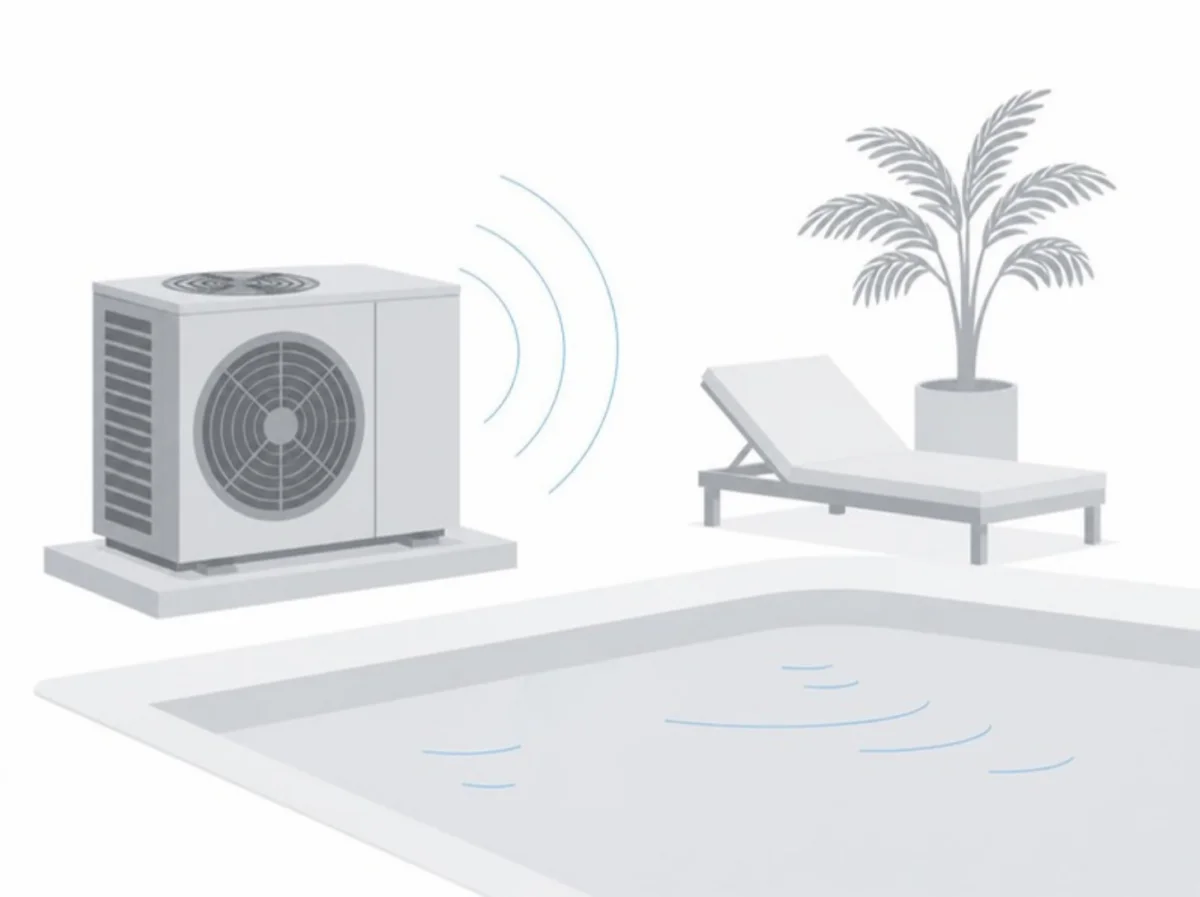
A pool heat pump changes its sound in cold weather because it stops to defrost its outdoor coil. Madimack says the unit is louder for about 15 minutes, and both Madimack and AquaCal call defrost normal.
In the passive kind of defrost, one of two found in these manuals, the compressor stops and the fan keeps pulling air over the coil.
Hayward's round units do this for 15 minutes when the coil reaches 29°F, then restart the compressor once the coil sensor reads 50°F, and shut down for 2 hours showing "deF" if three cycles fail. Pentair's UltraTemp runs its fan for about 15 minutes in the same way, and the feature must be enabled in its service menus.
In the active kind the refrigeration cycle reverses and sends heat to the coil. Madimack's InverELITE manual says "Defrost mode usually last for around 15 minutes, during this period, the heat pump fan will stop running, and relatively louder noise will be heard." It adds that more condensation and white smoke, which it identifies as water vapor, are "totally normal" at that time.
AquaCal's 2018 operation manual for its TropiCal and HeatWave SuperQuiet units describes a 10 minute active defrost, during which "the melting of the ice may appear as steam coming off the heat pump. This is normal." On a Raypak Crosswind the HEATING indicator flashes for the whole cycle, per its manual.
Water under the heat pump
Pool heat pumps drip a lot of condensation, and none of these makers treats it as a leak by itself. Pentair puts normal output at three to five gallons per hour, and AquaCal at 8 to 10 gallons per day, depending on humidity.
Raypak and AquaCal both say to switch the heat pump off and keep the filter pump running, then see whether the dripping stops. Hayward says condensation "will dry up in a few hours", while a real leak keeps dripping with the heat pump off. Hayward also says water with no or very low chlorine on a test strip is condensation.
Why is my pool heat pump buzzing or humming?
No pool heat pump manual opened for this page has a row for buzzing, humming or rattling. The nearest rows cover a fan that will not turn or a compressor that will not start, and send both to a dealer.
Pentair's UltraTemp table lists a fan that is not turning, with no alarm, against "Faulty Fan Relay. Faulty Capacitor. Faulty Fan Motor. Control Board Failure. Incorrect wiring.", and its advice is "Call dealer for advice before attempting to replace parts."
Under its low refrigerant alarm the same guide asks for a check of the capacitor, the fan motor, and a fan blade that may be "slipping or broken". Hayward's guide notes that "An intermittent LP code can be caused by a bad fan motor or capacitor."
Raypak's TWPH manual and Madimack's both ask owners to listen for abnormal noise after the first start. For buzzing from contactors and capacitors on a home heat pump, as those makers describe it, see our heat pump noise page.
Published noise figures for pool heat pumps
The few makers that publish a figure claim low numbers measured at a distance. Madimack declares 30.8 to 44.5 dB(A) for its InverELITE V2 84,000, taken 10 feet away, and Aquastrong declares 32 dB(A) for the HEX022TOP, taken 33 feet away, as listed in our quietest pool heat pumps guide.
Hayward, Pentair and Jandy publish no figure for their heat pumps, and none of these makers names a decibel reading that signals a fault. Quiet modes help where they exist. Madimack's manual puts Silence mode "3dB(A) lower than Boost mode", and Raypak's TWPH Silent mode "operates at mid speed to provide heating or cooling while minimizing noise", and can be used to "mute" the unit while another mode is active.
Gas heaters carry no decibel figure in any of the manuals here. Hayward's warranty for the Universal H-Series excludes "Production of noise, odors, or discolored (rusty, etc.) water".
When to switch off and call a technician
Switch a heat pump off at the first abnormal noise, smell or smoke. Raypak's Crosswind manual says "If there are abnormal conditions such as noise, smell, smoke, or electrical leakage, please switch off the heater immediately and contact the local dealer. Don't try to repair it yourself."
For a gas heater that keeps running hot, Pentair writes "If water temperature remains high but the unit continues to operate, turn off the appliance and call your service technician." The same guide asks for a qualified service technician if the burner may need maintenance, and says the combustion air blower "is permanently lubricated, and does not require periodic lubrication."
A gas smell outranks any noise. Jandy's LXi manual opens with "WHAT TO DO IF YOU SMELL GAS": "Do not try to light any appliance.", do not touch electrical switches or use a phone in the building, and "Immediately call your gas supplier from a neighbor's phone." Raypak lists sooting with causes that include "Air starvation", "Improper venting" and "Insects or debris clogging burner intake ports."
Hayward's consumer guide ends its list of diagnostic codes with "Please contact a local authorized service center for service." Gas pressure, orifices, valves and refrigerant work are left to licensed or qualified technicians in the manuals quoted here.
Pumps, heat pumps and quieter equipment
If the noise comes from the pump rather than the heater, start with how to make a pool pump quieter, and compare replacements in the quietest pool pumps guide. A pump slowed down for quiet may need a faster speed while the heater runs, as Raypak notes.
For a new heat pump, the quietest pool heat pumps guide groups every published figure by measuring distance. A home heat pump has its own defrost and buzzing sounds on the heat pump noise page, and a water heater that uses the same technology is covered in the quietest heat pump water heaters guide.
Our pool heat pump guide notes that Rheem's product pages link Raypak's manuals, so the Raypak rows above are the nearest guide for Rheem owners.
No pool heater was run, opened or listened to for this page.