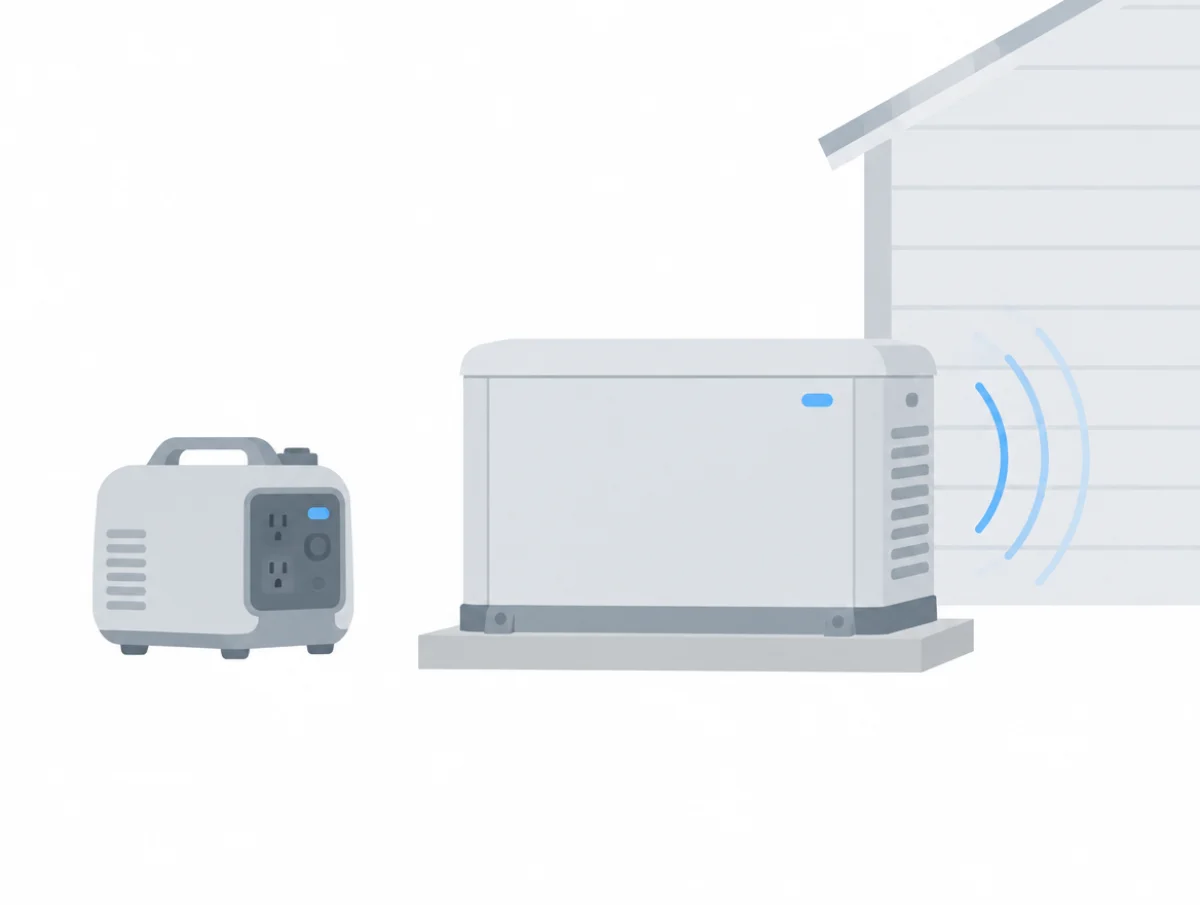
How loud is a Briggs & Stratton generator?
A Briggs & Stratton generator lists between 58 and 70 on Briggs's own sheets and pages, every figure taken at 7 meters. Where a model lands depends on its type: inverter portable, air-cooled standby or liquid-cooled standby.
| Group | Briggs condition | Lowest | Highest |
|---|
| Inverter portables | ¼ load, 7 m from control panel side | 58dB (P2400, UK page) | 66 dB(A) (Q6500) |
| Air-cooled standby, Low Idle Mode | ISO 3744, lowest microphone at 7 m | 62 dB(A) (PowerProtect+) | 65 dB(A) (PowerProtect 13kW) |
| Air-cooled standby, normal operation | ISO 3744, lowest microphone at 7 m, "average household usage" | 65 dB(A) (PowerProtect 26kW) | 69 dB(A) (PowerProtect 13kW) |
| Liquid-cooled standby | ISO 3744, lowest microphone at 7 m, no load | 66 dB(A) (30kW) | 70 dB(A) (60kW) |
Seven meters is the shared distance, and nothing else carries over. A quarter-loaded portable, a standby engine in its low idle state and a liquid-cooled engine with nothing connected are three different sounds, so a 62 in one row and a 61 in another say nothing about which machine is quieter.
How does Briggs & Stratton measure generator noise?
Briggs & Stratton measures its inverter portables at ¼ load from 7 meters on the control panel side, and its standby generators per ISO 3744, quoting the lowest microphone at 7 m. Each method is written next to the figures it produced.
For portables, a Briggs support FAQ updated April 13, 2026 says it measures PowerSmart and QuietPower inverters "running at ¼ load at 7 meters from the control panel side". The UK product pages repeat that wording in a footnote under each "Sound Level" row.
On the standby sheets, footnote 2 reads "Per ISO 3744. Sound level measurement at other locations around generator may differ depending on installation, based on lowest microphone at 7m." It adds "Normal operation based on average household usage." The quietest microphone flatters the machine, and Briggs never says which side of the enclosure that was.
None of the seven conventional portables on Briggs's US listing carries a figure, and neither do the US inverter product pages. Comparing decibel ratings explains which details must match before two makers' numbers can share a chart.
What is the decibel level of a Briggs & Stratton inverter generator?
A current Briggs & Stratton inverter generator lists 58 to 66 at ¼ load, 7 meters from the control panel side: 58dB for the P2400, 61dB for the P4500 and 66 dB(A) for the Q6500. Only the Q6500's figure comes from a US page.
| Model | Running watts | Engine | Figure | Where Briggs prints it |
|---|
| P2400 | 1,800 | 79cc | 58dB | UK page, 230 V EU and UK versions |
| P4500 | 3,700 | 224cc | 61dB | UK page, 230 V version |
| Q6500 | 5,000 | 306cc | 66 dB(A) | US support FAQ; UK page also 66dB |
The UK pages write the unit as plain "dB" where the US FAQ writes "dB(A)", with identical condition wording. We matched each UK model to its US namesake by name, wattage and engine size. The voltage and frequency differ, though, so read the P2400 and P4500 numbers as Briggs's figures for a close sibling.
The same FAQ lists the P2200 at 59 dB(A) and the P3000 at 58 dB(A). Neither model appears on Briggs's current US generator listing, so both stay out of the rankings and are mentioned here only as history.
How loud is the Briggs & Stratton P4500 inverter generator?
The Briggs & Stratton P4500 lists 61dB at ¼ load, 7 meters from the control panel side, on Briggs's UK page. The US P4500 page prints no decibel figure, only a feature called Quiet Power Technology.
Briggs describes that feature on the US page as one that "Automatically adjusts the engine speed further reducing noise, fuel consumption and emissions." The US page sells the P4500 in an E/X version with push button start and an R/S version with a key fob and Bluetooth, both 104 lb with a "Super Lo-Tone" muffler.
Three dB separates it from the P2400 and five from the Q6500 under the same stated condition. Against the Q6500 it gives up 1,300 running watts and the 120V-240V locking outlet, so the P4500 suits RV and campsite use more than whole-home backup.
Which Briggs & Stratton portable generators have no decibel rating?
Eight current Briggs & Stratton portables have no decibel rating on any Briggs page we found: the P2500 inverter and all seven conventional open-frame models, from the 3500 Watt to the 8000 Watt Elite Series.
The conventional models are the 3500, 5000, 5500, 5750 and 6250 Watt units and the 7000 and 8000 Watt Elite Series. Their US pages list watts, engine size and run time with no sound row. The Australian P2500 page has no figure either.
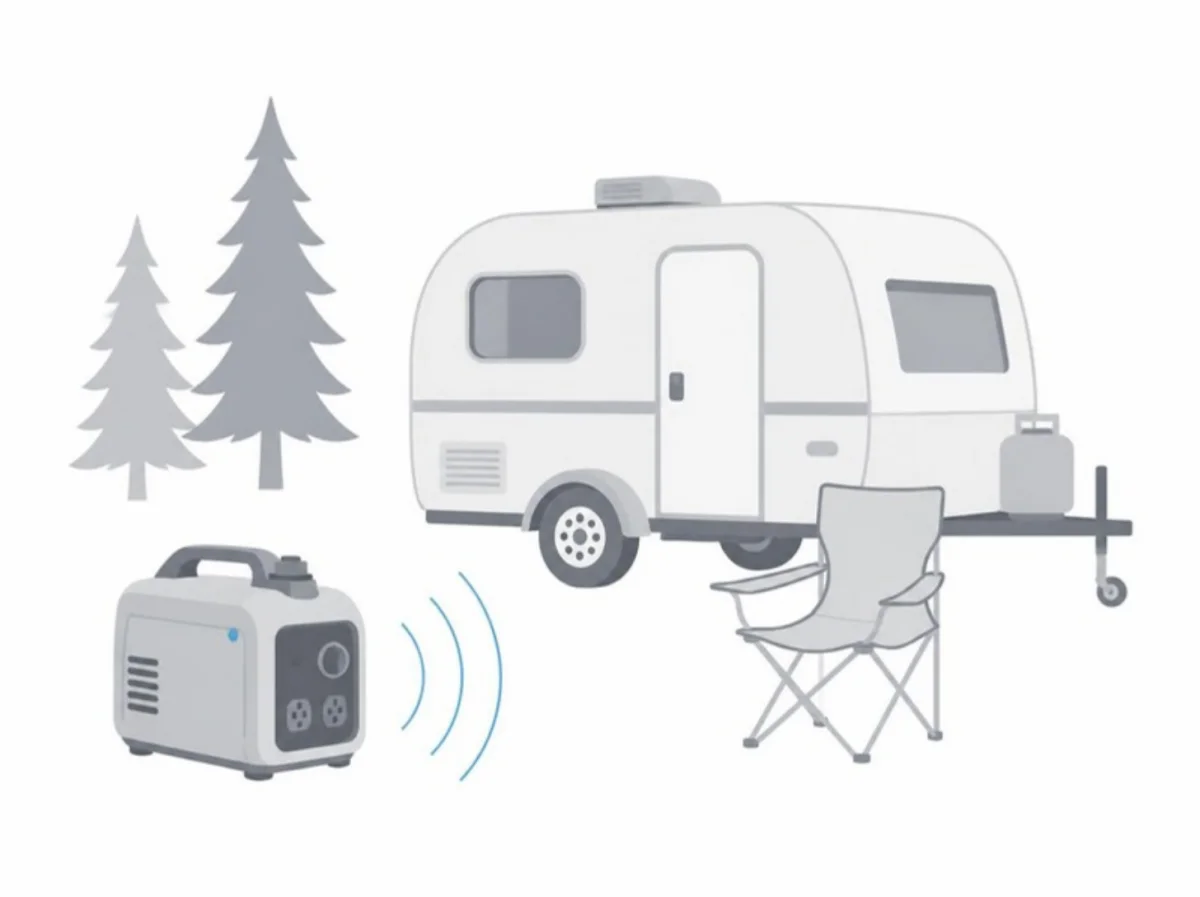
A missing number is not evidence of a loud machine, only of an unpublished one. Running a conventional generator next to a campsite or a neighbor's wall is a different matter, and generator noise and neighbors covers the limits local rules tend to set.
How loud is a Briggs & Stratton home standby generator?
A Briggs & Stratton air-cooled home standby generator lists 62 to 65 dB(A) in Low Idle Mode and 65 to 69 dB(A) in normal operation, ISO 3744 at the lowest microphone 7 m away. All twelve models with a readable sheet run a Vanguard engine at 3,600 rpm.
| Model | Number | Output, LP / NG | Low Idle Mode | Normal operation | Weight | MSRP |
|---|
| PowerProtect+ 18kW | 040757 | 18 / 18 kW | 62 dB(A) | 66 dB(A) | 490 lb | $6,135 |
| PowerProtect+ DX 18kW | 040760 | 18 / 18 kW | 62 dB(A) | 66 dB(A) | 490 lb | Not shown |
| PowerProtect+ 22kW | 040787 | 22 / 22 kW | 62 dB(A) | 66 dB(A) | 490 lb | $6,532 |
| PowerProtect+ DX 22kW | 040790 | 22 / 22 kW | 62 dB(A) | 66 dB(A) | 490 lb | Not shown |
| PowerProtect+ 26kW | 040807 | 26 / 24 kW | 62 dB(A) | 67 dB(A) | 545 lb | $7,336 |
| PowerProtect+ DX 26kW | 040810 | 26 / 24 kW | 62 dB(A) | 67 dB(A) | 545 lb | Not shown |
| PowerProtect 26kW | 040806 | 26 / 24 kW | 63 dB(A) | 65 dB(A) | 540 lb | $6,970 |
| PowerProtect DX 26kW | 040800 | 26 / 24 kW | 63 dB(A) | 65 dB(A) | 540 lb | Not shown |
| PowerProtect 22kW | 040786 | 22 / 22 kW | 64 dB(A) | 68 dB(A) | 465 lb | $6,037 |
| PowerProtect DX 22kW | 040780 | 22 / 22 kW | 64 dB(A) | 68 dB(A) | 465 lb | Not shown |
| PowerProtect 13kW | 040746 | 13 / 11.5 kW | 65 dB(A) | 69 dB(A) | 315 lb | $4,460 |
| PowerProtect DX 13kW | 040740 | 13 / 11.5 kW | 65 dB(A) | 69 dB(A) | 315 lb | Not shown |
Rows run from the lowest Low Idle Mode figure up. The PowerProtect 18kW, model 040756, is missing because its linked sheet would not open; its page lists 68 db(A) for normal operation, the same as the PowerProtect 22kW, at $5,746.
Each product page repeats the normal-operation figure as "Normal Operating Sound" without a distance or the Low Idle Mode number. The sheets are the only place both rows and the 7 m position appear, so every number in the table is a sheet number.
What is Low Idle Mode on a Briggs & Stratton standby?
Low Idle Mode is the quieter of two sound rows on Briggs & Stratton's air-cooled standby sheets, where it sits above "Normal Operating Sound". Briggs gives no definition of it on the sheets, product pages or brochures we read.
What Briggs does describe is its weekly test. The product pages call it "Eco-Cise Weekly Test Mode" and say the "Short 16-second weekly test mode ensures your generator is in top operating condition while reducing noise and fuel consumption." The PowerProtect 22kW and 26kW sheets list a "Programmable Exercise Cycle 16 sec (default) - 20 mins".
Briggs never ties those two ideas together in writing. Reading the Low Idle Mode figure as the sound of the weekly test is a reasonable guess, but it remains our guess, so this page keeps the Briggs label instead of calling it an exercise figure.
Is PowerProtect+ quieter than PowerProtect?
Yes, in Low Idle Mode: every PowerProtect+ lists 62 dB(A), against 63 to 65 for the PowerProtect models. In normal operation the order flips at 26 kW, where the PowerProtect lists 65 and the PowerProtect+ 67.
At 22 kW the PowerProtect+ leads in both rows, 62 and 66 against 64 and 68, for $495 more. Briggs's PowerProtect+ brochure points to the enclosure: "Our Quietest Enclosure Features enhanced insulation to reduce operating noise." It does not say which parts changed from the PowerProtect.
Both lines use the same Vanguard 993 cc V-twin at 22 and 26 kW, so the engine alone does not explain the gap. The PowerProtect+ units are also 25 lb heavier at 22 kW and 5 lb heavier at 26 kW, which fits the extra insulation Briggs describes.
Does the DX version change a Briggs & Stratton's decibels?
No. Each DX sheet prints the same Low Idle Mode and normal-operation figures as its standard twin. DX means dealer exclusive, and on Briggs's pages it changes the warranty and the pricing rather than the sound rows.
The standard PowerProtect+ models carry a 7-year warranty and the DX versions 10 years. Briggs shows an MSRP for standard models and none for DX ones, sending buyers to an installer instead. The PowerProtect 26kW is the exception, listed with a "10-Year Comprehensive" warranty in its standard form.
One paperwork slip is worth checking with a dealer. The PowerProtect DX 26kW product page shows model number 040806, the standard 26kW's number, while its own sheet BS1332 says 040800. Both list 63 and 65 dB(A).
How loud are Briggs & Stratton's liquid-cooled generators?
Briggs & Stratton's four Fortress liquid-cooled standby generators list 66 to 70 dB(A) at no load, ISO 3744 from the lowest microphone 7 m away: 66 for the 30kW, 68 for the 35kW and 48kW, and 70 for the 60kW.
| Model | Number | Engine | Output, LP / NG | No load | Weight |
|---|
| 30kW | 076880 | 1.6L inline 4, 3,600 rpm | 30 / 30 kW | 66 dB(A) | 1,000 lb |
| 35kW | 076830 | 4.3L V6, 1,800 rpm | 35 / 35 kW | 68 dB(A) | 1,541 lb |
| 48kW | 076850 | 4.3L V6, 1,800 rpm | 48 / 45 kW | 68 dB(A) | 1,634 lb |
| 60kW | 076860 | 5.7L V8, 1,800 rpm | 60 / 60 kW | 70 dB(A) | 2,020 lb |
Their sheet, BS1156, heads its pages "COMMERCIAL STANDBY GENERATORS SPECIFICATIONS", and only the 30kW page mentions a home. None of the four shows a price.
The label needs care. The sheet's row reads "No Load dB(A)", while each product page shows the same number as "Normal Operating Sound" with no unit. A reading with nothing connected cannot sit beside the air-cooled normal-operation figures, which assume household use, so the Fortress units get a table of their own.
How long does a Briggs & Stratton standby generator exercise?
A Briggs & Stratton home standby generator exercises for 16 seconds a week by default, according to Briggs's support FAQ, which adds that owners can set a longer or less frequent cycle. Twice a year a longer run takes place.
Briggs's FAQ says that if the generator keeps running "upwards of 45 minutes", it is "likely an extended exercise that occurs twice a year in the Spring and Fall", meant "to burn off excess fuel". That spring and fall run is the one most likely to draw a neighbor's attention.
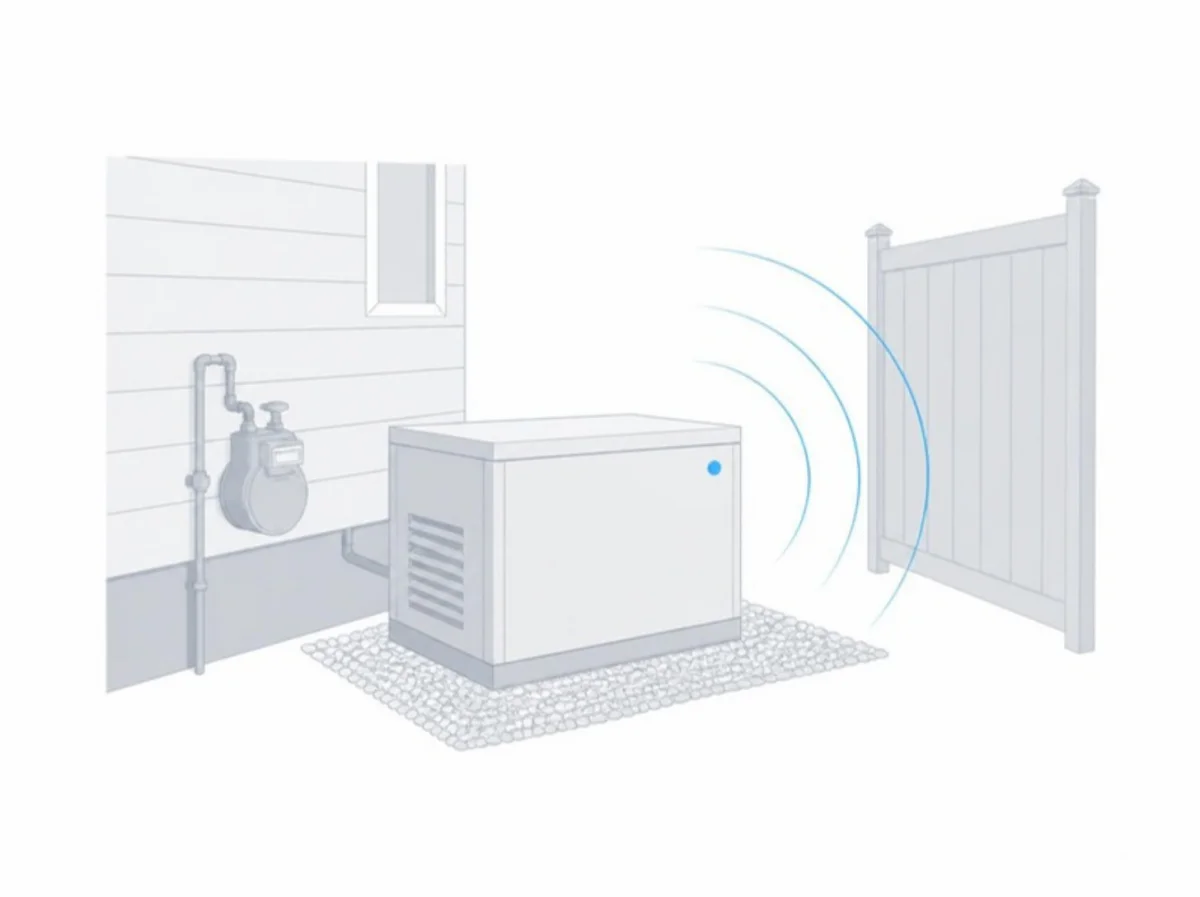
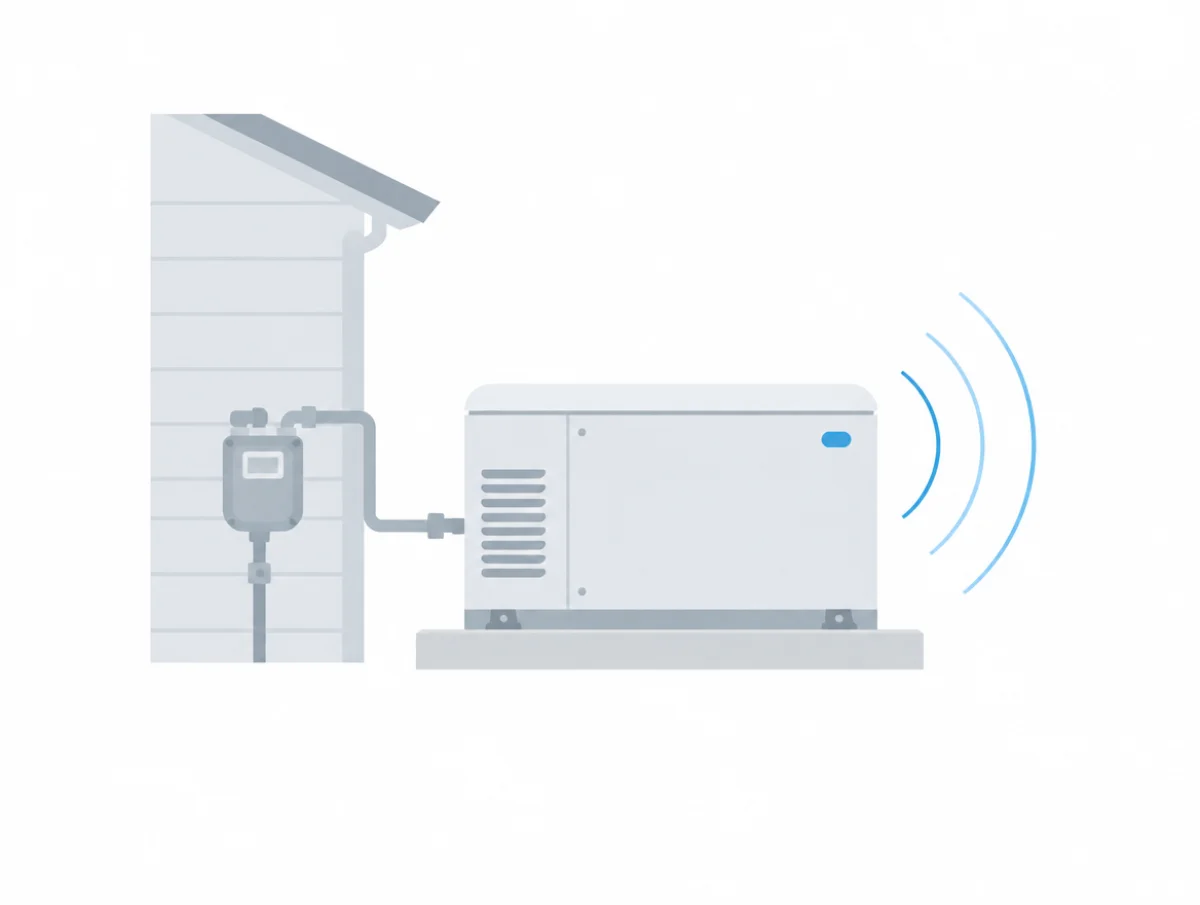
For placement, the sheets measure from 7 m and report the quietest microphone, so the side facing the nearest window may read higher. Ask the installer which face of the enclosure points where, since the PowerProtect+ exhaust faces forward, away from the house.