How loud is a Makita air compressor?
Between 58 and 80 dB on its US product page, and the pump explains most of the spread. Oil-free Quiet Series models print 58 to 60, the compact and cordless models 68 to 72, and the oil-lubricated Big Bore machines 79 to 80.
| Group | Model | Tank | Printed figure |
|---|
| Quiet Series, corded, oil-free | MAC100Q | 1 gallon | 58 dB |
| Quiet Series, corded, oil-free | MAC210Q | 2 gallons | 60 dB |
| Quiet Series, corded, oil-free | MAC320Q | 3 gallons | 60 dB |
| Cordless, 40V max XGT | AC001GZ (also sold as the AC001GM1 kit) | 2 gallons | 68 dB |
| Compact, corded, oil-free | AC001 | 1 gallon | 72 dBA |
| Big Bore, corded, oil-lubricated | MAC2400 | 4.2 gallons | 79 dB |
| Big Bore, corded, oil-lubricated | MAC700 | 2.6 gallons | 80 dB |
The unit changes from line to line. Quiet Series pages say "60 dB" in the feature bullets and "60 dBA" in the About paragraph, the AC001 uses "72dBA", and the Big Bore lines read "(79dB)" and "(80dB)". For what that A changes, see dBA explained.
Which Makita compressor is the quietest?
The MAC100Q, at "Quiet Series design at only 58 dB". The MAC210Q and MAC320Q come next at 60 dB, and every other Makita lists 68 dB or more.
That figure costs air. A 1/2 HP motor gives .7 CFM at 90 PSI, about a third of the MAC210Q's 2 CFM, and the 1 gallon tank empties fast under a finish nailer, so it suits pin and brad nailing more than steady trim work. It also failed our stock check: on November 8, 2026, its Amazon listing showed a future availability date rather than stock. The MAC100Q therefore sits in the also considered list, and the MAC210Q leads the picks.
How many decibels is the Makita MAC210Q?
Sixty. The features say "Quiet Series design at only 60 dB", the About text says "At only 60 dBA", and the new tool flyer repeats "at only 60 dB".
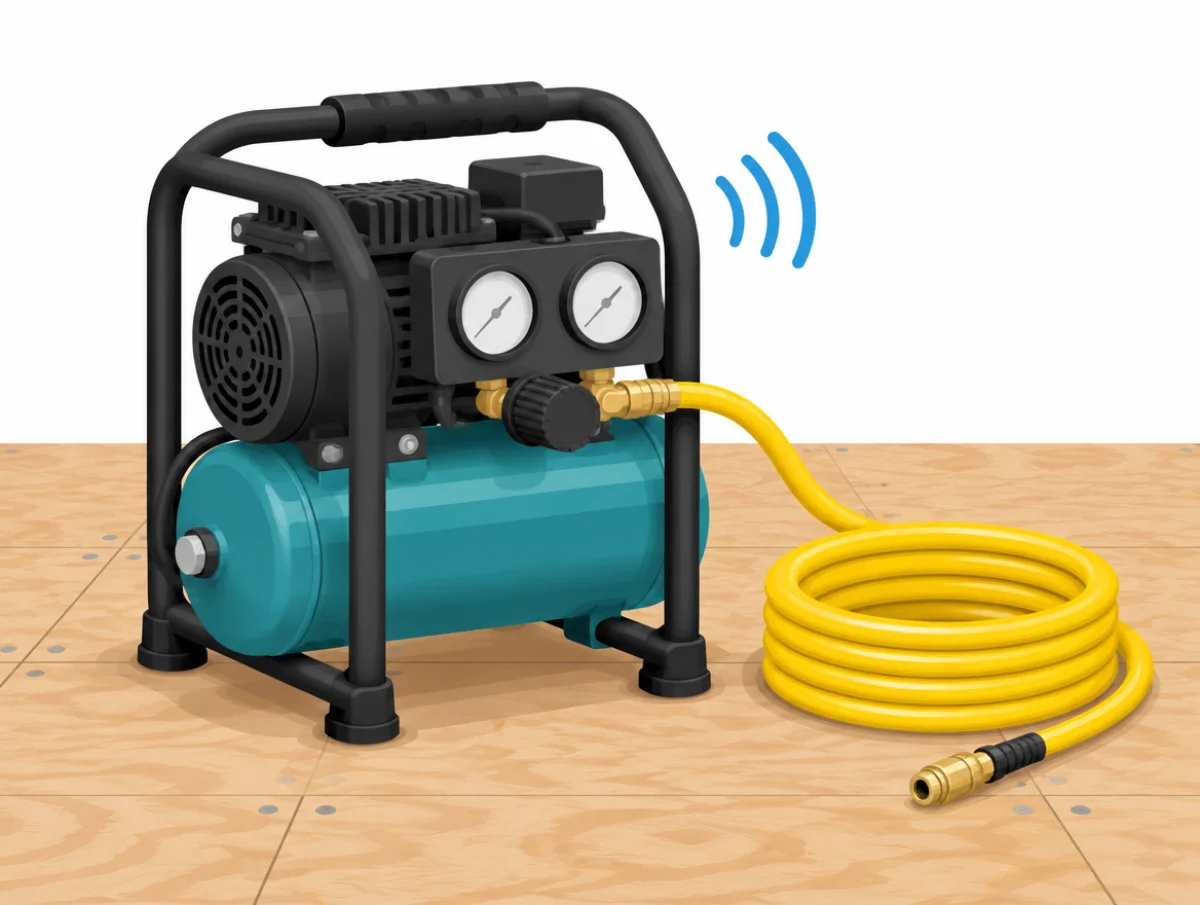
Speed gets the credit. The page says it "Runs at a lower RPM (1,750) resulting in longer motor and pump life", with a 1 HP induction motor drawing 7 amps, an oil-free dual piston pump and a 2 gallon tank that fills to 135 PSI.
The MAC320Q shares the 60 dB and the 1,750 RPM, but with a 1-1/2 HP motor, a 3 gallon tank and 2.6 CFM at 90 PSI against 2 for the MAC210Q. On Makita's figures, then, the bigger Quiet Series model costs no extra decibels. It costs 7.3 lbs and 1.5 amps.
Other makers' 60 dB class machines, such as the California Air Tools 8010, are compared in the quietest air compressors guide. Those makers give no distance either, so cross-brand gaps are rough.
The cordless AC001GZ lists 68 dB
That puts the 40V max XGT AC001GZ above the 60 dB Quiet Series and below the 72 dBA corded AC001, though Makita still files it under Quiet Series.
It holds 2 gallons, reaches 135 PSI and gives 1.2 CFM at 90 PSI from a brushless motor. One charge goes a fair way: Makita says it "Drives up to 700 brad nails using a fully charged 40V XGT® 4.0Ah battery", and up to 1,400 on an 8.0Ah pack. It weighs 20.7 lbs bare and 22.9 with a battery, and its page lists a 3-year limited warranty.
Amazon had no stock of the tool only AC001GZ on November 8 and showed no AC001GM1 kit, so it is not a pick.
Makita's cordless tire inflators are a different tool with European declarations at the ear, ranked on the tire inflators page.
Why is the small AC001 louder than the Quiet Series?
Makita does not say. The compact AC001 lists 72 dBA, 12 above the larger Quiet Series models, and its page prints no pump speed to set against their 1,750 RPM.
It is built for lightness instead: 23.1 lbs, a 1/6 HP induction motor, a 1 gallon tank filled to 125 PSI and .45 CFM at 90 PSI. Its flyer and feature list call it "Low noise for operator comfort" without repeating the 72. Makita sells it for the same jobs as the Quiet Series, "case and base installation, trim and finish carpentry, cabinet and furniture construction". Where noise is the reason for choosing, the MAC210Q lists less for those jobs at roughly twice the weight.
Big Bore models list 79 and 80 dB
The 2.5 HP MAC2400 lists "lower noise (79dB)" and the 2 HP MAC700 "lower noise (80dB)". A third Big Bore model, the 3 HP MAC5200, prints no figure at all.
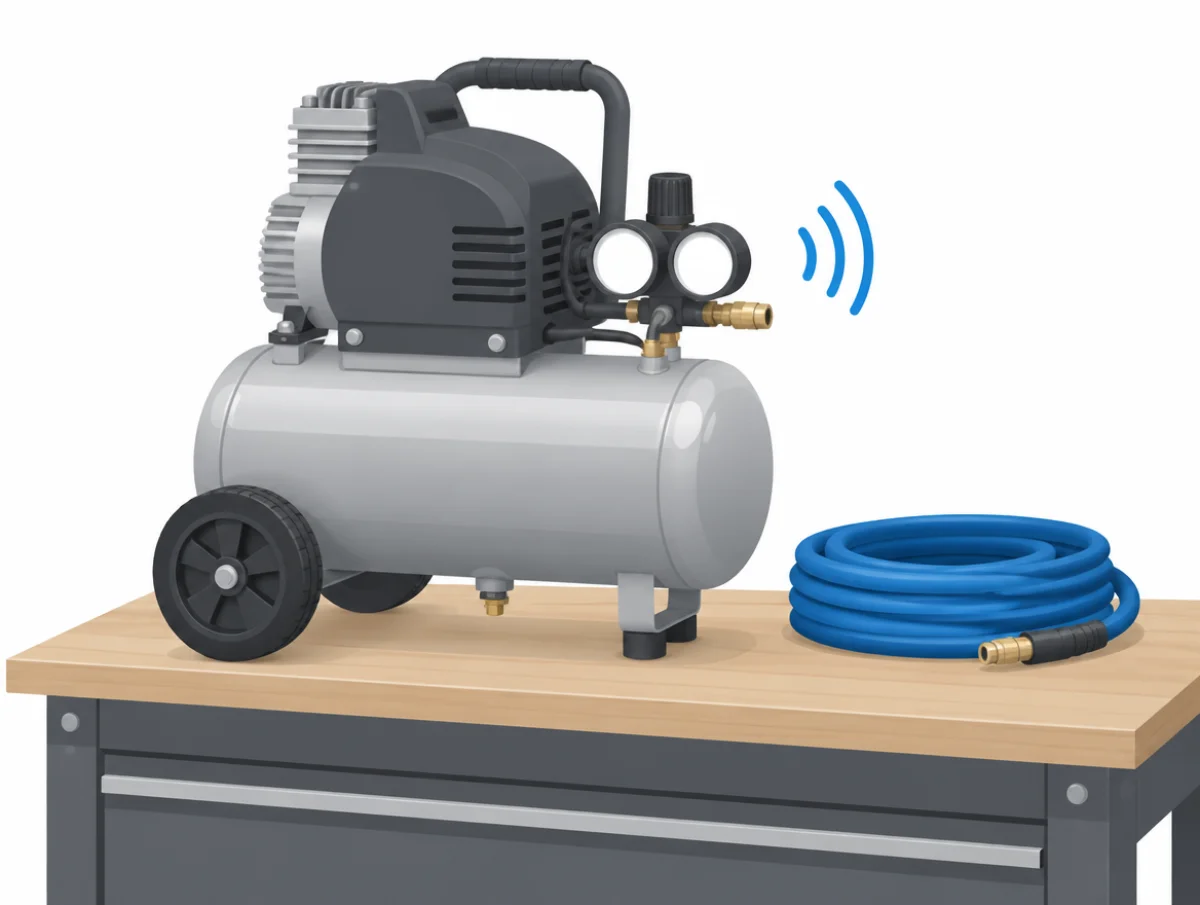
All three use an oil-lubricated pump with a cast iron cylinder. On the MAC2400 and MAC700 pages, the pump runs at 1,730 RPM and "at half the RPM of most competitive units, resulting in greater motor and pump life and lower noise". Both manuals list a 1720 motor RPM and a 44 mm stroke.
Size runs against the usual pattern here.
The bigger MAC2400 lists 1 dB less than the MAC700 while giving 4.2 CFM at 90 PSI against 3.3, on a twin stacked 4.2 gallon tank, and it weighs 77 lbs to the MAC700's 52. These are site compressors. Both sit 19 to 20 dB above the Quiet Series on Makita's scale, a gap that would read as several times as loud if the figures were measured alike, and Makita never says they were.
Of the current compressors we found, only the MAC5200 has no decibel figure. Its page describes "less noise" and "lower RPM for reduced noise" from the Big Bore pump but gives no number for its 3 HP motor and 5.2 gallon tank.
The MAC5501G, Makita's gas-powered compressor, is marked discontinued on makitatools.com, and its page carries no decibel number either. Battery tire inflators have no tank and are left out here. The brad and pin nailers these compressors feed are compared on the brad nailers page.
Placement does more than the spec sheet
Put the compressor "at least 12 inches away from the wall or other obstructions" in a clean, dry, well ventilated area, the manuals say, and the Quiet Series manual adds that it should rest "securely on the rubber feet".
That manual also says to "use extra air hose instead of an extension cord". Extra hose lets the compressor sit in another room or a garage while the nailer works indoors, and distance from the person working does more than anything printed on a spec sheet.
Every Makita compressor carries the same limit, "not more than a 50% duty cycle". A machine running most of the hour is too small for the job by that rule, and it will be loud for longer. More steps, drawn from the manuals of several makers, are on the air compressor quieting page.
None of the corded models is sold as variable speed; each motor switches on and off with tank pressure. How a variable speed drive changes that pattern in other machines is covered in inverter compressors and noise.