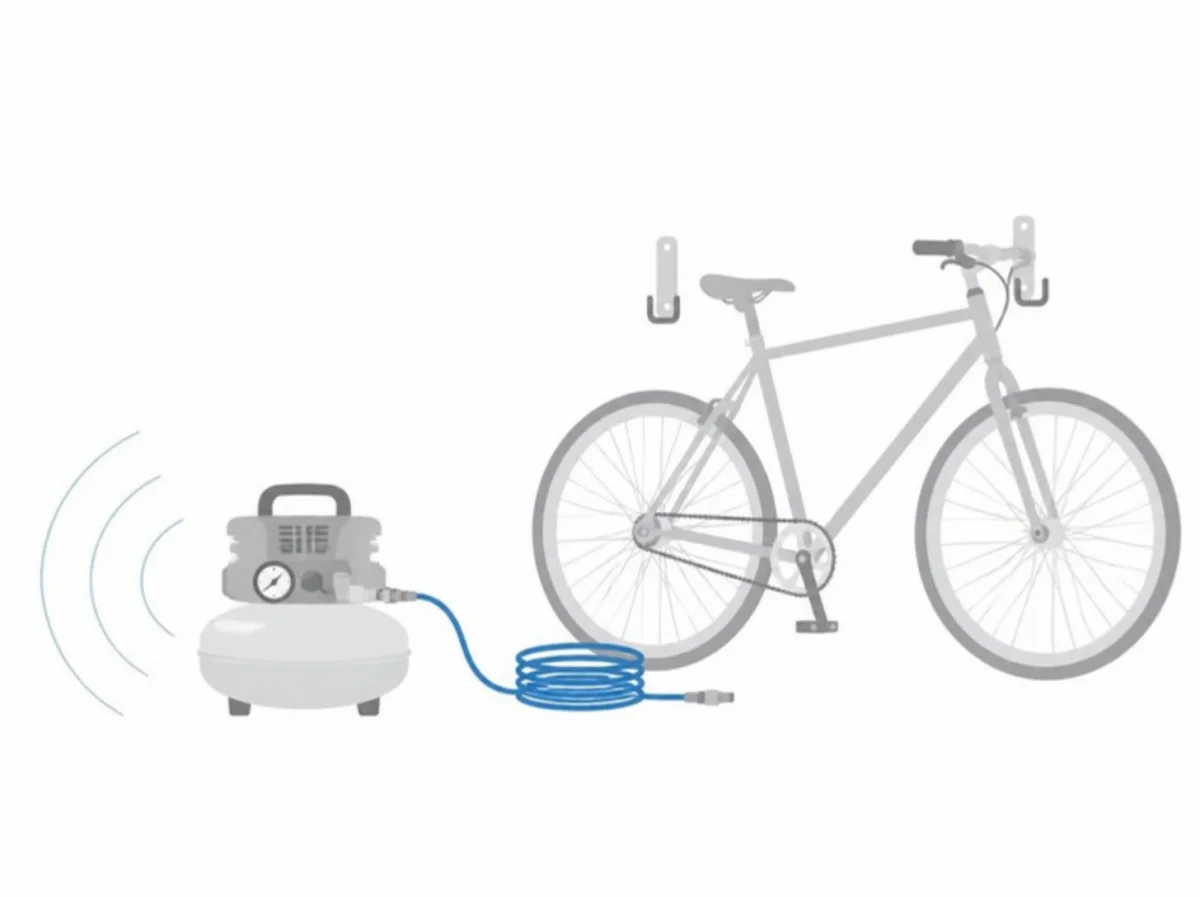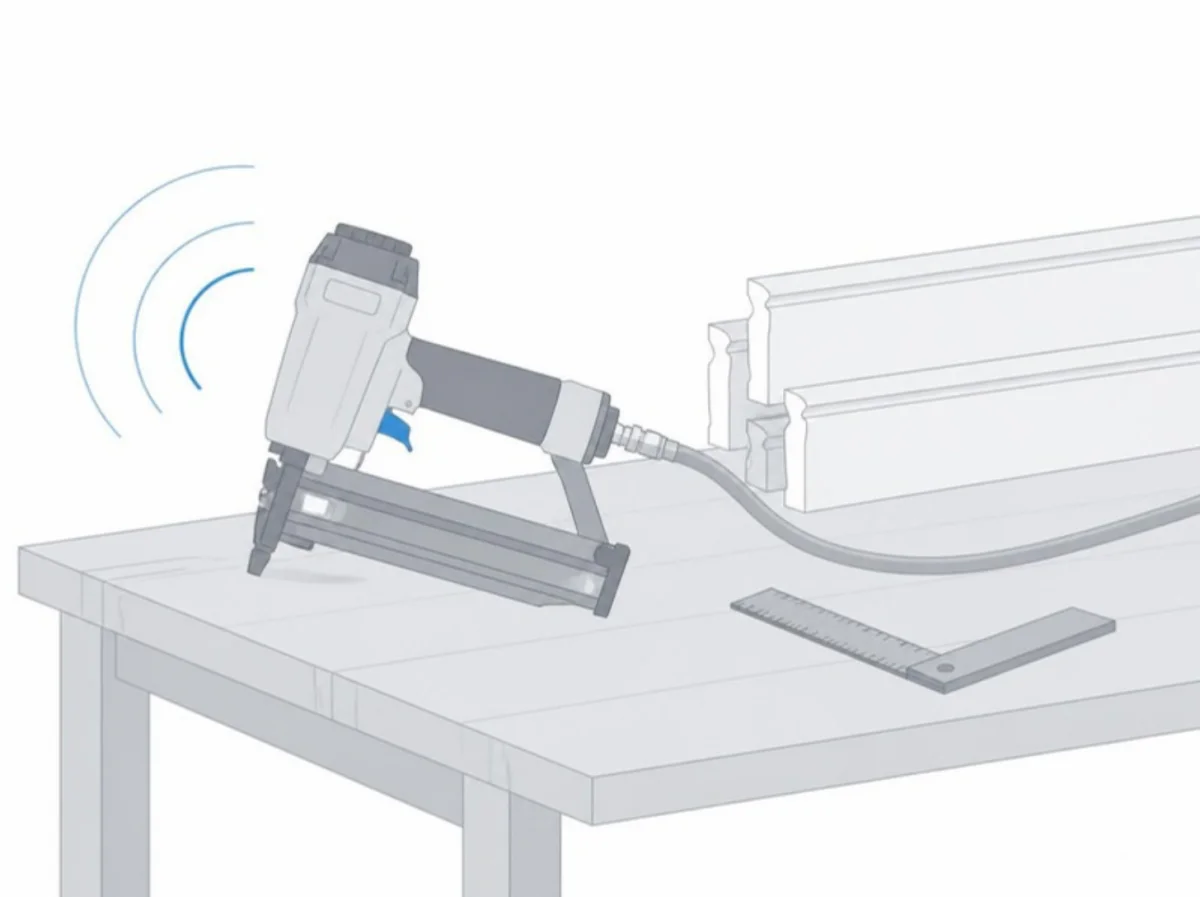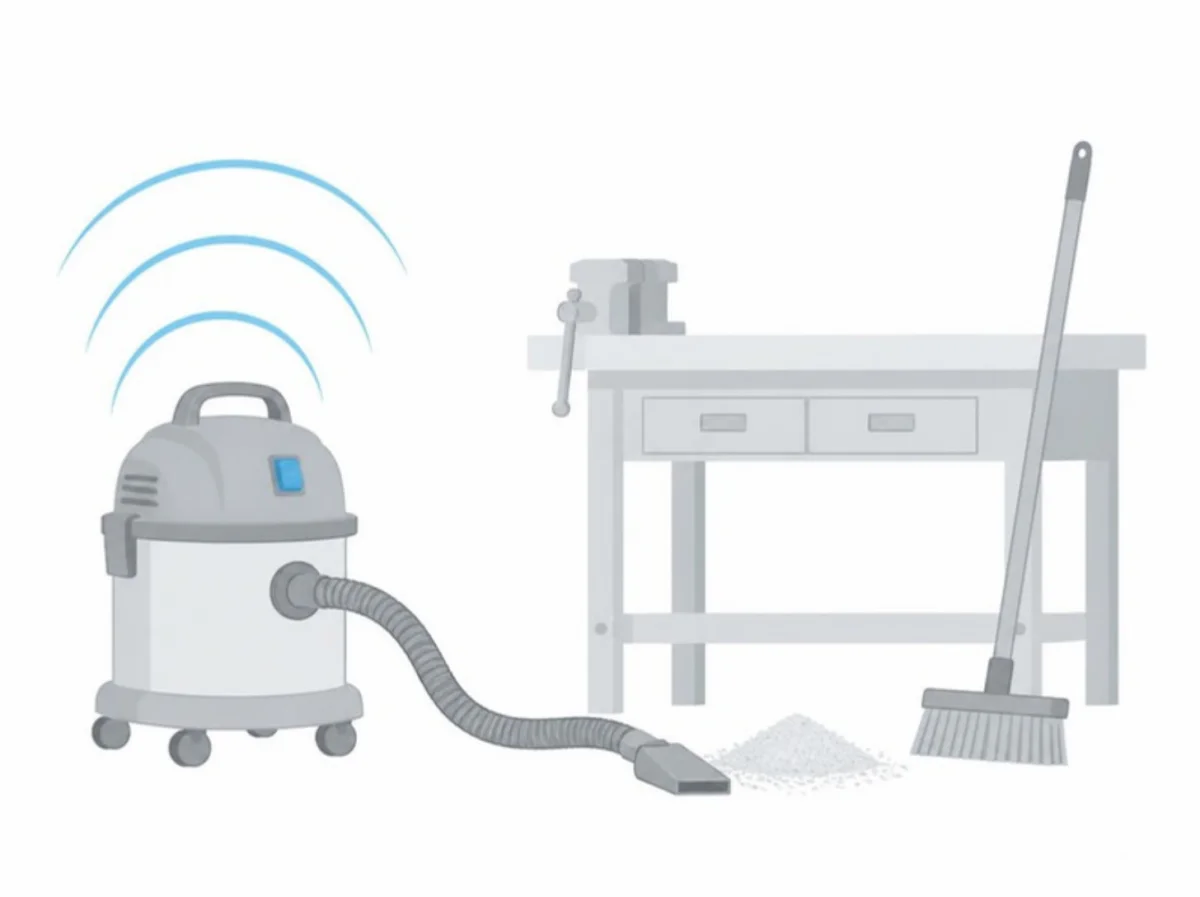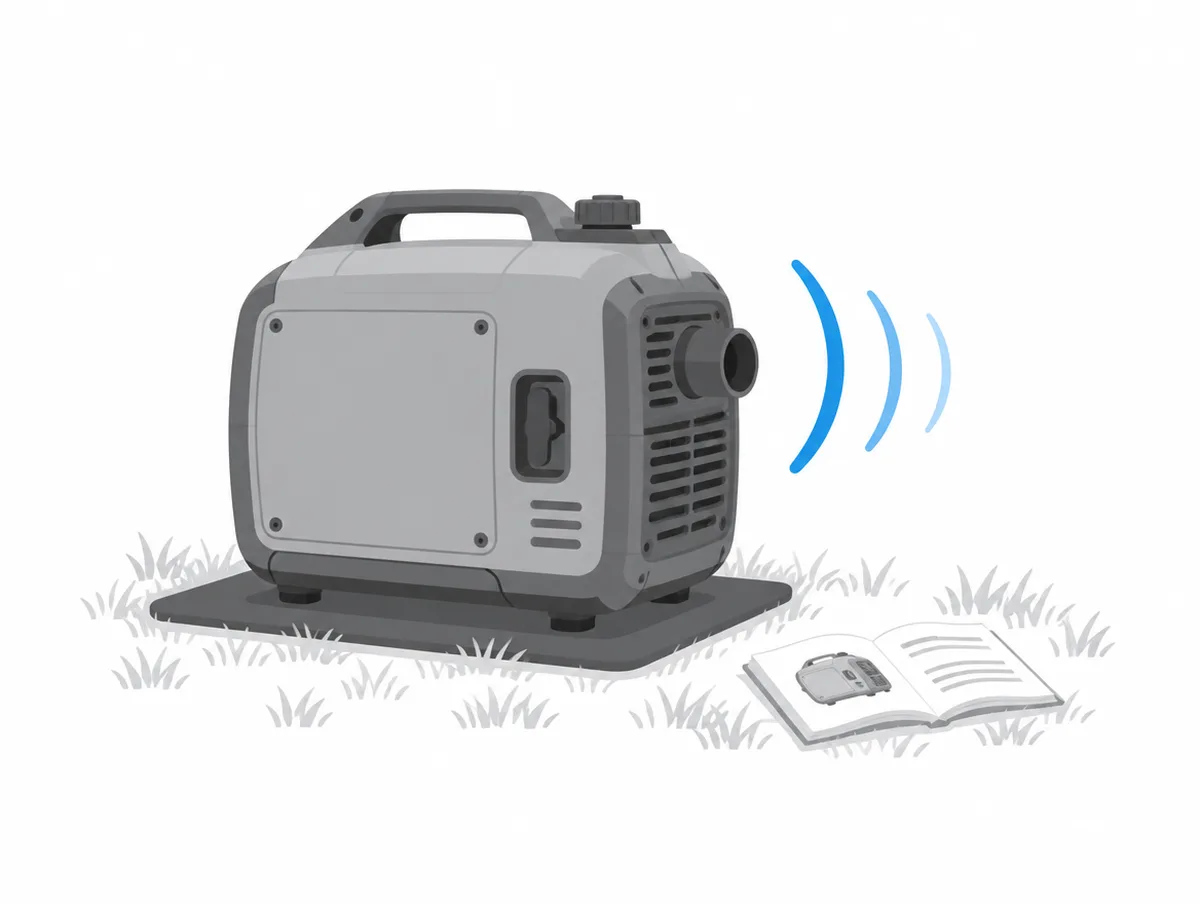
How to make an air compressor quieter comes down to two kinds of fix the makers describe. The first lets the machine run as it was designed to: set it level on its feet with room to breathe, keep the intake filter on and clean, and tighten anything that rattles. The second makes it run less: fix hose leaks, drain the tank, and stay within the duty cycle.
Neither kind turns a loud compressor into a quiet one. A pump that spins at 3400 RPM will not sound like one at 1700 RPM, however carefully it is set up, and the makers' own decibel figures show how wide that gap is.
Each step is drawn from the printed guidance of California Air Tools, Makita, DEWALT, Craftsman, Campbell Hausfeld, Metabo HPT, Rolair, SENCO and Milwaukee.
This page covers shop compressors that feed nailers, tires and air tools. It does not cover aquarium pumps or the compressor in an air conditioner.
Why is my air compressor so loud?
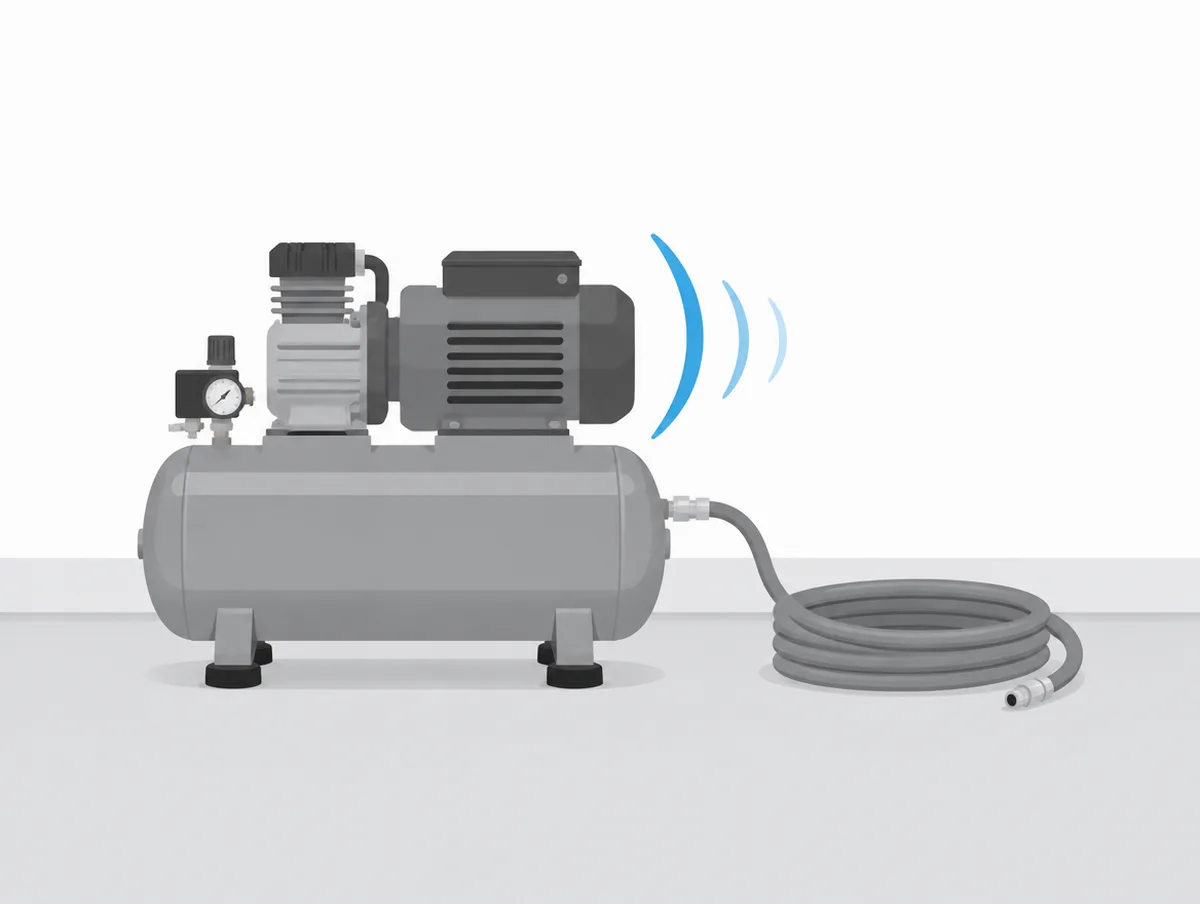
A piston pump, its motor and a cooling fan make most of the sound, and the speed of the pump matters most. Makers of quiet models credit slow motors, near 1,700 RPM, against 3400 RPM on a louder Rolair.
Rolair shows the gap inside one brand. Its JC10PLUS manual describes "low speed, oil-free direct drives designed to be extremely quiet" and lists 60 dBA; its VT25BIG, with a 3400 RPM motor, lists 86 dBA in its owner's manual. Neither figure comes with a distance.
Some of the noise is meant to be there. The Craftsman CMEC6150 manual says of its cooling fan, "It is perfectly normal for this fan to blow air through the vent holes in large amounts."
How loud is a normal air compressor?
Makers of quiet compressors list 56 to 70 dB, and louder conventional models reach 79 to 86 dB. Only Campbell Hausfeld, in our catalog, says where its figure was measured: 68 dBA at 3 ft.
California Air Tools lists 56 dB for its 1P1060S, 60 dB for the 8010 and 70 dB for its 2.0 HP models. Makita lists 58 to 60 dB for its Quiet Series, DEWALT 60.3 dB(A) for the DXCMS20045US and Metabo HPT 59 dB for the EC28M, none with a distance.
At the louder end, Makita's MAC2400 page gives 79 dB for its oil-lubricated Big Bore twin stack, credited to a pump running at 1,730 RPM, and Rolair gives 86 dBA for the VT25BIG.
A bare figure and one taken at 3 ft cannot be ranked against each other, which comparing decibel ratings explains, and dBA explained covers what the A adds.
Where should an air compressor sit to run quieter?
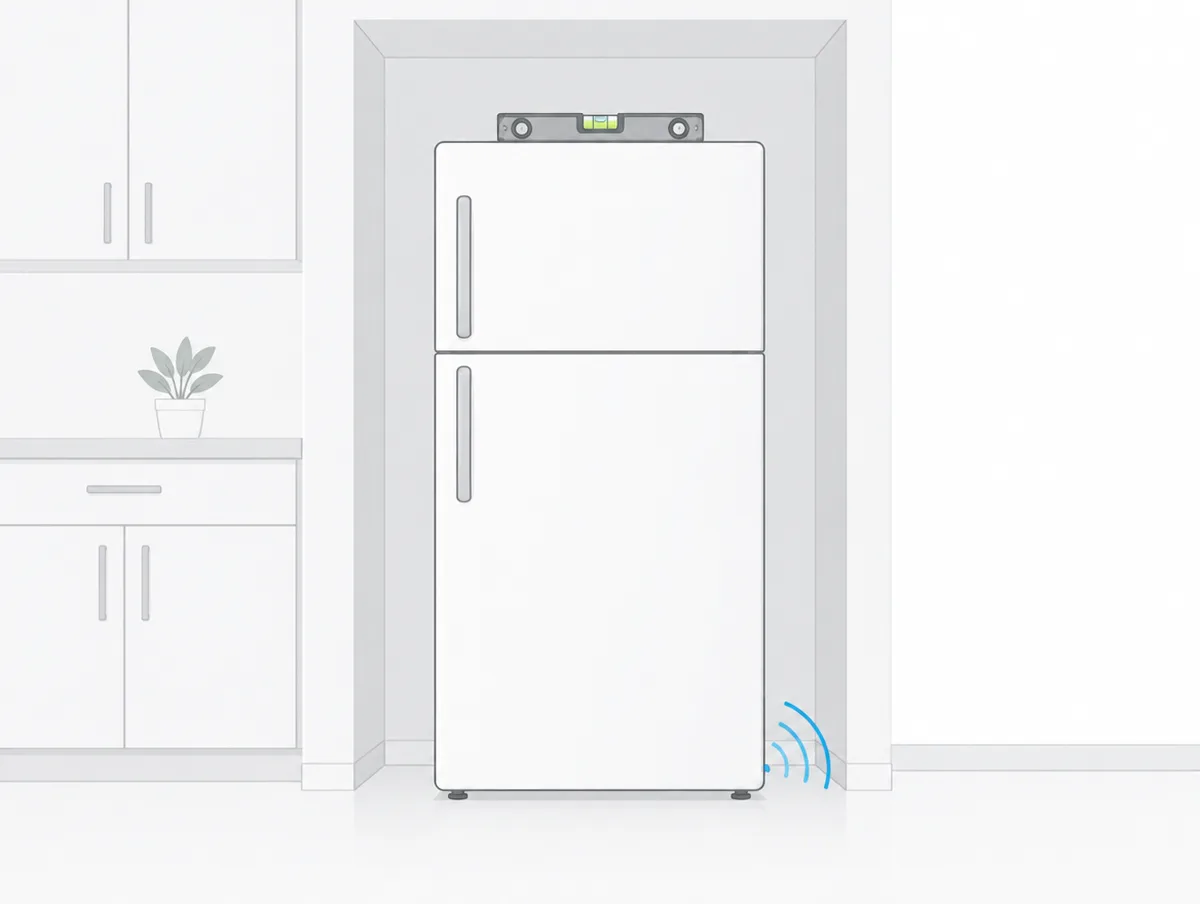
Air compressor makers ask for a flat, dry, ventilated spot with a set gap to walls: 12 inches for Makita, Craftsman and SENCO, 18 inches for Metabo HPT and Rolair, 2 feet for the California Air Tools 8010.
The clearances exist for cooling, and the manuals say so. California Air Tools' 8010 manual says "There must be at least 2 feet of obstacle-free space surrounding and above the air compressor." Rolair asks for 18 inches all round, and Makita's Quiet Series manual says its "head and shroud are designed to allow for proper cooling."
DEWALT prints two figures in one manual: 12 inches in its fire warning and 18 inches under general safety rules. Following the larger one meets both.
None of these manuals promises a lower reading for moving the machine out from the wall. A cool compressor is simply less likely to trip its overload and restart mid-job.
Level ground matters too. California Air Tools allows an incline of no more than 15 degrees, SENCO no more than 10, and Rolair warns that its splash-lubricated pumps seize when run at more than a 10 degree angle.
What do the rubber feet on an air compressor do?
Rubber feet and pads steady an air compressor and soak up vibration. Makita wants the unit "resting securely on the rubber feet", and Rolair says running without its pads "will void your warranty".
Rolair explains why in its JC10PLUS manual: "Excessive vibration is a major cause of premature compressor failure." Its schedule has owners check the pads weekly and listen for odd noise or vibration daily.
Metabo HPT's EC28M manual says to "set 4 rubber bumpers downward on the floor" both in use and in storage, so the machine never sits on its frame.
Worn feet can be replaced with the maker's own parts. The parts list in Campbell Hausfeld's DC080500 manual includes a rubber foot kit, SR080512SV, and SENCO's PC1010N manual lists a rubber pad set, 3433011A. The California Air Tools 8010 ships with a cushion foot that bolts to the front of the tank.
What should you tighten when a compressor rattles?
Loose mounting bolts come first. DEWALT and Campbell Hausfeld list "Compressor vibrates" in their troubleshooting tables with one cause, loose mounting bolts, and one fix: tighten them.
Makita adds covers to the list: "Keep all screws, bolts, and covers tightly mounted." Rolair says loose bolts or fittings "will lead to excessive vibration". Unplug it and drain the tank first, as every one of these manuals requires before maintenance.
Does a dirty air filter make a compressor louder?
Yes, according to California Air Tools, whose 8010 manual says "The air filter is designed to reduce noise" as well as keep dirt out. Its support page says keeping the filter attached ensures the unit "runs as quiet as possible."
The same California Air Tools page notes that 1 HP motors use one filter and 2 HP motors use two, so a missing second filter on a larger unit counts too. Makita says "Do not operate the compressor with the air filter removed."
Makita adds that the compressor "does not operate at full capacity if the air filter is dirty", so each fill takes longer.
Cleaning schedules differ. Metabo HPT says to open the EC28M filter once a week and blow it out with compressed air. Campbell Hausfeld says to wash foam elements in hot, soapy water and replace paper ones, which "cannot be washed". Rolair says to check its pleated element daily for holes and tears.
Rolair gives the reason a torn filter matters on a quiet pump: "Super thin reed valves play a major role in the quiet operation but are susceptible to damage from the ingestion of even the smallest piece of foreign material."
Is there an intake silencer for an air compressor?
No add-on silencer appears in the nine makers' manuals we read. The intake parts they describe are the filter, which California Air Tools says is designed to reduce noise, and Milwaukee's factory-fitted muffler tube.
Milwaukee's 2840-20 manual has owners remove "the clear plastic muffler tube from the intake filter cap" to fit the filter, then put it back, and says "The intake filter must be installed for optimal performance."
For replacement parts, Makita says "Use only genuine Makita replacement parts", warning that parts it did not make "may void your warranty and can lead to malfunction". A third-party silencer threaded into the pump head is a part none of these makers lists.
How long can an air compressor run before it needs a rest?
Small air compressors are rated for intermittent use. DEWALT and Craftsman give 5 minutes on and 5 off, Makita a 50% duty cycle, and California Air Tools and Rolair 70%.
DEWALT spells out what a breach means: if the compressor "run time exceeds 5 minutes in any 10 minute period, then the application requires more air than the compressor is capable to deliver." A compressor that seems to run all the time may be the wrong size, not faulty.
California Air Tools says its 70/30 motors should not run continuously for "more than ~60 minutes", and suggests 1 HP units avoid running more than 30 to 45 minutes at a stretch. Its 8010 manual adds that "Excessive use (over 1 hour continuous use) can cause the motor to overheat".
Rolair says the JC10PLUS "performs best when given as much rest as run time". Its belt-drive models are the exception, built with "S1 or 100% duty cycle motors and pumps", though Rolair limits an electric belt-drive motor to 15 starts per hour.
Can fixing air leaks make a compressor quieter?
Yes, by cutting how often the pump starts. California Air Tools says Teflon tape on hose threads helps "prevent air leaks and reduce compressor motor-pump(s) running time."
Rolair ties leaks directly to run time. If a JC10PLUS keeps running more than five minutes in every ten just to keep up, Rolair says "you'll likely need to shore up some air hose leaks or use a bigger air compressor for the job."
California Air Tools, DEWALT and Rolair all give the same test: brush soapy water on fittings and look for bubbles. Tighten what leaks, though California Air Tools adds "Do not overtighten."
Does draining the tank change how often it runs?
Yes. California Air Tools lists a tank "full of water due to condensation" as the cause when a compressor "cuts off within a much shorter time period" than it did when new, which means more frequent starts.
Drain intervals vary: daily or after each use for Makita and DEWALT, daily or after 4 hours of use for Metabo HPT, every 1 to 2 days on average for California Air Tools. Metabo HPT adds a warning about the job itself: "Use ear protection as air flow noise is loud when draining."
Is a longer air hose better than an extension cord?
Yes, according to Makita, DEWALT, Craftsman, Campbell Hausfeld, SENCO and Rolair, who all prefer extra air hose to a long cord. Cords drop the voltage, and a starved motor overheats and can hum.
DEWALT puts it simply: "Use longer air hoses instead of long extension cords. Your air compressor will run better and last longer." Campbell Hausfeld goes further for the DC080500: "Do not use extension cords with this unit." SENCO's manual says it "DOES NOT RECOMMEND THE USE OF EXTENSION CORDS".
When a cord cannot be avoided, the limits differ. California Air Tools allows one "no more than 25 feet long and at least 14 gauge" on the 8010. Craftsman asks for 12 gauge or heavier on the CMEC6150 and says "DO NOT USE 14 OR 16 AWG."
The cord also shows up in the noise. California Air Tools and DEWALT both list a motor that hums but will not start or runs slowly, and both point to a cord that is too thin or too long. A longer hose also lets the compressor sit farther from where you work.
Is it safe to run an air compressor indoors?
Yes for some models and no for others, according to their own manuals. DEWALT and Craftsman say "Do not operate unit indoors or in any confined area", while a Campbell Hausfeld DC080500 label reads "Use indoors only."
That Campbell Hausfeld label is an electric shock warning, paired with "Use GFCI." California Air Tools markets its cabinet model to anyone "working inside" where noise is a problem. Gas-powered machines are different again: Rolair says never to run them indoors or in an enclosed area, because of engine exhaust.
Can you put an air compressor in a box to quiet it?
No, not in a homemade one. Rolair says "Never operate in a confined area or poorly ventilated enclosure", and DEWALT warns that blocked ventilation openings "will cause serious overheating and could cause fire."
The other manuals point the same way. Metabo HPT says "Never place objects against or on top of compressor." Craftsman says not to place rags or other containers on or near the vent openings. Campbell Hausfeld says to "Operate compressor in a ventilated area so that compressor may be properly cooled."
The one quiet cabinet we found comes from a maker. The California Air Tools 8010SPC puts a 1400 RPM compressor inside a metal frame lined with quarter-inch acoustic foam "to reduce the noise by 30%", with two exhaust fans to keep it cool, and lists 40 dB without a distance.
The fans are what a plywood box lacks. An overheated compressor trips its thermal overload, and the makers' cool-down times run from about 20 minutes on the Metabo HPT to 30 on the DEWALT and "several hours" for a Rolair JC10PLUS.
Does low oil make an air compressor louder?
No manual we read lists low oil as a cause of noise. Rolair and Makita still treat the oil level on an oil-lubricated pump as a check before use, because the wrong level damages the pump.
Rolair's belt-drive manual says to keep oil at the top mark on the dipstick or "2/3 full in the sight gauge", and "Do not operate the pump with an inadequate or excessive amount of oil." It also bans detergent oil and says the unit must be level when running.
Makita's MAC2400 manual says "Always keep oil level in the middle of the sight glass", changes it every 300 hours or 3 months, and rules out multi-viscosity motor oils such as 10W 30.
Oil-free compressors take none. Campbell Hausfeld calls the DC080500 "an oilless type compressor requiring no lubrication", and Makita says its Quiet Series pump is built "for durability and no maintenance."
Why is my belt-drive compressor knocking?
Rolair's belt-drive manual lists three causes of a knocking noise: a loose pulley or flywheel, loose belts, and an internal pump problem, which it sends to service.
The same manual warns that poor pulley alignment and wrong belt tension "can cause motor overloading, excessive vibration and premature belt and/or bearing failure", and puts belt tension and bolt checks on its regular schedule.
It also tells owners to inspect the belt guard every day and to "Allow at least 18” behind the belt guard for proper cooling of pump from flywheel blast." Campbell Hausfeld builds its CE5003 with a fully enclosed metal belt guard.
Removing a guard to get at a rattle is something every manual here forbids during use. DEWALT says never to operate the compressor "with guards or covers which are damaged or removed", naming the pulley, flywheel and belt as the moving parts at risk.
Which air compressor noises mean stop and call service?
Strange noise or vibration means stop, say Makita, Craftsman and SENCO. California Air Tools sends metallic clanging to the dealer, and SENCO treats air blowing back from the inlet filter as a damaged reed valve.
Makita's instruction is the plainest: "If the air compressor appears to be operating unusually, making strange noises or vibration, stop using it immediately and arrange for repairs by a Makita authorized service center." Craftsman asks for "a trained service technician", and Campbell Hausfeld says "Vibration is generally a warning of trouble."
California Air Tools ties "metallic clangs" to a damaged head gasket or reed valve and says to "Stop the compressor and contact the dealer." Craftsman's table lists a knocking noise under a possible safety valve defect, and says the valve should be replaced if it keeps leaking.
A motor that keeps running past its set pressure is another stop sign. California Air Tools says to "Stop the compressor immediately and contact Customer Support". DEWALT and Craftsman say never to repair, drill or weld a leaking tank; the tank is replaced.
If a compressor that was fine has grown louder over months, our checklist on why appliances get louder covers the general pattern.
Do you need hearing protection with an air compressor?
Yes. DEWALT, Craftsman, Makita, Campbell Hausfeld, Metabo HPT and Rolair all call for it in their compressor manuals, quiet models included, and Milwaukee's manual lists it among the safety equipment for appropriate conditions.
DEWALT and Craftsman specify "ANSI S12.6 (S3.19) hearing protection", and Rolair recommends protection that complies with ANSI/ASA S12.6-2016. Metabo HPT asks for it during use of a compressor it rates at 59 dB, as well as during draining. The air tools on the other end of the hose add their own noise, which our page on power tool noise and hearing sets against the NIOSH and OSHA limits.
When is a quieter compressor the better fix?
A quieter compressor is the better fix when the noise comes from the pump's design. Clearances, filters and tight bolts stop added noise; they do not slow a 3400 RPM pump.
Rolair lists 86 dBA for the VT25BIG and 60 dBA for the slower JC10PLUS. Makita lists 79 dB for the MAC2400 and 58 to 60 dB for its Quiet Series, which run at 1,750 RPM. None of the four comes with a distance.
A quiet model usually delivers less air, so check the CFM your tools need first; a machine running flat out to keep up is heard most of the time. Our guide to the quietest air compressors ranks models by the figures their makers publish, with that trade-off spelled out.
Where do these compressor steps come from?
Every step here comes from manuals and support pages published by the compressor makers, listed in the sources. We read nine makers' documents covering pancake, hot dog, twin stack, portable and belt-drive stationary models, both oil-free and oil-lubricated.
We could not open Harbor Freight's site or its Fortress pages, which refused automated access, and Porter-Cable's site did not respond; its manuals were only on third-party hosts, which we do not cite. Craftsman's manual came from the Stanley Black & Decker service site linked from its product page.
We did not set up, pad, box, oil, drain or listen to any air compressor ourselves, and we did not measure one. Each decibel figure is the one the maker prints, quoted with whatever conditions it states, which for most is none.