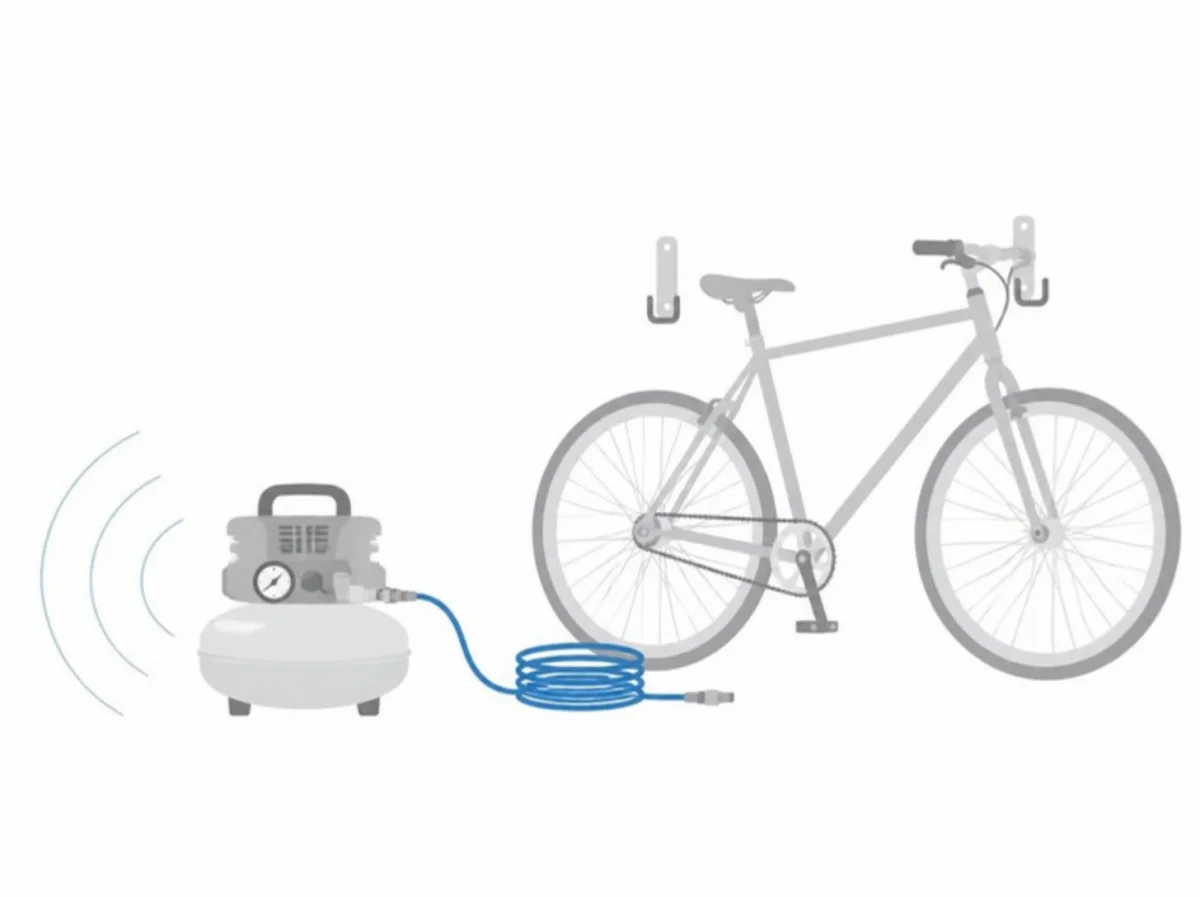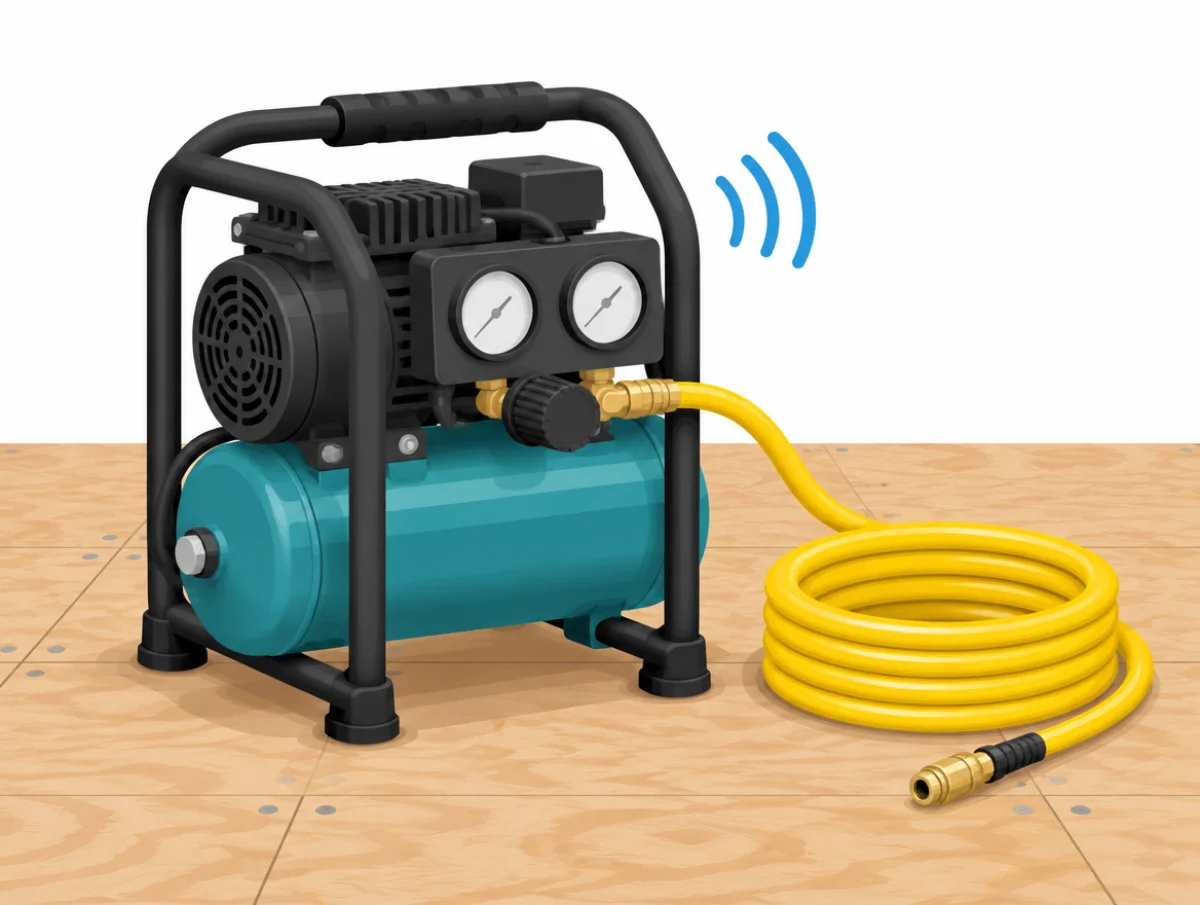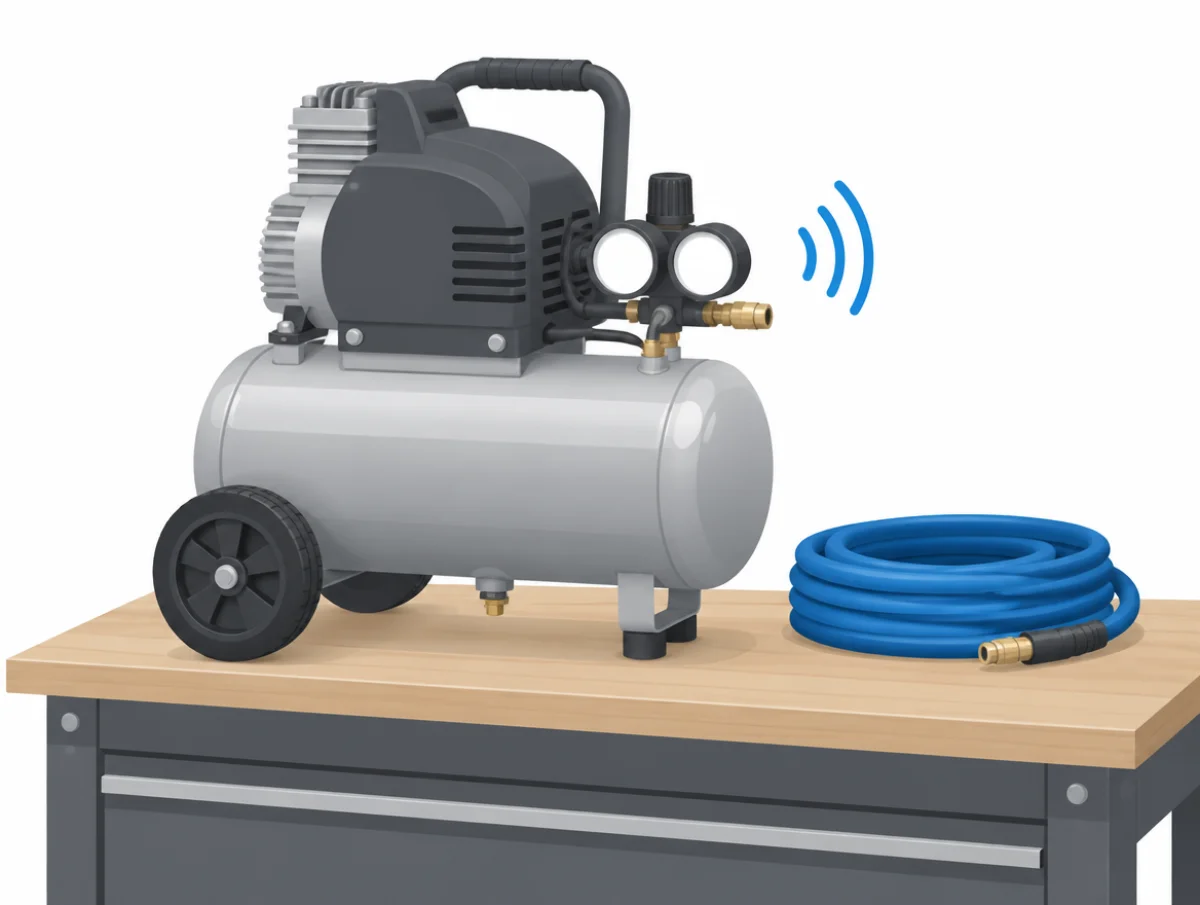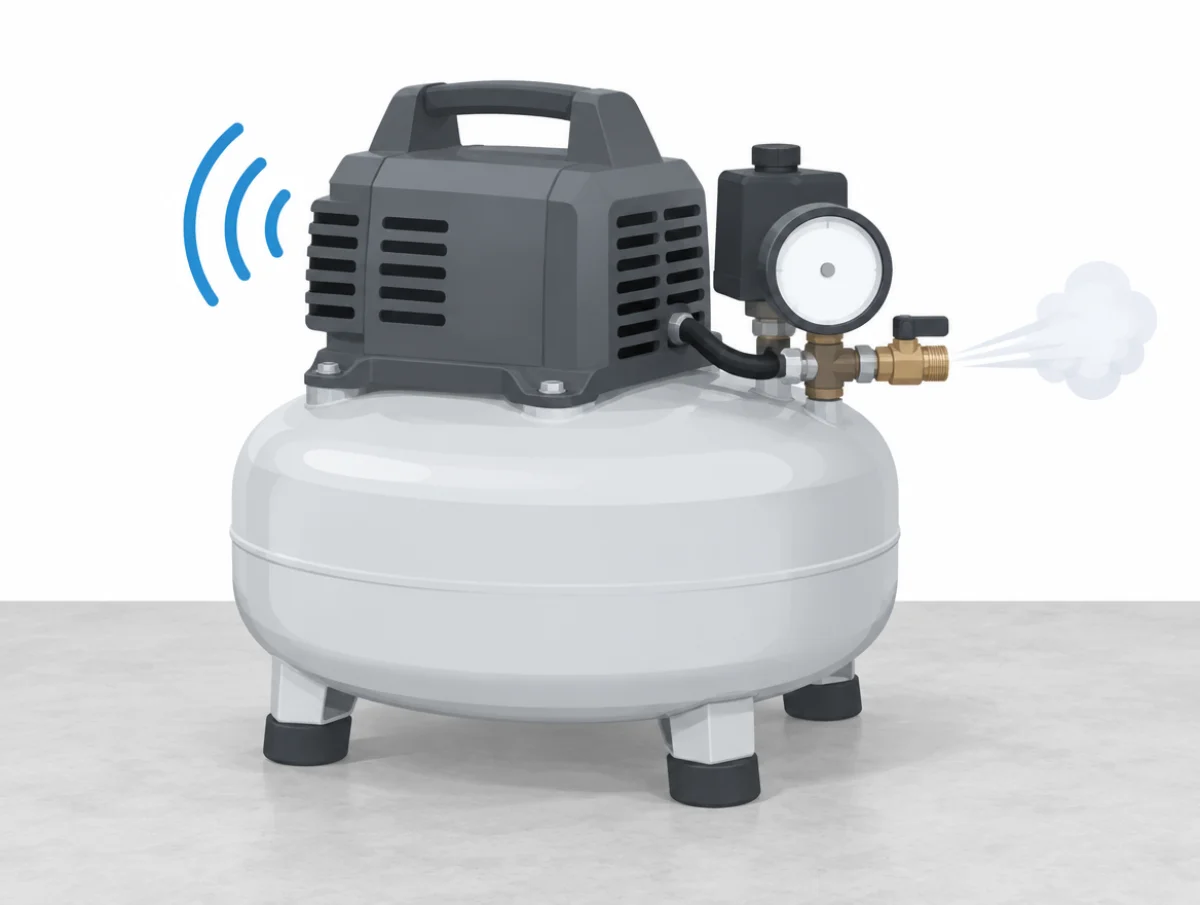
That short hiss of air when a compressor's motor stops is supposed to happen: it is the unloader valve on the pressure switch emptying the line between pump and tank, so the motor can start again without fighting trapped pressure.
Most of what a compressor does is routine cycling: the motor starts, the pump fills the tank, the pressure switch stops it, and a valve lets out a puff of air. Ingersoll Rand, Makita, Craftsman, DEWALT, California Air Tools, Campbell Hausfeld and Metabo HPT all print troubleshooting tables that sort those sounds from real faults, and their lists line up closely. The faults they name are a hiss that keeps going after the motor stops, a pump that restarts with no tool in use, knocking or metallic clangs, rattling and vibration, a safety valve that pops off, and air blowing back out of the intake filter. Porter-Cable would have made eight makers, but its own site turned us away and the copies of its manuals we found sat on sites it does not run.
This page is about portable and stationary shop compressors for nailers, tires and air tools, not the compressor in an air conditioner or a car. Lowering the everyday sound of a healthy machine is a separate job, covered in how to make an air compressor quieter.
A short hiss at shutoff is the unloader valve
The wording in Campbell Hausfeld's DC080500 manual is about as clear as a manual gets: "When the pressure switch turns the motor off you will hear air leaking out of the pressure switch unloader valve for a short time. This releases the air pressure from the discharge tube and allows the compressor to restart easier."
Makita's Quiet Series manual describes the same part as a valve "designed to automatically release compressed air from the compressor head and the outlet tube" once the tank reaches its cut-out pressure. Then the check valve closes, "allowing air pressure to remain inside the air tank." The puff should die away while the tank stays full. If the tank gauge falls, or the hiss never stops, something is leaking.
Why does my air compressor keep hissing after it shuts off?
Usually the check valve is letting tank air flow backwards out through the pressure switch. A worn unloader valve seal is the other suspect, and Makita and California Air Tools name both.
"A defective check valve results in a constant air leak at the pressure release valve where there is a pressure in the tank and the compressor is shut off." That line is from Makita's MAC2400 manual, and the fix that follows it is "Remove and clean or replace check valve. DO NOT OVER TIGHTEN."
In its 8010 manual, California Air Tools lists "The unloader valve leaks when the compressor is idle" with the cause "Unloader valve seal is defective." The owner lets all the tank air out, removes the unloader valve plug, cleans the seal and replaces it if necessary.
Not every maker trusts owners with that job. For air leaking at the pressure switch unloader valve, the same Makita manual says "Contact a trained service technician", and DEWALT sends a leaking check valve to a service center with a warning: "Do not disassemble check valve while air is in tank". Where makers split a job this way, both answers are given here.
The 2, 4 and 6 HP California Air Tools models use an electronic unloader, and the company's troubleshooting guide has a symptom just for them: "Air is continually leaking (blowing) out of Electronic Unloader Valve". Clean or replace the check valve first, then replace the unloader valve.
Leaks at a fitting or in the tank
A hiss at a hose fitting is a loose connection. Craftsman's table says to "Tighten fittings where air can be heard escaping" and check them with soapy water, then adds "Do Not Overtighten." The tank is another matter. A leak in the tank itself or at its welds means a new tank in the Craftsman and Makita manuals, never a repair, and DEWALT forbids welding or drilling holes in it because a weakened tank can rupture.
Why does my air compressor turn on by itself?
It is refilling a tank that is losing air. Loose connections, a loose drain valve and a leaking check valve are the three causes on both the DEWALT and Campbell Hausfeld lists. California Air Tools explains the cycle in its 8010 manual: "If there is an air leak from the compressor the pressure in the air tank decreases, the pressure switch resets and the motor automatically turns back on." Once you find the leak, switch off, release the tank air, unplug and contact Customer Support.
DEWALT files the problem under "The air receiver pressure drops when the compressor shuts off" in the DXCMS20045US manual. Brush soapy water on the connections and tighten them "until the leak stops", tighten the drain valve, and take the machine to a service center if the check valve is what leaks. Campbell Hausfeld adds a fourth check, "Check tank for cracks or pin holes", and its remedy leaves no room for patching: "Replace tank. Never repair a damaged tank."
The click is the pressure switch
That click as the motor starts and stops is most likely the pressure switch at work. None of the manuals describes the click by name, only the switch's job.
In Metabo HPT's EC28M manual, operation "is automatic and is controlled by the pressure switch which stops it when the pressure in the air-tank reaches the maximum level and restart it when the air pressure drops during use to the restart level." The same manual says not to start or stop the machine by pulling the plug, only with the knob on the switch.
Clicking on and off with no tool running points back to a leak.
A switch that never clicks off is a different fault. DEWALT lists an open drain valve, a defective pressure switch and too much air use for a compressor that runs continuously. California Air Tools is blunter about its own machines: if the motor does not stop at 120 PSI, "Stop the compressor immediately and contact Customer Support."
A loud pop is the safety valve venting
A pop with a burst of air usually means tank pressure went past the pressure switch's cut-out setting and the safety valve opened. Craftsman and Makita both read that as a pressure switch problem.
The valve guards against high pressure by "popping out" at a factory setting slightly above the switch's cut-out, according to the Quiet Series manual. Craftsman's CMEC6150 table lists "Excessive tank pressure - safety valve pops off" and blames a switch that did not shut off the motor. Move the On/Off lever to Off, and if the outfit still does not shut off, contact a trained service technician. Welded electrical contacts mean a new pressure switch, the MAC2400 table adds.
A safety valve that leaks without popping gets tested by hand. In the Craftsman and Makita manuals you pull the ring and replace the valve if it still leaks; on a DEWALT, air must stop escaping as soon as the ring is released.
Why is my air compressor knocking?
It depends on the pump. On an oil-free pancake, Craftsman ties a knocking noise to a possibly faulty safety valve. On oil-lubricated pumps, Ingersoll Rand's chart points inside the pump, at loose drive parts, worn valves, carbon, scored cylinders and worn bearings. The Craftsman entry is short. "Knocking Noise." sits against "Possible defect in safety valve.", and the correction is the same ring test as above.
Ingersoll Rand's SS3 and SS5 owner's manual has six checkpoints for "Knocking or rattling". The first four are a loose belt wheel or pulley or loose drive belts, compressor valves that are "leaky, broken, carbonized or loose", carbon on the pistons, and scratched or scored cylinders or pistons. The last two are bearing wear: "Connecting rod, piston pin or crank pin bearings worn or scored" and a "Defective ball bearing on crankshaft or motor shaft." Remedies run from inspection to repair or replacement, up to the whole crankshaft assembly. That table was written for an engine-driven wheelbarrow model, but the pump faults it covers belong to the same kind of piston pump found on oil-lubricated shop units.
California Air Tools uses different words for its oil-free pumps. "The compressor is noisy with metallic clangs" is the symptom, "Compressor head gasket or reed valve is damaged" the cause, and the instruction is "Stop the compressor and contact the dealer."
Belt, flywheel and guard checks for a belt-drive unit are in the knocking section of our compressor quieting guide.
Low oil makes an oiled pump louder
Ingersoll Rand's chart lists "Lubricant level too low" and lubricant viscosity that is too high among the causes of "Excessive noise during operation". Add lubricant to the proper level, or refill with the right oil.
Makita ships its oil-lubricated compressors without oil, so a new one must be filled before its first start, and the MAC2400 manual says "Always keep oil level in the middle of the sight glass". Ingersoll Rand puts "Check lubricant level. Fill as needed." on its daily list.
Oil-free machines can skip all of this. Campbell Hausfeld calls the DC080500 "an oilless type compressor requiring no lubrication".
Rattling and vibration start with loose bolts
Loose mounting bolts are the only cause DEWALT and Campbell Hausfeld give for a compressor that vibrates, and both fixes are to tighten them. Covers and shrouds are the other usual source, judging by the warnings elsewhere.
"Keep All Screws, Bolts and Covers Properly Tightened" is printed in the Quiet Series manual. Ingersoll Rand has owners check "tightness of screws and bolts" weekly or monthly and make sure belt guards and covers "are securely placed" every day.
Vibration can also be the first sign of something worse. If the equipment starts to vibrate abnormally, stop the motor and look for the cause, because "Vibration is generally a warning of trouble," in Campbell Hausfeld's phrasing. A rattle from inside the pump sends you back to Ingersoll Rand's knocking checkpoints.
Unplug the compressor and bleed the tank before tightening anything, since every manual here asks for both before service.
Why is my air compressor humming but not starting?
The motor is usually trying to turn against trapped head pressure or low voltage. A faulty unloader or check valve is among the causes on both the DEWALT and Campbell Hausfeld lists.
Under a motor that will not run, the MAC2400 table names a "Pressure unloader valve on pressure switch has not unloaded head pressure." Push the switch lever to off to bleed the line, and replace the valve if it does not open.
A check valve can also stick when a full tank sits for a long time: "When pressure is left in an air tank for prolong periods of time, the check valve spring can become compressed cause the motor to not start." California Air Tools has owners drain the tank, clean the check valve and stretch the spring.
Hot plugging is the other trap. A warning on the same company's tips page says it "will usually cause the motor to start HUMMING LOUDLY and may permanently damage the motor-pump assembly."
Air blowing out of the intake filter
This one means damaged reed valves. California Air Tools treats it as a motor and pump failure, fixed with new piston rings and reed valves or a new motor and pump. Its guide files the symptom under the heading "Noisy": "If air is pushing out from the air filter and not sucking into the air filter, then the Reed Valve or Valves are bent or damaged." The general cause is given as "Piston Ring or Reed Valves are Worn."
Wear of this kind is expected sooner or later. "Over time piston rings and reed valves can wear because of usage," and standard maintenance comes "typically after 2000-6000 operating/running hours depending on specific motor/pump model."
Noises that mean stop using it
Makita, Metabo HPT, Craftsman and Ingersoll Rand agree on this much: a new or unusual noise or vibration means stop, and none of them offers a home fix for it. Each sends you to an authorized service center or a trained technician.
Ingersoll Rand's version reads "Unusual noise or vibration indicates a problem. Do not continue to operate until you identify and correct the source of the problem." Craftsman wants the compressor stopped immediately "and have it checked by a trained service technician." Makita and Metabo HPT share nearly the same line: if the compressor is "making strange noises or vibration", stop using it at once and arrange repairs by an authorized service center. Metabo HPT and Ingersoll Rand also put a check for unusual noise and vibration on their daily maintenance lists, and the EC28M manual has no noise table at all, only those warnings.
The firm stop signs across these tables are metallic clanging, a motor that will not shut off at its set pressure, a popping safety valve and any leak from the tank.
How loud should an air compressor be?
Quiet shop compressors are rated from 56 to 70 dB by their makers, while Makita's oil-lubricated Big Bore models list 79 and 80 dB. Almost none of these figures comes with a distance. The quietest air compressors guide ranks the quiet models. Two brand pages list every figure one maker prints: Makita from 58 to 80 dB, and California Air Tools from 40 dB for a cabinet model up to 90 dB.
No manual names a decibel level at which a sound becomes a fault. The tables go by the kind of sound and when it happens. A compressor that is loud by design will not get quieter with a new check valve.
Quieter machines and other shop noise
To lower the noise of a compressor that works properly, read how to make an air compressor quieter. Nailers and impact wrenches add sound of their own, and how loud power tools get covers ear protection. For a machine that has slowly grown noisier over the years, see why appliances get louder.