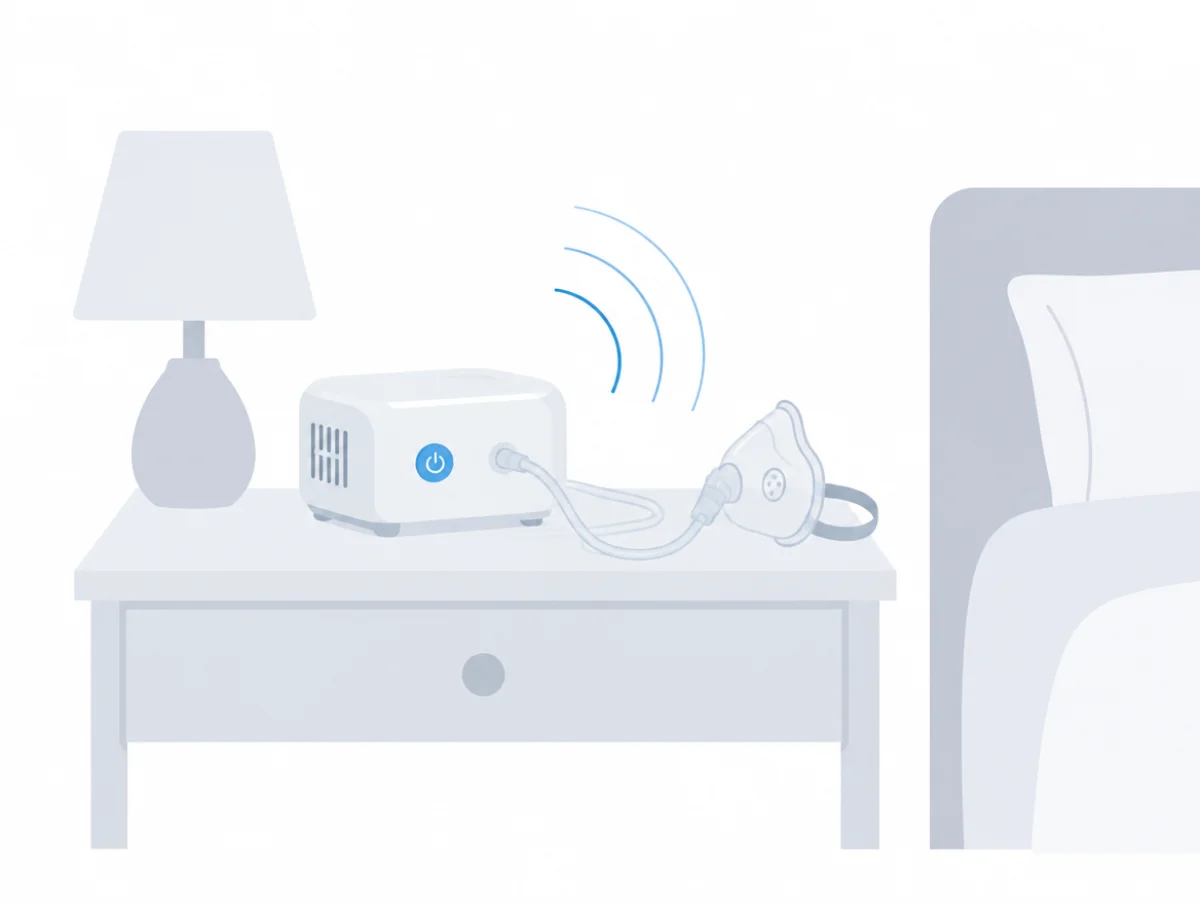
How many decibels is a nebulizer machine?
A compressor nebulizer with a published US figure sits between approximately 45 and 55 dBA on its maker's own numbers, and not one of those numbers comes with a measuring distance, an operating mode or a test standard.
Here is each claim as its maker states it:
- Omron RE-C800KD: "≈45dBA of sound while in use, a little more than a quiet library*"
- DeVilbiss Pulmo-Aide 5650 (except the 230 V 5650F): "51-55 dBA"
- Omron NE-C801: "≈52dBA of sound while in use, similar to the sound of an electric toothbrush*"
- DeVilbiss Traveler: "54 dBA"
The asterisks are Omron's, and they lead to a hearing charity's chart of everyday noises, not to a lab method. DeVilbiss's range comes from the instruction guide its own shop links, and the Traveler's single number from a Drive DeVilbiss specification sheet.
Two more figures exist and are not ranked. The Pulmo-Aide Compact's guide states a maximum sound pressure level of 56 dBA, a ceiling rather than a reading. Philips lists 58 ±3 dBA for the InnoSpire Essence, but on its UK page, for a 230 V unit.
Where approximately 45 to 55 dBA lands among fridges, rain and conversation is laid out on our decibel chart.
Is a mesh nebulizer quieter than a compressor nebulizer?
Yes, by every maker's own description, but no published number can prove the gap, because Omron bounds its mesh unit instead of measuring it: the MicroAir NE-U100 is specified as staying under 23 dBA.
The two technologies share nothing but the mist. A compressor nebulizer is a piston pump that forces air through tubing into a jet nebulizer cup. A mesh unit vibrates a perforated plate against the liquid directly, so there is no pump, no tubing and far less to hear. Omron's page calls the result "virtually silent operation" and says the unit "operates almost silently (less than a soft whisper at 23 dBA*)".
A bound is a different kind of claim from a value. Under 23 dBA says only what the unit stays beneath; it could sit anywhere below that line. That is why the NE-U100 heads its own group here rather than beating the compressors in theirs, a distinction our comparing decibel ratings explainer covers in general form.
The practical trade-offs are plain enough. The mesh unit costs $163.99 against $42.99 for Omron's adult compressor, its AC adapter is a separate purchase, and whether a given prescribed medication belongs in a mesh device is for the prescriber to say.
Philips used to sell a competing mesh unit, the InnoSpire Go, and marketed it with the same virtually silent language and no figure. Its UK product address now lands on a general Philips page, so it is not counted here.
No from PARI, and yes from Philips only for a unit the US cannot buy new. PARI prints no noise figure for the Trek S or the Vios anywhere we could find, and Philips's 58 ±3 dBA describes the UK InnoSpire Essence.
PARI's silence is thorough. The Trek S Standard page gives operating pressure, liter flow, weight and warranty. The Vios pages do the same, and the Vios Instructions For Use dedicates a full specifications section to weight, dimensions, electrical requirements and aerosol performance without a sound entry. PARI's compressors are widely prescribed, and readers deserve to know the omission is PARI's, not ours.
Philips sits in the same position here as it does for sleep machines. The FDA's announcement of the April 2024 consent decree says Philips Respironics agreed to stop selling certain new sleep and respiratory care devices in the US until requirements are met.
The InnoSpire Essence figure lives on a philips.co.uk page for the 230 V HH1340/00, with "230 V / 50 Hz, 1 Amp" in the same table, so it describes a machine wired for a different grid. How the decree reshaped the CPAP market is in our CPAP machine guide.
Do you need a prescription for a nebulizer?
Yes, a nebulizer is a prescription device in the US, and the makers print the restriction themselves. Omron's pages carry the caution that federal US law restricts the device "to sale by or on the order of a physician or licensed healthcare practitioner".
DeVilbiss's instruction guides open the same way, restricting sale to "by, or on the order of a physician".
That prescription is also the right place for every question this page does not answer. Whether a compressor or a mesh unit suits the prescribed medication, which mask or mouthpiece a child should use, and how often treatments run are clinical decisions. This guide compares published noise claims and nothing else, and the clinician who wrote the prescription outranks it on everything.
How do you make a nebulizer quieter?
A nebulizer compressor runs at its quietest on a level, sturdy surface, with its air openings clear, out of any bag, and with a fresh filter, and each of those points comes from the makers' own instruction guides.
Surface first. DeVilbiss says to place the compressor on a level, sturdy surface so the controls can be reached while seated, and warns against soft surfaces: never block the air openings of the product "or place it on a soft surface, such as a patient's lap or a bed or couch where the air openings may be blocked".
Keep it out of luggage while it runs. The Pulmo-Aide guide's safeguards include "Do not operate unit in a backpack or carrying bag."
Change the filter. DeVilbiss says the filter should be changed every 6 months, or sooner if it turns gray or discolors, and warns against substituting cotton or any other material.
Expect some sounds as normal. The Pulmo-Aide guide notes the exterior and the air outlet connector may become slightly warm during use and that warm air exits the side vents, which is the compressor working, not failing.
For the hours around a treatment, the other machines in the room decide what the night sounds like; our humidifier guide and oxygen concentrator guide cover two that often share the bedside.