Which shop air filter is the quietest?
On the printed figures, Powermatic's PM1250, at 41.3 dBA on Low and 50.8 on High, read at 1 m. The three other JET and Powermatic units printed at that distance all start at 51 dB or higher.
| Unit at 1 m | Low to High | Speeds |
|---|
| Powermatic PM1250 | 41.3, 45.0, 50.8 dBA | 3 |
| JET AFS-850 | 51 to 64 dB | 6 |
| JET AFS-1000C | 51 to 67 dB | 6 |
| Powermatic PM1200 | 52, 58, 65 dB | 3 |
Only the PM1250 is labeled dBA. JET and Powermatic belong to the same company, JPW Industries, which hosts all four manuals, yet the other three tables say plain dB, so the PM1250's lead of roughly ten decibels on Low is approximate. It also moves less air, 754 cfm with its filter fitted against 1196 for the PM1200. Powermatic credits its quiet to an "Optimized fan blade design".
Eight units rated at 3 feet
RIKON, POWERTEC and JET publish eight current filters with a reading taken 3 ft away. RIKON's 62-450 is lowest on Low at 57dB and shares the lowest High, 68dB, with POWERTEC's AF1045.
| Unit at 3 ft, by Low setting | Low / Medium / High | Top airflow |
|---|
| RIKON 62-450 | 57 / 64 / 68dB | 450 CFM |
| JET AFS-2000 | 59.1 / 62.0 / 73.8 dB | 1700 CFM |
| JET IAFS-1700 | 60 / 62 / 75 dB | Not quoted |
| POWERTEC AF4001 | 62 / 67 / 69dB | 400 CFM |
| POWERTEC AF1045 | 63 / 67 / 68dB | 1060 CFM |
| RIKON 62-1100 | 66 / 70 / 73dB | 1100 CFM |
| JET IAFS-2400 | 66 / 69 / 71 dB | Not quoted |
| JET IAFS-3000 | 69 / 73 / 75 dB | Not quoted |
The three IAFS figures come from spec rows on JET's pages with no manual linked; the rest are in each maker's manual. None of these sits beside the 1 m group, since 1 m is a little farther out than 3 ft.
Three groups, set by measuring distance
Each maker picks its own distance, and a meter set closer to a fan reads higher. Two makers here use 1 m, three use 3 ft, and three print a bare number.
JET and Powermatic at 1 m
JET's AFS-850 and AFS-1000C manuals head their table "Sound rating @ 1m". Powermatic writes "@ 1M" for the PM1250 and "@ 3.28 feet" for the PM1200, the same distance in feet. A footnote in the three newer manuals calls the figures "for general information only", while the 2018 PM1200 manual says only that its specifications were current when published. JET's older AFS-2000 uses "@ 3ft", which puts it in the next group.
RIKON, POWERTEC and JET at 3 ft
RIKON labels its row "Sound Ratings (L/M/H @3Ft)", POWERTEC "Sound Rating @ 3 Feet", and JET's industrial pages "Noise Level Db at 3Ft". None names a weighting or a standard. The order is only as good as each maker's method.
WEN, Laguna and Grizzly with no distance
WEN prints a span for each model, 50-60 dB for the 3410 and 63 to 68 dB for the 3417, and its AF1270 manual writes "63 - 68 dBA". Laguna gives three exact figures for the A|Flux:12. Grizzly prints "62, 67, 69 dB" for the G0738 and "62 - 69 dB" for the G0572. Each brand is compared only with itself; how distance moves a reading is covered in our guide to comparing decibel ratings.
How much quieter is a shop air filter on low speed?
Anywhere from 4 to 16 dB under High, in the per-speed tables the makers print. JET and Powermatic show the widest drops; Laguna, POWERTEC's AF1045 and JET's IAFS-2400 the narrowest.
At 1 m, the PM1200 falls from 65 to 52 dB and the AFS-850 from 64 to 51, 13 dB each, while the PM1250 drops 9.5 and the AFS-1000C a full 16, from 67 to 51. At 3 ft, RIKON's 62-450 drops 11, from 68 to 57, and JET's AFS-2000 14.7, from 73.8 to 59.1.
At the narrow end, Laguna lists 59.6 on High and 55.6 on Low, 4 dB apart, and the AF1045 and IAFS-2400 each drop 5. With no distance from Laguna, its small spread cannot be checked against anyone else. The decibel chart sets these levels beside familiar sounds.
More airflow, more noise, within one brand
RIKON's 1100 CFM unit reads 73dB on High against 68 for the 450 CFM unit, and JET's AFS-1000C tops out 3 dB above the smaller AFS-850. Inside one maker's line, more air usually means a louder reading.
Across brands the link is loose. POWERTEC's AF1045 moves 1060 CFM at 68dB, the same High figure RIKON prints for 450 CFM, and Laguna claims 1200 CFM at 59.6 dB, though with no distance. Even the airflow is measured differently: JET's AFS-850 and AFS-1000C tables quote "Air flow without filter", while Powermatic quotes the PM1250 "with filter" and the PM1200 "filtered". The CFM figures are not strictly comparable either.
Grizzly's T33150 HEPA filter and G9956 double filter list only "Sound rating: < 85 dB", a ceiling we quote and do not rank. The G5955 and G9955 data sheets have no sound row at all, though the G5955 sheet does mention a "Continuous Duty, Low-Noise Motor" without a number. Laguna's A|Flux:12 manual carries no figure we could find, while its page does.
Some familiar names are gone. Grizzly's site marks the Shop Fox W1830 and W1690 discontinued. JET lists only parts and filters for the AFS-1000B, and RIKON's pages for the 62-400, 62-100 and 61-series units hold parts lists only.
A filter does not replace a dust collector
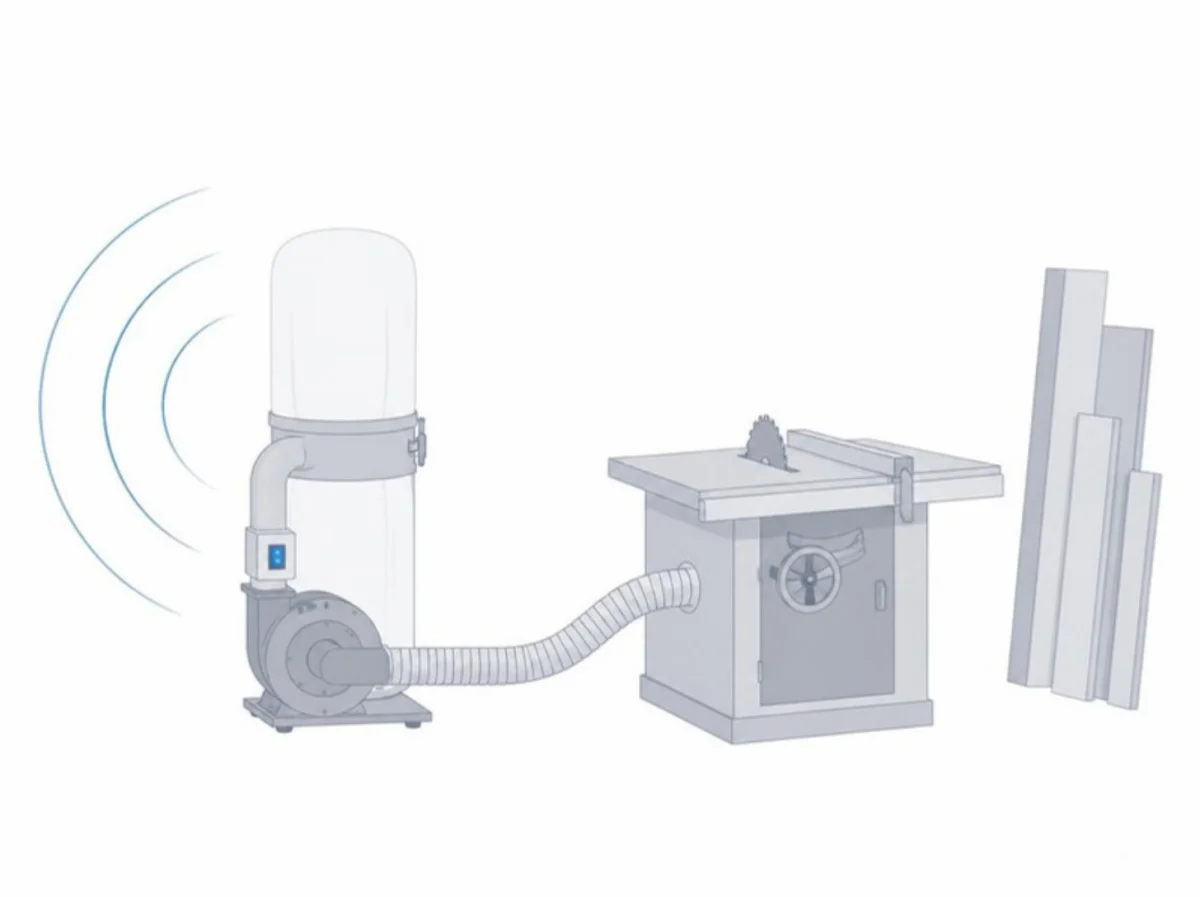
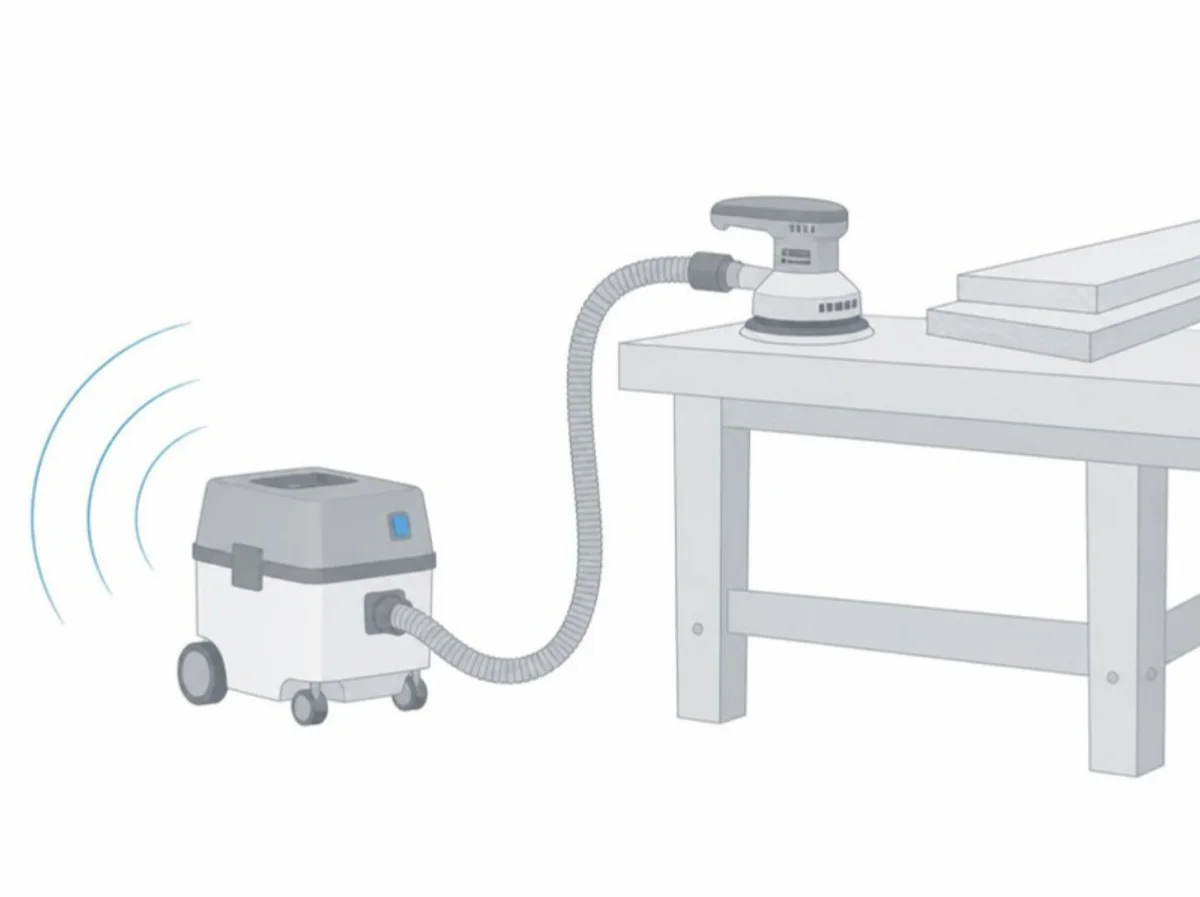
The two do different jobs. A shop air filter cleans dust already floating in the room; a collector or extractor pulls chips and dust at the tool before they spread. Most woodworkers run both.
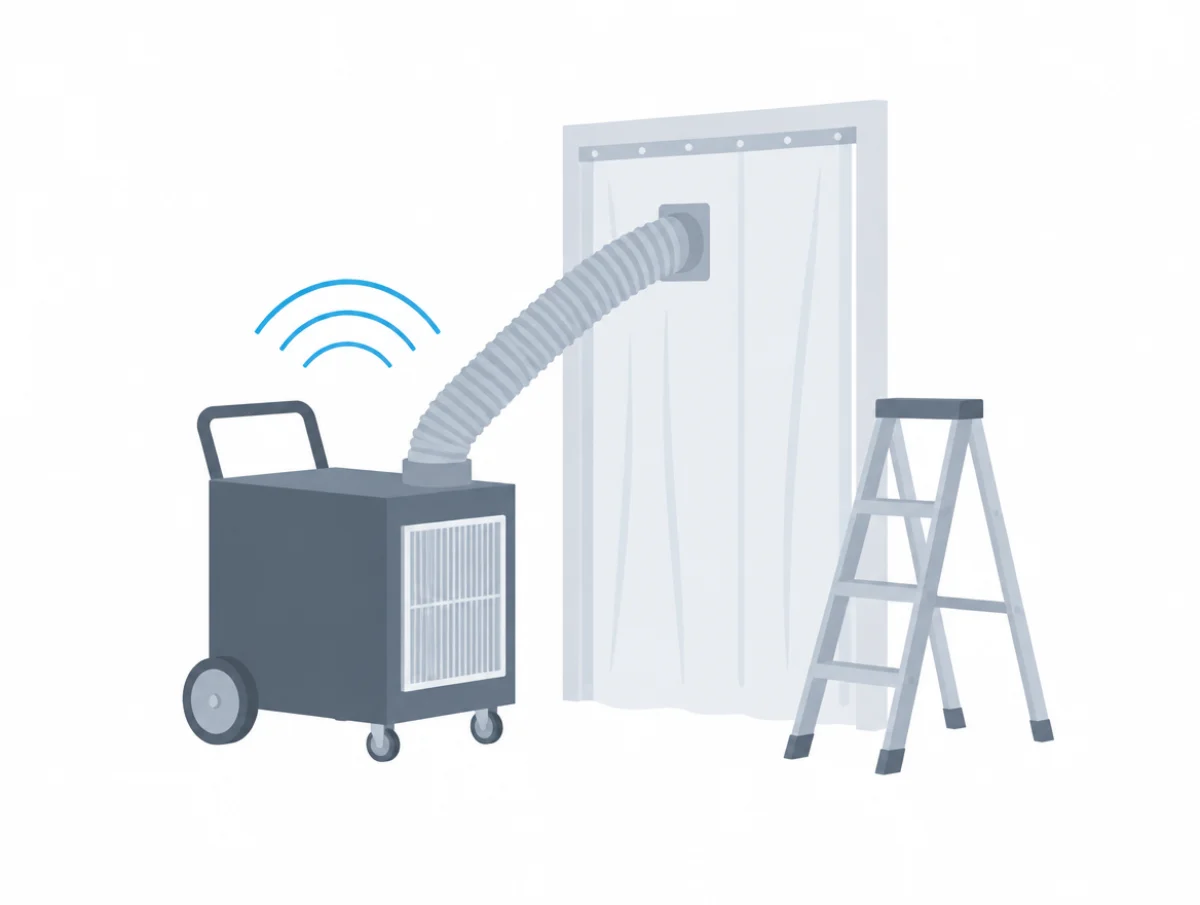
For capture at the source, see our dust collector guide for stationary machines and the dust extractor guide for sanders and track saws. A renovation behind plastic sheeting is a different case, and the air scrubber guide covers HEPA units on wheels. Where the filter hangs counts too, and our quiet workshop explainer looks at the shop as a whole.