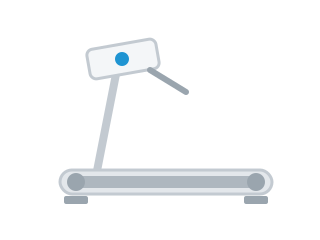
A walking pad is a small, flat treadmill with no console tower, built to slide under a standing desk or a sofa. Most top out at around 3 to 4 mph. They are sold hard on quiet: nearly every one we looked at claims to be quiet enough for a video call, and most print a decibel figure to prove it.
Those figures are the problem. Most are ceilings like "under 45 dB" or bare numbers like 35dB, with no speed, no walker on the belt and no distance to the microphone. Two brands even print two different numbers for the same machine. If you want a quiet walking pad, this guide sorts what the makers actually say from what can actually be compared.
We read the makers' own pages for more than forty walking pads and under-desk treadmills from ten brands, and the owner's manuals where the makers publish them. Sixteen carry a maker's noise figure. Six of them have a figure with a stated condition, or a written ceiling in a manual. None comes with a speed, a load and a measuring distance together.
Our picks are listed above, with full specifications for each.
What changed since our treadmill guide
Our guide to the quietest treadmills for an apartment found five published figures and concluded that walking pad figures could not be put in order. That is still true of the category as a whole. What changed is that we looked at more pads and more manuals, and found figures that say what they cover.
DeerRun states that its Z10 runs at 65dB "during both no-load and full-speed conditions". Egofit states that its M1T stays below 70 dB "even at top speed", alongside the same promise for the M1. UREVO's manual for the SpaceWalk 5L declares 65 dB or less, as its CyberPad manual does. With those, some figures can finally be read side by side. Most still cannot.
Idling or no load. KingSmith says the WalkingPad C2's "idling noise is lowered to 65 decibels". DeerRun says 65dB for the Z10 at no load. These are the only two figures that describe the same condition, and they are the same number. Neither states a distance, so the fair reading is that they claim the same thing, not that either is quieter.
Top speed. DeerRun gives 65dB for the Z10 at full speed, which is 3.8 mph. Egofit promises under 70 dB for the M1 at its 3.11 mph maximum, and below 70 dB for the M1T at top speed without saying which of its two top speeds it means. DeerRun's number is lower on paper. But Egofit's figures are ceilings, which say only that the noise does not reach 70, and the top speeds differ. So these three cannot be put in a strict order either. What you can say is that all three makers expect a walking pad at full speed to sit somewhere in the 60s.
Written ceilings in a manual. UREVO's manuals for the SpaceWalk 5L and the CyberPad for Office both print "On airborne noise: ≤65dB" and, just above it, "Noise emission under load is higher than without load." There is no speed or distance, but it is the maker's own document, and it is candid about what a walker does to the number.
The bare claims, which cannot be ranked
The rest of the figures carry no condition at all:
- UREVO CyberPad for Office: 35dB, from what UREVO calls laboratory testing "under specified testing conditions" that it does not specify.
- KingSmith WalkingPad Z1: "noise levels below 40 dB".
- DeerRun Q2 Urban, Q2 Urban Plus, Z20 and Z10: "Low Noise" at under 45 db in each spec table.
- THERUN W1, Goplus and RHYTHM FUN: under 45 dB each.
- LifeSpan TR1200Pro and Mobvoi Home Walking Treadmill: under 60 dB. Mobvoi says its figure comes from testing in its "simulated lab environment".
- Egofit ComfortDeck-M2T: under 70dB, with no speed attached.
These cannot be placed in order. A ceiling of 45 from one brand and a ceiling of 60 from another tell you nothing about which pad is quieter, because neither brand says what it measured. And the brands that give two numbers show how wide the gap can be. DeerRun's Z10 is under 45 db in one part of its page and 65dB in another. UREVO's CyberPad is 35dB on the page and 65 dB or less in the manual. KingSmith's Z1 claims under 40 dB, while the same company's C2 states 65 decibels idling. Either the Z1 is far quieter than the C2, or the two figures describe different things. KingSmith does not say which.
The most important fact about walking pad noise does not come from a walking pad maker. NordicTrack's advice for apartment owners, which we quoted in our treadmill guide, says footstrike impact, not motor hum, is what travels to downstairs neighbors. It moves from the belt, through the frame and into the floor.
That is good news for walking pads. NordicTrack says walking and light jogging are quiet enough for most apartment situations, and that running at speed generates more impact. Every pad here is a walking machine. It also means the decibel figures in this guide, all of them about motor and belt noise, say very little about what the people below you will hear. A quiet walking pad on a wooden floor can still thump.
Your building matters too. In NordicTrack's words, a concrete slab building transmits almost no vibration between floors, while a wood-joist building with a thin subfloor transmits noticeably more. Our page on keeping an apartment quiet covers the other machines neighbors hear through floors and walls.
Setting up a quiet walking pad under a desk
Most people buy a walking pad for a standing desk, so the noise that matters most may be the noise your microphone picks up. Our guide to a quiet home office covers the rest of the room, from the desk frame to the computer fans.
A few things make the most difference. Put a dense rubber mat under the pad, larger than its footprint. Egofit says its pads can go on a carpet or mat to reduce vibration and sound, and NordicTrack says thin foam mats do little. Level the pad so all its feet make solid contact with the floor, as NordicTrack advises for treadmills, because a pad that rocks will rattle. Walk at a steady pace during calls, since both idling figures here are already 65. And keep the belt lubricated on the maker's schedule: a dry belt drags, and a belt that drags gets louder.
If you also sit part of the day, pair the pad with a desk whose motor you will not hear over it. Our guide to the quietest standing desks lists what desk makers publish, and the same caution about bare ceilings applies there.
Check the weight limit in the manual
UREVO's product pages list a 400 lb maximum load for both the SpaceWalk 5L and the CyberPad for Office. Both manuals say 136 kg, which is 300 lb. When the page and the manual disagree, we quote the manual, and so should you. A pad run above its rated load is a pad run under strain, and UREVO's own manual says load raises the noise.
Weight limits across the picks run from 220 lb for the KingSmith C2 and the Egofit M1 and M1T to 300 lb for the DeerRun pads. Goplus lists 340 lb for its pad.
Brands that publish nothing
Several brands make no noise claim in numbers for the models we checked. Sunny Health & Fitness gives no figure in the descriptions of its walking pads. KingSmith gives none for its P1, A1 Pro, R3 and Z3 pads, only words like "Ultra-Silent". Egofit gives none for the ComfortDeck-M2. UREVO gives none on the pages or in the US-style manuals of the SpaceWalk E1L and E1L Pro. DeerRun gives none for the Sleek Fold 1 and Sleek Rise 1. LifeSpan's TR5000 and TX6 under-desk treadmills have no operating noise row, though the TR1200Pro does. Sperax's US store showed only a password page when we checked, so there was nothing to read. We found a figure for SuperFit pads only on retailer listings, not on a maker page, so we have left them out.
How we chose
We read the maker's product page for each walking pad and the owner's manual wherever the maker publishes one, and recorded each noise figure in the maker's exact words with whatever condition it gave. We grouped the figures by what they claim to cover: idling or no load, top speed, a written ceiling in a manual, or nothing stated. We compared figures only inside a group, and only where the conditions matched. We then chose on what the makers do publish: speed range, weight limit, size, folding and price on the maker's own store. Pads shown as unavailable on the maker's store went into the also considered list.
For the effect on neighbors we relied on NordicTrack's published apartment guidance, because no independent body rates treadmill or walking pad noise and no walking pad maker publishes anything comparable.
We did not measure any of these walking pads. Every figure is the maker's own, quoted as published, with the condition the maker gave or a note that it gave none.