Learning how to make a treadmill quieter starts with telling the sounds every healthy machine makes from the ones an owner can fix. The fixable ones mostly come from a frame that rocks, bolts that have worked loose, a belt running off center or too slack, and a deck that has gone dry.
Each step below is taken from a treadmill or walking pad maker's own manual or help pages, starting with checks that need no tools. Footsteps carried into the floor below are a separate problem, set out in our guide to keeping an apartment quiet.
How do you make a treadmill quieter?
Make a treadmill quieter by levelling it, giving it a firm floor and the maker's mat, tightening its frame bolts, centering and tensioning the belt, lubricating the deck only as the manual directs, and keeping the motor compartment clean.
Roughly from free to the jobs needing a wrench or a part:
- Learn which sounds are normal for a new machine.
- Walk in the middle of the belt.
- Level the frame and lock the feet.
- Move it off the wall and onto a firm floor or the maker's mat.
- Check and tighten the frame bolts.
- Center the belt, then set its tension.
- Lubricate on your manual's schedule, or never if it says so.
- Vacuum the motor compartment where the manual allows.
- Grease the incline parts if your manual lists them.
Which treadmill noises are normal?
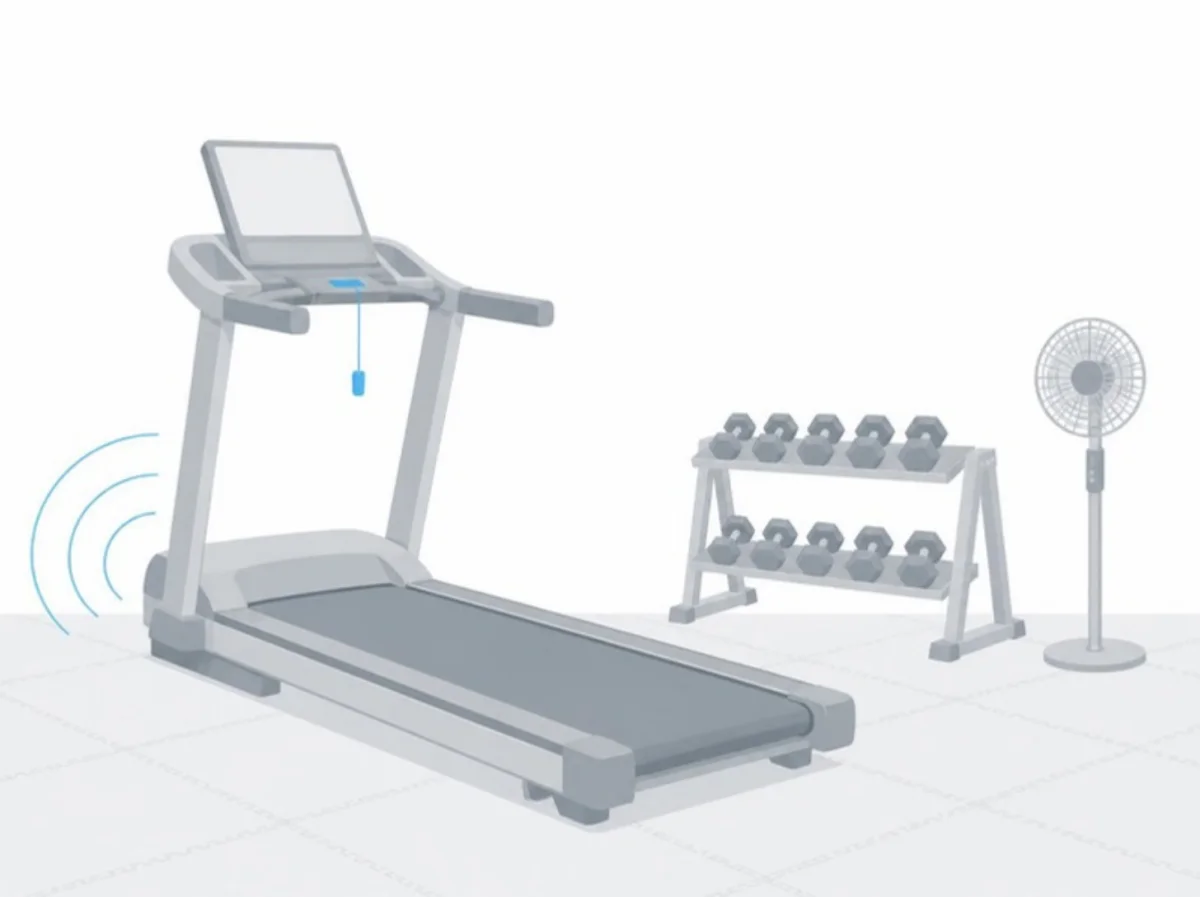
Normal treadmill noises include a rhythmic thump from the belt and a chirp while a new motor breaks in, and both fade with use. Horizon's rule: anything no louder than a normal speaking voice counts as normal.
Peloton's noise page traces the thump to "the seam on the running belt" as it circles the deck, and says walking or running above 3 mph speeds up the break-in. A chirp that lingers after break-in, or keeps going for minutes without easing, is one Peloton wants reported to Member Support.
Horizon's article on normal noises credits the thump to the belt passing over the rollers and says a belt stretches over time and rides more smoothly. iFIT adds that a fan you hear with the external fans switched off may be the treadmill's own CPU cooling fan.
How do you level a treadmill so it stops rocking?
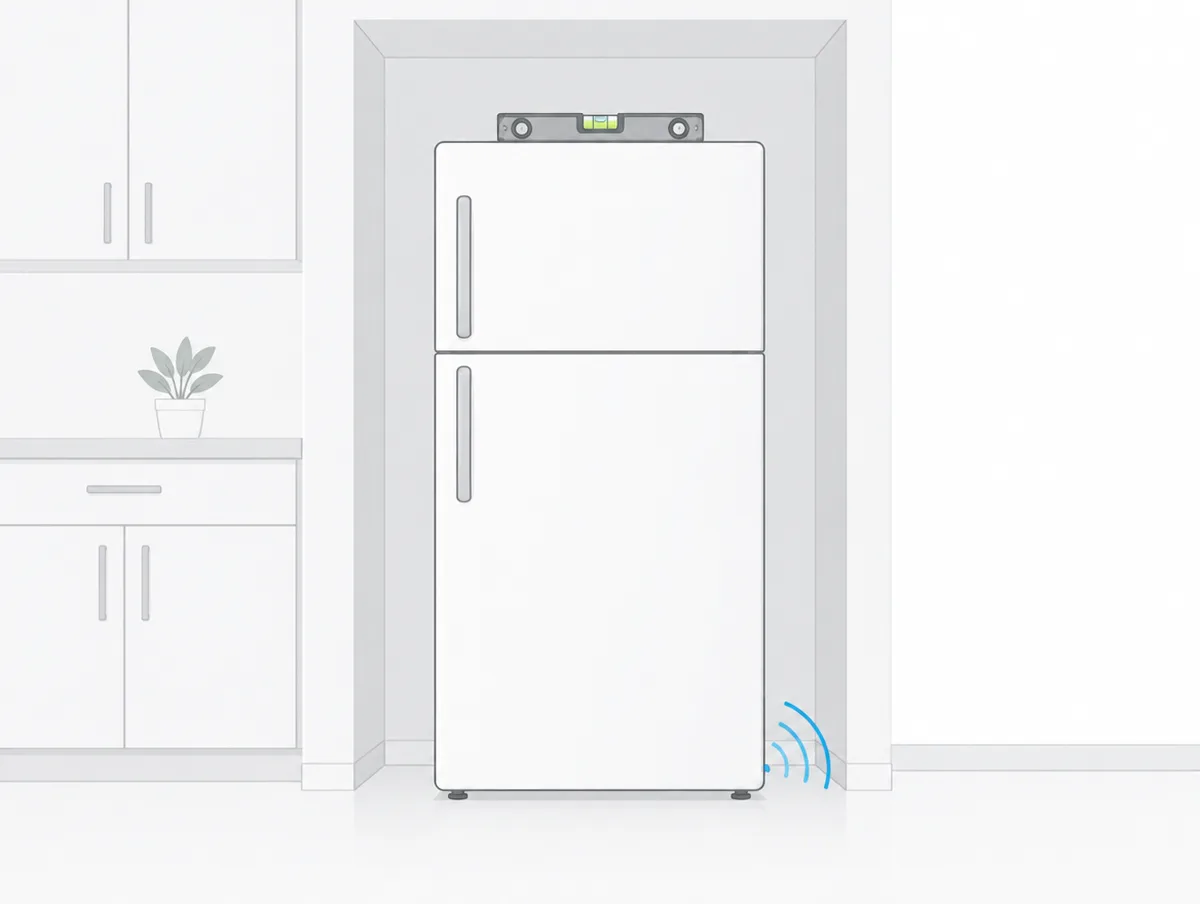
Level a treadmill by raising or lowering its adjustable feet until no corner rocks, checking with a carpenter's or bubble level, then locking each foot with its nut. On a Peloton Tread, only the rear feet adjust.
BowFlex's T9 owner's manual gives the reason: if the treadmill is not level, "the running belt may not track properly." Life Fitness's Run CX manual finds the stabilizing leg that is off the floor, loosens its jam nut and turns the leg until the rocking stops.
Peloton's levelling article starts with the incline at zero and both front feet down, then takes a 27 mm or adjustable wrench to whichever rear foot is lifted. The front feet are fixed, and adjusting them "could damage the Tread and compromise the incline accuracy."
Peloton then runs the Tread at minimum and maximum incline to show up anything left. If the machine still will not settle, Peloton says the floor may not be flat enough and suggests moving it. iFIT says a floor mat can also help a treadmill feel more level.
Does a treadmill mat reduce noise?
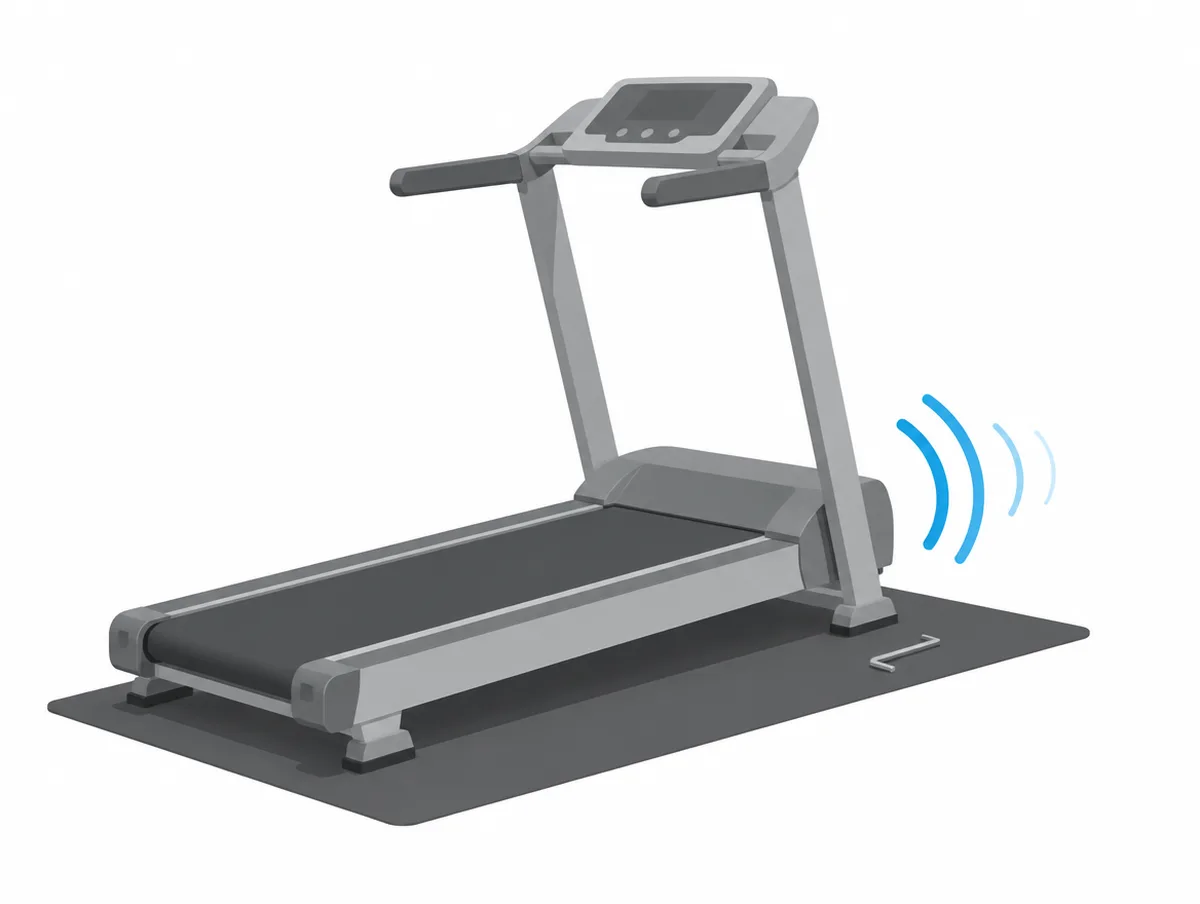
Yes, by the makers' own descriptions, though none prints a decibel figure. Horizon sells a foam mat it says reduces noise and vibration, and BowFlex, Horizon and WalkingPad suggest a mat for floor reverberation or a slamming sound.
Horizon's Fitness Mat is 82 by 39 inches of shock-absorbing foam, 5 mm thick. NordicTrack's apartment article names its own 40 by 80 inch Large Equipment Floor Mat and wants any mat to reach past the machine all round.
Firmness counts as much as size. Peloton's Tread Flex FAQ asks for a mat that is hard and thick and will not curl up into the incline mechanism, and to avoid high pile carpet.
Carpet has limits of its own. SOLE's F63 manual says "Do not operate treadmill on deeply padded, plush or shag carpet," warning of damage to both. LifeSpan's TR1200B Pro manual keeps its walking treadmill off thick carpeting so that air can circulate underneath.
Where should a treadmill go to be quieter?
A treadmill is quieter clear of walls, on a solid floor and, in an apartment, nearer an interior load-bearing wall than mid-room. Horizon says a wall close by reflects more noise; NordicTrack says open floor spans carry more vibration.
Horizon's treadmill noise FAQ and the BowFlex manual rate carpeted concrete above a wood overlay floor for reverberation. NordicTrack says floor sections over open space, such as the middle of a big room, pass on more vibration than sections over structural support, and asks owners to keep the machine away from shared walls too.
How do you make running on a treadmill quieter?
Running on a treadmill gets quieter, by iFIT's and NordicTrack's advice, with feet landing mid-belt, a softer cushioning setting where the deck offers one, and a mat. NordicTrack adds that incline walking carries far less footstrike force.
iFIT's noise troubleshooting page starts with the user: where you walk on the belt and the shoes you wear can make noise, so stay in the middle, "not too far forward or back." NordicTrack says the softer settings on its T Series 10 lower the peak force of each step, but that cushioning reduces impact noise at speed rather than removing it.
How do you stop a treadmill rattling?
Stop a treadmill rattling by checking every frame bolt after a few workouts, then monthly. Horizon says bolts loosen as a new treadmill settles and can cause noise; BowFlex and LifeSpan schedule monthly hardware checks too.
Horizon's care and maintenance article goes further than other makers. For a bolt found loose, it suggests a medium-strength thread locker on the threads before tightening, with metric Allen sockets from 3 to 8 mm, and leaving the treadmill unused for the 24 hours or so the locker takes to cure.
Peloton ties excessive shaking on the Tread Flex to loose bolts or an uneven floor, while calling minor screen wobble at higher speeds normal. iFIT's checklist for an unexpected hum or buzz has the same step: tighten loose hardware and finish the routine maintenance in your manual.
How do you make a treadmill belt quieter?
Make a treadmill belt quieter by centering it so it cannot rub the side rails, then tensioning it only until it stops slipping. Horizon, BowFlex, SOLE, Life Fitness and Peloton adjust both with small turns of two bolts or screws.
How do you center a treadmill belt?
Center a treadmill belt with the rear roller bolts, usually a quarter turn at a time, with the belt moving slowly, then let it settle. iFIT says an off-center belt can rub a foot rail and make noise.
UREVO's SpaceWalk 5L manual draws the same link in its troubleshooting table, giving friction noise the cause "Walking belt off center." BowFlex centers at no more than 1 mph, SOLE at 3 mph, and Life Fitness at 2.5 mph with two people, one standing astride the belt on the side rails.
Peloton's belt maintenance page gives the Tread a visual check each month: the red line on the belt should sit between two red dots at the front of the deck. SOLE says some drift is normal with a user's gait, and that tracking needs less attention as a belt beds in.
How tight should a treadmill belt be?
A treadmill belt should be just tight enough not to slip or hesitate under a heavy step. SOLE, LifeSpan and iFIT all warn that overtightening strains the belt, bearings or motor rather than quieting anything.
Horizon's belt adjustment article checks tension at 3 mph by stamping hard on the belt; if it stops or hesitates, both bolts go a quarter to half turn clockwise. NordicTrack says a loose belt slaps the deck with a rhythmic thump that keeps its own beat, whatever your pace.
SOLE's manual reads "DO NOT OVERTIGHTEN", citing belt damage and early bearing failure, and LifeSpan caps adjustment at 2 full turns each side. If a belt still slips after a lot of tightening, SOLE says the drive belt under the motor cover may be loose, and that tightening it is for a trained service person.
Should you lubricate a treadmill belt?
Yes, if your manual sets a schedule, and no if it calls the deck waxed or the belt lubricant-infused. Makers disagree widely on how often, so the manual for your model overrides any general rule.
| Maker and model | What the maker says | How often |
|---|---|---|
| Horizon, silicone decks | About 20 ml of silicone, never over 30 ml at once | Every 150 miles or 3 months |
| Horizon, waxed decks | Add nothing, for the life of the belt | Never |
| BowFlex T9 | Half the supplied bottle of 100% silicone; LUBE shows and the machine will not run | Every 3 months or 150 miles |
| NordicTrack and ProForm (iFIT) | Pre-coated at the factory; use only iFIT's own lubricant | As needed, usually not over once a year |
| SOLE F63 | 2 to 3 ounces of food grade silicone, after wiping under the belt | Every 90 hours or 90 days |
| LifeSpan TR1200B Pro | Silicone only, never over 2 ounces | Every 50 hours or 3 months |
| Egofit M1 and M1T | 1 ounce of 100% silicone | Every 50 hours or 3 months |
| UREVO SpaceWalk 5L | 5 to 10 mL; too much can make the belt slip | About every 200 km |
| Life Fitness Run CX | Lubricant-infused belt; no lubrication task in the schedule | None listed |
Dryness is where the noise comes from. SOLE says a dry deck raises friction and loads the drive motor, drive belt and motor control board, and NordicTrack describes the result as a dry, grinding sound. iFIT's lubrication FAQ tests it: unplug, wait a minute, lift the belt edge and feel under the middle for a slight shine.
The wrong product is the usual mistake. iFIT says never to apply silicone spray to its belts or decks unless a service representative says so; LifeSpan and Egofit rule out aerosol silicone sprays, and SOLE bans bathroom caulk and anything with a spray or foam base. Horizon, BowFlex and SOLE ship a bottle or tube with the machine.
More is not better either. LifeSpan says over-lubrication can damage the electronics, and UREVO that it can make the belt slip. NordicTrack's blog suggests every three months while iFIT's maintenance guide says annually, so follow the manual for your model.
Why does a treadmill squeak or creak on an incline?
A treadmill that creaks while inclining usually has dry joints on its elevation rack or a dry incline motor screw, according to Horizon. Horizon greases the screw every quarter at maximum incline and lubricates the rack joints as needed.
Horizon recommends a PTFE grease for the screw and a PTFE spray for the rack joints, with the power off or the emergency stop pressed first. BowFlex asks for a Teflon-based spray on the silver tube of any air shock that helps lift the deck.
How do you make a treadmill motor quieter?
No owner fix makes a healthy treadmill motor quieter. The makers' steps keep it from working harder than it should: a lubricated, correctly tensioned belt, and a motor compartment kept free of dust and hair.
NordicTrack says a motor's pitch and volume shift slightly as it works harder, and that iFIT trainer-led workouts change speed smoothly, avoiding the short acceleration sounds of stabbing at the speed buttons. iFIT warns that an overtightened walking belt puts excess strain on the drive motor.
Can you clean under a treadmill motor hood?
Yes, on models whose manuals schedule it, and always unplugged first. Horizon says quarterly, SOLE every other month, and BowFlex, LifeSpan and Life Fitness monthly; Peloton's care page gives owners no such step.
Horizon wants the plug out and 2 to 3 minutes for power to drain, then a soft-bristled vacuum attachment kept clear of wires and connectors. BowFlex waits 60 seconds and until every display is dark. Its safety page says covers come off only when Customer Technical Support instructs, so ask before any job beyond the scheduled clean.
LifeSpan ties the job to plush carpet fibers drawn into the motor compartment, and SOLE to dirt and hair pulled in from under the deck, and SOLE also wants the floor beneath vacuumed every month. Peloton says service beyond its listed procedures is for an authorized technician.
How do you make a walking pad quieter?
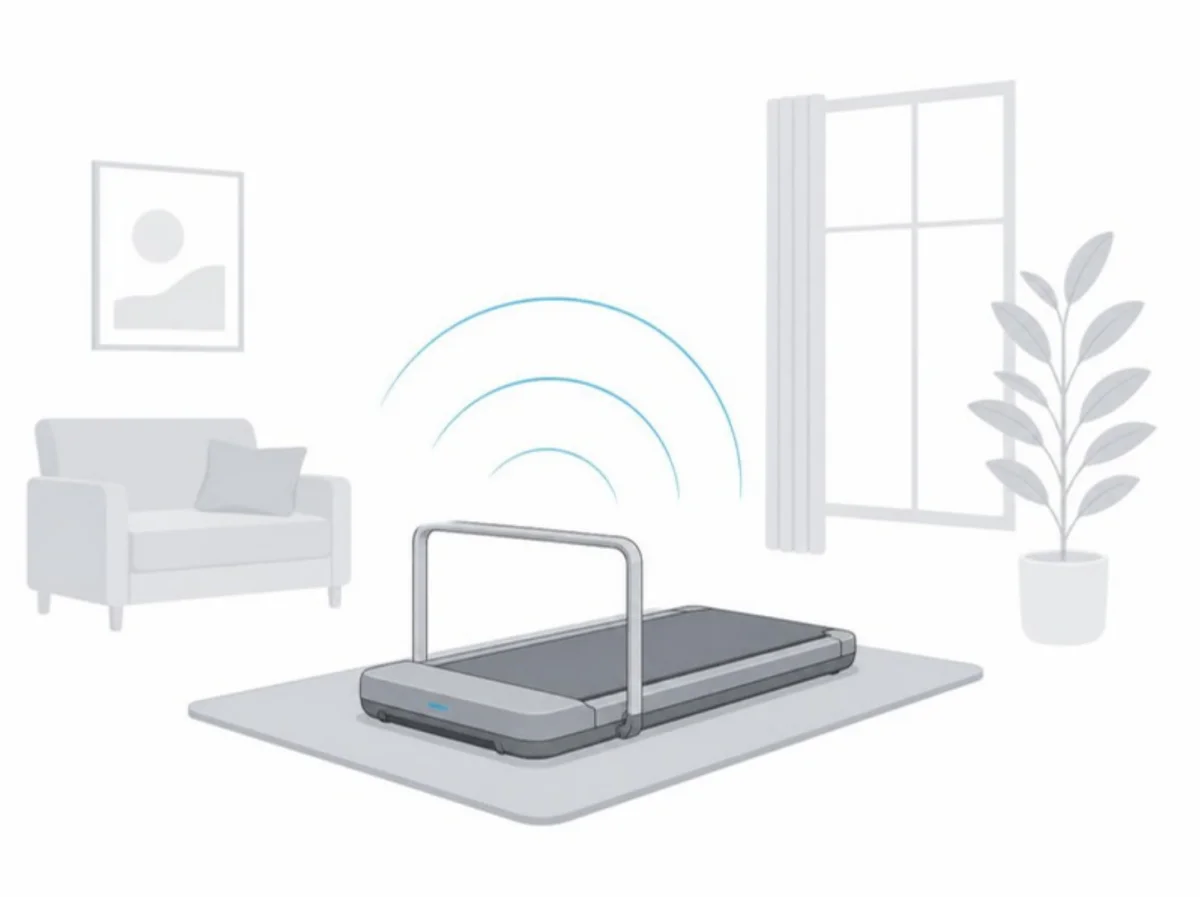
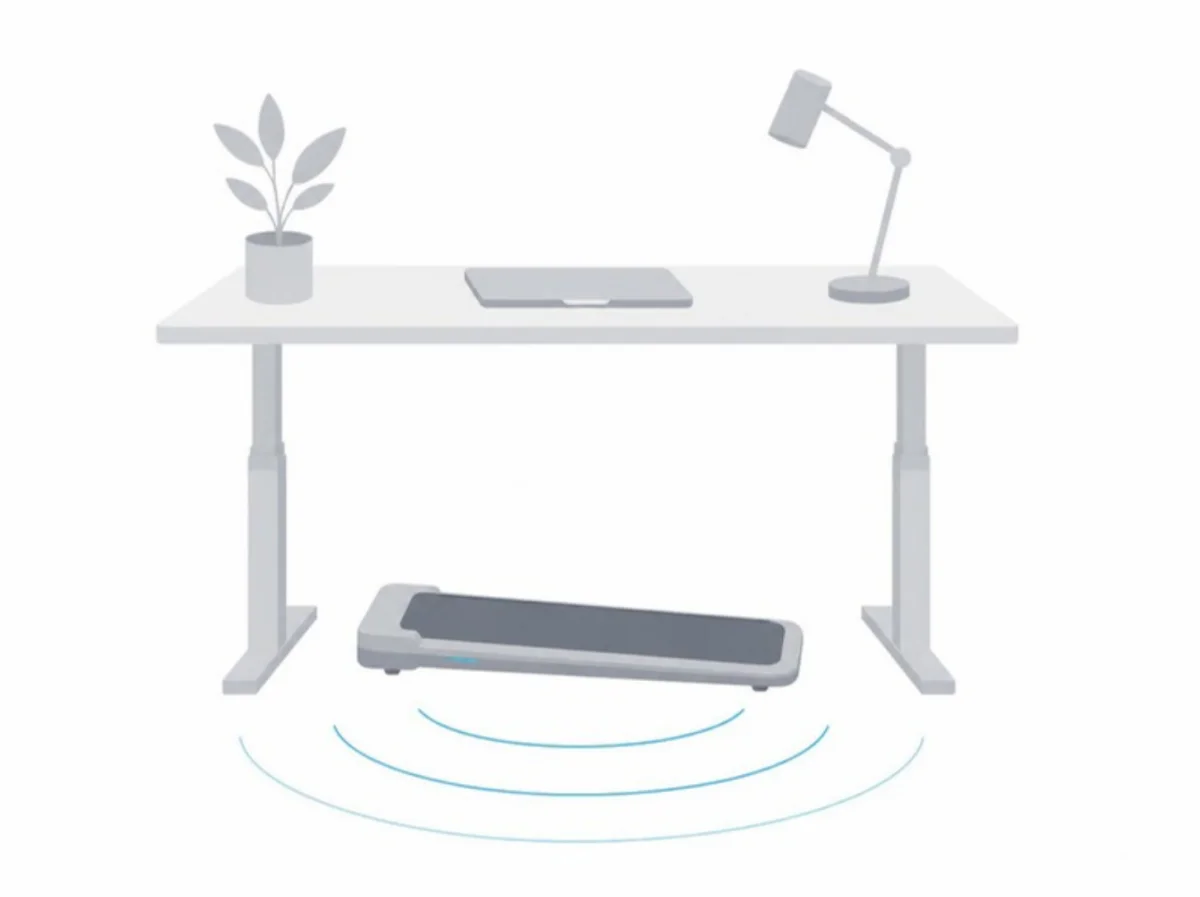
Make a walking pad quieter with a floor mat under it, a centered belt, and lubricant only in the amount its manual gives. WalkingPad suggests a mat for a slamming sound, and UREVO ties friction noise to an off-center belt.
WalkingPad's FAQ says noise varies with model, speed, user weight, flooring and maintenance condition. It sends some sounds to its support team: sharp metallic whistling from the motor's carbon brushes or abnormal sounds from the front or rear drum that last a couple of days, and the motor cover grinding against the walking belt.
Egofit's M1 and M1T manual wants the pad sitting level and stable. UREVO centers the SpaceWalk belt with quarter turns of the idler roller screws, after unplugging, and warns that the belt should not be adjusted too tightly or it will be damaged.
What should you avoid when quieting a treadmill?
Avoid what the manuals forbid: deep or plush carpet, blocked air openings, the wrong lubricant, an overtightened belt, adjusting fixed feet, opening covers while plugged in, and power arrangements the maker rules out.
From the manuals we read:
- Air openings: Life Fitness and Sunny say never to run the treadmill with them blocked.
- Enclosures: no maker we read suggests building a box or cover around a treadmill.
- Covers: SOLE and Sunny say never to remove one without first disconnecting power.
- Waxed decks: Horizon says nothing should ever be applied to them.
- Fixed feet: Peloton says not to attempt to modify the Tread's front feet.
- Power: BowFlex and Horizon say their treadmills are not compatible with GFCI outlets and should not run from a power strip, surge protector or extension cord.
Electrical rules differ by model, so take the outlet, circuit and cord requirements from your own manual and nowhere else.
When does a noisy treadmill need service?
A noisy treadmill needs service when the noise can also be felt, grows louder than a speaking voice, or survives levelling, belt and bolt checks. Peloton also wants a call for anything unusually loud, unfamiliar or unsafe.
Horizon says a noise you can feel usually means something has come loose or an object is touching the belt, so check the hardware and look underneath first. BowFlex's support staff will ask whether it comes from the front or back, whether it thumps, grinds, squeaks or chirps, and whether the maintenance schedule has been kept.
LifeSpan says to switch off and unplug a treadmill that needs service and let all other users know, and its troubleshooting table answers excessive motor noise with a burning smell by replacing the motor. UREVO says to stop a workout at once when an error code and buzzer appear, and contact after-sales if a restart does not clear it.
How loud is a normal treadmill?
A normal treadmill is rated at about 70 dB or under by the makers that print a figure, nearly always with nobody on the belt. Technogym's 57 dB is the only figure in our catalog that includes a runner.
| Maker and model | Printed figure | Condition the maker states |
|---|---|---|
| BowFlex T6, T9 and T16; Horizon 7.0 AT and 7.4 AT | No greater than 70 dB | No user, 12 km/h (7.5 mph), typical head height |
| Life Fitness Run CX | Below 70 dB (A) | Unloaded, 8 km/h for home units |
| Technogym Run | 57 dB | 10 km/h, 85 kg user on average |
| KingSmith WalkingPad C2 | 65 decibels | Idling |
| Egofit M1 | Under 70 dB | At maximum speed, 3.11 mph |
| LifeSpan TR1200Pro | Under 60 dB | None |
| UREVO CyberPad for Office | 35 dB on the page; 65 dB or less in the manual | Unspecified test conditions |
| Peloton Tread Flex | 70 dB | None |
BowFlex, Horizon, Life Fitness and UREVO all print that a loaded belt is noisier than an empty one, so an empty-belt figure is a lower bound. Figures taken under different conditions cannot be ranked, as comparing decibel ratings shows, and the decibel chart sets them beside household sounds.
When is a quieter treadmill the better fix?
A quieter treadmill is the better fix when a level, tight, centered and properly lubricated machine is still too loud where it stands, or when the complaint is footstrike through a wood-framed floor.
Our guides rank only the figures makers print: the quietest treadmills for an apartment, the quietest treadmill for running and the quietest walking pads. If yours has grown louder with age, why appliances get louder covers the wear behind it.
Where do these treadmill steps come from?
Every step here comes from a treadmill or walking pad maker's own document: help articles from Horizon, iFIT and Peloton, NordicTrack's apartment article, the WalkingPad FAQ, and manuals from BowFlex, SOLE, Life Fitness, LifeSpan, Egofit, UREVO and Sunny.
We did not level, tension, center, lubricate or open any treadmill or walking pad for this page, or listen to one. Horizon's help center refused plain downloads, so we read it in a browser, and UREVO's manuals are scanned images. ProForm's advice comes from the iFIT help center it shares with NordicTrack, and we used no Matrix document. Decibel figures come from our catalog.