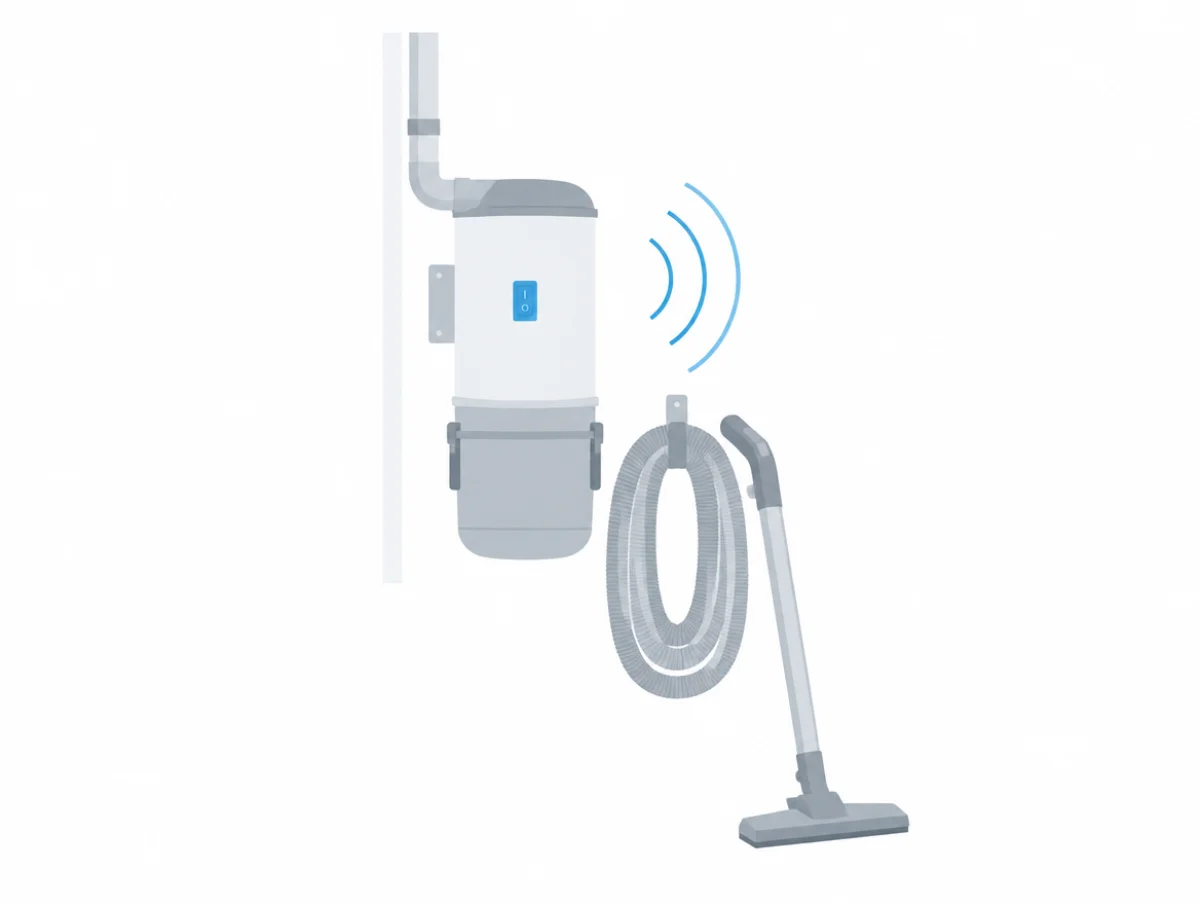
A central vacuum's power unit hangs in a garage, basement or utility room, so a sound that reaches the living room usually means a straining motor or vibration travelling along the pipes. Drainvac's tips for a quiet central vacuum name both.
Beyond that page, makers say little about sound. Of the six whose troubleshooting pages and manuals load today (Drainvac, Cana-Vac, VACUFLO, BEAM, VacuMaid and Hide-A-Hose), only Drainvac and Cana-Vac tie a symptom to a sound. Not one names a high pitched whine, bearing noise, grinding or clicking. Where a sound has no maker explanation, this page says so. We did not run, open or measure any central vacuum for it.
Why is my central vacuum so loud?
A central vacuum gets louder when its motor fights a restriction. Drainvac's article is the only maker page that says a restriction makes a unit louder: "Obstructions or accumulated dust can force the motor to work harder, which increases noise."
The same article asks owners to "Clean or replace filters regularly and check that the ducts are clear." VacuMaid's FAQ sets a limit for the canister: "Do not allow the dirt canister to become more than 3/4 full." A starved motor also runs hot, and the Drainvac Compact Automatik manual warns that "Lack of air flow will cause the motor to overheat."
Placement matters as well, because "it is the motor that produces the most sound." BEAM's troubleshooting FAQ also puts its units in the basement or garage partly for "less noise".
For a sound inside a wall, one maker sentence fits: "Poor mounting of the ducts or supports can cause vibrations throughout the house." Drainvac's cure is pipes held with suitable clamps and a unit fixed properly to the wall.
Why is my central vacuum making a high pitched noise?
No central vacuum maker we found describes a high pitched noise or a whine, or says what causes one.
What makers do list are things that choke airflow. Treat them as checks before a service call, not as a diagnosis of the sound:
- Close every inlet not in use, since Cana-Vac's troubleshooting page lists an "Open vacuum inlet".
- Use one hose at a time, because VacuMaid's chart includes "Another Wall Inlet Door Open".
- Check the outdoor exhaust, which Cana-Vac lists as "Exhaust line is clogged" and VacuMaid as "Outside Exhaust Blocked".
- Clean the screen that guards the motor, the "Blower Protection Screen" in VacuMaid's chart.
- Look in the 90° elbow behind each inlet valve, where the VACUFLO FAQ says a blockage "will usually not make it past".
BEAM's tissue test finds a clogged line without tools. With the unit switched on manually, start at the wall valve nearest the unit, "open the door to the wall valve and let a tissue be sucked from your hand." If the tissue fails to reach the dirt receptacle from a valve, "there might be a blockage of some degree" there.
Cana-Vac ties a hiss to an air leak
Cana-Vac is the one maker that gives hissing a cause. After asking owners to check that "no air leaks occur" at each connection, its owner's manual 070580 goes on: "If one is present, you may hear a 'hissing' sound. Correct if present."
Every inlet valve gets the same check. Other makers describe leaks with no sound attached. A loose dirt canister gasket "will allow a vacuum leak" in VacuMaid's owners manual, and VACUFLO lists a canister that "may not be properly seated to the gasket" as a cause of low suction.
For the pipes, Drainvac's article on power loss tests each inlet, nearest first: "As you move further away from the unit, you should find where the air is lost." Whistling appears in none of these documents.
A short buzz at start-up can be normal
Exactly one manual calls a start-up buzz normal, and only for its own product. The Doc IT ALL and Doc IT IN manual, MOD-10102 from Canavac Systems, says an electronic motor starting feature makes "A short duration buzz when the motor is first started", lasting 1 to 2 seconds, which "is normal for this product."
That covers the Doc IT ALL hose cabinet and nothing else. A buzz from another brand, or a longer one, has no published explanation. The manual's "motor noise" that trips arc fault breakers is electrical, not sound.
Why won't my central vacuum turn off?
A central vacuum that keeps running after the hose comes out usually has a stuck inlet switch, a shorted low voltage wire or a stuck relay, the three causes on VacuMaid's FAQ.
After checking that no hose sits in another inlet, the makers share one test: pull the low voltage wires off the unit while it runs. Cana-Vac's verdict if it stops: "there's a faulty low voltage wire." If it keeps running, BEAM's answer is that "the relay in the pc board is faulty and the entire pc board needs to be replaced", and Drainvac's manual reaches the same conclusion about its printed circuit.
None of them mentions a relay that clicks, so a click is left unexplained. VacuMaid adds that checking the wiring inside the power unit "should only be attempted by a qualified service technician."
Brushes, black dust and a motor that cuts out
Central vacuum motors run on carbon brushes that wear away, and makers describe worn brushes through tripping and carbon dust rather than any sound. Cana-Vac's owner's manual wants them replaced "before they are completely worn out."
| Maker | What it prints about brushes |
|---|---|
| Drainvac | Inspect after 500 hours of use, about every 5 to 7 years in a home |
| Cana-Vac | Unit and motors inspected by a service center every 5 to 6 years |
| VacuMaid | Many brushes need replacing after about 700 to 1,500 hours; inspection every 4 to 6 years |
| VACUFLO | A circuit protector that keeps tripping may mean worn brushes |
VACUFLO explains the dark film on the pipe beside the unit: "The black film is carbon dust that is caused by the wearing down of the motor brushes."
Bearings get one line, and the answer is no oil. "The motor bearings are lubricated and sealed at the factory and do not require oiling," per the VacuMaid FAQ, and Cana-Vac and BEAM also say no lubrication is needed. Nobody describes bearing noise.
A unit that stops mid-clean may simply be hot. Let it rest. After roughly an hour or more of running, VACUFLO asks owners to "let the unit cool down for 5-10 minutes and try again", and VacuMaid's thermal switch can need "approximately 10 minutes to cool before resetting." Keep the top of the unit clear, as the VACUFLO operating manual and the VacuMaid FAQ both ask.
Mufflers and an outdoor exhaust
Makers offer one add-on for a quieter unit: a muffler on the exhaust port. On Drainvac's tips page it "acts like a filter for the motor and airflow noise", and Cana-Vac's 070580 manual puts it as "For additional noise reduction a muffler can be installed to this port."
Cana-Vac adds that "The exhaust can be routed outside as an option", following building codes. A blocked outdoor vent then shows up in VacuMaid's chart under both low and no airflow. How much venting outside changes a rating is a figure nobody prints, as our guide's section on outdoor exhausts and ratings sets out.
When to call a service center
Call for service when a unit trips or overheats again after a reset. VacuMaid's rule: "If the breaker or reset trips again, or the unit repeatedly overheats, stop using the system and contact VacuMaid or a qualified service professional."
Cana-Vac draws the line at a unit that restarts and then "automatically shuts off shortly after", and wants brushes replaced by an authorized service center to keep the warranty. VacuMaid warns that "Tampering in any way with the motor blower will invalidate your warranty." Hide-A-Hose's owner's manual troubleshoots only a unit that will not turn on and a hose that will not stay in the wall.
Related guides and explainers
Makers rate working units from the four brands in our quietest central vacuums guide at 58 to 78 dB, and none prints a level that signals a fault. Only VACUFLO names a distance, 6 feet, for the figures behind which central vacuum is the quietest. Portable machines are ranked on the quietest vacuums and quietest canister vacuums pages.
Portable machines have their own sounds on vacuum noises. A clogged shop vac filter strains a motor the same way, as making a shop vac quieter shows, and why your appliance got louder and our quiet basement page cover wear and the room the unit lives in.