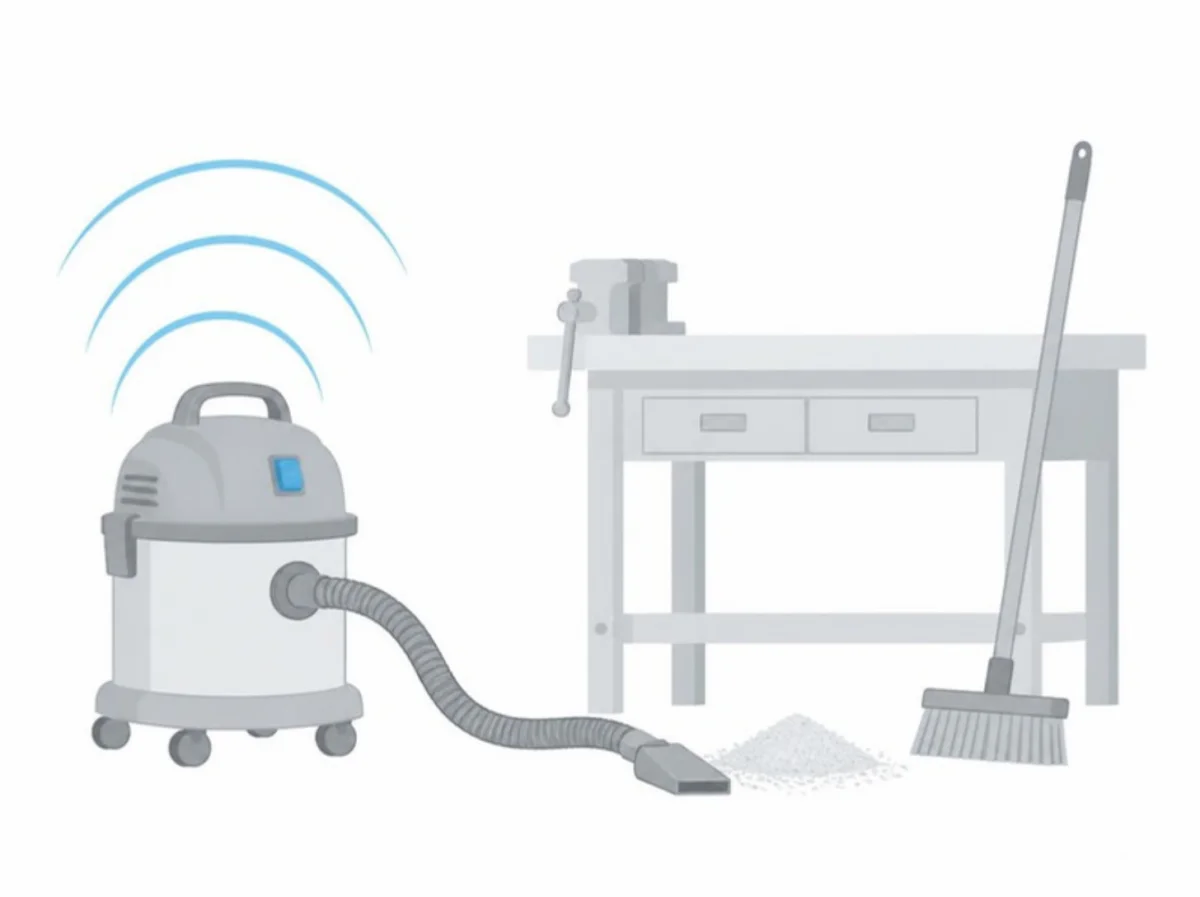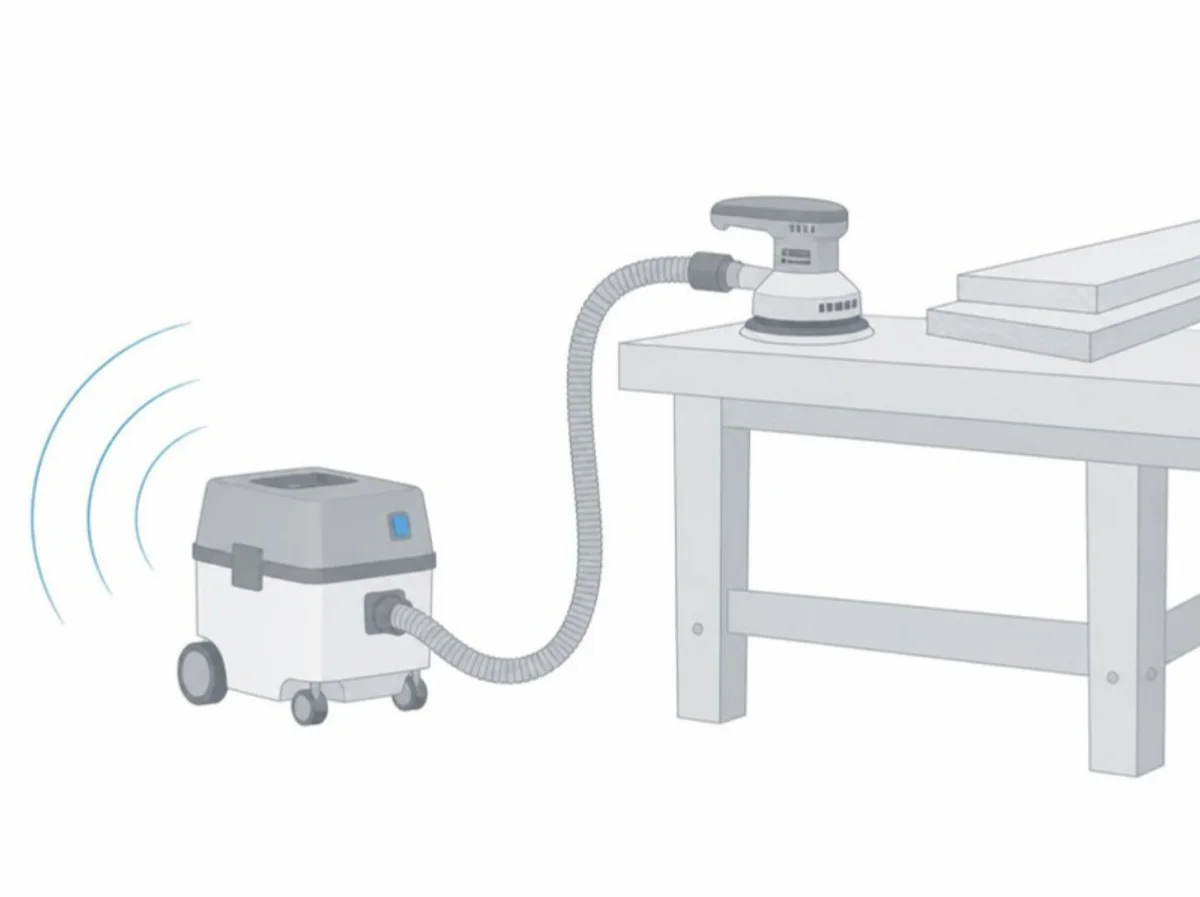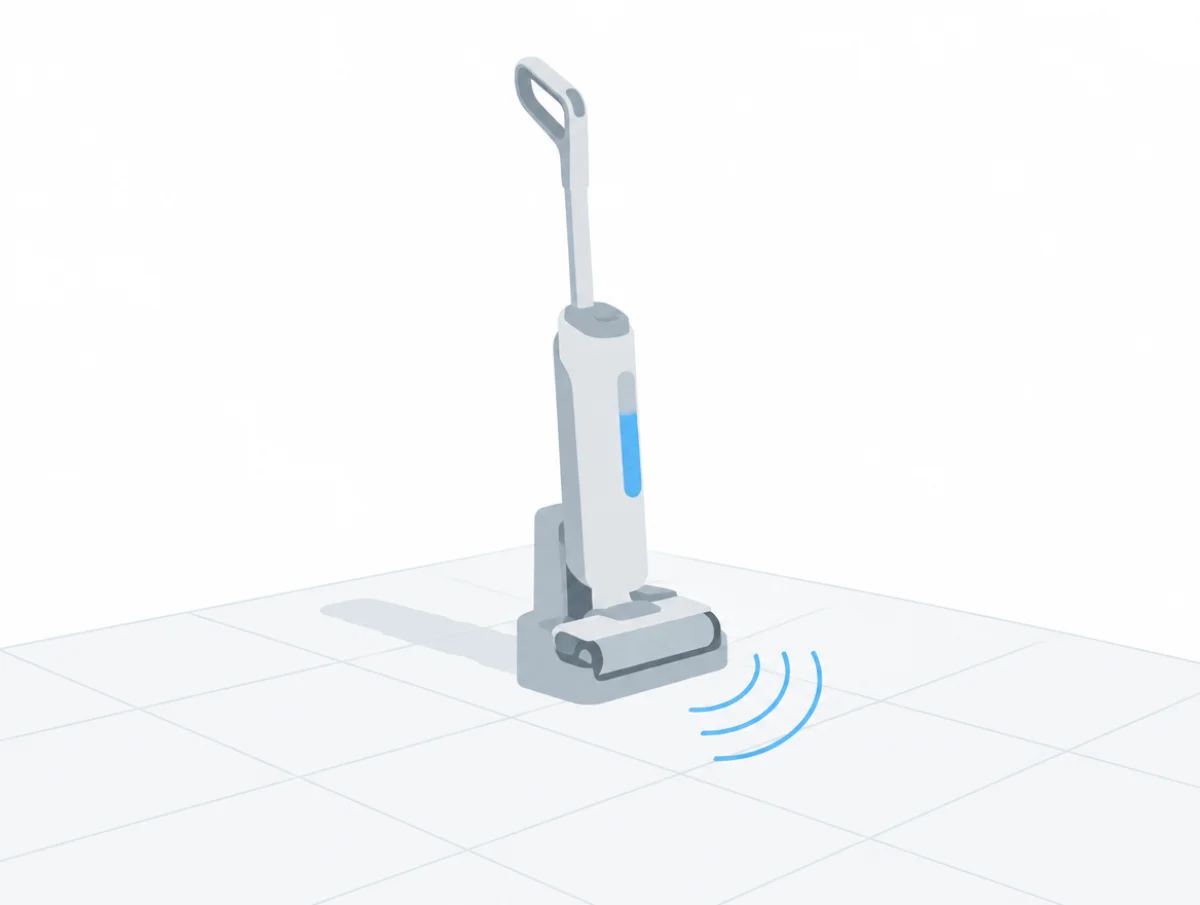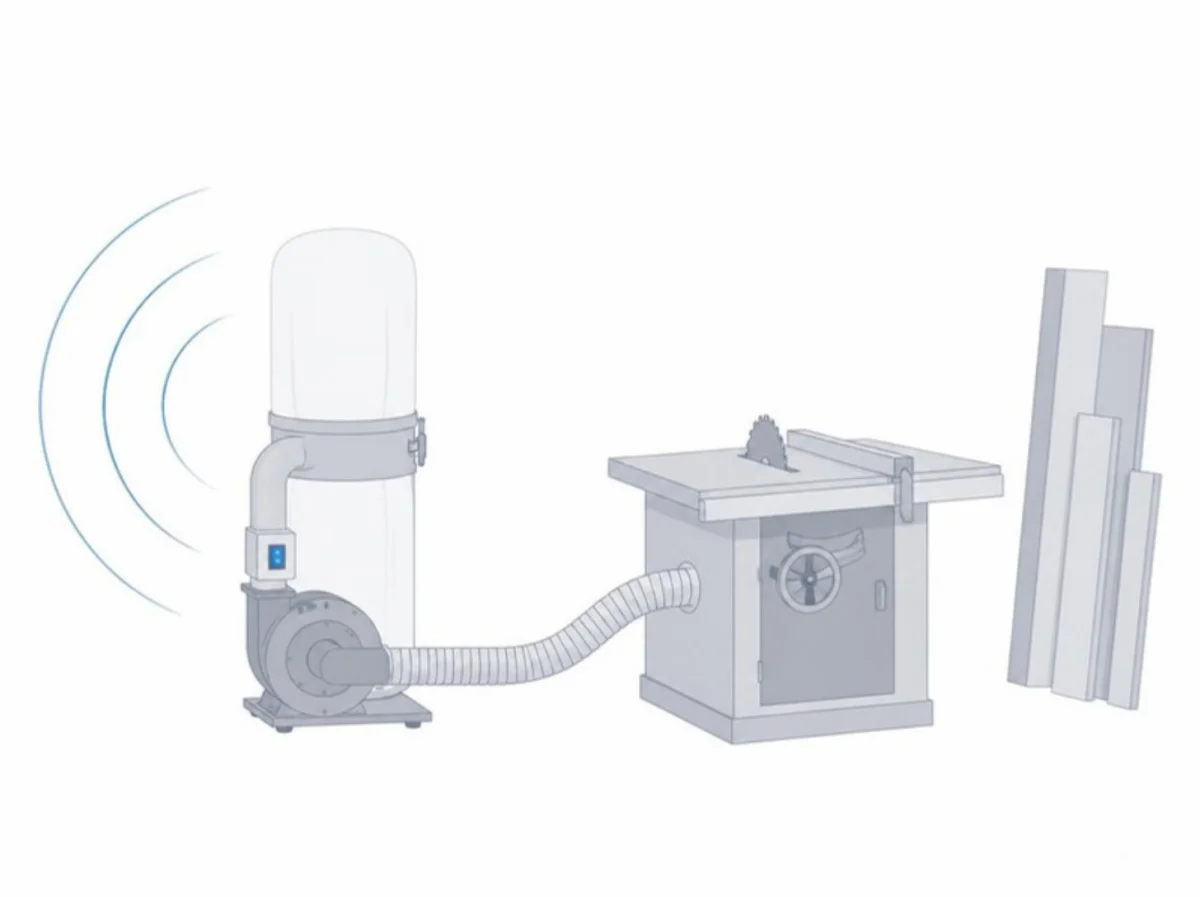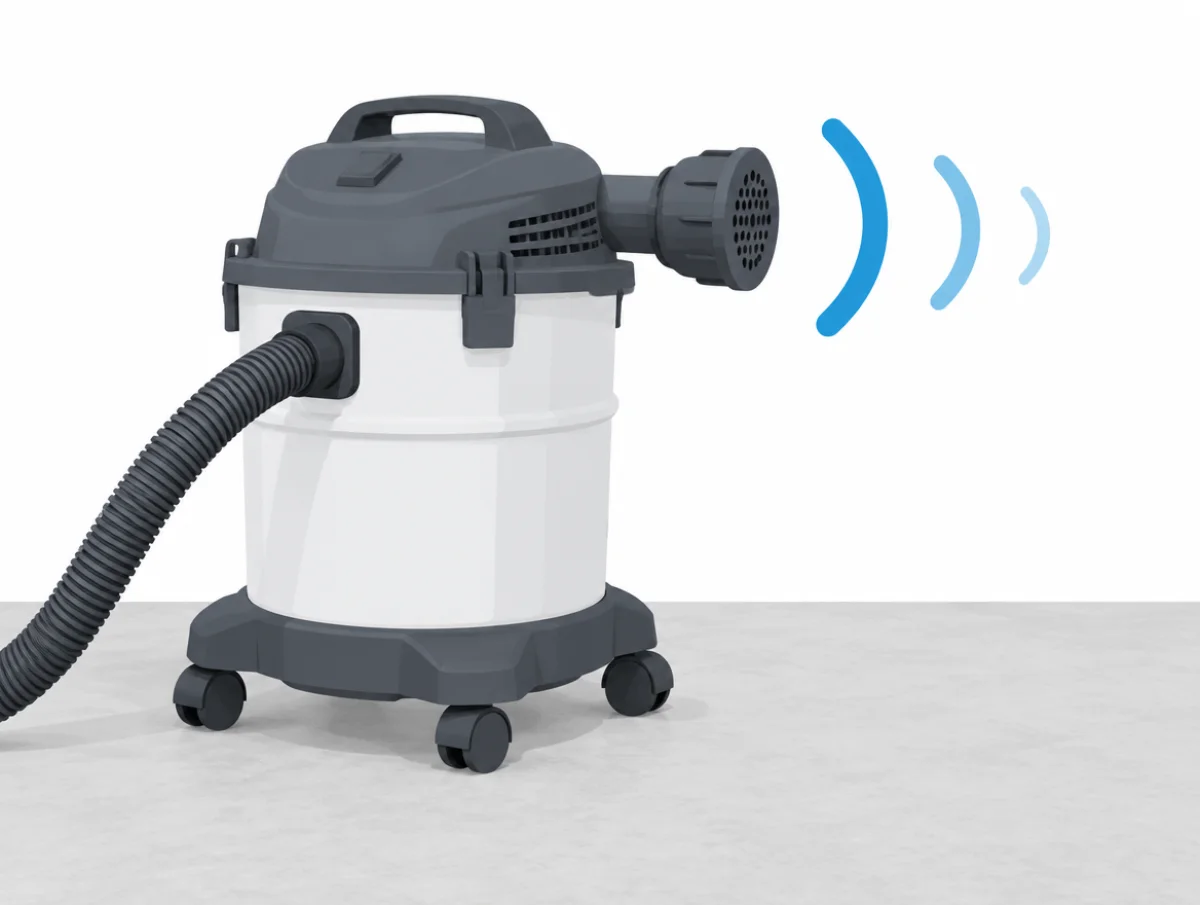
Craftsman makes a muffler for the blower port of its wet dry vacs. The 2-1/2 inch diffuser "connects to a blowing port to suppress motor noise without reducing suction power", and Vacmaster ships a similar part in the box with its Beast series. Both makers treat much of a shop vac's noise as something that leaves with the exhaust air, and that is the one direct fix either offers.
Almost everything else in the manuals is about keeping air moving freely, because a choked vac speeds up and screams. That rule also explains the sound owners worry about most. A sudden high pitched whine usually means the airflow has stopped, most often because the float has shut off a full tank.
The steps below draw on manuals, accessory pages and troubleshooting tables from Shop-Vac, Craftsman, Ridgid, Vacmaster, Milwaukee, DEWALT, Bosch, Festool and Makita.
The noise leaves through the blower port
The motor and the exhaust air it pushes out make most of the racket, and the noise fixes Craftsman and Vacmaster sell both fit the port where that air leaves.
Craftsman describes its muffler diffuser as "designed to reduce the operation noise of a wet/dry vac", a fitting for the exhaust stream. How hard the motor works sets the rest. Ridgid's WD12701 manual links a rise in pitch to "increased motor speed" when airflow stops, so anything that chokes the air path changes the sound as well.
Does a muffler or diffuser make a shop vac quieter?
Craftsman and Vacmaster say it does, and both sell one for that purpose. Neither puts a number on it.
The Craftsman CMXZVBE38660 "helps reduce air noise for quieter operation" and fits its vacs with a 2-1/2 inch blowing port. It also spreads the airstream "to reduce blowing debris and dust", which is a second reason to fit one in a dusty shop. Vacmaster includes an Air/Noise Diffuser with its VJH1211PF, and the operator's manual is direct about its job: "For quiet operation, install the noise diffuser into the blower port", then twist it clockwise to lock.
Shop-Vac sells a replacement blower port diffuser "with tether and foam" for most of its vacs, though the listing makes no noise claim. Ridgid's accessory pages refused our automated requests, so any Ridgid diffuser is missing here.
None of these makers prints a decibel figure for a diffuser. How much quieter one makes a vac is unknown.
Take the diffuser off before using the blower
The blower port becomes the outlet for the blowing hose, so the diffuser has to come out first. Vacmaster's blower steps start with "Remove noise diffuser from blower port".
Check the size before buying an aftermarket part. Craftsman and Vacmaster fit their diffusers to their own ports, and the Craftsman part names the 2-1/2 inch port size.
Why is my shop vac making a high pitched noise?
It has probably lost its airflow. A full tank lifts the float, the float seals the motor intake, and the motor whines; Shop-Vac, Milwaukee and DEWALT all describe the same chain.
Once the float seats on the Ultra Quiet model, "the motor will develop a higher than normal pitch noise and the suction is drastically reduced. If this occurs, turn unit off immediately." That is from the Shop-Vac 12 gallon manual, and Milwaukee's 0910-20 manual uses almost the same words. On the DEWALT DWV010, the sound "will change at once" when the ball float blocks the air, and the manual is plain about the response: "When the motor has a high pitched sound and air/water flow stops, empty the canister."
Ignoring it is expensive. Running on after the float rises "will result in extensive damage to the motor," Shop-Vac warns. Ridgid's version is shorter: "do not run motor with float in raised position."
Whining with a tank that is not full
Floats can close early. A Milwaukee vac that has tipped over "could lose suction", and once it is set upright "The float will return to its normal position." The 4 gallon manual asks owners to "Be sure that the float is clean and moves freely in the float cage to ensure that the float valve works," and to clean the tank and accessories "more often when used to pick up wet, sticky materials."
If the float moves freely, look for a blockage. Vacmaster's troubleshooting table lists "Reduced efficiency and motor speed vibration" with two causes, a blockage in "the nozzle or hose or the collection tank inlet" and a cartridge filter "clogged by fine dust".
A clogged filter strains the motor
Weak suction, a motor that runs hot and, in Vacmaster's table, motor speed vibration. Those are the symptoms the makers tie to a clogged filter, although none of them goes as far as calling the vac louder.
"Suction weakens or cleaner runs hot" heads the Shop-Vac troubleshooting list with a clogged filter first, and the fix is "Brush dirt from filter. If condition continues, change filter." Ridgid's filter "should be cleaned often to maintain peak Vac performance."
Wet filters clog fastest. Used on dry material, a wet Ridgid filter "will clog quickly and be very difficult to clean", and Festool's CT manual agrees that "A moist main filter clogs more quickly when extracting dry materials."
Loud bursts from a dust extractor are filter cleaning
The makers expect them. The DEWALT DWV010 cleans one of its two filters "Every 30 seconds," and its troubleshooting table tells owners to "Listen for the solenoid clicking" to confirm the cleaning works. Bosch's VAC090 manual cautions that "The sound of the filter cleaning system may surprise those near the work area," and asks users to warn people nearby first.
Makita goes further and blocks the hose on purpose. Its VC4210L manual has you close the opening with your palm and "let the machine operate at full speed for approx. 10 seconds" to clean the filter. That brief scream is part of the routine.
Hose whistles and air leaks
Whistle is not a word that appears in any of these manuals. The closest guidance is about air leaks, which weaken suction and point you at every fitting, the tank cover and the hose itself.
The Shop-Vac manual asks you to "Check all fittings for tight fit (nozzles, hose, etc.)" and "Check that tank cover is sealed properly." Its troubleshooting page lists a "Loose hose connection" and a "Hole in hose" under loss of suction, fixed by tightening the connection or replacing the hose.
A nozzle sealed flat against a smooth floor chokes the air too. Festool fits its CT hoses with a sleeve whose "bypass function" it says "prevents strong suction from sanding machines and floor nozzles on smooth surfaces." Festool presents it as suction control, not a noise fix. Cord reel noise, for the record, is not covered anywhere in these documents.
Running without a filter can wreck the impeller
Ridgid is the only one here to name the impeller. Dry debris that gets past a missing or torn filter "may damage the motor or be exhausted into the air," and the manual is clear about prevention: "To avoid damage to the blower wheel and motor, always reinstall the filter before using the Vac for dry material pick-up." The filter may come out only for picking up large amounts of liquid. The filter cage and float stay in regardless, "as they prevent liquid from entering the impeller and damaging the motor."
What a damaged impeller sounds like goes undescribed, and none of the manuals treats it as an owner repair. A grinding or rattling motor after debris got through belongs with the service steps further down.
Lower power settings have no published figure
Some vacs have a lower setting. Milwaukee's 0910-20 has Speed One (I) for "max run-time mode" and Speed Two (II) for "max power mode", and Festool's CT extractors adjust suction with plus and minus buttons. Neither says the lower setting is quieter.
Bosch gives its 70 dB figure with the Power Broker dial at maximum, as our quiet shop vac guide notes, and prints nothing for lower dial positions. The one mode-specific figure in that guide is Metabo HPT's 62 dB in Standard Mode, taken with nothing being vacuumed.
How loud is a shop vac?
Between 60 and 74 dB(A) as sound pressure, on the figures published by the shop vac and dust extractor makers in our guide, from Makita's VC4210L at the low end to Karcher's wet dry vacs at the top. Milwaukee publishes 87 dB(A), but as sound power.
Most of those figures arrive with no distance or test condition. Festool alone names a standard, EN 60335-2-69, for its 71 dB(A). Shop-Vac's Ultra Quiet 12 gallon carries a relative claim instead, "Runs up to 60% quieter than standard models", with no decibel figure behind it.
Sound power and sound pressure cannot be ranked together, as sound power vs sound pressure explains, and the decibel chart sets these numbers beside everyday sounds.
Stop signs that mean service
Abnormal motor noise, lost suction, and debris or liquid coming out of the exhaust. Ridgid lists all three and wants the vac switched off the moment you notice them: "loss of suction, debris/liquid exiting the exhaust, or abnormal motor noises. Immediately stop using Vac if you notice these signs." The same reasoning is behind its rule against leaving a running vac unattended.
Milwaukee asks owners to inspect for "undue noise, misalignment or binding of moving parts, breakage of parts" and to send the tool to a Milwaukee service facility for repair. A Shop-Vac that will not start may have a "Defective switch or defective motor", and the listed action is "Contact Customer Service."
Some shutdowns are protective. The DWV010 switches itself off through a thermal overload; empty the canister, let it cool and try again, then call DEWALT if it will not restart. On the Makita, a dust-clogged cooling air filter can trip the motor's overload switch, so the manual asks you to "Clean the cooling air diffusor regularly."
Do you need hearing protection with a shop vac?
Yes. "Exposure to noise can cause hearing loss," warns the Milwaukee 0910-20 manual, and DEWALT's DWV010 manual names the ANSI S12.6 (S3.19) standard for the hearing protection it wants worn. Ridgid's warning is tied to the blower: "To reduce the risk of hearing damage, wear ear protectors when using the Vac/Blower for extended time or in a noisy area."
Fitting a diffuser or buying a quieter model changes none of these instructions.
A shop vac rarely runs alone, either. It is usually beside a saw or a sander, and how those combined levels compare with workplace exposure limits is covered in power tool noise and hearing.
When a quieter shop vac is the better fix
If yours has a diffuser fitted, a clean dry filter and sealed fittings, and it still drowns out the shop, the design is the limit. Maintenance stops extra noise; it cannot take the machine below where it was built to run.
The lowest figures in our quietest shop vacs guide belong to dust extractors, the tool-triggered machines with HEPA filters, and the quietest dust extractors sorts more of them by declared figure. DEWALT's StealthSonic quiet vac is absent because it was not listed on DEWALT's site, and retailer copies of maker manuals are not cited. For floors rather than workshop debris, see the quietest wet dry floor cleaners.
The rest of the shop is covered in the quiet workshop guide, and how to make an air compressor quieter does the same job for the other machine humming in the background.