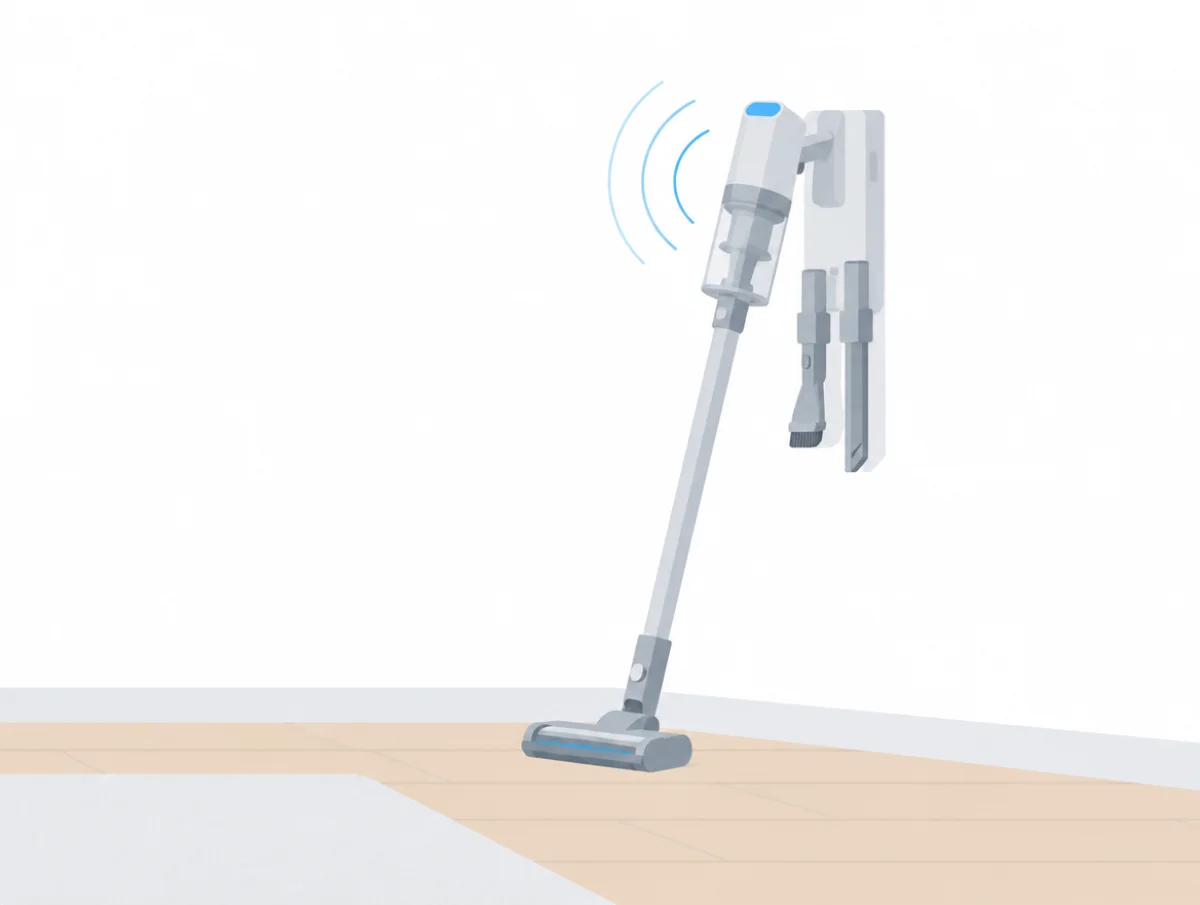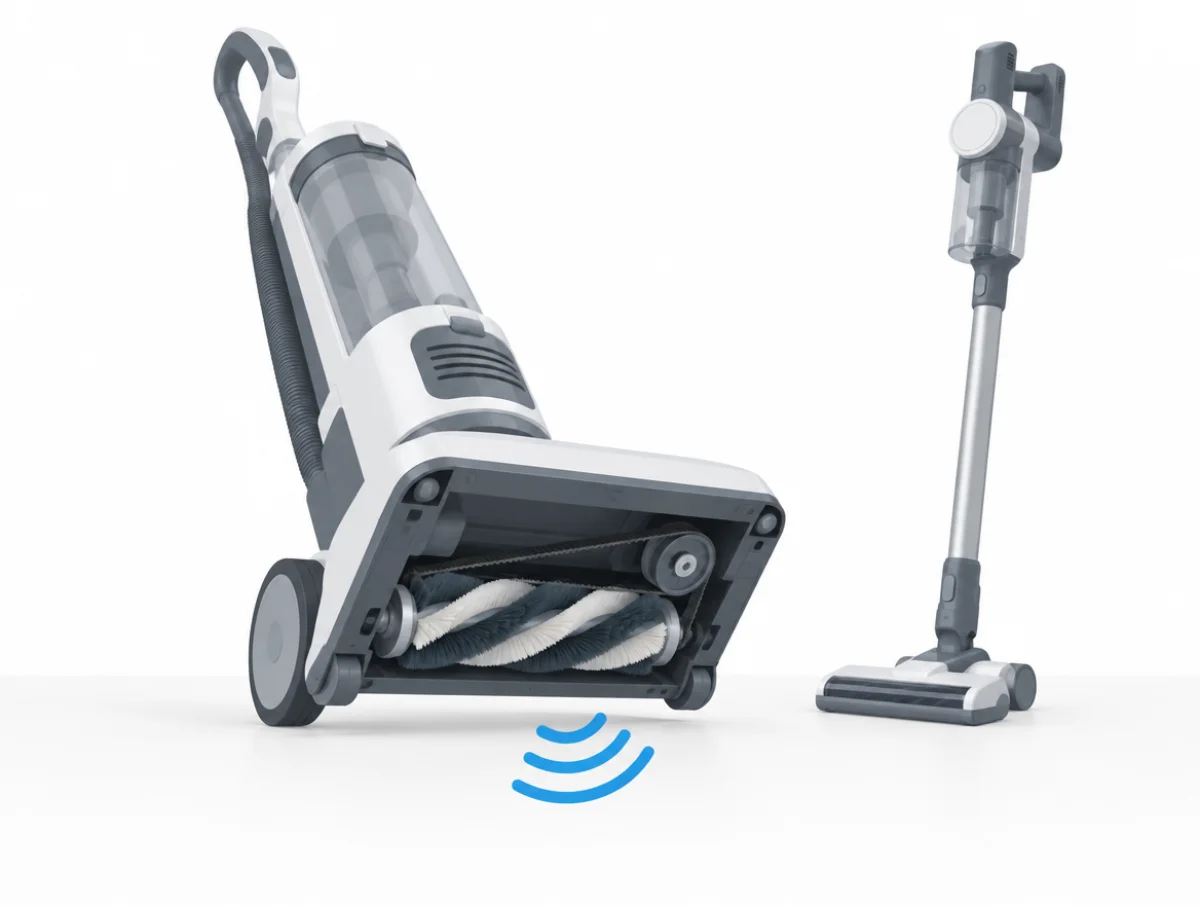
Listen for the pitch. When a vacuum suddenly goes shrill, it is almost always short of air, and on Bissell's Pet Hair Eraser Lift-Off you can even see why: a vent by the cord slides inward and makes "a higher pitched noise" when there is a clog or the filters are dirty. Grinding sends you to the brush roll, a hot rubber smell to the belt. A motor that roars and then stops has usually overheated behind a blockage.
That short list covers nearly everything Dyson, Shark, Hoover, Bissell, Miele, Kenmore and Tineco describe in their manuals and help pages. Airflow and the brush roll account for most of it.
This page covers upright, canister and stick vacuums, plugged in or cordless. Robot vacuums make their own sounds, the self-empty dock above all, and those have a page on robot vacuum noises. Where only one brand covers a sound, the section says so; sounds no brand covers are left off.
Some change in sound is built in
Kenmore designed its BU1005 upright to sound different when airflow drops. A by-pass valve opens to feed cooling air to the motor, and "You will notice a change of sound as air rushes through the valve opening."
That valve can open in normal use too, "when using attachments or when cleaning new carpet," according to the BU1005 guide, because tools restrict the airflow and lint from new carpet fills the bag quickly. A new bag fixes it, or opening the suction control while you use the tools. The guide also warns: "Do not block By-Pass Valve."
Shark's FAQ for the Spectra UV204 upright makes the same point about tools, "Attachments do restrict the air flow", and adds that suction falls as the HEPA or cloth filter fills. A vacuum that sounds different with the crevice tool on is behaving as designed.
Why is my vacuum making a high pitched noise?
It is short of air. Look for a clog in the hose or head, or a filter caked with dust.
Bissell describes the sound best. On the Lift-Off, "the circle vent right by the cord will slide inward triggering a higher pitched noise if there is a clog or dirty filters." Its page for PowerForce and PowerGroom bagged uprights explains why it is worth acting on: "Dirty filters could damage the motor and cause it to sound loud."
Hoover's FAQ gives an order for a bagless upright. Unplug it and empty the dirt cup. Then "check the elbow pipe for clogs", rinse or replace a dirty filter, and stretch the hose out to look for anything stuck inside. A rinsed filter needs to dry "for at least 24 hours" before it goes back in.
Seals count too. For noise from the dustbin of a PURE ONE S12, Tineco has owners clean the bin and filters and "Make sure all gaskets are in right place."
Grinding starts at the brush roll
Hair, string or a hard object wound into the brush, or a brush roll that no longer turns freely, explains most grinding. Bissell, Tineco, Kenmore and Dyson all start at the floor head.
Unplug the vacuum, take off the brush roll access plate and pull the brush out. That is Bissell's routine, and it checks two things: "Brush should spin easily" and "Belt should be intact." If either fails, "If part is damaged, it will need to be replaced." The Lift-Off page sets a sharper test: the brush roll "should spin freely, multiple times with one flick." To be sure the brush is the source, the bagged upright page has owners run the vacuum with brush and belt removed; if the noise stops, the brush needs replacing.
On a stick, Tineco wants the power brush and tube cleared, and to "Remove the hair wrapped around the brush roller."
A hard object can get past the brush entirely. Kenmore's B200 guide lists "Sound changes" with the cause "Sharp or hard objects are stuck inside the impeller", the fan that moves the air. Switch off and shake the debris out.
Some brush rolls look after themselves. "The brush bar will automatically stop if it becomes obstructed," reads Dyson's UP20 upright manual, which asks owners to clear hair from it regularly because debris left there may damage flooring.
A burning rubber smell means the belt
On a belt driven upright, a hot rubber smell is the belt slipping or stretched. Kenmore and Hoover agree on that, and Hoover adds a clogged brushroll as a second cause.
"Replace belt whenever a burning rubber smell caused by excessive slippage occurs," the Kenmore BU1005 guide instructs, and the B200 guide adds a schedule: "REPLACE the belt every 6 months." Hoover's UH72630 manual files "Smoky/burning smell detected" under two causes, "Belt broken or stretched" and "Brushroll is clogged". A new belt goes on "with the lettering on the outside," per the Hoover FAQ.
What about a squeal? None of the manuals uses that word for a vacuum belt, so grouping a squeal with the belt is this page's reading, not a maker's. Shark covers the opposite symptom on its Spectra uprights: "The agitator will not turn on if the belt is broken or if the belt is not installed correctly."
Why is my Dyson vacuum making a pulsing noise?
Six pulses mean a blockage. Three mean the battery needs charging. Both come from Dyson's V9 Submarine and Digital Slim manuals.
"If your machine detects a blockage, the motor will pulse six times," the V9 Submarine manual explains, and the machine will not run until the blockage is cleared: "If you try to use your machine when the motor is pulsing, it will automatically cut out." Disconnect it from the charger and let it cool before you look. The pictures send owners to both ends of the wand and to the cleaner head, where the brush bar and inlet get checked.
You cannot switch the blockage pulse off. The Digital Slim manual lets owners turn off alert pulses, but "Turning off alerts will not turn off the blockage alert pulsing. This is to ensure you clear any blockages, preventing damage to your machine."
Why did my vacuum suddenly get louder?
A clog, a full bag or bin, or a clogged filter, in that rough order. Miele, Bissell, Hoover and Shark all check those three before anything else.
Miele's HS11 canister instructions name the usual culprits: "large objects block the suction wand", a FilterBag that is full "or contains particles of fine dust", and "A heavily soiled motor protection filter or exhaust filter". Bissell's Total Floors page starts with the pre-motor filter: wash it and "Let it completely air dry before placing back in the machine."
Cordless sticks add two possibilities. The motor may have switched modes, or the battery may be low, which on a Dyson brings the three pulses. On the A10 Essentials, Tineco's first step is to "Confirm if the noise comes from the main motor" or from the roller brush, because the fixes differ.
A vacuum that gets loud and then stops has overheated
Air stops reaching the motor, the motor heats up, and a thermal protector cuts it. "When the thermal protector activates the cleaner will stop running," as Hoover's UH72630 manual puts it, and Kenmore's BU1005 guide says the protector trips "If a clog prevents the normal flow of air to the motor." Every maker resets it the same way: unplug, clear the clog and filters, and wait.
How long to wait is where they part company:
| Vacuum | Cool-down before restarting |
|---|---|
| Miele HS11 canister | approximately 20 to 30 minutes |
| Hoover UH72630 upright | 30 minutes |
| Kenmore BU1005 upright | approximately 50 minutes |
| Shark Spectra UV204 upright | approximately 1 hour |
| Dyson UP20 upright | 1 to 2 hours before checking |
The UP20 "is fitted with an automatically resetting thermal cut-out," and "If any part becomes blocked the machine may overheat and automatically cut-out." Shark's Spectra FAQ has owners empty the dust cup, clean its filter and "Allow the unit to cool for approximately 1 hour." Shark's own site refused automated requests, so that FAQ is quoted from the Internet Archive's August 2025 copy.
Kenmore names one habit that trips it: "Always return the vacuum cleaner to the upright position before using the hose and attachments." Skip that and the agitator motors can overheat.
Cordless sticks have their own version. A blinking indicator on Tineco's PURE ONE S12 marks an overheating battery, and the instruction is to "Cool down and check the device in order to avoid overheating."
Noises that mean stop and get service
If the noise survives a clean of the clog, filters, brush and belt, Kenmore's rule applies. Its B200 guide is the most direct of the lot: "If at any time the vacuum does not pick up properly or makes an unusual noise, STOP OPERATION and service." For a vacuum that "turns off on its own", one cause it lists is "The motor is damaged", and the remedy is Kenmore's help line.
Repeat cut-outs mean the same. "If the thermal protector continues to activate after following the above steps your cleaner needs servicing," Hoover's manual reads. Motor noise on an A10 Essentials goes to Tineco with "Please contact Tineco customer service." The Bissell Total Floors page ends: "If the vacuum continues to have a loud noise > Contact Us for more assistance."
Two safety rules apply while you look. Dyson and Hoover both want the vacuum unplugged or disconnected before you search for a blockage, and Tineco adds: "Unless prompted to do so, do not press the trigger when checking any part of the machine."
How loud is a normal vacuum?
Somewhere around 58 to 87 dB in the figures makers print, though the brands measure different things and most print nothing at all.
SEBO lists 58 to 69 dBA for its household canisters and uprights on our SEBO decibel page. Miele prints 73 to 79 dB across its US canisters and sticks without naming a mode, collected in our Miele vacuum chart. Tineco gives the A30S 67.1 dB, per our Tineco vacuum page. The four Dyson sticks on our Dyson decibel page run 82 to 87 dBA, but that is sound power, which cannot be set beside the sound pressure most other brands appear to print. Our primer on sound power and sound pressure shows why the two scales cannot be mixed.
No rating describes a fault. A vacuum louder than its figure usually has one of the problems above, and why your appliance got louder covers the general pattern. The decibel chart puts vacuum levels beside everyday sounds.
Quieter vacuums and related guides
If a clean, unblocked vacuum is still too loud for your home, a model with a lower published figure is the remaining fix. Our guides rank models one measurement basis at a time.
Start with the quietest vacuum cleaners, then the quietest cordless stick vacuums, quietest canister vacuums and quietest handheld vacuums. Robots have the quietest robot vacuums and the page on robot vacuum noises.
The fixes above come from Dyson, Hoover, Miele and Kenmore manuals and from Bissell, Tineco, Hoover and Shark support pages, read on November 10, 2026. Dyson's own pulsing article sits on a regional support site that refused our requests, so the pulse details come from its US manuals instead.