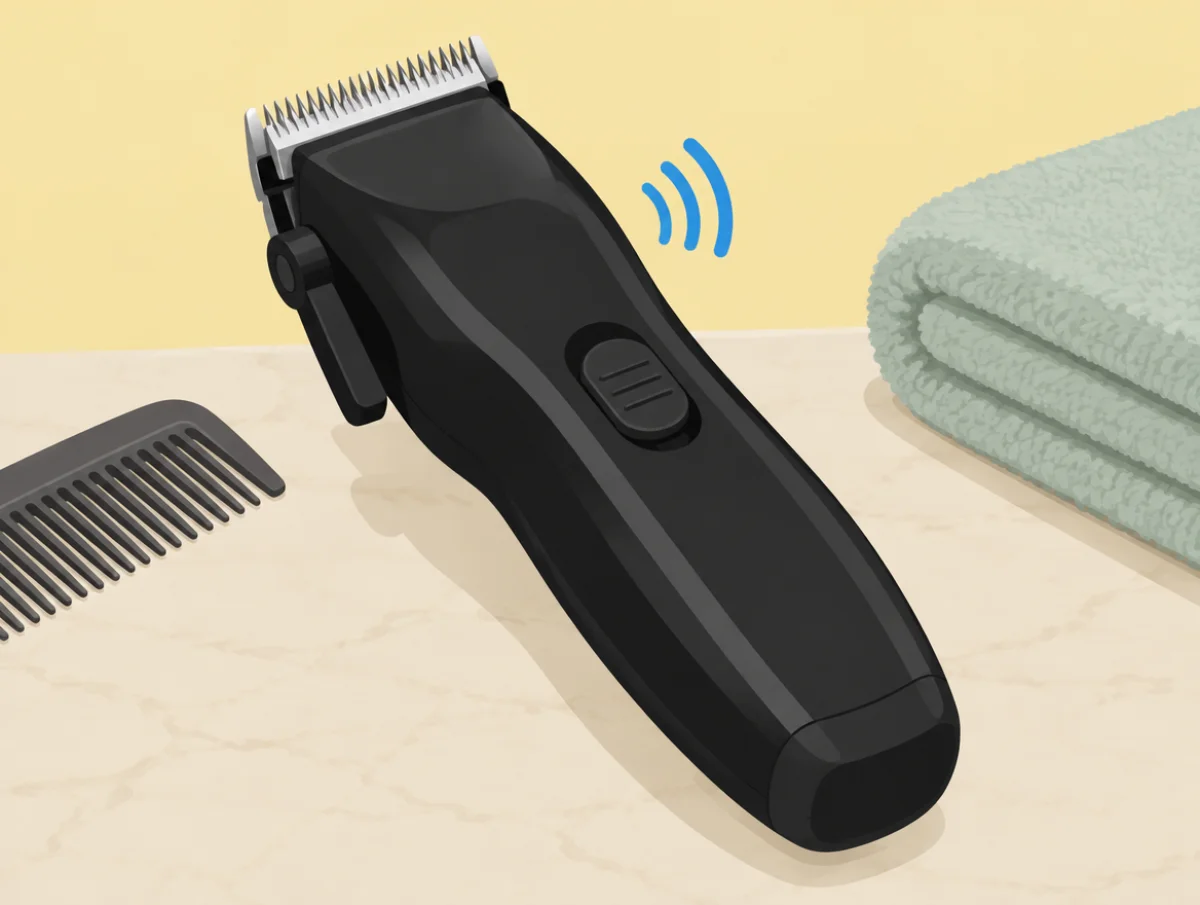
Hair clippers have three families of noise worth telling apart. A corded magnetic clipper hums the whole time it runs and starts to clatter when its power screw drifts out of tune. A blade that is dry, clogged or seated badly gets louder on any clipper. And a cordless one running out of charge can slow down and change pitch.
Everything below comes from support pages, manuals and instruction booklets by Wahl, Andis, Philips Norelco, BaBylissPRO, Panasonic and Conair, all read on November 16, 2026. Oster's US site showed a bot check that day, and Remington's US manual library listed battery data sheets but no clipper manuals, so neither brand is quoted. JRL, StyleCraft and Gamma+ were not checked.
| Sound | Cause a maker names | First step |
|---|---|---|
| Clatter for a moment at switch-on | Normal (Andis) | Nothing |
| Steady clatter or rattle, corded magnetic clipper | Power screw out of tune for your voltage (Wahl, Andis) | Oil, then retune the screw |
| Loud clunking | Clipper not tuned, so not at full power (Wahl) | Retune the screw |
| Louder than it used to be | Dry blade (Panasonic) | Oil the blade |
| Strange noise after cleaning | Cutter or attachment not seated (Philips, Panasonic) | Take it off and refit it |
| Slowing down or leaving streaks | Blades need oil (Andis), packed-in hair (Conair, BaBylissPRO) | Oil; clear the hair |
| Sounds different on battery | Low charge (Philips, Panasonic) | Charge it |
| LED flashes 5 times, will not start | Too much load on the blade (Wahl Magic Clip) | Clean, oil, plug in to reset |
| Abnormal sound with heat or a burning smell | Malfunction (Panasonic) | Stop and send for repair |
Why does a hair clipper buzz and rattle?
A magnetic hair clipper buzzes whenever it runs, and Andis still sells its Master on "Cool, quiet operation." The fault is a clatter on top of that hum, which Wahl and Andis both trace to the power screw.
Andis draws the line clearly in the Master manual. A clatter "for an instant when initially turned on" is normal. One that carries on, or starts when the blade meets hair, means "the power adjustment is off."
Wahl takes the same view of a clunk. Asked whether a loudly clunking clipper is broken, its help center answers "No, the unit is not broken. Rather, it is not properly tuned and as such it is not operating at maximum power."
Not every clipper has a screw to turn. The Wahl Pro blog files its tuning steps under a "vibrator clipper," and the Andis product page lists the Master's motor type as magnetic. Three cordless manuals checked for this page, the Wahl Magic Clip, the Andis Master Cordless and the BaBylissPRO FX870, have no power screw section at all. On those, start with oil, hair and charge.
Tuning the power screw on a magnetic clipper
The power screw is a small screw in the side of a magnetic clipper that Wahl and Andis both set at the factory. Either maker says household voltage can push it out of adjustment, and a clatter is the symptom.
On its Power Screw page, Wahl is direct: "The power screw was adjusted for peak efficiency before leaving the factory." It adds that "if voltage in your home is too high or low; the clipper power screw may need adjustment." Andis says its clipper "has been adjusted to line voltage at the factory" and that voltage variations may call for a new setting "for your area."
Find the screw first. Wahl places it on the right-hand side of the clipper. On the Andis Master it sits "in the lower part of the housing opposite the switch." Wahl says the end of the cleaning brush or a screwdriver will turn it, and its Pro blog reaches for a Phillips screwdriver. Andis asks for a screwdriver. Oil the blades before you start: it is step one in the Andis manual, and Wahl's tuning page oils first too, with "three drops on front of each blade and one drop on each side."
Six versions of the same routine
The Andis manual and Wahl's help pages keep the clipper switched on throughout, and every version agrees on direction: clockwise brings the clatter in, counterclockwise takes it away. Where they differ is how far past quiet to go.
| Source | First turn | Where to stop |
|---|---|---|
| Andis Master manual | Clockwise until it "clatters continuously" | Counterclockwise "carefully until the clatter ceases" |
| Wahl maintenance guide | Clockwise until the arm hits the coil | Counterclockwise until quiet, then 1/8 to 1/4 turn more |
| Wahl help center, Power Screw | Clockwise until you hear a noise | Counterclockwise until quiet, then 1/4 turn more |
| Wahl Pro blog | Clockwise until it makes a loud noise | A half turn counterclockwise |
| Wahl help center, tuning issues | Counterclockwise only | When the clatter goes away |
| Wahl FAQs USA | Counterclockwise | Normal running noise, then a further quarter turn |
The Wahl maintenance guide explains what you hear when the screw goes in too far: a noise "caused by the arm hitting the coil." Backing out past silence is what Wahl calls "maximum power," and the Pro blog says a clipper that is noisy, or one that runs while the blades sit still, "may simply be out of tune."
Andis stops sooner, right where the clatter ceases, and calls that the "optimum power setting." Use the steps printed for your own model. If the Wahl FAQ routine still leaves the clipper sounding wrong, Wahl asks you to contact it directly.
Oil first when a clipper gets louder
Dry blades make a clipper louder. Panasonic lists "Louder sound" among the results of skipping oil in its ER-SB40 manual, beside "Shorter operating time" and a blade that "has become blunt."
The ER-SB40 troubleshooting table answers "Makes a loud sound." with two actions: "Apply oil." and "Confirm that the blade is properly attached." Wahl's maintenance guide does the same for a clipper that pulls hair, where the first cure is "clean blades and oil," and the Andis manual reads a blade that leaves streaks or slows as "a sure sign that the blades need oil."
How often each maker wants oil
The schedules disagree more than the drop counts do.
| Maker and model | How often | How much |
|---|---|---|
| Andis Master | "before, during, and after each use" | A few drops on the front and side of the blades |
| BaBylissPRO FX870 | Before and after use | A drop on the front and sides of the cutter blade |
| Conair HC7000 | Before each use | 2 drops, with the clipper running |
| Panasonic ER-SB40, ER-GB80 | Before and after each use | A drop at each marked point |
| Wahl maintenance guide | Each time the clipper is used | 5 drops across top and bottom blades |
| Wahl Magic Clip cordless | Daily | 3 drops on the top blade, the heel now and then |
| Wahl home clippers | "every few haircuts" | 3 drops on the front of each blade, 1 on each side |
| Philips, models packed with oil | Every six weeks | A few drops on the cutter teeth |
| Philips, models sold without oil | Never | None |
That last row matters for Norelco owners. Philips' strange noise page says a product sold without oil "is designed to function without additional oil and you do not need to add any."
Which oil? Here the makers part ways. Wahl's blade cleaning page says "Use only Wahl Clipper oil" and rules out "HAIR OIL, GREASE, OR ANY OIL MIXED WITH KEROSENE OR ANY SOLVENT." Philips accepts the bottle in the box "or any other sewing machine oil." Andis has a view on cans: "Spray lubricants contain insufficient oil for good lubrication, but are an excellent clipper coolant."
More is not better. The Conair HC7000 booklet warns that over-oiling "could damage the motor" and says "Never attempt to oil the motor bearing, as it is permanently lubricated." Wahl's Magic Clip sheet gives the reason to wipe up: "Oil in the motor compartment will eventually lead to poor motor performance." BaBylissPRO and Wahl both point the blades down while oiling, Andis shows a set position that keeps oil out of the motor, and all three wipe the excess off with a soft cloth.
Hair packed between the blades
Packed hair slows a clipper. Conair and BaBylissPRO clear it the same way: leave the clipper running and flick the taper lever back and forth a few times, then oil.
"Packed-in hair can slow down any clipper," the Conair HC221R booklet says, calling the lever trick what "the professionals do." BaBylissPRO's FX870 manual prints the same routine and adds that doing it every time keeps the blades free of cut hair.
Deeper cleaning is where the instructions split by product. Wahl's home clipper page says "DO NOT USE WATER TO CLEAN THE BLADES" and reaches for the brush. Philips rinses washable models, the ones with a tap or shower symbol, under water but bans soap, which "can remove the protective grease on the cutter." Andis suggests running the blades in a shallow pan of its Blade Care Plus. Wahl's Magic Clip sheet forbids dipping or soaking. Follow the manual for your model, not a neighbor's.
A clipper that will not move at all may be stuck on old oil. Wahl's battery page suggests pinching or pushing the blades by hand with the switch on, because "Oil may have dried out between the blades."
Why is my clipper slowing down?
A clipper slows when its blades are dry, packed with hair, dull or rusty, or its battery is low. On magnetic models, Wahl's maintenance guide adds retuning the power screw for blades that stall or stick.
That guide is blunt about blades. "dull blades (will pull hair)" and "rusty blades (causes sticking)" both call for "immediate replacement," and broken or bent teeth on either blade mean replacing both. Wahl's hair pulling page tries oil first and asks owners to contact Wahl if that fails.
How long should a blade last? Panasonic gives one example, about 3 years for a trimmer used 5 minutes at a time, 10 times a month. Replace it when cutting gets much worse "despite proper maintenance." For rust, Wahl's rust page prescribes cleaning, oiling and storage "in a low humidity environment."
A weak battery changes the sound
A cordless clipper or trimmer low on charge can sound wrong. Philips says such a product "may sound different than before," and Panasonic warns that a nearly flat battery can make the blades "move slowly or stop," even plugged in.
Panasonic's fix for that last case is to charge for a minute or more before using the trimmer on the cord. Each brand flags low charge differently:
- Andis Master Cordless: the light turns red
- BaBylissPRO FX870: the blue LED flashes with about 10 minutes left
- Wahl Magic Clip: the LED flashes at about 20% charge
- Panasonic ER-SB40: "LOW" blinks, with about 5 minutes of trimming left
On the Andis Master Cordless, a clipper that powers off mid-cut can take its adapter cord and carry on. Philips models running on AA cells need fresh batteries of the type the manual names, never old and new mixed.
Battery care is where the advice clashes outright. Wahl's lithium page calls it best practice "to fully drain your clipper's battery before recharging." Panasonic's ER-SB40 manual says the opposite for its lithium cell: "charging after every use will have no effect on battery life." Its ER-GB80 manual splits the difference, allowing a top-up but recommending a charge when empty. Andis lets the Master Cordless sit on its stand and asks you to unplug the stand if the clipper will be idle for seven or more days.
Wahl ties the blade to the battery, too. "A clean, well-oiled, and cool blade helps alleviate stress on your clipper," its lithium page says, and the Magic Clip will lock itself out, flashing its LED five times, when it senses too much load on the blade. Clear any debris, oil the blades and plug in the cord to reset it.
Clicks, clunks and a blade that sits wrong
None of the six makers names a click as a fault. Philips and Panasonic do name a cutter or attachment that is badly seated, which can sound strange or loud until you take it off and refit it.
Philips puts reassembly second in its noise checklist, after cleaning: "It can be that your product has not been assembled properly, which is causing it to make a strange noise." Panasonic's answer to a loud sound includes confirming the blade is properly attached. One click is expected, though. The ER-GB80 blade goes back on when you "push in until you hear a click."
Blades on clippers with screws can also shift. Wahl's alignment page says they "may need to be realigned if they have been bumped or removed for cleaning." Wahl's maintenance guide sets the top blade 1/32" to 1/16" (.79 to 1.59 mm) back from the bottom blade and parallel to it, and BaBylissPRO prints the same gap for the FX870. Both tie that gap to keeping the moving blade off the skin rather than to noise. After aligning, Wahl asks you to tighten the screws, switch on and off a couple of times, and check again.
Grinding, squealing and a hot blade
Grinding and squealing are words none of these manuals use. The nearest entries are rust, which Wahl says "causes sticking," and heat, which Panasonic answers with charging, cleaning, oiling and, failing that, a new blade.
Panasonic's troubleshooting table lists "The blade gets hot." alongside a short running time and a trimmer that has stopped. The order of fixes is the same for all of them: charge it, clean and oil the blade, replace the blade, then have the battery replaced at an authorized service center.
When the noise means a fault
Stop and unplug if an abnormal sound comes with heat, a burning smell, or a deformed cord. Panasonic lists all of these as malfunctions and asks owners to "Immediately request inspection or repair at an authorized service center."
Philips reaches the same point by elimination. If cleaning, reassembly, oil and a charge do not help, "your product may be damaged internally," and it suggests a repair or exchange. Wahl's alignment page says "Other than blades, this clipper has no user-serviceable parts."
Andis is similar. The Master's "internal mechanism" is "permanently lubricated at the factory," and anything past the manual's own steps belongs with Andis or an authorized service station, as does a clipper that has been dropped. BaBylissPRO adds one charging warning: a charge light flashing "more than 4 flashes per second" means the clipper is faulty, so stop charging and contact a service center.
Keeping a clipper quiet between haircuts
Brush the hair out after every cut, oil on your maker's schedule, wipe off the excess, and store the clipper somewhere cool and dry. On a magnetic clipper, retune the power screw whenever the clatter comes back.
Long storage has its own rules. Wahl suggests switching a lithium clipper on and giving it a partial charge every three months or so if it will sit for more than six months. Panasonic says a battery left unused for 6 months or more will weaken, and asks for a full charge once every 6 months. Wahl also wants blades kept "well lubricated at all times, even during storage," according to its oiling FAQ.
Where to go next
If you are choosing a new clipper, our quietest hair clippers guide ranks the only figures any clipper maker publishes: Philips declares sound power of 69 dB(A) for newer Norelco clippers and trimmers and 75 for older designs.
Why a sound power figure differs from the level at your ear is covered on our sound power vs sound pressure page. Trimmers and shavers have their own guides, the quietest beard trimmers and quietest electric shavers. For a toddler's first home haircut, the quiet nursery guide covers the room, and how to make a hair dryer quieter covers the other loud tool in the bathroom drawer.