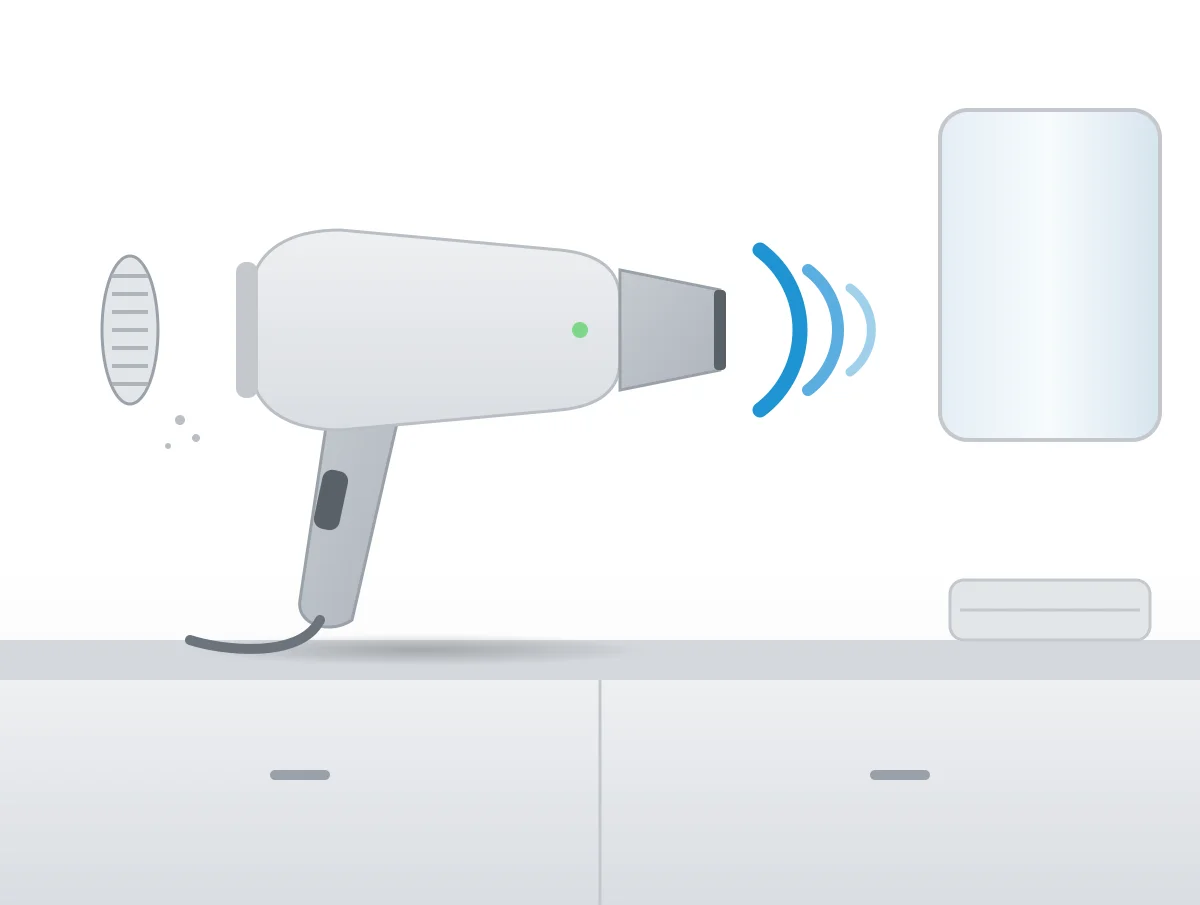
Slow the fan down first. Most of the roar from a hair dryer is air being forced through a narrow nozzle, and Laifen, which prints 59 dB for its Swift, puts "cooler temperatures and lower speeds" at the top of its advice for a quieter blowout. Drying takes longer. Nothing else here changes the sound as much.
Everything after that is upkeep and knowing when to quit. Lint, hair and styling product clog the intake filter, a cover left unlocked can sit loose, ion outlets can crackle, and old motors start to whine. Manuals from Dyson, Conair, BaBylissPRO, Panasonic and Remington set the cleaning routine for each, and some add a reminder light.
Those five manuals, two Bio Ionic help articles and a Laifen post on dryer noise supply every step below. Shark, T3, ghd, Dreame and Revlon pages refused our requests, a gap explained at the end, and nothing here was tried on a dryer of ours.
Six fixes, from free to a new dryer
- Drop the airflow setting before you drop the heat.
- Clean the intake filter on the schedule your manual sets.
- Lock the filter cover back on before switching on.
- Keep hair, towels and fingers away from the air inlet.
- Clean the ion outlet if it crackles.
- Stop and call the maker when the motor grinds, whines or keeps cutting out.
A fan with a heater, held next to your ears
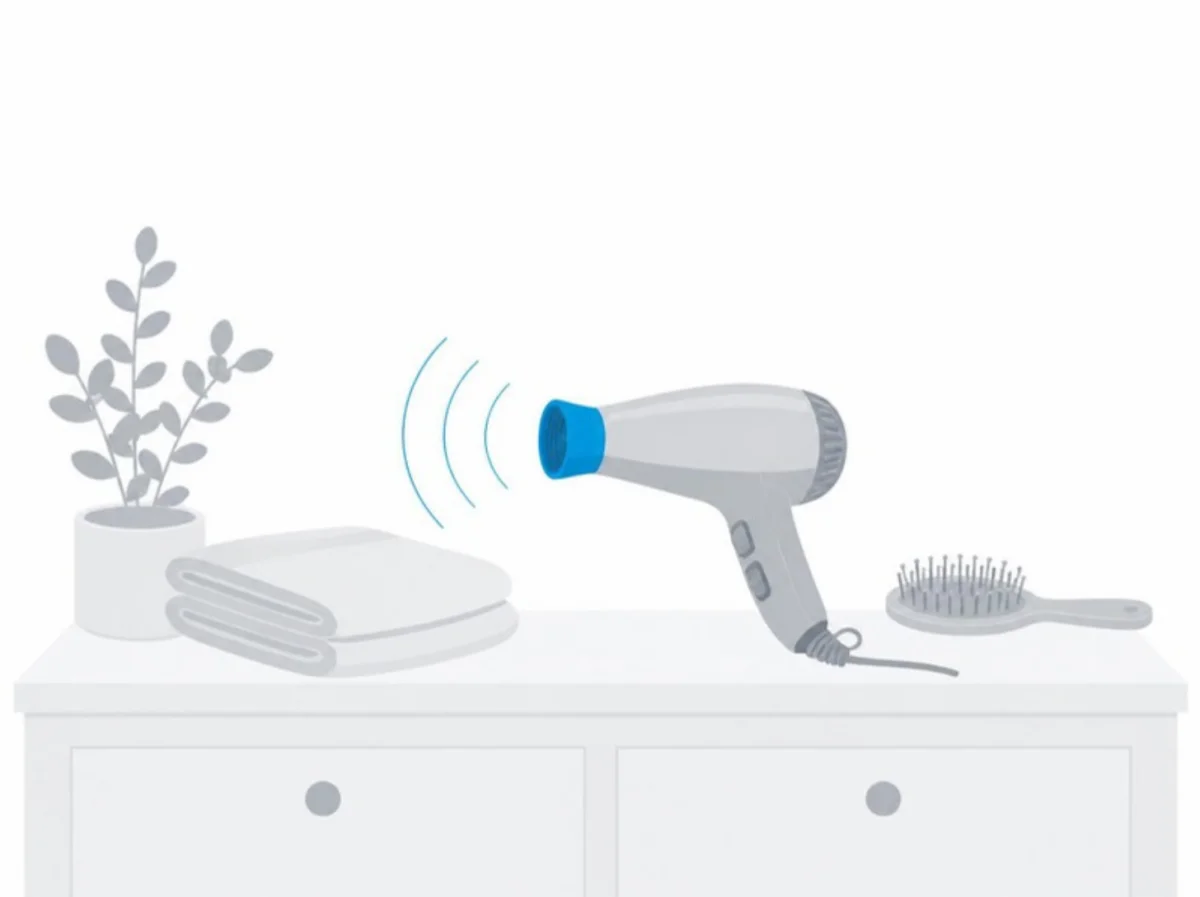
Strip a hair dryer down and it is a small, very fast fan pushing air past a heating element and out of a nozzle. The fan and the rushing air make nearly all the noise.
Fast brushless motors moved part of that sound out of earshot. Laifen's Swift page says its "motor noise is controlled above 20khz which is beyond the range of human hearing", which leaves the broadband hiss of air. Our quietest hair dryers guide found high speed dryers printing 57 to 62 dB, and a conventional DC motor from Valera printing 59 dB(A).
That is the floor. No setting or cleaning routine turns a 60 dB machine into a whisper, but a clogged filter, a loose part or a tired motor can push one well above its rating.
Does turning the speed down make a hair dryer quieter?
Yes. Airflow speed is the setting that changes the sound most, and Laifen pairs lower speeds with cooler temperatures in its own list of ways to make a blowout quieter.
Heat seems to matter less. Dreame footnotes the loudest reading for its Hair Miracle to cold air at high speed, which points at the fan rather than the heater. Laifen and Dreame never set out the two effects side by side, and nobody else publishes per-setting figures, so treat heat as the smaller lever.
Every manual here has a low setting. The Dyson Supersonic HD07 has "3 precise settings" for airflow, shown by its LEDs as Fast, Medium and Gentle. Panasonic's EH-NA65 switch reads HIGH for "Strong airflow" and LOW for "Gentle airflow". Conair's model 1000 has four speeds and matches low with cool for "delicate, thin, or easy-to-style hair", and BaBylissPRO's AirSquare offers 9 heat and speed settings plus a style-setting mode that locks both.
The cost is time, and Laifen admits "it may take you a while to dry your hair". It also suggests running the dryer in shorter spells instead of continuously, to limit the motor heat it ties to louder running. Cold shot is no help. Dyson's manual describes it as press and hold "to deactivate heat", and the fan keeps going.
Does a dirty filter make a hair dryer louder?
It can. Laifen blames lint, hair or dust on the filter and vents for "an odd rattling and buzzing noise", while Conair, Remington and Panasonic link a blocked intake to overheating, cutting out and bursts of cold air.
Conair's DigitalAire Pro booklet spells out the slower decline: "Lint and debris buildup can lead to a slowdown in the dryer's performance and can cause the dryer to stop operating over time." Dyson adds styling products to the list, asking for the Supersonic's filter to stay "clear from hair product residue and debris". Hairspray in a bathroom ends up on the mesh.
How often each maker wants the filter cleaned
| Maker and model | Cleaning schedule | Reminder |
|---|---|---|
| Dyson Supersonic HD07 | Monthly | Three white LEDs flash |
| Conair InfinitiPRO 1000 | When reminded, checked between reminders | CLEAN FILTER on the screen after 15 hours |
| Conair InfinitiPRO DigitalAire Pro 999 | Weekly, rear filter and inlet mesh | None stated |
| Conair DigitalAIRE Drying Wand 998 | Every month | None stated |
| BaBylissPRO AirSquare | After 40 hours, or when buildup shows | Red LED breathes |
| Panasonic EH-NA65 | At least once a month | None stated |
| Bio Ionic Smart-X | Weekly at home, daily in a salon | Speed lights flash when auto-clean is due |
Older Conair designs such as the Flo Pro 680 give no interval at all. Unplug, let it cool, and brush dust and lint off the intake "with a small brush or the brush attachment of a vacuum cleaner." Remington's PROluxe AC9140B asks for the inlet grille to be cleaned regularly "to prolong motor life", with a cloth or soft brush.
Brush, wipe or rinse
Makers split on water, so read your own booklet before the tap goes on. Dyson's rule is "Don't use water to clean the filter mesh", along with a warning not to press too hard on it. Panasonic goes further, "Do not wash the filter in water", because doing so "may cause fire or electric shock". BaBylissPRO does the opposite with the AirSquare's removable cover: rinse it under hot water and do not refit it "IF THERE IS ANY EVIDENCE OF WATER ON THE FILTER." Bio Ionic sits between them, cleaning the Smart-X's metal filter with the brush in the box and then a cloth, ideally moistened with isopropyl alcohol.
Some meshes stay put. Conair's DigitalAire Pro warns "Do not attempt to remove the inlet mesh. It is permanently attached." The AirSquare's fixed mesh filter is off limits too, cleaned in place with a soft brush or cloth. Panasonic's method for packed dust is to vacuum the outside, push the dirt back through the fine inner mesh with a fingertip, and scrub it away with a toothbrush.
Bio Ionic also builds an auto-clean into the Smart-X. Hold the "Speed lower" button for about 10 seconds with the dryer plugged in. The cycle stops by itself after 15 seconds.
Lock the filter cover before switching on
A cover that is not locked is one more loose part. Dyson's last cleaning step is "Rotate clockwise to lock before use", and Panasonic asks owners to "check that the filter is securely attached before using."
Some dryers enforce it. The AirSquare "will not turn on without the filter attached", and when its cover is pulled off mid-run, every LED flashes and the dryer shuts down. Panasonic forbids running the EH-NA65 with the filter removed, because hair can get pulled into the inlet. None of the manuals we read ties an unlocked cover to a rattle by name, but Laifen counts loose parts among the causes of buzzing.
Why is my hair dryer rattling?
A rattle or buzz usually means lint on the filter, a loose screw or part, debris inside the motor, or a damaged fan blade, the four causes Laifen lists. Only the filter is a fix the manuals leave to owners.
For debris, Laifen notes that particles reach the motor more often "when the hair dryer is used in a dusty place", and suggests shaking the dryer to free them, unplugged. It also tells owners comfortable with tools that they may take the dryer apart while it is off, or else "consult a specialist."
Panasonic disagrees about opening the case. Its manual says "Never modify, disassemble, or repair", warns this "may cause ignition or injury due to abnormal operation", and sends repairs to an authorized service center. Conair's warranty excludes damage from unauthorized repair. Read your warranty first. The instructions printed for your model are what decide it, and a dryer opened against them may lose its warranty coverage.
Whining, squealing and crackling sounds
A grating whine from an aging dryer is motor wear, and Laifen says "there may be no choice but to replace the hair dryer." A crackle from an ion outlet, on Panasonic's nanoe dryers, means the electrode needs cleaning.
Panasonic separates two sounds that come from the same small outlet. "A humming noise may come out of the nanoe™ outlet (C), but this is the sound of nanoe™ being discharged and is not a malfunction." A crackle, or sparks inside that outlet, is listed under troubleshooting as an "Abnormality caused by a dirty electrode (needle portion)."
The fix takes a cotton swab. Dampen the tip with tap water, reach the needle deep inside the nanoe outlet, and rub it gently about 5 times; Panasonic recommends "the thin cotton swabs made for use with babies." If the crackle survives that, the manual sends the dryer to the store or an authorized service center.
Cutting out, cold bursts and switching back on
That pattern is overheat protection, and each maker here blames a blocked filter or grille first. Unplug the dryer, let it cool, clear the intake, then switch on again.
Remington describes both versions in the PROluxe manual: "the appliance may either stop unexpectedly or start to blow cold air." It adds that "Overheating is usually caused by a blocked grille/filter." Conair's Drying Wand may "run hot and cold intermittently" and wants 10 minutes of rest. Conair's other booklets allow 10 to 15 minutes and close with "Make sure the air vents are clean."
Panasonic lists the same symptom, a dryer that keeps flipping to cold air while set to Hot, and adds sparks seen within the body. Those sparks come from the thermostat switch, which Panasonic calls a protective device, "and this is not a malfunction." The listed causes are lint on the inlet or outlet, or hair blocking the inlet.
On Conair's model 1000, a flashing first LED means the dryer has stopped. Turn it off, unplug it, let it rest 5 minutes and wipe the rear filter. If the fault light stays on, Conair says the dryer "will need to be serviced or replaced". Dyson uses colour: three flashing white LEDs ask for a filter clean, while three flashing red ones mean contact the Dyson Helpline and "Don't turn back on."
Keep hair and towels clear of the intake
Hair pulled into the inlet is a hazard before it is a noise. Panasonic wants hair kept "at least 10 cm (4˝) away from the air inlet", since it may get caught and damaged.
Conair's Drying Wand booklet links the intake to heat as well as hair, asking owners to keep the rear filter "away from hair during use to prevent hair from getting pulled into the fan, which may cause the appliance to overheat." Conair and BaBylissPRO both want the air openings kept free of lint and hair. Remington warns that a blocked inlet or outlet grille "will cause the unit to automatically stop."
Laifen has one more idea, alone among these makers: wrapping the handle in a towel, provided it does not cover the vents. It also suggests a room with rugs, curtains and soft furnishings. A hard-tiled bathroom reflects the sound back at you, which is why the same dryer seems louder there than in a bedroom.
Do attachments make a hair dryer quieter?
A little, in Laifen's view, and nobody publishes a figure for the difference. Diffusers and concentrators steady the airflow, though Laifen says the level "mainly depends on the motor and speed of airflow."
Laifen's wider claim is that attachments "control the flow of air better", limiting the turbulence that makes noise. It stops short of a big promise: "the noise level cannot be reduced considerably".
Diffusers come with their own setting advice. Remington asks owners to "Dry gently on a medium heat / low speed setting" with the PROluxe diffuser and never to use it on the highest heat. Dyson pitches its gentle air attachment for "Cooler, gentle drying for fine hair and delicate scalps", with no claim about sound. Fitting one and choosing the lower speed it calls for may help more than the attachment itself.
Faults that mean the dryer should stop
Stop when the dryer keeps overheating after a clean, smokes or glows, has a hot plug, or will not run once the filter is clear. Each manual here then sends it to the maker or an authorized service center.
Panasonic's list is the plainest. If air is not emitted, the unit "stops sporadically", or the interior "becomes red hot and smoke is emitted", the instruction is to stop at once and "request inspection or repair at an authorized service center." A plug that runs abnormally hot points to a loose outlet connection, and the fix is an outlet that fits securely.
Conair and BaBylissPRO use nearly the same wording: if the dryer still does not run after the filter and mesh are cleaned, do not use it, and call the consumer service line (1-800-3-CONAIR, or 1-800-326-6247 for BaBylissPRO). Remington says that if overheating continues after cleaning, stop using the appliance and contact Customer Service. A motor that grates or whines with age belongs in the same group. Laifen treats it as the end of the dryer's life rather than a repair.
How loud is a normal hair dryer?
For high speed dryers that publish a number, 57 to 62 dB, with salon models up to about 69 dBA. None of those makers says how far away the microphone sat.
Those figures come from our hair dryer guide, where Laifen prints 59 dB for the Swift and Elchim prints "Under 69 dBA" for its 1875W salon dryer. Laifen's blog adds 62 dB for its SE Lite and 61 dB for the Mini. It also claims older dryers reach "70 to 90 dB", without naming a source for that range.
Bare dB and A-weighted dB(A) figures from different brands are not strictly comparable, as comparing decibel ratings explains, and the decibel chart sets the range beside everyday sounds. A dryer that is louder now than when new fits the pattern in why your appliance got louder: something wore, loosened or clogged.
A quieter dryer, if the fixes run out
If yours is clean, its cover is locked, it runs on its gentle setting and it is still too loud for a shared flat or a sleeping baby, the motor and fan are the limit. Replacement is the remaining step.
The quietest hair dryers ranking orders the models whose makers print a figure, including the Dreame and Laifen dryers mentioned above. For the other buzzing tool in the bathroom cabinet, see the quietest hair clippers, and for drying a nervous dog, the quietest dog dryers. The quiet apartment guide covers noise that travels through shared walls at 7 a.m.
Shark, T3, ghd, Dreame and Revlon stayed out of reach
Shark is the gap that matters most, given how many owners ask why theirs is loud. Its US product pages carried no noise or filter wording, and its UK cleaning page, like the help centers of ghd and Dreame, refused our requests. T3's filter cap and dryer pages rate-limited us, and Revlon's hair tools site blocked every request. Remington's US manual links failed, so the Remington steps come from the international PROluxe AC9140B booklet. Laifen's advice comes from a blog post rather than a manual, and the Dreame footnote is quoted from our hair dryer guide.