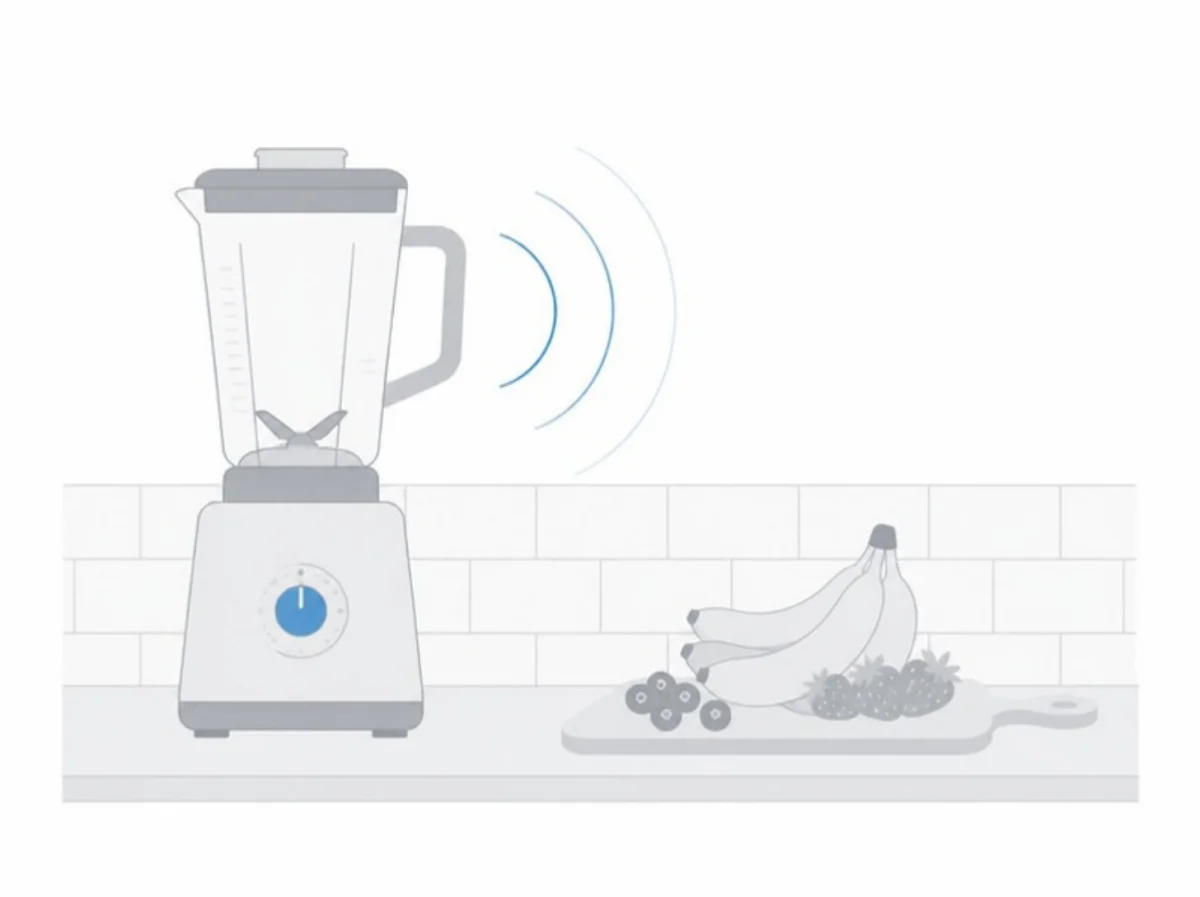
Learning how to make a blender quieter starts with where the motor base sits and how the jar meets it. Vitamix, Blendtec, KitchenAid, Breville, NutriBullet and Hamilton Beach all tie extra noise to a soft or uneven surface, a jar that is not locked down, a badly ordered load, or a worn drive socket.
The steps below are drawn from those makers' own manuals, care guides and help pages, ordered from habits that cost nothing to parts and shields bought from the maker. Stand mixers get one section of their own, built on KitchenAid's troubleshooting guide, since that is where most mixer noise questions end up.
How do you make a blender quieter?
Make a blender quieter by setting it on a hard, level counter, seating the jar fully, loading in the maker's order, pulsing frozen food before high speed, and replacing worn sockets with maker parts.
In rough order of effort:
- Clear the counter under the feet and keep the vents open.
- Lock the jar, blade assembly and lid in place before pressing start.
- Add ingredients in the order your manual shows, with enough liquid.
- Pulse ice and frozen fruit first, then raise the speed.
- Stay inside the fill lines, run times and program limits.
- Inspect the drive socket, coupler, centering pad and blade assembly.
- Use a shield or enclosure only if your maker sells one for your model.
- Know which sounds mean the blender should go to service.
Why is a blender so loud?
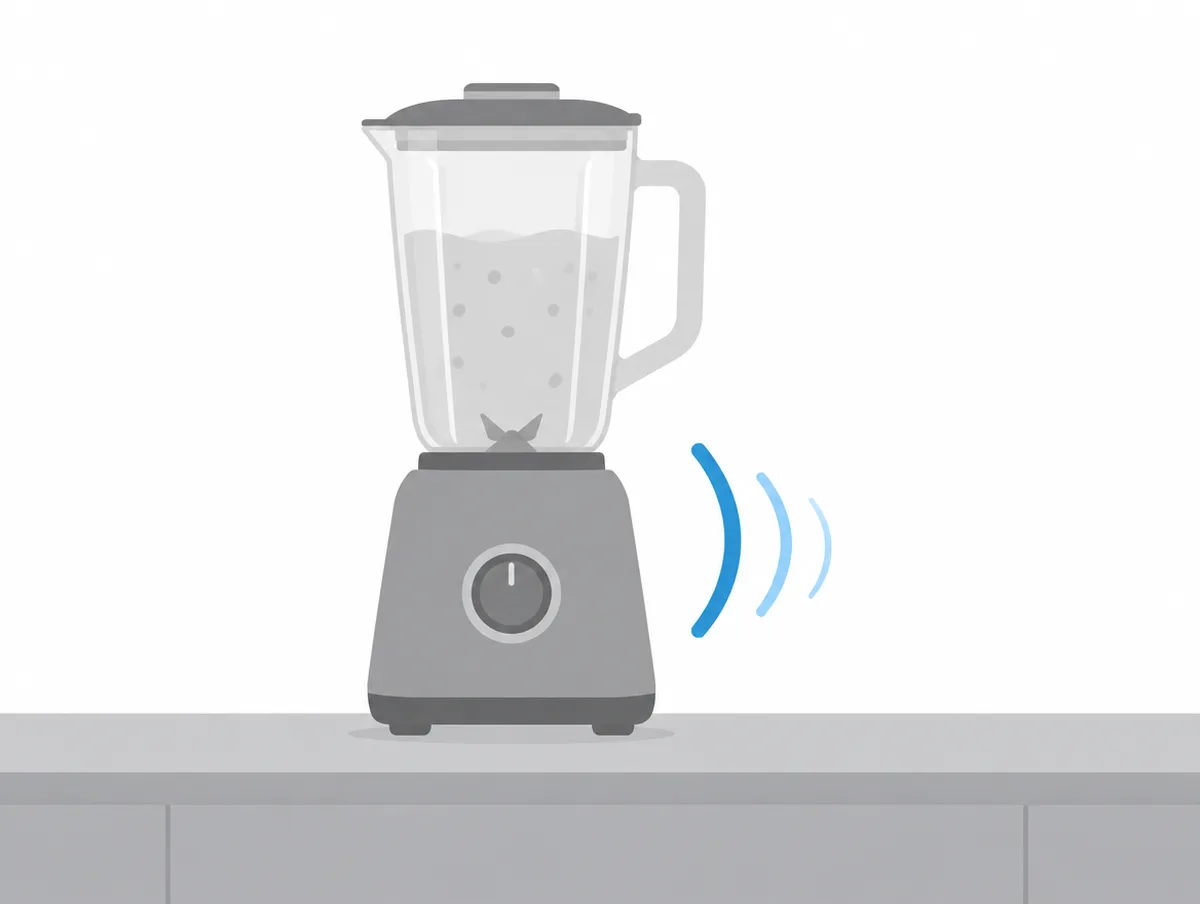
A blender is loud because a fast motor, its cooling fan, the coupling to the blades and the ingredients hitting the jar all make noise, and makers add that vibration passes from the base into the counter.
NutriBullet's product development lead names two main sources: the motor "spinning at high speed" and vibration travelling into the countertop. Breville credits the quieter running of its Super Q to "a unique cooling system", and Blendtec says its Professional 800 housing "optimizes sound and airflow for cooler, quieter operation".
Hamilton Beach sells its home Sound Shield on frozen food, saying the two-piece cover reduces noise "even with frozen ingredients", and Vitamix says a drive socket that can align with the container cuts noise while blending. Those four sources, motor, fan, coupling and contents, map onto the steps that follow.
Where should a blender sit on the counter?
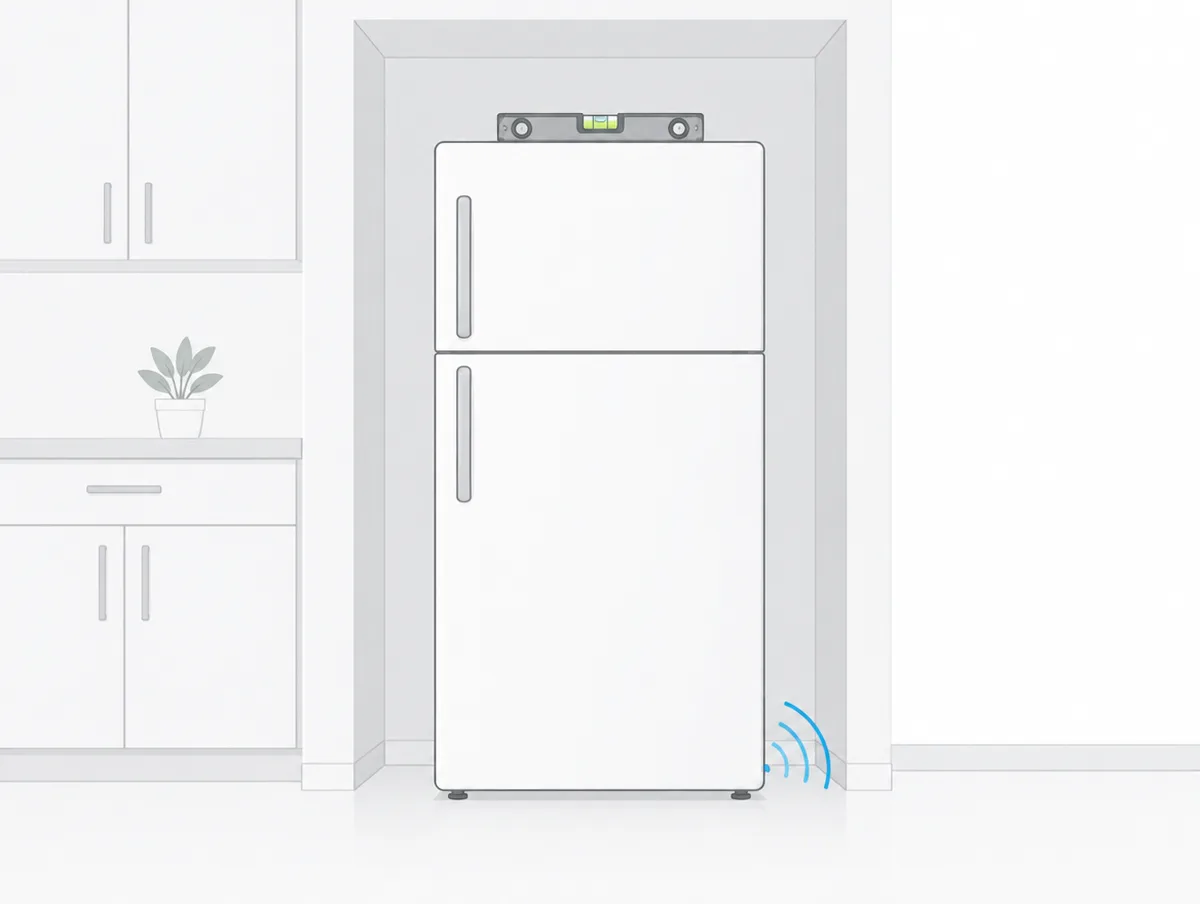
A blender should sit on a solid, flat, dry counter with open space around its vents. Vitamix, Blendtec and Breville all say so in their manuals, and Breville adds a warning to keep it back from the edge.
Vitamix's troubleshooting page answers a shaking machine by checking that it is set "flat on a solid surface, such as your countertop, not a cutting board or other non-fixed surface." Blendtec's Professional series manual wants "a flat, clean, and dry surface", with the vents on the sides and the exhaust at the back left clear.
Breville's Super Q instruction book asks for a level surface away from the counter edge and warns that "vibration during use may cause the appliance to move." For commercial machines, Vitamix asks for at least 12 inches of open space around the blender to help prevent overheating.
NutriBullet adds one placement tip of its own: a blender pushed against a wall, backsplash or cabinet sounds louder because those hard surfaces reflect the noise back into the room. Its suggestion is to slide the base toward the middle of the counter while it runs.
Should you put a mat or towel under a blender?
No. NutriBullet calls a towel, mat or folded cloth under the base a myth and says it is "not recommended", because soft material can make the blender less stable and may block the vents under the motor base.
The rubber feet are the maker's own damping. NutriBullet says worn, cracked or detached feet let a blender vibrate more than normal, and Vitamix says a machine that still shakes on a solid counter may have a problem with its feet or drive socket, which goes to customer service.
Does seating the jar properly reduce blender noise?
Yes. KitchenAid says a jar that is not seated may stop the coupler from engaging fully and cause a grinding sound, and Vitamix asks for the container to sit flush with the centering pad before you start.
KitchenAid's K400 noise page lines the jar up with the slot in the jar pad, handle toward the control dial. Vitamix's Ascent manual checks that the container and blade base are flush with the centering pad so the drive spline meets the drive socket.
Blendtec's Designer series manual places the jar "secure and fully seated on the motor base", with the lid sitting on the jar completely. NutriBullet's list of rattles is a loose blade assembly, a cup not seated, an unsecured lid, and a gasket that is damaged, stretched or sitting wrong.
Once the motor is running, leave the jar alone. Vitamix's commercial care guide says not to shake or rattle the machine or container in use, and its care FAQ lists rocking or tilting the container among the causes of a worn drive socket.
What order should ingredients go in a blender?
Ingredient order depends on the maker, so follow your manual's chart. Vitamix and Hamilton Beach put liquids first, NutriBullet puts greens and soft produce before liquid, and all three put ice and frozen food on top.
Vitamix's Ascent and Explorian manuals print a load order from the bottom up: liquids, dry goods, leafy greens, fruits and vegetables, then ice and frozen ingredients. Hamilton Beach's 53604 guide says to "ALWAYS place liquid in blender jar first" and asks for at least 1 cup of liquid per recipe.
Hamilton Beach reverses the order for its 20 ounce personal jar, which blends upside down: frozen food goes in first so it ends up on top. NutriBullet's quiet blending tips say the right layers stop the motor from "fighting through a dense mass of frozen ingredients", which it calls one of the loudest moments of a blend.
Quantity matters too. Breville puts the best ice load for the Super Q jug at 8 ounces, about 10 ice cubes, and says thicker mixtures puree best with the jug a quarter to half full. Hamilton Beach and NutriBullet both say not to fill past the top marking.
Is pulsing quieter than blending on high?
Yes, pulsing is quieter for chunky and frozen loads. KitchenAid says to pulse first and then raise the speed, NutriBullet finds short bursts often quieter than one long cycle, and Hamilton Beach says to pulse ice that is not blending.
KitchenAid gives the reason on its K400 page. Starting at high speed sends chunky items "to float around in the middle of the jar", which takes longer, and "Blending chunky items like frozen fruits or vegetables immediately at high speeds can cause wear on the coupler."
Slow is not always gentle, though. Vitamix's care guide says a mixture that is too thick, or one run too long on a LOW setting, can trip the thermal protector, and both of its home manuals say not to process recipes at lower or higher speeds than recommended.
Do blender programs make less noise?
No, not by any figure a maker prints. Blender programs take out the guesswork: Blendtec cycles speed up, slow down and shut off by themselves, and Vitamix programs stop automatically at the end.
Ninja is the only maker we read that uses the word mode for quiet. SharkNinja Australia's page for the Ninja Stealth IQ carries the heading "Stealth Mode Reduces Noise" and says the brushless motor blends tough food "while minimising strain, noise, and wear." It prints no decibel figure for either.
How do you make a Ninja blender quieter?
A Ninja blender is a jug on a motor base, so the checks other makers give apply: lock the jar down, load it as the owner's guide shows, pulse frozen food first, and keep the vents clear.
SharkNinja's US and Canadian support sites, and its US product pages, refused our automated requests, so we could not quote Ninja's troubleshooting or owner's guides. Your printed owner's guide carries the model's own fill lines and run limits.
What we could read is the Australian listing for the Stealth IQ Kitchen System, sold with a StealthShield. SharkNinja says the shield "dampens blender sounds" and is "Compatible with single-serve cup only", and that the base is "Built with noise-dampening materials". Neither claim comes with a number.
Is it normal for a blender to get hot or smell like burning?
Yes, a warm blender base and a brief burning smell can be normal under heavy loads, say Hamilton Beach, Vitamix and Breville. All three want it switched off to cool, and a recurring smell goes to the maker.
Hamilton Beach's troubleshooting says heavy use "may cause curing of motor windings" and that the smell may fade after a few heavy uses. Vitamix's care guide says that on a burning odor you should add more liquid or lessen the load. Home Vitamix manuals allow 20 to 45 minutes for an overheated motor to cool.
Breville's Super Q flashes OVERLOAD PROTECTION, has a red reset button underneath, and may need at least 20 to 30 minutes to cool. Vitamix limits the tamper to 30 seconds at a time and nut butters to one minute after the mixture starts circulating, both to avoid overheating.
When does a worn drive socket or coupler make a blender louder?
A worn drive socket or coupler adds grinding and rattling once its teeth wear down. Vitamix, Blendtec and KitchenAid all blame the same habit: lifting the jar off, or setting it down, while the motor is still spinning.
Vitamix Commercial's care FAQ says "Drive sockets also help reduce blending noise," and that a properly installed one is "attached, but slightly loose" so it can line up with the container. Its list of wear causes includes a foreign object in the container and running without the centering pad.
The same FAQ says to replace a blade assembly that "Makes an audible noise when spinning", turns freely like a pinwheel, or moves up and down or side to side. Blendtec's care page says its commercial jars made since 2016 carry an internal double bearing wall that "reduces sound and fatigue on base."
KitchenAid says pressing down on the lid while blending, or pulling the jar off while it spins, can strip the coupler "teeth". Hamilton Beach reads grease around the bottom of the jar or on the counter as a possible jar bearing problem.
Who replaces the part depends on the machine. Vitamix's commercial guide shows operators how to change a drive socket, but its home manuals say "Any repair, servicing, or replacement of parts must be performed by Vitamix or a Vitamix authorized service representative."
Do blender sound enclosures and shields work?
Yes, by the makers' own descriptions, though none prints a decibel figure for a home model. Hamilton Beach, Blendtec, Vitamix and Ninja each sell blenders with a shield or enclosure designed around them.
| Maker | Shield or enclosure | What the maker says |
|---|---|---|
| Hamilton Beach | Sound Shield 950, two-piece hinged shield | Muffles the sound the blender produces; sold as a part |
| Blendtec | Professional 800, sealed home enclosure | "operates at a sound level that won't interrupt" |
| Blendtec | Stealth 885, commercial | "the sound level of normal conversation" |
| Vitamix | The Quiet One and Quick & Quiet, commercial | "Patented Noise Reduction" |
| Ninja | StealthShield, single-serve cup only | "dampens blender sounds" |
Hamilton Beach lists the Quiet Shield as a $56.99 replacement part on its Sound Shield 950 page. Blendtec's manual for the Professional 800 asks for enough room "above and around the unit" for the enclosure to move freely.
An enclosure needs its own care. Vitamix says The Quiet One's sound reducing pad must be in place before the enclosure goes on, and that neither the enclosure nor the pad is dishwasher safe. Blendtec warns that slamming the lid or using the wrong cleaning chemicals damages the enclosure seal.
Can you build a box or drape a towel over a blender?
No. NutriBullet warns that "Covering the motor base traps heat and restricts airflow, increasing the risk of overheating," and says a purpose-built enclosure is very different from a box or blanket made from household materials.
Every manual we read keeps the motor's air paths clear. Blendtec wants vents and exhaust unobstructed "to allow proper cooling during use", and Vitamix asks for 12 inches of open space around a commercial blender. A homemade cover blocks the very airflow those makers design around.
Which blender noises mean stop and call service?
A high-pitched screech, a motor that stays loud with the jar off, a rattle from inside the base, or a blade that feels gravelly by hand all send the blender to service, according to Vitamix, Blendtec and KitchenAid.
Vitamix asks owners to call if the machine makes "a high-pitch screeching sound or other unusual noises", and says a leak around the base "always requires a call". KitchenAid's K150 page sends a rattling noise from the base to service while the unit is under warranty.
Blendtec's Professional series manual has the clearest test. Remove the jar and press Pulse; if the motor alone is "excessively noisy", contact service. Then run the jar for a few seconds, trying a second jar if you have one, and call if the blade assembly "seems loose or sounds 'gravelly' when turned by hand."
How do you make a stand mixer quieter?
Make a stand mixer quieter by locking the bowl, seating the accessory fully, setting beater clearance with KitchenAid's dime test, and kneading yeast dough no faster than Speed 2. Light tapping with dense mixtures can be normal.
KitchenAid's mixer troubleshooting guide puts a dime in the bowl with the flat beater fitted. Properly adjusted, the beater nudges the dime "about a quarter inch" each pass; a dime that never moves means the beater sits too high, and one pushed round continuously means it is too low.
On a tilt-head mixer that bounces, KitchenAid points to the neck pin through the neck of the mixer. The pin can be pushed back and its screw tightened, with a 1/8 inch hex key on some models, following the owner's manual. KitchenAid adds that slight vibration, and a little head movement with heavy dough, is normal.
The line between normal and not is repetition. KitchenAid says to stop using the mixer if grinding, knocking or metal-on-metal sounds persist after the bowl and accessory are secured. A mixer that has sat unused can be run empty on Speed 10 for about two minutes to spread its grease; KitchenAid says no added oil is needed.
How loud is a normal blender?
A normal home blender has no maker figure to compare against, because none of the home brands we read prints one. The blender figures in our catalog come from commercial makers, and each carries a different condition.
Santos declares 63 dB(A) for its #62, measured with the blender loaded and the microphone 1 m away. Hamilton Beach Commercial declares less than 81 dB(A) for the shielded Eclipse in its HBH755 manual, and less than 85 dB(A) for the Rio and Tango, all at maximum speed with an empty jar.
An empty jar leaves out the ice, so those ceilings say more about motors than about a frozen smoothie. A loaded measurement and a no-load ceiling cannot be ranked against each other, as comparing decibel ratings sets out, and the decibel chart sets them beside everyday sounds.
When is a quieter blender the better fix?
A quieter blender is the better fix when yours sits on a hard counter, seats properly, is loaded and pulsed as its manual says, and has sound blades and sockets, yet still runs too loud for your kitchen.
Some blenders are loud by design, and a shield from the maker is the only add-on any of them sells. Our ranking of the quietest blenders sorts the few models whose makers publish a figure, with the condition each figure was taken under.
For juice, our guide to the quietest juicers covers machines built for that job. For a blender in sight of the living room, see planning a quiet open-plan kitchen.
How did we put these blender steps together?
Every step comes from a maker's own document: owner's manuals from Vitamix, Blendtec, Breville and Hamilton Beach, care pages from Vitamix Commercial and Blendtec, help pages and a troubleshooting guide from KitchenAid, and NutriBullet's own article on quiet blending.
The decibel figures are the ones in our blender catalog, each traced to a maker manual. Nobody at QuietSpecs reseated a jar, swapped a drive socket, changed a load order, fitted a shield or adjusted a mixer's beater, and no blender or mixer was switched on to compare sounds.
SharkNinja's US and Canadian sites blocked our requests, so Ninja appears only through its Australian product page. KitchenAid's blender and mixer PDF manuals refused automated downloads, so we relied on its product help articles and mixer troubleshooting guide instead.