An outdoor AC unit gets most of its loudness settled on installation day, by where the condenser stands, what it sits on and how much open air surrounds it. After that, an owner has a short list of levers: a quiet setting on some variable speed models, the compressor blanket the maker sells, and keeping the space around the cabinet clear.
This page takes those levers in order, from a setting you can change tonight to work that needs a dealer. Every step is quoted from documents that Carrier, Bryant, Trane, American Standard, Lennox, Daikin and York put out: installation instructions, product data, a service manual and homeowner pages. It covers split central air and heat pump condensers.
A unit that has started making a new sound is a different problem. Buzzing, grinding, screeching and hissing are covered in our guide to an outside AC unit making loud noise, and most of those end with the system switched off and a call to a technician.
How loud is a normal outdoor AC unit?
A rated outdoor AC unit sits between 52 and 77 dBA of sound power, going by the units listed in our quietest central air conditioners guide. The low figure is at minimum speed and the high one at full load, all rated to AHRI 270.
Those ratings describe the machine, not what you hear on the patio. Daikin's DC9VS spec sheet goes a step further and estimates sound pressure at set distances. A 3 ton unit with nothing hard nearby comes out at 64 dBA at 3 feet, 54 at 9 feet and 50 at 15 feet, in its standard mode.
Distance does more than any add-on part. Moving from 3 to 15 feet away takes 14 dBA off every row of that table. The difference between the two kinds of figure is explained in sound power vs sound pressure.
Turn on quiet mode, if the condenser has one
Only some variable speed condensers have a quiet setting. Daikin's FIT line and Trane's 18 TruComfort both offer one, and our Goodman and Amana pages quote a similar setting from those makers' inverter sheets. None of the other installation manuals cited here mentions such a setting.
Daikin's version is the best documented. Its installation and service reference for the DC9VS, DH7VS and DH9VS describes a mode that "enables the system to operate at decreased compressor and fan speeds", switched by the user and set to "OFF" by default. There are three depths, set at the thermostat, and level 3 is "the most quiet." Out of the box it sits at level 2.
The DC9VS sheet puts numbers on each depth.
| 3 ton DC9VS setting | Sound power | Capacity given up |
|---|---|---|
| Normal mode | 71 dBA | None |
| Quiet LV.1 | 67 dBA | About 5% |
| Quiet LV.2 | 62 dBA | About 30% |
| Quiet LV.3 | 57 dBA | About 35% |
The bigger sizes lose more. At 5 tons, level 3 takes the rating from 77 to 66 dBA and costs about half the capacity. A footnote says the quiet figures were "determined at a distance of 3 [ft]." The matching inverter models are covered on our Goodman and Amana pages, whose sheets print a three-level quiet mode table of their own.
Quiet mode can switch itself off. With the default capacity priority setting left on, Daikin explains, "the quiet mode function will be temporary off" when the house calls for a lot of cooling, until the room is back at set point. Its cooling boost mode works the other way, and the same manual warns that outdoor sound "may increase" while boost runs.
Trane's feature is simpler. Its 18 TruComfort page describes a "New Quiet Mode" that will "limit the compressor speed to a minimum speed to comply with most local sound ordinances." The page gives no figure for it.
Noise settings on Carrier's Infinity control
The settings Carrier documents for the outdoor unit are aimed at heat pumps. In the Infinity System Control instructions, an installer can cap a variable capacity heat pump's speed between 4500 and 7000 RPM (default 7000), "Used to reduce operating noise while in high heating capacity", at the cost of heating capacity.
Two more settings deal with defrost on heat pumps. Quiet Shift works on 1 stage and 2 stage communicating heat pumps, not variable speed ones, and Defrost Fan Delay runs the outdoor fan for about 12 seconds after defrost to soften the noise of the reversing valve. Neither changes how a cooling-only condenser sounds in July. The sounds themselves are described in our heat pump noises explainer.
Do compressor sound blankets work?
They help a little. Where a maker prints ratings with and without its blanket, the gap is 0 to 3 dBA, and many current condensers already have one on the compressor from the factory.
Carrier's Comfort Series sheets are the clearest test, because each prints two AHRI 270 tables, "without Sound Shield" and "with Accessory Sound Shield".
| Size | 26SCA5 without / with | 26SCA4 without / with |
|---|---|---|
| 1.5 ton | 72 / 71 dBA | 72 / 70 dBA |
| 2 ton | 73 / 71 dBA | 74 / 74 dBA |
| 3 ton | 69 / 68 dBA | 74 / 71 dBA |
| 4 ton | 75 / 75 dBA | 78 / 77 dBA |
| 5 ton | 75 / 75 dBA | 74 / 73 dBA |
At 4 and 5 tons on the 26SCA5 data, the shield changes nothing. Its best result anywhere in the two tables is 3 dBA, on a 3 ton 26SCA4. York is in the same range: its YC4 technical guide, read through the Internet Archive, calls its blanket "A field installed dense foam cover that provides 2 dBA sound level reduction."
Carrier also says when the part is worth ordering. Its 26SCA5 usage guideline suggests the wraparound cover "when unit is installed closer than 15 ft (4.57 m) to quiet areas, bedrooms, etc." and "between two houses less than 10 ft (3 m) apart."
Check before you buy one
Many condensers already wear a blanket. The DC9VS sheet lists a "High-density compressor sound blanket" among its standard features, and Bryant's 290VAN heat pump data marks "Sound Blanket" standard at every size. Bryant also sells a separate wrap for the accumulator, for the rare case of a "transient tone", and says it "can reduce the tone by up to 10 dB."
Leave the factory cover alone. Daikin's manual tells installers "Do not pull the sound-proof cover or remove it from the compressor," and Carrier's 24VNA6 service steps end with reinstalling the blanket so the thermistor and harness run as they did from the factory. Fitting one means opening the cabinet, and Carrier's instructions say only factory-authorized kits and accessories are to be used. The manuals here do not mention aftermarket universal blankets.
Can you put a fence around an AC unit?
Yes, if it keeps the clearances in the installation manual. Trane, Lennox and Carrier each want a foot or more on most sides and an open top, and no maker here claims that a fence lowers the sound.
| Maker and model | Sides | Above the unit |
|---|---|---|
| Carrier 24VNA6 and 24ACB7 | 6 inches on one side, 12 on the rest, 24 at the service end | 48 inches |
| Trane 4TTX8 | 12 inches from walls or shrubbery, 3 feet at service sides | 5 feet unrestricted |
| Lennox SL25KCV | 30, 36, 12 and 6 inches on the four sides | 48 inches |
Lennox adds that clearances may need to grow "to prevent air recirculation when the unit is installed under a deck or in another tight space," in its SL25KCV instructions. A hood or roof over the condenser would break every top clearance in the table.
Screens are fine with the makers. Trane's landscaping article suggests "an air conditioner privacy screen" when space is tight, plants at least 2 to 3 feet off on all sides and branches trimmed to keep 5 feet clear above. American Standard offers fencing or a brick or stone wall to hide the unit. Neither page mentions sound; both are about looks and airflow.
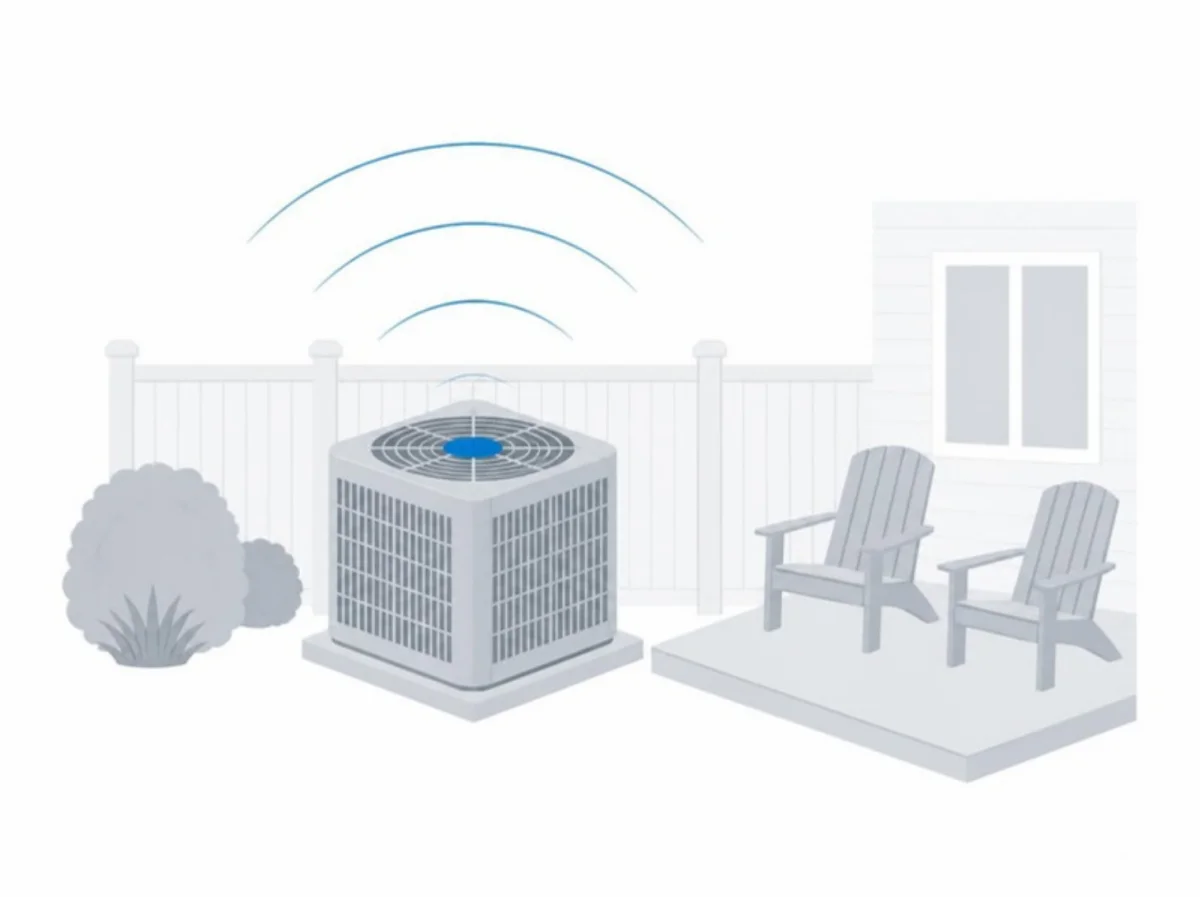
Hard walls close by bounce sound back
Daikin's distance table counts reflective surfaces. For the 3 ton DC9VS at 9 feet, the estimate is 54 dBA with no surface nearby, 57 with one and 60 with two, and each added surface raises every distance in the table by 3 dBA.
The drawing beside the table shows a back wall, not a fence, so treat the figures as a guide to solid panels rather than to open lattice. A condenser boxed into a corner between two house walls sits in the two-surface row. Daikin's installation manual also wants a spot "where the operating sound will not be amplified."
A level pad that stands apart from the house
A solid, level pad keeps the cabinet steady, and a pad that does not touch the house keeps its vibration out of the walls. Trane, Daikin, Lennox and Carrier all set rules for it.
"The pad must be separate from any structure," reads Trane's 4TTX8 installer's guide, which also wants it level and at least 1 inch larger than the unit on all sides. Daikin gives the reason: "To reduce the possibility of sound transmission, the foundation slab should not be in contact with or be an integral part of the building foundation."
On level, Carrier's limit is ±2°, "per compressor manufacturer specifications," while Lennox accepts a slope of up to 2 degrees away from the building. Carrier ties its limit to the compressor maker, so a slab that has sunk out of level is a job for the dealer.
Feet and pads have a place too. Carrier's support feet, plastic feet that lift the unit 4 inches off the pad, are suggested "For improved sound ratings" among other uses in the 26SCA5 data. On roofs, Daikin says "Vibration absorbing pads or springs can be installed" under the legs or frame, and Trane recommends "Properly selected isolation" against sound reaching the building. Neither prints a decibel figure for them.
Where the condenser stands decides the most
The condenser should stand away from bedrooms and windows, with some line set run outdoors before the pipes reach the house. Moving one is a dealer job involving refrigerant, so these rules matter most when a unit is first placed or replaced.
Trane does not recommend a location "where noise may distract the building occupants," naming sleeping quarters and the windows of a living area, and asks installers to discuss the spot with the owner first. Daikin's first rules for a site are a base solid enough for the unit's weight and vibration, and a spot away from bedrooms "so that the operating sound will cause no trouble." The 24VNA6 instructions from Carrier put the outdoor unit at least 10 feet from bedrooms when the line set is fixed to joists.
Neighbors count as well. Daikin asks for a location where hot air or "the operating sound will not cause a nuisance to the neighbors of the user." Trane's quiet mode wording points at the same thing: local sound ordinances.
Fixes a technician can make
A technician can damp tubing vibration, add a suction line loop or enable Quiet Shift-2, all described in Carrier's service manual rather than any owner's guide. They involve refrigerant lines, compressor mounts or control boards, so they are not owner jobs.
For operational vibration, the manual suggests checking the charge and insulating piping and wall penetrations. It adds that "a sound dampener or mass weight" on vibrating tubing "has been known to reduce this noise," and that split post grommets under the compressor may help when the piping cannot be changed.
A "waa waa" sound through the suction line may call for "more flex or muffling in the lines," usually fixed with a field-made suction line loop. On heat pumps, Quiet Shift-2 holds the compressor off for about a minute during the defrost shift so pressures can equalize, and the manual expects it to improve the noise without removing it entirely.
How to make an AC unit quieter inside the house
Indoor noise from a split system usually starts at the furnace or air handler, the ducts, or refrigerant lines touching the framing. The outdoor fixes above do little for it, so the cause decides where to look.
Line sets are the outdoor unit's route inside. Trane wants vapor lines secured with isolators every 8 feet along joists and rafters and never hung from ductwork, and its guide recommends flexible electrical conduit "whenever vibration transmission may create a noise problem within the structure." Lennox notes that "TWO 90° ELBOWS INSTALLED IN LINE SET WILL REDUCE LINE SET VIBRATION." Daikin warns that "Refrigerant tubing is highly prone to transmit noise and vibration to the adjoining structure."
On a Carrier Infinity system, the installer can choose a QUIET cooling airflow, "the minimum cooling airflow that the system can safely run (typically 300 CFM/ton)," for homes where duct noise is severe. Carrier warns that ducts can sweat at low airflow in humid weather.
Blower, duct and register sounds are sorted out in air handler noises explained. If the unit in question sits in a window rather than outside, the steps are different, and they are in how to make a window AC quieter.
When a louder unit means a fault
A condenser that was quiet last year and is loud now needs a diagnosis, not a blanket. Rattles, buzzing with a stalled fan, hissing and grinding are fault sounds, and the makers send each one to a technician.
Owner upkeep is short. Lennox asks owners to trim shrubbery away from the unit, check for debris that collects around it and keep winter snow below the louvered panels; checks of the fan and blade go to a licensed technician. The full list of sounds and what each maker says about it is in our outside AC unit noise explainer.
Replacing a loud condenser
When the unit is well placed, level and blanketed and still too loud, the fix left is a different condenser. Variable speed models print a minimum speed rating beside the full load one, and the lowest minimum in our guide is 52 dBA.
Size matters as much as the model, because within one data sheet the bigger sizes often rate 10 dBA or more above the smallest. Compare ratings at the tonnage you actually need. Our brand pages list every size: Trane, Carrier, Daikin and York. Heat pump owners can rank outdoor units by their heating figures in the quietest heat pumps guide, and a home without ducts has the quietest mini-splits.
Why variable speed units start and run more softly is set out in inverter compressors and noise.