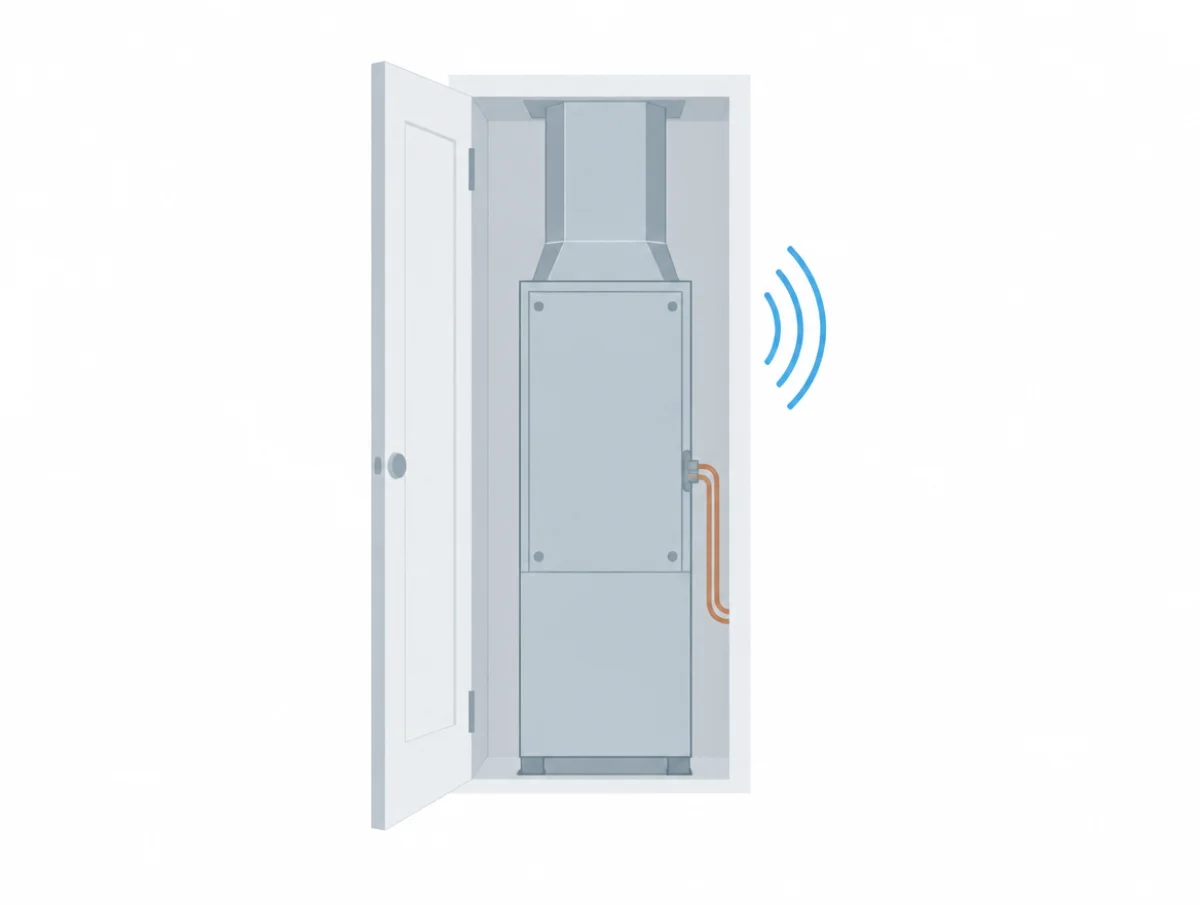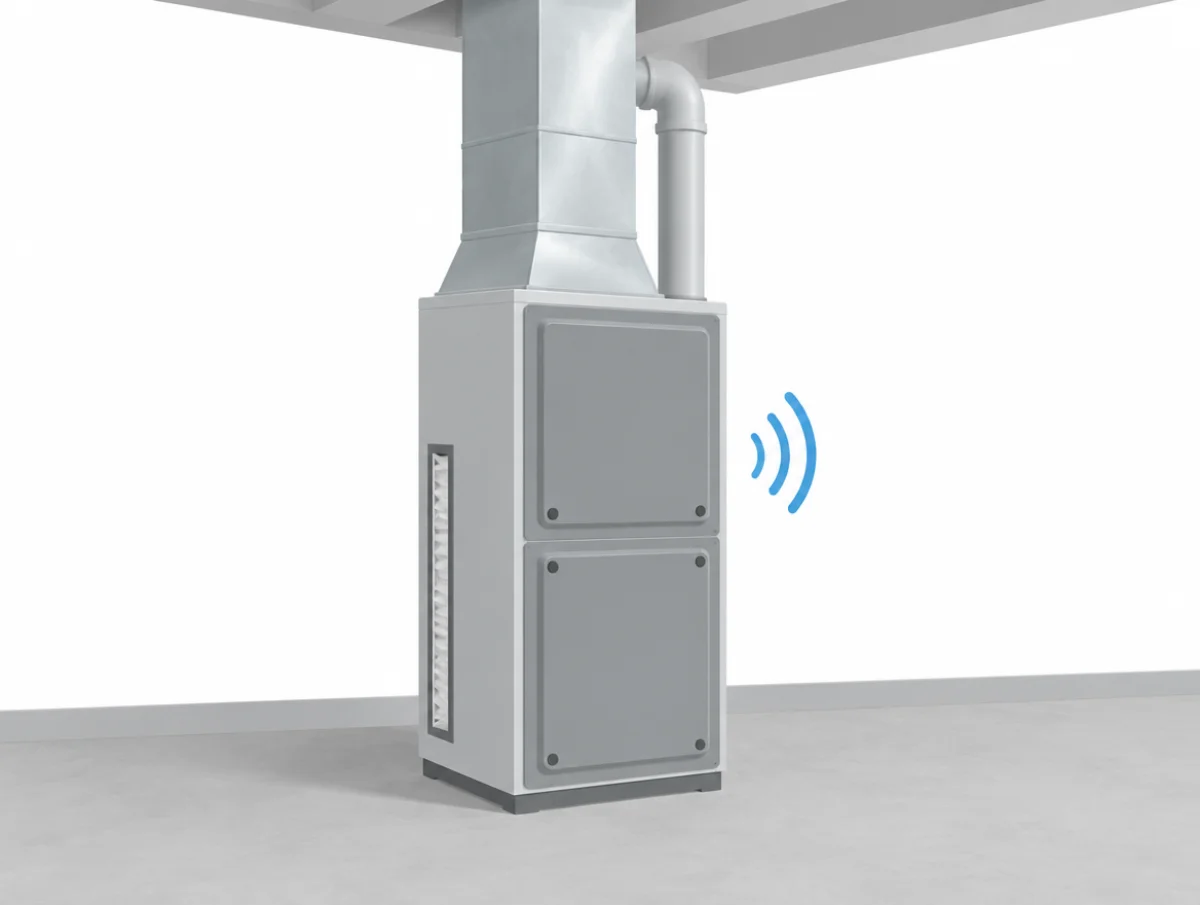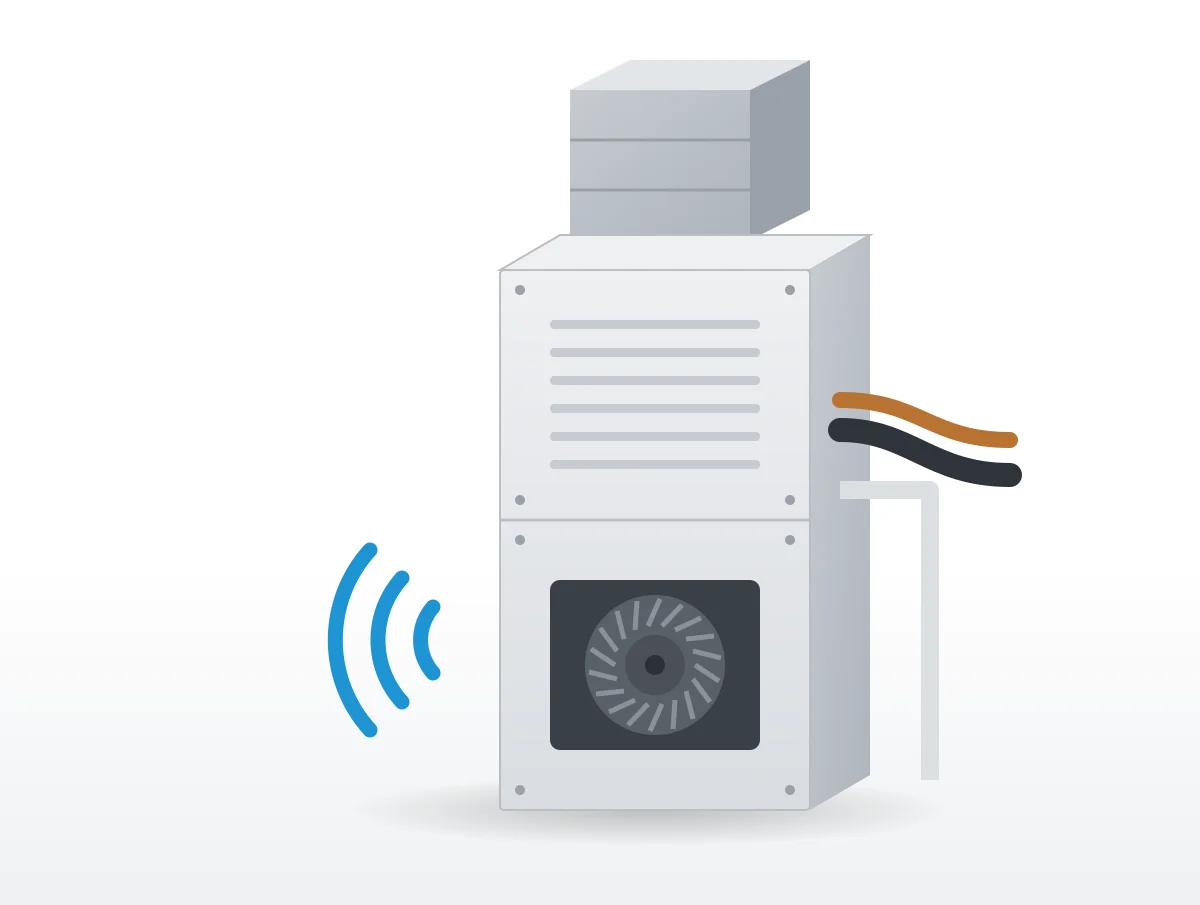
A steady hum and, for the first 2 or 3 minutes, the rush of refrigerant: that is what a healthy air handler sounds like, going by the people who build them. Trane draws the line at odd noises "beyond the humming or normal startup and shutdown sounds." Squealing, hissing at the coil, a rattle you can feel, or a buzz with a burning smell all fall outside it.
The air handler is the indoor half of a central air or heat pump system, one cabinet holding a blower, an evaporator coil, a filter, a condensate drain and, in many homes, electric heat strips. Each part makes its own kind of noise. The causes below come from help pages by Trane, Carrier, Lennox, Goodman, Daikin and American Standard, installation instructions from Lennox, Goodman and Rheem, and two Fujitsu operation manuals, read on November 11, 2026. Mitsubishi Electric and York had no page on indoor cabinet sounds that we could find.
Outdoor unit noise has its own pages, outside AC unit noises and heat pump noise in winter. A gas furnace is in furnace noises, and a pump on the drain line in condensate pump noises.
A hum and a short whoosh are part of normal running
Blower hum and air rushing through the ducts sit inside Trane's definition of normal. Fujitsu adds refrigerant to the list in the operation manual for its ARUH12LUAS duct type indoor unit: "refrigerant flowing sound may be heard. It may be particularly noticeable for 2-3 minutes after starting operation."
Learn what yours sounds like on a good day. One line on Trane's maintenance list for owners reads "Listen for excessive noise or vibrations," and another, "Tell your technician if you hear any unusual noises." American Standard wants owners to "note any changes in the type or volume of sound as the unit ages."
Why is my air handler humming or buzzing?
A hum that grows loud "could be caused by a problem with the blower motor," and Trane's advice is to call for repair.
Carrier describes one pattern to watch for. With a failing blower motor or capacitor, "you may notice a humming sound with no airflow, or no response at all." The blower motor has a run capacitor, Trane explains, and "If the capacitor is bad, the fan will stop running."
Buzzing is more serious. "Electrical buzzing, arcing or a burning smell can signal a potentially serious electrical or motor-related issue. These are not DIY situations." Carrier tells owners to stop troubleshooting there and call a professional.
Rattles and vibration usually start in the blower
Rattling with "excessive vibration" is abnormal on Trane's list, which blames "a problem with the blower wheel, a fan, fan motor," or "a loose screw or bolt." Daikin's version runs close: "Loose fan blades, misaligned blowers, or failing bearings can generate rattles and vibrations." And from Lennox: "Hearing a rattle or banging sound could mean something is broken inside the motor."
Panels count too. Before start up, Goodman's AMST installation instructions require that "All panels must be in place and secured." American Standard says rattling "typically happens when the system is cooling down and is not usually cause for alarm," though that line sits in its furnace section, not under air handlers.
Then there is the house itself, which can pick up vibration from the cabinet and carry it into the framing. Rheem's air handler instructions deal with that at installation: "Flexible connectors should be used between the unit and the ductwork to prevent transmission of vibration from the unit to the structure," with heat resistant material at the supply end when electric heat kits are fitted.
Squealing and grinding point to the bearings
"Sounds like screeching or squealing could mean the blower has bad bearings," according to Lennox. Carrier groups squealing, grinding and banging together as sounds that "often indicate loose parts or motor bearing failure that requires immediate attention."
American Standard says a loud drive or blower motor "may need some lubrication," and its furnace list ties a clunk to "a cracked belt." Both apply only to motors and blowers built that way. Which current air handlers have belts or oiling ports is something the makers leave out, so check your own manual before reaching for oil.
One high pitched sound has a cheap test, though Trane wrote it about furnaces: "If you remove the filter and the noise stops, change the filter." Nothing in the air handler documents repeats it.
Why does my air handler click?
Inside the cabinet, three causes turn up: "a faulty control board, a loose connection, or a safety switch." Trane also names a faulty thermostat and asks you to note when the click comes. As the system starts? As it stops? The whole time it runs?
Electric heat adds relays called sequencers. On a call for electric heat, Lennox's Merit instructions explain, "the heat sequencer is energized. A time delay follows before the heating elements and the indoor blower motor come on." Installers are told to allow "a minimum of 3 minutes for all sequencers to cycle on."
What a sequencer sounds like, nobody describes. A click as the strips switch in is plausible, but it is not on anyone's list of normal sounds.
Hissing near the coil can mean a leak
Timing decides it. Right after start up, a short refrigerant flow sound is normal to Fujitsu. A hiss near the indoor coil may instead be "a large refrigerant leak," and Trane's instruction is blunt: "Shut off the system and call for HVAC repair."
The Fujitsu duct type manual also lists "a sizzling sound" in heating mode, which "is produced by the Automatic defrosting operation." That defrost happens in the heat pump outside, and the heat pump noise page covers it.
A frozen coil is the related warning. Switch the thermostat from cool to off, and "DO NOT chip away at the ice. This can damage the coil." Trane traces freezing to a dirty filter, a dirty coil, low refrigerant or a refrigerant leak.
Drain trouble shows up as water, not sound
The condensate drain appears in these documents as a matter of air and water. No maker names a gurgle.
What they do describe is the trap. A drain trap "prevents air from being drawn back through the drain line during fan operation thus preventing condensate from draining," Goodman explains. On draw through units Lennox requires one, since traps "prevent the blower from drawing air through the drain lines into the air supply." Rheem calls for "a 5 inch trap" with its top below the drain pan, and adds a rule that is easy to get wrong in a retrofit: "There must be only one trap in the drain line." Goodman's tip for a dry trap is "Priming the 'P' trap may avoid improper draining at the initial installation and at the beginning of the cooling season."
A system that suddenly goes quiet in hot weather may have tripped its float switch. That switch "will shut the outdoor compressor and condenser fan down. It will also shut down the supply fan," and Trane says a clogged condensate line or pan "may be to blame."
Water on the floor under an air handler "is not normal," and the system should be turned off. If your drain runs to a pump, see condensate pump noises and the quietest condensate pumps.
Whistling vents and a roaring return
Sound at the registers usually starts in the ducts. "Loose or ill-fitting ducts, as well as debris in the ductwork, may reverberate or echo sounds through the registers into living spaces," Goodman writes, and leaky ducts can make "a whistling or rattling noise," by Daikin's account.
Airflow is the other half. Goodman's explanation covers most of what a homeowner can see: if "the air filter or supply vents are blocked, intake duct work is impaired or too many registers are closed off, the pressure and the speed of the air may change from intended set up, possibly increasing the sound level."
For installers, the AMST instructions size ductwork at 350 to 450 CFM per ton "with the static pressure not to exceed 0.5” in w.c." and add: "Do not operate this product without all the ductwork attached." Ducts that are too small "create resistance," Lennox notes.
Ducts that tick or pop as they warm are covered in the duct section of furnace noises. A ping "can also be caused by contracting and expanding ducts," American Standard adds.
Why is my air handler making noise when off?
Often the blower simply has not stopped. The Merit air handler "should cycle off 45 seconds after the outdoor unit shuts off," and its electric heat tap carries a "120-second OFF delay." With electric heat, Lennox allows "up to 5 minutes for all sequencers to cycle off" once the thermostat stops calling.
Water makes noise after shutdown too. "During operation and immediately after stopping the unit, the sound of water flowing in the air conditioner’s piping may be heard." That line is from Fujitsu's AUU cassette manual; the duct type manual mentions the refrigerant flow sound instead. Trane counts "your ductwork pinging as it expands and contracts" among the sounds of a normal home.
Past those windows you are on your own. A noise that keeps going long after shutdown, or a blower that never stops at all, is not described anywhere in the material we read.
A dirty filter makes the blower work harder
"Dirty filters are the leading cause of high static pressure," Lennox writes, and restricted airflow makes "your blower motor" work harder. Goodman puts a blocked filter among the causes of louder airflow at the registers.
The filter instructions are specific. Trane's air handler page asks for a clean or new filter "at least every 90 days," inserted "with the arrows on it pointing in the direction of the airflow," in "the same size and type that was originally supplied." Carrier wants it checked monthly and changed "at least every three months." Goodman's warning is the strongest of the three: "Never operate unit without a filter installed as dust and lint will build up on internal parts resulting in loss of efficiency, equipment damage and possible fire."
How can you reduce air handler noise?
Owners can do three things: keep the filter clean, keep registers and returns clear of "furniture or drapes," as Trane puts it, and keep every panel in place.
Everything else is installer work. Rheem's flexible duct connectors and Goodman's duct sizing happen at installation, and a technician can "measure static pressure" and look for duct leaks, Lennox says.
Equipment type makes a difference as well. Multi-speed blower motors "maintain a more consistent temperature and humidity level while reducing energy use and noise," in Lennox's description, and inverter driven systems "are designed for quiet operation," in Daikin's.
If you are replacing the unit, the quietest air handlers guide lists published figures. Daikin's sheet puts the FXTQ09 and FXTQ12 cabinets at 35.9 dB(A) with the blower on its top setting and 25.9 on low, measured to AHRI 260. Fujitsu's AMUH24KUAS prints 29 on its Quiet speed, measured in Fujitsu's anechoic chamber. Different tests, so neither number beats the other.
When to shut it off and call a technician
"If your normally quiet indoor or outdoor unit suddenly starts making a loud noise, shut the system off and call for HVAC repair." Trane gives the same instruction for hissing at the indoor coil and for a frozen coil.
Carrier's list of signs that need a professional reads "Repeated breaker trips, electrical odors or noises, visible wiring damage, standing water, ice or an air handler that stays unresponsive." Owners should not remove access panels or inspect capacitors. A tripped breaker stays tripped, too: "It flipped for a reason." With "a malfunction such as burning smell," Fujitsu's manual says to stop the unit and disconnect all the power supply.
Squealing, grinding and rattling with vibration all end in a repair call on the Trane, Carrier and Lennox pages. None of them gives a decibel figure that separates a normal air handler from a faulty one.
Other parts of the same system
For the equipment itself there are the quietest air handlers, the quietest package HVAC units and the quietest condensate pumps. For the rest of the system, read outside AC unit noises, heat pump noise in winter and furnace noises, and if the whole system is louder than it used to be, why appliances get louder.