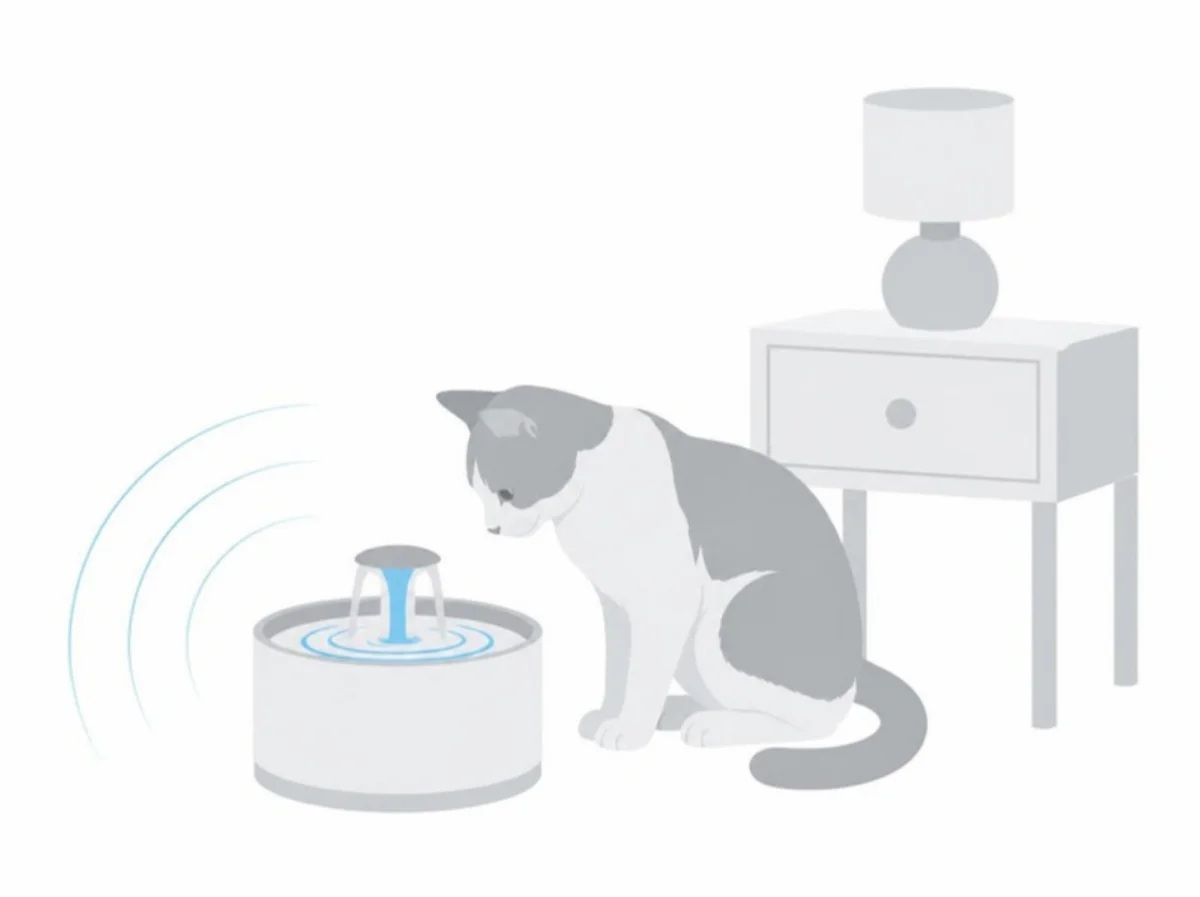
Water is behind most of the fixes that fountain makers print for a noisy fountain. Every noise answer from PetSafe, Pioneer Pet and PETLIBRO used for this page checks the water level, and most check it first. The motor comes second, and the floor under the bowl third.
That holds for cat and dog fountains alike, plug-in or cordless. What follows takes each sound in turn, from gurgling to buzzing, rattling, dripping and a pump that starts and stops on its own, using support articles, FAQs and manuals from PetSafe (Drinkwell and Outlast), Catit, PETLIBRO, PETKIT, Pioneer Pet and HomerunPET. The short version, with the decibel claims, sits in our quietest pet water fountain guide.
Some makers are missing. Veken's site did not load for us in November 2026, and PETKIT's help center refused our connections, so PETKIT appears only through its printed manuals.
The makers describe faults and fixes, not sounds. The sections below match the noises owners describe, such as buzzing or gurgling, to the problems the makers do name, and say so where the match is our reading.
Which sound points to which cause?
The sound narrows the search. Gurgling and slurping point to the water level, buzzing or grinding to the impeller, rattling to the surface or the pump's footing, and dripping to the filter, the tray or the height the water falls.
| What you hear | Where the makers point | First thing to try |
|---|---|---|
| Gurgling, slurping, sucking | Water too low for the pump | Refill, keeping at least 1 inch over the bowl base on a Drinkwell |
| Buzzing, humming harder, grinding | Hair, debris or scale on the impeller | Take the pump apart and clean the impeller and its well |
| Rattling or vibration | Hollow floor, loose suction cups, missing pads | Level floor, a rubber mat, a reseated pump |
| Steady dripping | Clogged filter, a tray that drains, a loose pipe | Replace the filter, check the tray seal, reseat the pipe |
| Splashing | Flow set high, debris in a spout | Turn the flow down, brush out the spout |
| Runs, stops, runs again | Sensor, intermittent or flush modes, low-water cut-off | Check the mode and the water light |
Pet fountain makers print quietness claims without a measuring distance, and our guide sets those out. Catit even uses the water as an alarm on the PIXI Mini: "As the level drops, the flowing water becomes more audible, giving you an early reminder to top up."
A gurgling fountain is short of water
Gurgling or slurping usually means the water has dropped close to the pump, which then struggles to pull water in. PetSafe opens every one of its fountain noise articles with this check.
The wording is the same across PetSafe's articles for the Drinkwell Platinum, the ½, 1 and 2 gallon Drinkwells, the Mini, the Multi-Tier and the Outdoor Dog Fountain. If the level is too low, "the pump may struggle to draw water, creating noises." The floor is fixed too: "Never let the water level fall below 1 in. from the base of the bowl." On the Platinum the check takes in the reservoir as well, and on the Mini and Multi-Tier the filter housing.
Pioneer Pet's FAQ heads its noise answer "ALL FOUNTAINS" and starts in the same place: "A low water level can damage the pump and will cause noise." Catit's Flower Fountain Q&A says the water should always reach the wavy line in the plastic rim. PETLIBRO's steps for the original Dockstream and the Glacier include a refill to the maximum line. Our pet fountain guide quotes PETLIBRO and Catit on this at more length.
Running dry is when pumps fail
A pump left in a dry bowl is at risk, and PetSafe ties its 1 inch rule to exactly that. The Platinum pump article repeats it with a reason: keep the water up "to avoid pump failure."
Newer fountains cut the pump before that point, which explains a fountain that goes silent with water still in it. Catit's PIXI Stainless Steel UV-C Q&A answers that complaint directly: "When the water level drops below 30%, the pump will stop running to protect the fountain from damage." A refill starts it again.
The cut-offs signal themselves in different ways:
- PETKIT EverSweet Solo 2: a flashing blue light means water shortage and standby, according to its manual.
- PETKIT EverSweet Max 2: the water shortage light flashes red and goes off after a refill.
- PetSafe Outlast pumpless fountains: the motor stops and the status light glows solid red until the fountain is filled to the max line.
- Catit Easy Clean Flower Fountain: a blinking red light means low water.
That last one has a quirk. If the Easy Clean will not restart after a refill, Catit's Easy Clean Q&A has owners lift the reservoir off the base "for at least 5 seconds before lowering it back into place."
Why is my fountain pump buzzing or grinding?
A fountain pump that buzzes, hums harder than it used to or grinds most likely has something on or around its impeller: pet hair, food, slime or hard-water scale. Taking the pump apart and cleaning the impeller is the remedy PetSafe, Catit, PETLIBRO and Pioneer Pet all print.
Most small fountain pumps turn a little impeller inside a chamber, and on PetSafe's pumps a magnet holds it in. "The impeller is held in place by a magnet," reads PetSafe's pump disassembly article, so it may resist a little as you pull it out. Its order is faceplate, then stator, then impeller. In hard-water areas it warns of "white mineral deposits on or down inside the pump," which "may eventually prevent the impeller from turning properly."
The cleaning is plain. Mild dish soap and warm water go on every part. Mineral build-up gets a 50/50 mix of water and white vinegar "for at least 15 minutes before scrubbing," and bleach is ruled out. A film can also form "in the pump opening or the impellor compartment, restricting water flow or impeller movement," according to the weak flow article for the gallon models.
How often? PetSafe's general pump cleaning article says "at least once a month," adding that multi-pet households may need every 2 weeks. Pioneer Pet's answer is once a month or at every filter change, removing the impeller and clearing "pet hair, food particles or other debris." Once the impeller is back in place, its FAQ says to "spin it a few times."
Catit's answers point the same way. For the PIXI Stainless Steel UV-C, its explanation of a noisy pump is "Small foreign objects may have entered the pump," fixed by stripping and cleaning it. The same model has a sponge on the pump that "helps prevent hair and debris from entering the pump," and Catit asks owners not to throw it away. On the Flower Fountain, hair and debris make the pump "less powerful", and older Flower pumps have a slider that should sit on the + side for full flow.
Aquarium filters suffer the same impeller troubles, and our page on aquarium pump noises covers them in more depth.
A broken shaft will not clean up
Some noises outlast any cleaning because a part has broken. PETLIBRO's first step for a loud original Dockstream is to take the pump rotor apart, check that the shaft is intact and clean the pump.
PETKIT's EverSweet Max 2 manual names the usual way that happens. Dropping the pump while cleaning "may cause the internal ceramic shaft to break, resulting in product damage." Cleaning cannot put a broken shaft right.
A new pump that hums and moves no water
Out of the box, a pump can arrive with its impeller loose. "Occasionally the impeller inside the pump can become disengaged during shipping," Pioneer Pet's FAQ explains, and running through the manual's motor maintenance steps resets it. Catit's Easy Clean Flower Fountain flags the same fault with a solid red light, meaning the impeller "is likely jammed or missing."
Rattles and vibration come through the floor
A fountain that rattles or drones is usually passing pump vibration into whatever it stands on. The fixes makers print are a flat, level spot, something soft underneath, and a pump that is firmly seated in the bowl.
Every PetSafe noise article asks for "a flat, level surface." Each also suggests a mat: "Place the fountain on a rubberized mat or something similar if the fountain is vibrating on the surface where it is placed."
Catit is specific about the floor. Its Flower Fountain Q&A puts the fountain on the floor rather than a table or countertop and adds, "A wooden floor will naturally be noisier than a concrete floor or tiles." A Catit magazine piece suggests the brand's own placemat where tile is not an option.
Inside the bowl, the pump's footing matters. For its stainless steel and ceramic fountains, Pioneer Pet asks owners to check that the suction cups under the pump housing are "sticking to the bottom of the fountain bowl" and that none are missing, and that the pump spout lines up with the spout of the housing. PETLIBRO's Glacier checklist looks for 4 black pads under the filtration unit, no gaps around it, and a power cord "properly fixed in the cord slot."
Why is my cat fountain dripping?
A dripping sound is water falling into the bowl from a height. The makers trace it to a clogged filter, a tray that drains too quickly, a loose water pipe, or a level low enough to lengthen the fall.
PETLIBRO gives four steps for its Capsule Dog Water Fountain. Fit a fresh filter, fully soaked first, and change it every two weeks, sooner with more than one dog. Check that the pump, blue water pipe, serving tray and tray base are properly attached. Keep the water above the minimum line. Then pull the blue pipe up slightly so it meets the tray more closely, which PETLIBRO says can cut the noise.
The original Dockstream gets its own test for a dropping sound. With the fountain off its base and the tray refilled, the tray should hold water "for nearly 4 hours." If it empties in a few minutes, the filter box is not sealed to the steel tray, and PETLIBRO advises against taking the filter box apart, since the seal is built in.
Filters slow the flow when they clog. "Dirty filters will not allow water to flow easily through them," PetSafe's weak flow article states. On the Platinum, hair caught in the pre-filter and a cracked reservoir that lets air in both appear in the overflow article, which also notes the fountain will run without the reservoir as a test.
Splashing from a stream that is too strong
A fast or long stream splashes however quiet the pump is. On the PIXI Mini, Catit's tip is "Turn the spout sideways to reduce water noise."
Several fountains let you tame the stream itself:
- PetSafe Outdoor Dog Fountain: turn the flow control dial on the pump down by rotating its tab downwards.
- PetSafe Drinkwell Butterfly: remove the butterfly topper for "a quieter, bubbling water flow", according to the product page.
- Pioneer Pet stainless steel and ceramic fountains: a flow lever on the pump sets the strength.
- Pioneer Pet Swan: the lever works best in the middle, between the minus and plus signs.
Pioneer Pet calls debris stuck inside the Swan's neck "the most common cause of noise and splashing." A drinking straw brush, bottle brush or pipe cleaner clears it, and the white rubber directing tube should be in place.
Cordless and smart fountains run to a schedule
A battery or app fountain that starts, runs briefly and goes quiet is usually doing what it was set to do. Intermittent modes, motion sensors, timed flushes and low-water cut-offs all switch the pump on and off.
PETKIT's EverSweet Max 2 shows how much varies with the power source. Plugged in, its intermittent mode defaults to "dispense water for 3 minutes and stop for 3 minutes." On battery, "the water is pumped for 25 seconds per hour by default," and the mode cannot be switched. A pause set in the app ends by itself after 10 minutes.
HomerunPET's BF10 adds a hair flush: "a 2-min water flow comes out every 12 hours in Sensing and Intermittent modes." A short burst at night with no cat nearby can be that.
Sensor fountains wake when a pet comes close. The PIXI Stainless Steel UV-C watches a 120° area and reacts within 1 m (3.3 ft). After a power cut it comes back in sensor mode.
Pumpless fountains change pace too. On the PetSafe Outlast, "the fountain motor will slow down slightly at night when the room is dark and will speed up again during the day." A different note after dark is by design.
When the pump itself is worn
A pump that still struggles after a full clean, a refill and a level surface may simply be worn out. PetSafe and PETKIT both treat the pump or motor as a replaceable part.
For a Platinum pump that still fails after cleaning, PetSafe writes, "you may need to replace it." The Outlast motor wears with use, "which over time may cause the motor to stop functioning properly," and a replacement motor is sold separately. PETKIT's Max 2 manual says pump service life "may vary depending on different usage and maintenance" and to fit a new one if needed. It also asks that "Repairs should only be performed by professionals."
If a clean, full, level fountain still makes a sound you cannot place, contact the maker's customer care. Each PetSafe support article cited here ends with a link to its customer care team.
More on pet gear and pump noise
To compare fountains by their printed claims, start with our quietest pet water fountain guide. For the rest of a pet corner, there is the quietest litter box guide, and fish keepers have the quietest aquarium pump guide.
Pump sounds in water features follow similar rules, covered in pond pump noises. For a fountain in the room where you sleep, see the quiet bedroom page, and for anything that has crept louder with age, why your appliance got louder.