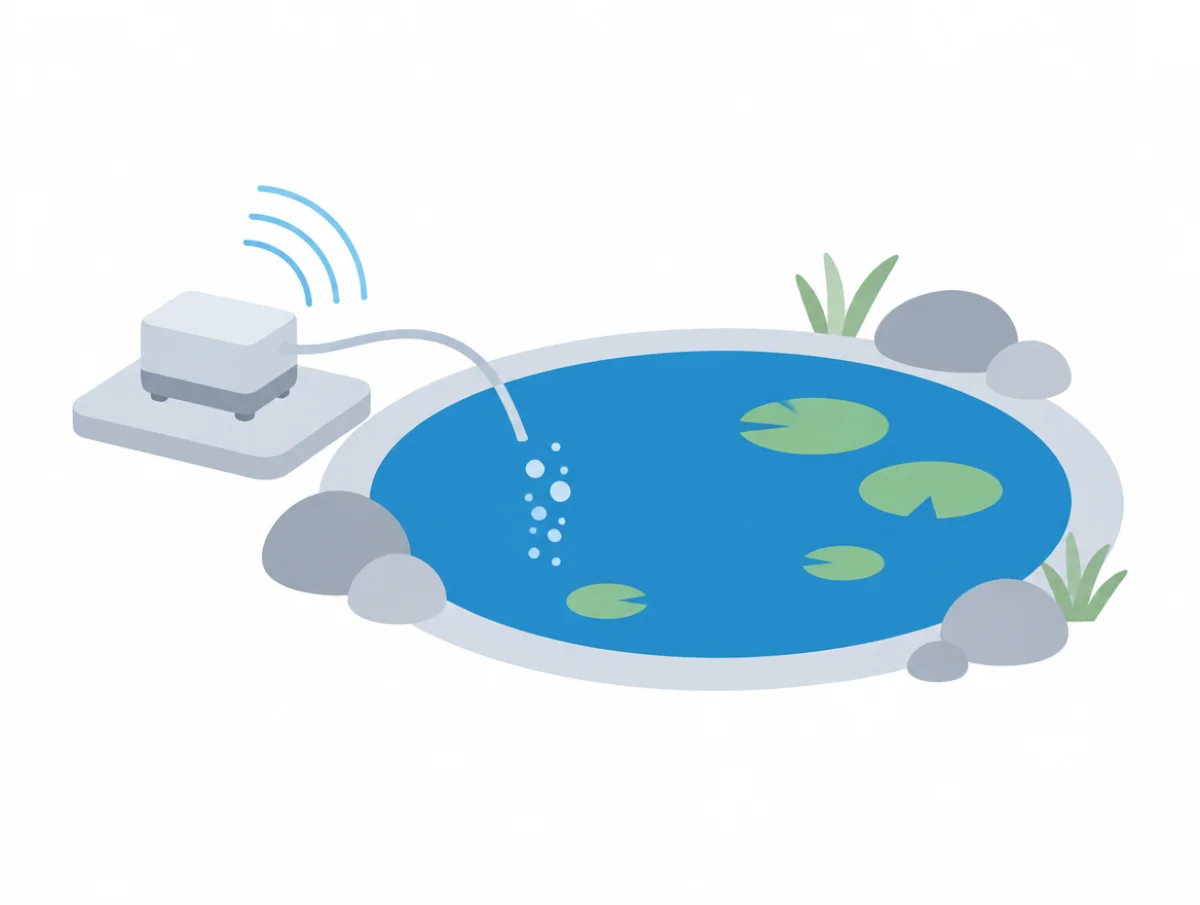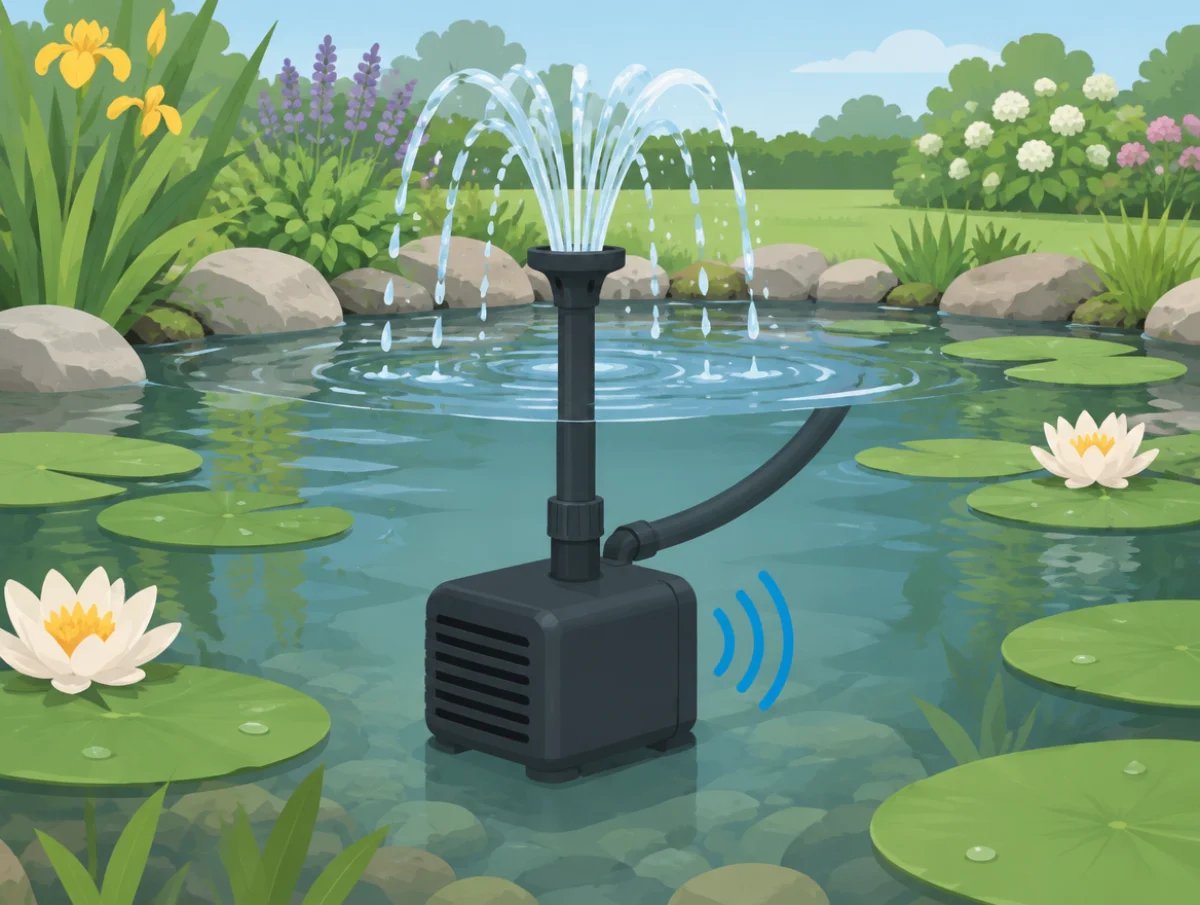
A steady hum is the sound of a pond pump at work. Aquascape reads silence as the warning sign: a pump that makes "no humming, vibrating, or operating sound may not be receiving power." Gurgling and buzzing point to low water or air at the intake, and rattling or grinding to debris, a damaged impeller or a broken ceramic shaft. On the bank, an air pump that grows louder usually has a clogged filter or tired diaphragms.
This page covers submersible water pumps, external pumps that sit beside the pond, and the air pumps that feed diffusers. The causes and fixes come from support articles and manuals by Aquascape, OASE and its Atlantic Water Gardens brand, Danner (Pondmaster), EasyPro, Airmax, Hiblow and MDM, which makes Sequence pumps. We found no noise guidance from Little Giant, TetraPond, Laguna, Beckett or Pond Boss in the manuals and support pages we could reach.
Two files are retailer copies, since we found no maker-hosted version: OASE's US AquaMax Eco Premium instructions and MDM's ValuFlo 750 manual. We could not tie the server holding the Airmax manual to Airmax itself.
Which sound points to which part
| What you hear | Usual cause in the maker guidance |
|---|---|
| A steady hum | Normal running |
| A hum with little or no water moving | A clogged, stuck, scaled or broken impeller |
| Buzzing, gurgling or grinding from a small kit | Low water, with the pump pulling in air |
| Rattling and vibration from a Mag-Drive | A broken ceramic shaft, debris in the volute or worn end caps |
| Bubbles and sputtering at the waterfall | Trapped air, low water or a leak on the suction side |
| Loud running from an external pump | Cavitation, usually from the suction plumbing |
| A louder, rattling or knocking air pump | A dirty inlet filter, a blocked airline or worn diaphragms |
A hum means the pump is running
None of these makers presents a silent pond pump as normal. Aquascape's article on its AquaSurge and SLD pumps treats silence as a power fault and sends owners to the GFCI, the outlet, the plug and any controller or receiver. Once the pump "can be heard humming, running, rattling, or making another sound," the same article moves the search from electricity to the water supply.
Some pumps change their sound on purpose. At start-up an OASE AquaMax Eco Premium "runs through various speeds" during a self-test of about two minutes, checking whether it sits under water or is running dry, according to the US operating instructions. A brand-new one "will only achieve its maximum capacity after several operating hours."
Why is my pond pump humming but not pumping water?
A pond pump that hums without moving water usually has a clogged, stuck or scaled impeller, or too little water reaching its intake. Aquascape, EasyPro and Danner all begin with the intake and the impeller chamber.
"If your AquaSurge pond pump has reduced water flow or hums without pumping water, the impeller may be clogged, obstructed, or damaged," reads the AquaSurge impeller article. Unplug the pump, lift it out, take off both intake screens and the water chamber cover, then clear "debris, string algae, or other obstructions" and look for broken or worn blades. The AquaJet troubleshooting page adds "debris wrapped around the impeller" and a check that the pump gets its 120 V AC supply.
Hard water causes the same symptom more slowly. Aquascape's scale article lists "The pump hums but produces little or no water" and "The impeller becomes difficult to rotate or remove" among the signs. Danner's Mag-Drive 24/36 instructions want the magnet impeller cleaned of scale "at least once every three months", more often in hard or salt water. Atlantic's TT-Series manual takes the crusty film off with a scrub brush and white vinegar.
EasyPro's Eco-Clear manual files the case under "Running, no water": obstructions, "Check if impeller is broken or stuck", a lift too high or a pipe too small, a dirty filter, low water. The Danner FAQ adds two more. One is inlet and outlet hoses swapped. The other is "Trapped air inside the volute. Pump needs to be primed."
A pump that hums, stops and later restarts may be protecting itself. The AquaMax switches off after about 90 seconds when it runs dry or is blocked and keeps trying to start at intervals. Atlantic's TT pumps cool the rotor through a steel screen behind the impeller, and "If the screen becomes blocked the pump may overheat."
Rattling and grinding come from inside the volute
Danner answers the question directly. Its FAQ asks "Why is my Mag-Drive pump noisy and vibrating?" and gives three causes: "The ceramic shaft has broken", "Debris is caught inside the volute", and end caps worn so that one is "spinning inside it’s socket", a socket that is octagonal when new and turns round with wear.
A dropped pump is the usual story behind a broken shaft. Danner's FAQ calls ceramic shafts "extremely hard but unfortunately also brittle", liable to break "from a sudden shock". The whole impeller assembly then has to be replaced "immediately before it causes further damage to the magnet and eventually the entire inside cavity of the pump."
Atlantic builds a monthly check around the same sound. Spin the impeller by hand, and if it is hard to turn, feels gritty, or "a grinding noise is evident in the rotor chamber", take the rotor out and clean it. Running at low water or with a clogged inlet "may cause noise, heavy vibration, and pump failure," the TT manual warns, so clear the inlet before blaming the motor.
Impellers wear out on their own schedule. OASE calls the AquaMax impeller unit "a wearing part" outside the warranty, and Danner covers impellers and internal moving parts for one year against five for the pump body.
Why does my pond pump gurgle?
A pond pump gurgles when it draws air, most often because the water around it has dropped or the intake is blocked. Aquascape treats gurgling as an early sign of running dry.
On its small AquaGarden kits, Aquascape puts noise down to low water "almost always". The chain runs from falling water to air, "The pump begins to pull in air", and then to sound: "This creates a buzzing, gurgling, or grinding noise," according to the fountain kit article. The fix is to "Add water immediately until the pump is fully submerged". EasyPro has the same entry for the Eco-Clear: "Low water conditions with pump sucking air".
Bubbles at a waterfall have a longer list. In Aquascape's waterfall plumbing article the causes are trapped air, low water, a restricted intake, or air getting in through loose fittings "on the suction side of the plumbing." A little air after a restart is normal and clears as water circulates. Continuous bubbling, falling flow or "unusual pump noises" are not, and air pockets that never clear "may require adjustments to the plumbing layout."
Pumps fitted inline need water before they start. Danner's Mag-Drive and Hy-Drive pumps are not self-priming, and the ZG140 sheet is blunt: "Unless the air can escape from the outlet, the pump will not start."
Running dry is the expensive mistake
A pond can be full while the pump starves. Aquascape's run-dry article counts blocked flow as well as low water: build-up on the intake, skimmer baskets full of leaves, filter mats left to clog.
The noise comes late. "Do not wait until you hear the pump gurgling or see reduced water flow to add water or perform maintenance," Aquascape writes. "Hearing the pump gurgle or make unusual noise indicates it is already at risk of operating under low water flow conditions."
The damage Aquascape pictures runs from scratches and "Black marks on the rotor and ceramic shaft" to ceramic bearings knocked out of place by heat and a pump body that may bulge or warp.
That damage is a cost to the owner. Dry running is "generally not covered" by Aquascape's limited warranty, its warranty article explains, because it comes from operation rather than a defect, and EasyPro says running an Eco-Clear low on water will void its warranty.
Danner's Mag-Drive and Hy-Drive pumps "will overheat and seize" if run dry, and its 24/36 sheet allows only that "after 30 minutes damage may occur". Atlantic adds a habit to avoid: "Repeating cycles of stopping and restarting will damage the water pump."
External pumps get loud at the suction side
An external pump that runs loudly is most often cavitating. In MDM's ValuFlo 750 manual, cavitation heads the "Excessive Noise" row, and the fixes start on the intake side: "Verify airtight plumbing on the suction plumbing especially fittings!", clear the basket strainer, "Increase pipe size where possible", and "Decrease suction pipe length, reduce the number of elbows, etc." The last checks that pump and pipe suit the system.
Placement does much of the work. EasyPro's EXP installation tips open with "Position the pump as near to the water and as low as is practical", which helps it "avoid cavitation". The pump should sit no more than 9 feet above the water, and EasyPro is firm about one part: "Do not use spring loaded check valves!"
Aquascape's numbers for its EXT pumps are tighter. It suggests keeping the 3 inch suction line at 10 feet or less, with the inlet no more than 3 feet above the water surface. Air leaking in at any connection, including the threaded union above the check valve, can stop it priming. After a failed priming attempt, let the pump cool for a few minutes before the next, so cold water does not shock the warm mechanical seal.
Heat matters for the motor too. Aquascape wants the EXT motor shaded from direct sun and any enclosure well ventilated, and MDM lists poor ventilation as a cause of sporadic running.
Vibration travels through pipes and mounts
Rigid plumbing passes a pump's vibration along, and two makers say the pump should not carry the pipe. The Danner pump cover "is not designed to support long pipe runs or correct pipe misalignment," and EasyPro wants the plumbing on its external pumps "self supported and properly aligned."
Small kits rattle when they sit badly; Aquascape's noisy fountain kit page lists "Vibration from improper placement" with low water and air. Air pumps need a firm base. Aquascape asks for "a solid, level surface" with the rubber feet intact under a Pro Air, EasyPro wants its KLC compressors "placed horizontally on a strongly built surface", and Airmax mounts its PondSeries compressors on rubber to cut noise and vibration.
Shaking can open the air line as well. The Airmax troubleshooting table blames missing bubbles at some diffuser plates on a "Vibration loosened connection or cracked fitting" and suggests a little soapy water on each joint to find it.
Nothing we read covers a submersible pump humming through the pond liner or the ground around the pond. The makers stop at the pump's own base and plumbing.
Why is my pond air pump so loud?
A pond air pump gets louder when it struggles for air or wears inside: a dirty inlet filter, a kinked airline, a clogged diffuser or worn diaphragms. Aquascape and Airmax both start with the filter.
The Pro Air "should operate relatively quietly," in Aquascape's loud noise article, and "A new rattling, buzzing, knocking, or unusually loud vibration may indicate restricted airflow, excessive vibration, or wear inside the compressor."
The checks run in order: clean the intake sponge, look for kinks and blocked diffusers, check the footing, inspect the diaphragms. Internal knocking "may indicate worn or misaligned internal components." Aquascape's aerator guide adds that the Pro Air manuals call for a filter check "annually, whenever abnormal noises occur, and more frequently in dusty conditions."
Airmax's table in the PondSeries manual is short. "Compressor running louder and possible excessive vibration" leads to "Compressor air filter is dirty/clogged", with the instruction "NEVER re-install wet filter." Unusual noise with weaker air means the compressor "needs maintenance kit and possibly new air filter."
For "loud, irregular noise" from a KLC, EasyPro's manual lists "Diaphragm damaged", "Faulty valve" and "Valve chamber cover out of place", and the remedy is to exchange the casing or diaphragm block.
A Pro Air with an arm rubbing its magnet has a diaphragm problem: worn, stretched or badly seated diaphragms, or loose center hardware. "The internal slider or arm should not normally rub against the magnet during operation," the slider article reads.
A rebuild can make things worse. Hiblow's FAQ warns that knock-off repair kits are not to spec, so "the air pump can run significantly louder." If the kit is genuine, it asks: "Did you tighten all the nuts and bolts when installing the rebuild kit? Are the internal “L” tubes secured?"
Diaphragms wear, and back pressure speeds it up
Linear air pumps have rubber parts that fail on a timetable. EasyPro says "Change diaphragm once a year" for the KLC, and Airmax recommends a maintenance kit every 12 to 18 months for PondSeries compressors. OASE says the AquaOxy's diaphragms "need to be replaced occasionally", always in left and right pairs, and counts them as wear parts outside the warranty.
Resistance in the air line wears them faster. "Excessive backpressure will prematurely damage the diaphragm causing more frequent repair," the KLC manual warns, naming restrictive tubing, undersized or clogged diffusers, wrong valves and deeper water. Hiblow's explanation for a replacement that lasted half as long is the same: clogged diffusers whose back pressure "may be exceeding the design pressure for the pump model you are using."
Leave the check valves alone. Aquascape tells aerator owners not to remove them to bypass a weak airflow problem, since they keep pond water from siphoning back into the pump. Hiblow's ideal spot for the pump itself is "A cool and dry location out of the sun".
Cold weather and freezing
None of these makers describes a winter sound as such. Their cold weather guidance is about ice that blocks air or water, which is when pumps start to labor.
Air lines freeze from the inside. "In the winter damp air can condense on the inside wall of the hose. This can freeze and eventually block the hose completely," the KLC manual reads, so check tubing often in freezing weather. Airmax's cure for a frozen PondSeries line is "1 cup isopropyl alcohol in the airline running out to each plate", then running the compressor to push the blockage through.
Water pumps need flowing water. Aquascape lets a pump run through winter if ice does not stop water reaching it, and asks owners to pull the pump during a power cut in freezing weather. When plumbing has already frozen, it says to "not restart the pump until the plumbing has completely thawed and you have checked for damage."
Danner allows winter running "as long as it is not subjected to freezing conditions." Atlantic says that "Under no circumstances should the pump be left in frozen water", and a TT pump left in the pond should run about once a week. The AquaMax is rated frost resistant to -4 °F, while the AquaOxy air pump is stored somewhere frost-free.
An aerator kept on in winter belongs in shallow water. Aquascape puts the Pro Air diffuser about 1 to 1.5 feet below the surface, away from the deepest point where fish overwinter. Airmax warns that ice near running diffusers will be much thinner than the rest.
Sometimes the loud part is the waterfall
A waterfall's sound, in Aquascape's waterfall design article, depends on "the height of the drop, water flow, spillway width, and the rocks below the falling water." Drops of about 2 to 6 inches sound softer, and "Drops of 12 inches (30 cm) or more generally produce louder splashing." More flow means more volume; wider spillways and well placed rocks soften and spread the sound. A plunge waterfall, falling straight from a ledge, is "usually one of the loudest designs."
Too much pump cannot be fixed with a valve on Aquascape's PL and PN pumps. A ball valve "should not be partially closed to control or reduce the flow", its ball valve article explains, and a smaller pump matched to the flow is the answer.
When to switch off and call the dealer
Several manuals tell owners to stop first and ask questions after. "In case of excessive vibration, unusual noise or odor, turn off the power immediately and consult your nearest dealer," reads Atlantic's TT manual. Airmax goes further: "Never operate the system if unusual noises or odors are detected. Disconnect the power cord from the outlet and call for service."
A broken ceramic shaft on a Danner pump means replacing the impeller assembly at once. An Aquascape pump that stays silent with confirmed power goes to Customer Care or a dealer, and a Pro Air whose arm keeps touching the magnet after new diaphragms should be taken out of use and referred to Aquascape Technical Support. For KLC faults outside the table, EasyPro's advice is to "contact seller or manufacturer for advice".
Disconnecting power comes before any of these checks in the Aquascape, Atlantic, OASE, EasyPro, Danner and Airmax instructions. Atlantic adds that no hand or object should go near the inlet while the pump runs, and OASE asks that power to all units in the water be cut before anyone reaches in.
How loud should a pond pump be?
Submersible pond water pumps come with no noise figure from any maker we checked. Pond air pumps carry figures between 35 and 48 on their makers' sheets, each measured a different way.
In our quietest pond pumps guide, EasyPro's KLC series runs from 35 to 42 dB with no distance stated, Hiblow's pond units between 40 and 48 dBA at one meter, and Pondmaster's AP air pumps 40 or 45 dBA. Because the three bases differ, EasyPro's 35 does not prove a quieter pump than Hiblow's 40; our page on comparing decibel ratings shows why. The decibel chart sets 40 dB beside everyday sounds.
A pump that has drifted louder over the years, with nothing above to explain it, may be wearing in the ways covered in why appliances get louder.
More on pumps and a quieter garden
Indoor cousins of these pumps, from tank air pumps to canister filters, are on the aquarium pump noises page. A pump drawing from a well rather than a pond has its own clicks and cycling, covered in well pump noises, and a pool pump near the patio is handled in how to make a pool pump quieter. For the rest of the yard, from mowers to blowers, see yard work noise.