Clicking every few seconds is the well noise most worth catching early. Goulds, Flotec, Sta-Rite and Wayne all trace a pump that starts and stops that often to a waterlogged pressure tank or a low air charge, and every start wears on the motor.
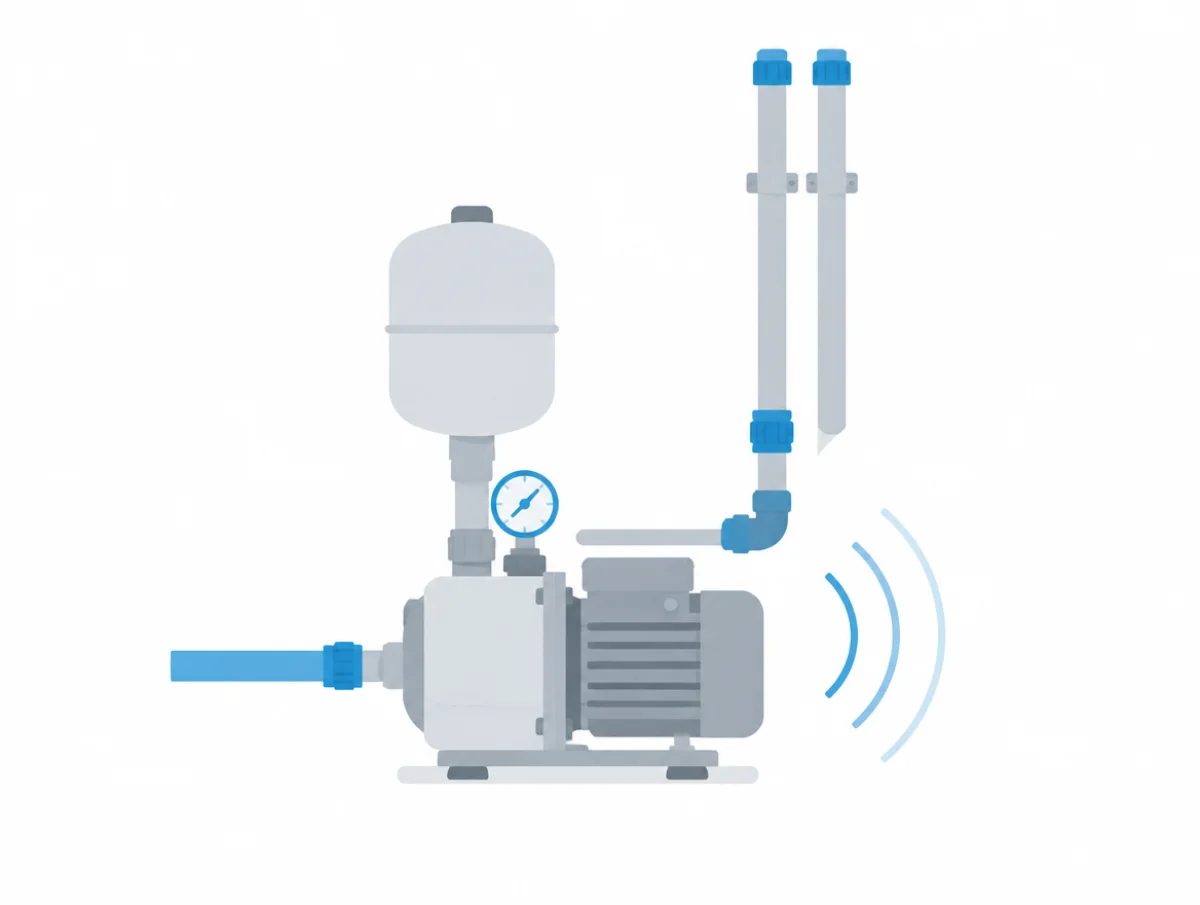
A home well system has three parts that make noise. The pump is either a jet pump in the house or a pump house, or a submersible pump down in the well; a pressure tank stores water under an air cushion; and a pressure switch turns the pump on and off. Clicking that never stops is usually the tank or switch. Humming, a gravel sound or running with no water points at the pump or the well, and banging in the pipes is a valve or check valve problem.
The causes and remedies below are the ones Goulds (Xylem), Franklin Electric, Red Lion, Wayne, Grundfos, Flotec, Sta-Rite (Pentair), Amtrol and Square D print in their manuals and support pages.
Six sounds and what usually causes them
| What you hear | Usual cause in the makers' tables |
|---|---|
| Clicking on and off every few seconds | A waterlogged tank, low air charge or bad switch setting |
| Rapid buzzing or clattering at the switch | Switch chatter from where the switch sits |
| A hum with no pumping | Voltage, wiring or a seized motor |
| Running with little or no water | Lost prime, a low well or an air bound pump |
| A sound like gravel | Cavitation or over pumping the well |
| A bang when the pump stops | Water hammer from a missing or failed check valve |
Whining and squealing are missing from the table on purpose. None of these makers explains a well pump that whines or squeals, so those two sounds stay without an answer here rather than one borrowed from forum posts.
Why does my well pump turn on and off so often?
That is short cycling. Under "Pump starts too frequently", the Goulds service manual lists six causes: "Waterlogged tank", "Check valve broken or stuck open", "Improper switch setting", "Improper switch placement", "Leaks in piping" and "Tank too small for pump." Wayne adds kinked air volume control tubing and a "Ruptured disphragm/bladder (pre-charged tank)", and its remedy for that one is "Replace tank."
Grundfos treats it as a switch problem. Frequent starts and stops can mean "The differential of the pressure switch between the start and stop pressures is too small," according to the SQ manual, and the fix is "Increase the differential."
Tank size matters for a simple reason, which Amtrol spells out: "The larger the well tank, the greater the drawdown capacity, the less the pump needs to run." Pump choice can play a part as well. A pump that does not match the job's flow, head, lift or duty cycle "can lead to short cycling, excessive runtime and premature motor wear," Franklin Electric warns.
Checking the tank's air charge
Every maker here that gives a figure sets the air charge just under the switch cut-in. "The pressure should be 2 psi below the pump cut-in pressure," so a 30 to 50 psi system uses 28 psi on Goulds' numbers, and Amtrol's example is "38 psig precharge for a 40/60 pressure."
Flotec's steps begin with "DISCONNECT POWER and open faucets until all pressure is relieved." Read the air valve with a tire gauge and, if it is low, add air "until air pressure is 2 PSI less than cut-in setting of switch." Sta-Rite's SN manual prints the same steps, and the Flotec tank manual adds a schedule: "To prevent waterlogging, check tank air charge annually."
A tank that will not hold air has usually failed inside. On a waterlogged pre-charged tank the "bladder is normally leaking or broken," Wayne explains, the air valve "will expel water if the bladder is broken", and "The tank must be replaced."
Where Amtrol disagrees
Amtrol, which makes the Well-X-Trol tank, does not want owners pumping air into a tank that has started short cycling. "DO NOT ADJUST THE PRE-CHARGE PRESSURE IF THERE HAS BEEN A REDUCTION OF THE PUMP CYCLE TIME," its manual reads, because lost air "CAN MEAN THERE MAY BE INTERNAL CORROSION". Adding pressure to such a tank could "RESULT IN RUPTURE OR EXPLOSION", and "ONLY QUALIFIED PROFESSIONALS SHOULD CHECK, ADJUST OR RE-CHARGE THE PRE-CHARGE OF TANKS."
The pump makers give owners the tire gauge steps. Amtrol does not. Follow the instructions printed for the tank you actually have.
Why is my well pressure switch chattering?
The switch is reading a different pressure from the tank, usually because it sits too far away or behind a restriction. "Locating the switch more than 4' from the tank will cause switch chatter."
That line is from the Goulds submersible manual, which also says "Do not install valves, filters, or high loss fittings between the switch and the tank(s) as switch chatter may result." Its example is a 1 1/4 inch spring check valve, which loses as much pressure as 12 feet of pipe, so placing one between switch and tank "will create switch chatter."
Two causes appear in the Goulds service manual. A pressure difference between switch and tank gets the fix "Move pressure switch to tank cross tee". For the second, "High volume flows can cause switch chatter," the suggestion is a pressure pulsation plug from the switch maker, but "use only if absolutely nothing else works and water is clean."
The lines from pump to tank and switch "should be the same size to prevent switch cycling," Amtrol adds. With tanks set side by side, the switch belongs "as close to the center of the tanks as possible."
Adjusting or replacing the switch
Worn contacts or wrong settings can make a switch cycle by themselves. Flotec's chart has "Pressure switch is out of adjustment or contacts are welded together", with the fix "DISCONNECT POWER; adjust or replace pressure switch."
On the 9013FSG, set cut-in first by turning "the large range nut down for higher cut-in pressure (clockwise)", then set cut-out with the smaller differential nut, according to Square D's support page. Turning that nut clockwise "increases the differential between cut in and cut out", which is the change Grundfos recommends for frequent starts.
A hum with no pumping is usually electrical
Either the supply is wrong or the motor cannot turn. Wayne's chart gives four causes: "Line voltage does not match selector switch", "Inadequate wiring", "Damaged or misalignment causing rotating parts to bind" and "Low supply voltage". Binding parts call for "Replace or take to service shop for repair." Low voltage gets a shorter answer, "Contact an electrician."
In the Goulds service manual, a jet pump motor that has stopped on its overload comes back by itself: "Overload contacts will close automatically in a short time." For submersible pumps, Goulds sends a tripped thermal protector, low voltage, a faulty control box and damaged cable to the same place, "Have a qualified electrician inspect and repair, as required."
Why is my well pump running but no water is coming out?
A jet pump has usually lost its prime. A submersible is short of water or air bound. In either case Flotec's first step is to "Stop pump; then check prime before looking for other causes."
Jet pumps lose prime through "Air leaks" or a "Water level below suction pipe inlet," in Flotec's list, and a well with more than 25 feet to water needs a deep well jet. While priming, pause "every 5 minutes to cool pump body" and refill the pump as needed, Wayne advises. Red Lion lists "Well draws down too far" under a pump that loses prime, with the fix "Move pump closer to water source", alongside air leaks in the suction line and a faulty foot valve.
Submersible pumps
"Pump air bound" is on the Goulds submersible list, fixed by "Successively start and stop pump until flow is delivered." If that does not cure it, the well "contains excessive air or gases". A pump that is not fully under water gets "Check well recovery, lower pump if possible."
Franklin Electric's drive FAQ describes the same fault from the controller's side: "System is drawing down to pump inlet (out of water); over-pumped well; well is running dry". For gas, "If possible, set deeper in well to reduce possibility of air/ gas locked pump."
Running dry damages the pump
Flotec, Red Lion and Wayne all say never to do it. "Running pump without water may cause pump to overheat, damaging seal and possibly causing burns to persons handling pump," is Flotec's warning.
A dry pump's surface "will rise to a high temperature that could cause skin burns if touched, and will cause serious damage to the pump," according to Red Lion, and Wayne adds the warranty: "Do not run the pump dry or damage will occur and will void warranty."
A closed outlet is just as bad. "Never run pump against closed discharge. To do so can boil water inside pump, causing hazardous pressure in unit, risk of explosion and possibly scalding persons handling pump." Goulds puts the reason in one line, "A dead headed pump will super heat water very quickly, and hot water has no lubricity."
Pumps that protect themselves
Some pumps stop on their own. An SQ pump that "has been stopped as a result of dry running, it will start automatically after 5 minutes", and "If the pump is restarted and the well has not recovered, the pump will stop after 30 seconds." A Grundfos pump that runs, stops and tries again on that rhythm is short of water.
Franklin Electric sells Pumptec, a monitor that provides "protection against dry well conditions, waterlogged tanks, and abnormal line voltage conditions." For driven wells that sometimes run low, Red Lion's advice is to "Have an electrician replace the pressure switch with a low pressure cut-off switch to prevent pump damage."
Why does my well pump sound like it is pumping gravel?
It is cavitating. Wayne prints the symptom word for word as "Pump cavitates, sounds like pumping gravel" in both its CWS and SWS50 manuals, with the fix "Increase suction plumbing diameter or decrease pipe friction."
Over pumping is the related cause. Sta-Rite's jet pump manual lists "Intermittent over-pumping of well. (Water drawn down below foot valve.)" and the fix "Lower foot valve if possible, otherwise restrict pump discharge". Goulds lists "Overpumping the well" too, and the vacuum on a shallow well system "should not exceed 22 inches at sea level." On a submersible the warning sign is a sudden drop in flow: "If the flow rate suddenly falls, the reason might be that the pump is pumping more water than the well can yield. The pump must immediately be stopped and the fault corrected." That last instruction is Grundfos's.
Air spurting from the taps
Sputtering faucets often come with the gravel sound. Flotec lists "Air spurts from faucets" with three causes: the pump picking up prime, a suction leak ("Check joints for leaks with soapy water") and a gaseous well, for which the advice is "Consult factory about installing a sleeve in the well." Gaseous wells should use tanks with air escapes "to vent off excess air and prevent spurting at the faucets," Goulds adds.
Banging pipes when the pump stops
That is water hammer, and check valves in the well pipe are what stop it. "Check valves also prevent water hammer and upthrust damage," the Goulds submersible manual explains.
"Check valves should be installed every 200' in the vertical discharge pipe," and they also prevent "back-spinning the pump and motor which will cause premature bearing wear." Anyone who disables a check valve for a drain back system "should use other means to prevent water hammer and upthrust damage."
A stuck open check valve shows up as cycling, too, because water runs back down the well and the pressure drops; Goulds and Wayne both list a check or foot valve stuck open among the causes of short cycling.
Banging that happens when a tap, toilet or washer shuts off, rather than when the pump stops, is house plumbing. Our water heater noises and toilet noises explainers quote A. O. Smith, TOTO and Fluidmaster on that kind.
Quieting a jet pump inside the house
A flexible link in the piping is Wayne's answer for a jet pump that is loud through the house. "A rubber hose installed between the water system and the house piping will reduce the noise transmitted to the house."
The same manual suggests a valve and isolating hose between the system and the house plumbing, both to make the pump easy to remove and "for reducing noise transmitted through the house piping." Wayne also says to "Slope all inlet piping upwards towards the pump to prevent trapping air," and Red Lion wants the pump in "a clean, dry, and ventilated location".
No well pump maker here offers a sound cover. The quiet fixes they do give are the ones on this page: stop short cycling, place the switch correctly and keep air out of the suction line. The same thinking applied to a basement pump is in how to make a sump pump quieter.
When to call a well pro or an electrician
Wiring, voltage and motor faults go to a qualified electrician. Pulling a submersible pump or replacing a tank goes to a well professional.
"All electrical work must be performed by a qualified technician," in the Goulds manual. The electrical connection on a Grundfos "should be carried out by an authorized electrician in accordance with local regulations", the Wayne manual says "All wiring should be performed by a licensed or certified electrician," and Red Lion's pump "should be serviced by qualified electrical or plumbing personnel only."
Power comes off first. "Disconnect and lockout electrical power before attempting any maintenance. Failure to do so can cause shock, burns, or death." Wayne's version is "Before servicing a pump, ALWAYS shut off the main power breaker and then unplug the pump", and under flooded conditions you contact the power company or a "qualified licensed electrician" before removing it.
"Capacitor voltage may be hazardous," Flotec warns, adding "If in doubt, consult a qualified electrician." If a tank "appears to be malfunctioning or shows signs of corrosion, call a qualified professional immediately", in Amtrol's instructions, and "a licensed professional must install and periodically inspect and service the Product."
How loud should a well pump be?
There is no published baseline. None of the jet or submersible well pump makers here prints a decibel figure, and the nearest figures are for home booster pumps, rated at 43 to 45 dB.
Our quietest booster pumps guide lists DAB's E.SYBOX at 43 dB(A) measured 1 meter away, the Grundfos SCALA2 at 44 dB(A) and Franklin Electric's VersaBoost Pro at 45 dB. They are measured in different ways, which the guide explains, and the decibel chart shows what that range sounds like.
A well pump that has grown louder with age belongs in why appliances get louder. Pool equipment has the same cavitation and air leak problems, and the quietest pool pumps guide covers it.