White, pink and brown noise differ in how their power is spread across frequency: white noise has the same power in every hertz, pink noise falls by 3 dB per octave and brown noise by 6 dB per octave. None of the three names says anything about loudness. That is set by the volume control, and it is the part that matters for hearing and sleep.
This page defines the three colors from a federal telecommunications glossary and a university acoustics page, then turns to the studies that measured sound machines and sleep. We did not measure any machine ourselves.
What do white, pink and brown mean physically?
They describe the slope of the noise spectrum, power per unit of frequency. Federal Standard 1037C, the U.S. government's telecommunications glossary, defines white noise as having "equal power per hertz over the specified frequency band".
Pink noise gets a one-line entry in the same glossary: "In acoustics, noise in which there is equal power per octave."
The glossary has no entry for brown noise.
A physics and music course page from the University of Modena and Reggio Emilia fills the gap. For pink noise, the intensity per hertz "decreases as the inverse of frequency", a drop of 3 dB from one octave to the next. Brown noise falls "as the inverse of the square of the frequency", or 6 dB per octave.
| Color | Power per hertz | Power in each octave band | Defined in |
|---|---|---|---|
| White | Flat | Rises 3 dB per octave | Federal Standard 1037C |
| Pink | Falls 3 dB per octave | Flat | Federal Standard 1037C, Modena page |
| Brown (also called red) | Falls 6 dB per octave | Falls 3 dB per octave | Modena page |
The octave-band column follows from two rules in the OSHA Technical Manual. An octave band is one whose upper edge is twice its lower edge, so each band up holds twice as many hertz as the one below. And doubling the sound power adds 3 dB. White noise therefore gains 3 dB per octave band, pink stays level, and brown loses 3 dB.
Why pink noise sounds deeper than white
The National Park Service equates frequency with pitch: a bullfrog call sits lower than a cricket because its frequency is lower. White noise, with its energy climbing in every higher octave band, leans toward the hiss end. Pink is balanced band by band. Brown tips the balance toward the bass.
Makers describe the difference in everyday words. On the Hatch Baby product page, white noise is "like steady static (think fan or radio)" and pink noise is "softer and more balanced (like rainfall)".
What frequency is brown noise?
Brown noise has no single frequency. It covers the whole band the generator produces, like white and pink noise, with each octave carrying 6 dB less power per hertz than the octave below it.
Across human hearing, 20 Hz to 20,000 Hz by the National Park Service's figures, that slope adds up. The range spans about ten octaves, so the power per hertz at the top sits roughly 60 dB below the bottom for brown noise, and roughly 30 dB below for pink. That is arithmetic on the definitions, not a measurement.
Green, grey and blue noise have looser definitions
Blue sits in the glossary; green and grey do not. Federal Standard 1037C carries entries for white, pink, blue and black noise. The Modena page adds blue noise, rising 3 dB per octave, and purple noise, rising 6 dB per octave.
Neither source defines green or grey noise, and we found no standards body that does. Even red is loose: the Modena page calls it "often used as a synonym of brown noise", but warns it sometimes means noise with even stronger low frequencies "without precise mathematical rules".
Sound machine names drift further. LectroFan's Micro2+ lists "Super Dark Brown Noise", "Darker Brown Noise", "Darker Pink Noise" and "Hot Pink Noise". Yogasleep's Rohm offers "white noise, bright white noise, and deep blue noise", a name that does not match blue noise as acousticians define it, since that rises toward the treble.
Treat any color on a box as a product name unless the maker publishes the slope.
How many decibels is pink noise?
Pink noise has no fixed decibel level; it can be played at any volume. What the studies report is the level they chose, measured at the sleeper.
The University of Pennsylvania team behind a 2026 study in Sleep played steady pink noise at 40 or 50 dBA, calibrating each bedroom with a class-1 sound level meter placed near the sleeper's head. A Gothenburg pilot study in Communications Medicine used 45 dB.
For scale, the WHO guidance on community noise keeps bedrooms below 30 dB(A) through the night. Every study level above sits higher than that line.
Our decibel chart places these numbers among household sounds.
Pink noise vs brown noise for sleep, in the studies
Researchers have studied pink noise far more than brown, and almost always in one of two forms: short bursts timed to brain waves, or steady noise all night. No study we found compared pink and brown noise for sleep.
| Study | Who | Sound | Main finding |
|---|---|---|---|
| Ngo et al., Neuron, 2013 | Sleeping humans | Sounds timed to slow-wave up states | Stronger slow oscillations and better declarative memory; out-of-phase sound had no effect |
| Papalambros et al., Frontiers, 2017 | 13 adults aged 60 to 84, one night each | 50 ms pink noise pulses timed by EEG | Overnight recall improved 26.8% against 5.7% on the sham night |
| Zhou et al., J Theor Biol, 2012 | 40 overnight, 10 nap | Steady pink noise | More stable sleep time, scored from ECG |
| Vincens et al., Commun Med, 2026 | 12 healthy adults, five nights | Steady pink noise at 45 dB | Eased sleep fragmentation and blood changes caused by traffic noise |
| Basner et al., Sleep, 2026 | 25 healthy adults, seven nights | Steady pink noise at 40 or 50 dBA | Less REM sleep; earplugs worked better against traffic noise |
The memory results come from bursts, not a steady hiss. In the Papalambros study, a computer read each sleeper's EEG and fired five pulses of pink noise just before the peak of a slow wave, then paused. The authors list their small sample as a limitation. The Ngo abstract reports that stimulation out of phase with the slow waves "remained ineffective".
A bedside sound machine plays without an EEG, so these results do not carry over to it. The Zhou study did use steady pink noise, but judged sleep from heart signals rather than brain recordings.
Brown noise has one controlled comparison. A 2025 University College London study played white, pink and brown noise for 10 seconds each to 31 listeners and found "no significant modulation of pupil size across noise conditions", an arousal marker. It did not test sleep.
The broadest look is a 2021 systematic review of 38 studies on continuous white or similar broadband noise. Under the GRADE criteria, it rated the quality of evidence that continuous noise improves sleep as "very low".
Is pink noise bad for you?
Not for hearing, at the levels tested, but one 2026 lab study found it cost REM sleep. In the Penn study, 25 healthy adults with an average age of 28.5 slept seven nights in the lab under different sounds.
On the night with steady pink noise at 50 dBA and nothing else, REM sleep was estimated at 99.5 minutes against 118.1 on the quiet control night, a drop of 18.6 minutes. Adding pink noise to traffic noise made sleep structure worse overall. Earplugs blocked nearly all the traffic noise effects until the loudest events, at 65 dBA.
Morning hearing tests, cognition and cardiovascular measures showed no effect. Participants did rate their sleep, alertness and mood worse after pink noise nights. The authors write that the REM finding should "caution against the widespread and indiscriminate use of broadband noise", and they ask for research on noise color and level.
Brown and white noise were not part of the study.
The Gothenburg pilot points the other way for traffic noise, finding that steady pink noise at 45 dB eased its effects. Its authors ask readers to interpret the results "cautiously" given 12 participants.
How loud should white noise be for a baby?
No government agency or pediatric body publishes a decibel number for home sound machines. The best measurements come from a 2014 study in Pediatrics, which compared machines against 50 dBA, the recommended limit for infants in hospital nurseries.
The team, from the University of Toronto, played 14 infant sleep machines at maximum volume and measured them at 30, 100 and 200 cm, correcting for a 6-month-old's ear canal. At 30 cm, all 14 exceeded 50 dBA. Three produced more than 85 dBA, which over 8 hours would exceed workplace limits for adults.
The authors concluded the machines "are capable of producing output sound pressure levels that may be damaging to infant hearing and auditory development". The study measured output only. It did not follow any babies, and it tested full volume, not the settings parents use.
What the AAP and the makers say
The American Academy of Pediatrics issued a policy statement on noise in November 2023. Its summary for families says pediatricians "can counsel parents who use infant sleep machines or noise machines about safe use", and that the 85 decibel adult workplace standard "should not be assumed as safe for children or teens". We could not open the full statement, so we do not quote placement or volume advice from it.
Makers fill the gap with their own guidance:
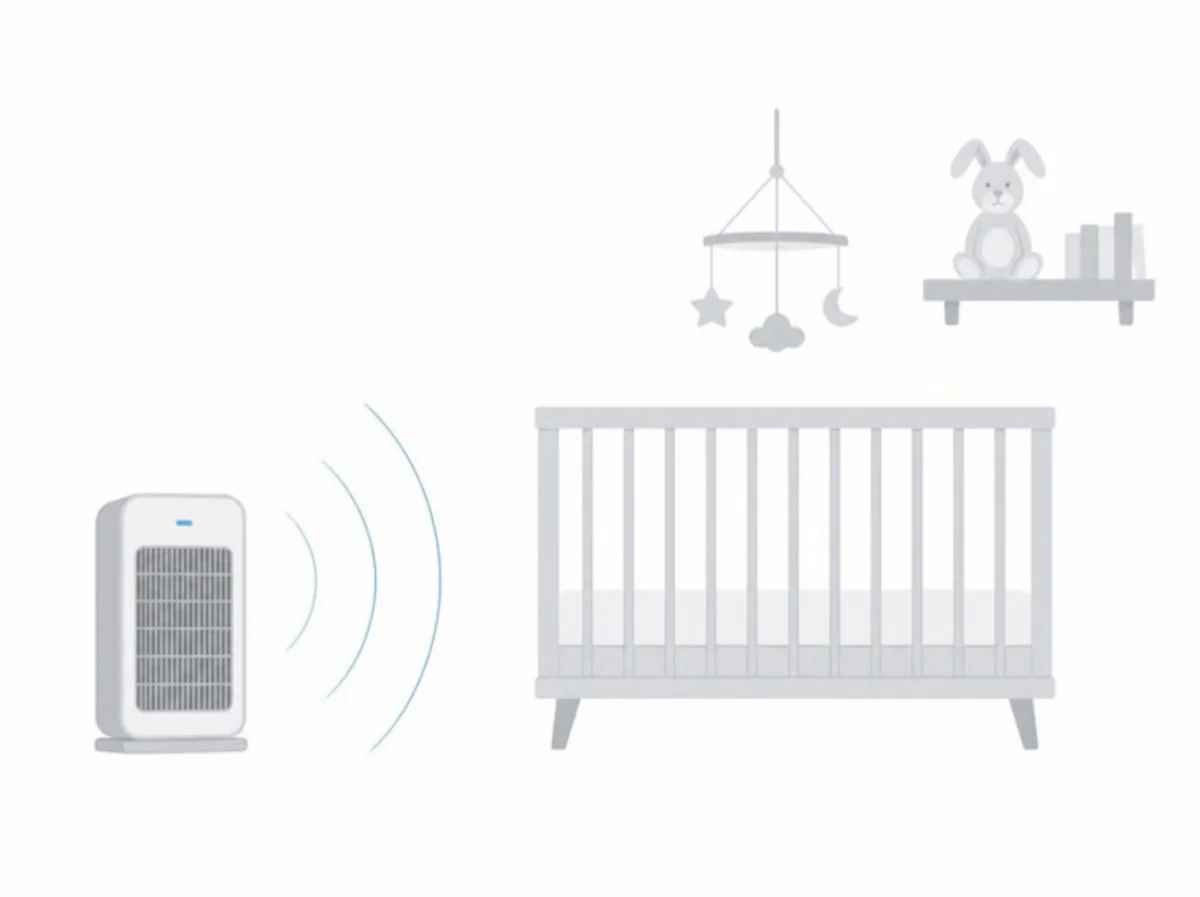
- Hatch Baby: "at least 3 feet from baby's sleep space, ideally near the door"
- Hatch Baby: start sound "at 30%"
- Hatch Baby: "do not perch on the crib"
- Hatch, Rest 2nd gen: under 50 decibels at maximum volume, 5 to 10 feet away in a carpeted nursery
The last figure comes from a Hatch help article that also calls a precise decibel number "difficult" because room size, placement and surfaces change it. Hatch's own volume check on the product page is that you should be able to talk at arm's length without raising your voice.
Yogasleep markets its portable Hushh as "easy to clip onto a stroller, crib, or diaper bag". Clipped to a crib rail, a machine can sit as close to a baby as the 30 cm position in the Pediatrics study, the one where all 14 machines exceeded 50 dBA at full volume.
Distance helps, but less indoors
Outdoors, OSHA notes, the sound pressure level falls by 6 dB for each doubling of distance from a small source. In a room the drop is smaller, because reflected sound keeps arriving. Moving a machine from 30 cm to 120 cm is two doublings, up to 12 dB in open air and less in a nursery.
The Penn authors also raise a separate concern for the youngest sleepers. Because REM sleep makes up about half of a full-term newborn's sleep, they write that broadband sound use "in newborns and toddlers" may be worth discouraging until confirmatory studies are done. Their own study was in adults. Our nursery decibel guide covers the rest of the room, and a pediatrician is the person to ask about a particular child.
How loud should brown or pink noise be for adult sleep?
No health agency sets a level for sleep sounds. The nearest reference is the WHO bedroom guideline of under 30 dB(A) at night, which a sound machine adds to rather than replaces.
For hearing, the NIOSH recommended limit for workers is 85 dBA averaged over an eight-hour shift, with a 3 dB exchange rate. The noise exposure calculator shows how fast the allowed time shrinks above 85 dBA, and a phone app can give a rough reading at the pillow, as our guide to measuring noise at home explains.
The studies above never went past 50 dBA at the head. Our bedroom decibel guide covers the quiet side of the room.
Sound masking is tuned to speech
Sound masking is the engineered office version, tuned to speech rather than flat like white noise. The U.S. General Services Administration's Sound Matters guide defines it as low-level background sound from speakers "that is matched to the spectrum of human speech so that normal conversation is rendered unintelligible by casual listeners".
The guide sets electronic masking at 45 to 48 dBA for open-plan workspaces and 40 to 42 dBA for private offices. It also groups "white noise" with mechanical background sound as ways to add cover to a quiet office.
Home sound machines sell the same idea, and LectroFan tells buyers to use its machine "to mask disruptive noise". Yogasleep's Dohm uses "a real fan inside" with a tone dial. LectroFan's Classic offers 10 fan sounds and 10 noise variants "(white, pink, and brown)", and the EVO lists 22 sounds including brown, pink and white noise. Some fans in our box fan guide are sold partly for their sound.
The studies and standards behind this page
The color definitions come from Federal Standard 1037C, read in the Internet Archive's copy because the government's own pages are no longer online, and from the University of Modena and Reggio Emilia course page. The octave and distance rules come from the OSHA Technical Manual, and the pitch and hearing range from the National Park Service.
Health and sleep statements come from the studies named beside them, read as PubMed abstracts or, for Papalambros 2017 and Basner 2026, the full text on PubMed Central. The Pediatrics paper on sleep machines and the full AAP statement were behind bot checks, so we relied on their abstracts. Exposure limits come from the WHO, NIOSH and the AAP's own summary, and maker statements from Hatch, LectroFan and Yogasleep pages read on November 20, 2026.