What is the quietest smart trainer?
The quietest smart trainer cannot be named on maker figures, because four models tie. Van Rysel's D500 and RCR and Magene's T300 and T200 each state exactly 56 dB at 25 km/h, measured 1.5 m away.
A tie on paper means the choice moves to everything else. The D500 is the cheapest of the four at $499 and was in stock on October 24, 2026. The RCR adds 2800 W and runs without a plug. The T300 shares the largest fixed moment of inertia here with the T300 Plus, and the T200 is $469, but both were out of stock on Magene's US store.
How many decibels is a smart trainer?
A smart trainer with a published figure is rated at 56 to 59 decibels, but at different test speeds, so the range is not a ranking.
Grouped by the condition each maker printed, the figures for trainers listed on US stores look like this:
- Exactly 56 dB at 25 km/h, 1.5 m: Van Rysel D500 and RCR, Magene T300 and T200
- Under 56 dB at 25 km/h, 1.5 m: Magene T110, T300 Plus, T500, T600 and T600 Eco
- 59 decibels at 20 mph, no distance: Saris H3 Plus
Within the first group the four figures are identical, so there is no order to give. The second group carries the same number written as a ceiling, and the third names a different speed.
An exact 56 dB against "Less than 56dB"
An exact 56 dB and Magene's "Less than 56dB" are different kinds of claim, so neither group outranks the other. A ceiling promises the trainer will not exceed a number; an exact figure reports what the test read.
Magene uses both forms across its own range under one condition, 1.5 m and 25 km/h. The T300 gets "56dB", the T300 Plus "Less than 56db", the T600 "Below 56db". Nothing on those pages says the ceiling trainers measured lower. We place them beside the exact figures and let price, power and stock decide.
The T200 page carries both forms at once. Its spec table reads 56db at 25 km/h, while a banner higher up promises under 56 dB at 30 km/h. We use the spec table, which shares the other picks' speed.
Saris and its 59 decibels at 20 mph
The Saris H3 Plus is rated at "59 decibels at 20 mph", a speed no other maker here uses, and Saris names no measuring distance. It is not ranked against the 56 dB trainers.
Saris frames the number against its own older models, calling the H3 and H3 Plus five times quieter than previous generations. That is a claim about Saris's lineup. A reader comparing it with Magene's 1.5 m figures would need a distance that Saris does not give.
Is there a silent smart trainer?
No, none of the smart trainers we read is rated anywhere near zero, and the word silent appears only as marketing, either beside a 56 dB figure or with no figure at all.
Wahoo lists "Virtually silent operation" among the current KICKR's features and prints no decibel figure. Garmin calls the Tacx NEO 3M "an extraordinarily quiet trainer", also without one. Magene heads the T300 section "Virtually Silent" and puts 56dB right under it.
Decathlon describes the D500 as "whisper-quiet" on the same page that gives 56 dB at 25 km/h. In each case the claim and the decibel figure, where one exists, describe the same trainer at the same moment; the adjective adds nothing to measure.
Can you buy a quiet smart trainer in the US right now?
Yes, but only two of the trainers with a maker figure were in stock on October 24, 2026: the Van Rysel D500 and the Van Rysel RCR, both on decathlon.com.
Magene's US store listed all seven of its trainers with US dollar prices, from $349 for the T110 to $899 for the T600 and T600 Eco, but every one had its Add to Cart button disabled and a notify-me button in its place. Saris showed the H3 Plus as Sold Out with a restock alert.
Zwift no longer offers its own Hub on its US shop; the Zwift Hub One link redirects to the Wahoo KICKR CORE 2, which has no published figure.
Van Rysel and Magene list matching specs
Several Van Rysel trainers list the same published specs as Magene models. The D500 and the T200 share a 2.62 kg·m² moment of inertia, a 13.6 kg weight and nearly the same unfolded size. The RCR and the T600 Eco share 2800 W, a 27% grade, 1% accuracy and a self-powered mode.
Decathlon's D100 matches the T110 on 600 W, a 6% grade, 5% accuracy and its folded size, and both Van Rysel pages send owners to the Onelap Fit app for updates. Neither company says who builds the trainers. The D100 page gives no noise figure, so it is not a pick.
Is a direct-drive trainer quieter than a wheel-on turbo trainer?
Yes, according to Wahoo, whose trainer FAQ credits direct-drive models with "quieter operation" than wheel-on ones. No maker here publishes figures for both kinds, so numbers cannot check it.
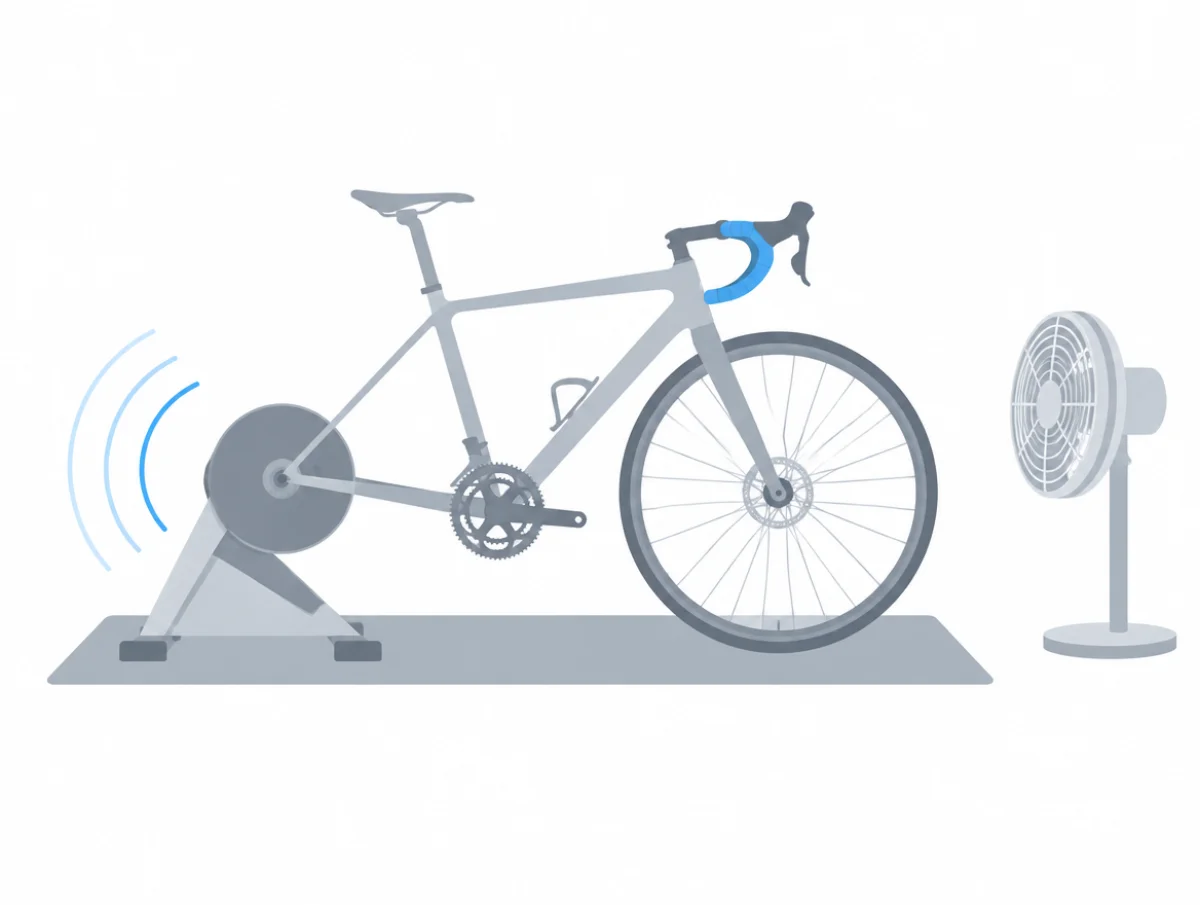
Every trainer with a maker figure in this guide is direct drive, meaning the bike's rear wheel comes off and the chain drives a cassette or a Zwift Cog on the trainer. On a wheel-on trainer the tire presses on a roller, and that contact is a noise source of its own.
Wahoo's FAQ recommends a trainer-specific tire for wheel-on use because such tires resist "the heat and friction of indoor training, reducing wear and noise". Elite says the Elastogel roller on its wheel-on Tuo "reduces friction noise by up to 50%", without a decibel figure for either roller.
How do you use a smart trainer in an apartment without bothering the neighbors?
A smart trainer in an apartment disturbs the floor below less on a dense mat, set up squarely, with a clean drivetrain. Makers describe each step but give no decibel saving for any.
Saris sells a 63 by 36 inch mat whose "Durable construction absorbs vibration and noise" and whose PVC foam, it says, gives "superior sound absorption". Wahoo's KICKR MAT, $89.99, is sold as "sound-dampening floor protection", and Magene ships a 4mm mat with the T500.
The trainer's stand and the floor
The quietest bike trainer stand, on the makers' account, is a wide one that sits still. Magene says the T300's "Larger contact area between the frame and the floor improves the stillness of the riding platform", and Wahoo's noise checklist for the KICKR CORE starts with frame fit and correct adapters.
A trainer that rocks or creaks often has a setup problem rather than a loud motor. Wahoo's CORE noise article asks owners to confirm frame and drivetrain compatibility, the right axle adapters, and a cassette mounted squarely with no play before suspecting the trainer itself.
The chain is the remaining noise
Once the resistance unit is quiet, the chain is what you hear, and two makers say so outright. Saris built the H3 Plus so that "the only sound you'll hear is the gentle whir of your drive train", and Magene says the T300's chain is the only noise left at 56dB.
Both Van Rysel picks ship with a Zwift Cog and Zwift Click, and Wahoo sells KICKR and KICKR CORE 2 versions with them. Decathlon describes Click's virtual gear changes as happening "without moving the chain", which removes the clatter of a derailleur shift, if not the chain itself.
Do Wahoo, Garmin Tacx, Elite and Zwift publish trainer decibels?
No. None of these four brands gives a decibel figure for any trainer it currently sells in the US, on the product pages, spec tables, support articles or data sheets we read on October 24, 2026.
Wahoo's pages for the KICKR, KICKR CORE 2 and KICKR ROLLR print no figure, and its support pages for the 2022 KICKR v6 and the KICKR CORE list none. Wahoo did once: its support pages give the 2011 KICKR "Noise Level: 70 dB" and the 2016 and 2017 KICKR 61 dB, with no speed. The KICKR MOVE page says Wahoo stopped selling it in June 2026.
Garmin's US spec tables for the Tacx NEO 3M, NEO 2T, FLUX 2 and Nera list power, flywheel and weight but no noise row. Elite's pages and data sheets for the Justo 2, Avanti, Rivo and Tuo, and its 2026 catalogue, describe quietness in words only.