An air exchanger runs around the clock, so a new sound from one gets noticed quickly. Most of what owners hear traces back to a short list in the makers' manuals: dirty or unbalanced fan wheels, loose screws, a worn bearing, a control the motor does not like, and the defrost cycle that starts when the outdoor air turns cold.
"Air exchanger" is the everyday name for a heat recovery ventilator (HRV) or an energy recovery ventilator (ERV). Lifebreath gives a quick way to tell which you own: open the unit and look at the core, because an HRV has a metal core and an ERV a non-metallic one. Everything below applies to both. The sounds are the same.
Every cause and fix here is quoted from documents published by RenewAire, AprilAire, Panasonic, Resideo (Honeywell Home) and Lifebreath, with the model each covers. None of the ventilators named here was run, opened or measured by us. Manuals from Venmar, vanEE, Broan-NuTone and Zehnder could not be opened while this page was being written. Their units are left out.
Why is my air exchanger making noise?
An air exchanger making noise usually has a fan problem, RenewAire and AprilAire say: dirt on the impellers, an unbalanced rotor, loose fan screws or a failing bearing. Defrost and the speed setting explain most other changes.
The checks below run from the simplest to the one that needs a professional:
- Think back to whether the sound arrived with the first cold spell, which points to the defrost cycle.
- Check the wall control and any timers for a high speed override, or a humidity set point below the humidity in the house.
- Switch off power and turn each fan wheel by hand to see that it spins freely, as RenewAire asks.
- Clean dust off the impeller blades and tighten any loose fan screws.
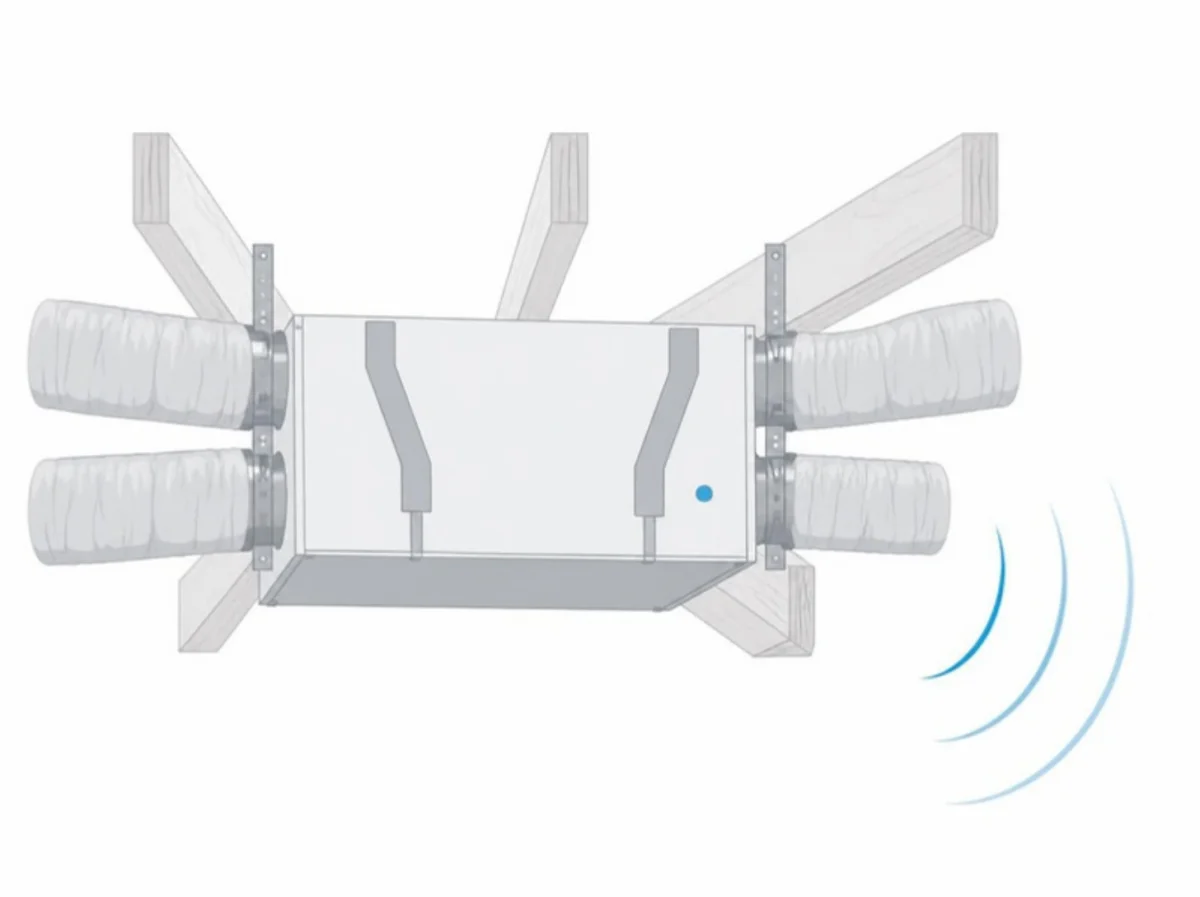
- Look at how the cabinet is hung and how the ducts meet it.
- Call a contractor if the noise survives all of that, since RenewAire says a fan may then have a bad bearing.
| Sound | Cause the maker gives | Document |
|---|---|---|
| Fan noise with vibration | Rotor imbalance, dirt on the impeller blades or a bad bearing | RenewAire EV Premium manual |
| Noise, vibration | Clogged impellers or loose fan screws | AprilAire V22BEC instructions |
| Motor hum | Harmonic distortion from a solid state control | Panasonic Intelli-Balance 100 manual |
| Louder in cold weather | Defrost cycle, with the exhaust fan running harder | AprilAire, Resideo, Panasonic |
| Stuck on high speed | Timer override, humidity set point, other controls or defrost | Lifebreath FAQ |
| Vibration in ducts or framing | Rigid duct joints, overtightened gasket screws or a weak mounting surface | Panasonic, RenewAire, AprilAire |
| Air rushing at a grille | Return grille with too little free area | AprilAire V22BEC instructions |
| Beeping | Filter reminder, or a damper or motor error | Panasonic Intelli-Balance 100 manual |
| Clicking, whistling, gurgling | Not explained in any maker document we found | None |
Why is my HRV or ERV fan so loud?
A loud HRV or ERV fan with vibration you can feel through the cabinet usually comes down to the fan wheels. RenewAire names rotor imbalance or a bad bearing, and AprilAire names clogged impellers or loose fan screws.
RenewAire's EV Premium manual gives the symptom a section of its own, "ERV HAS AIRFLOW BUT IS MAKING NOISE." It starts with a test by touch: "Feel the EV Premium while it is running to see if there is excessive vibration from the fans." The cause follows: "Fan noise and vibration can be caused by an imbalance in the rotors or possibly by a bad bearing."
The fix starts with the power off: "Turn off power to the unit and rotate the fan impellers by hand." The wheels should turn freely. RenewAire suggests wet swabs to lift dust and dirt off the blades. If the problem continues after that, the manual says, "a fan may have a bad bearing."
AprilAire's V22BEC installation instructions put the same complaint in the troubleshooting table, under the symptom "Noise, vibration." The two reasons it gives are "The impeller(s) is (are) clogged." and "Fan screw(s) are loose." The procedures are to clean the fan impellers, then check the screws and tighten them if required.
RenewAire also wants all mounting and support hardware checked and tightened after the first 30 days of operation, when construction dust often turns up in the filters. Dirt matters for airflow too: when blowers run but move little air, AprilAire's first suspect is "The filters, blowers, or core are clogged." Neither maker says a dirty filter makes the unit louder.
A hum that comes from the speed control
A motor hum on a Panasonic Intelli-Balance 100 can come from the wrong type of control. Panasonic's manual warns that "Solid state controls may cause harmonic distortion which can cause motor humming noise."
The same warning is a safety rule. To reduce the risk of fire or electric shock, Panasonic says not to use the unit with any solid-state control device. If the hum began after a control was added or changed, find out what that control is and ask the installer.
None of the other makers here mentions humming. RenewAire's bearing note is the closest match: a noise that remains after the impellers turn freely and are clean may be a bad bearing. For hums from the blower of a central system, see our page on air handler noises.
Why is my air exchanger louder in winter?
An air exchanger gets louder in cold weather because of its defrost cycle. AprilAire and Resideo switch off the supply fan and push the exhaust fan harder, Panasonic raises the air volume, and each maker sets its own temperatures.
On the AprilAire V22BEC, defrost "is activated automatically and cannot be manually turned on or off." During it, "the exhaust fan runs on high speed and the supply fan is off". The trigger is the temperature of the incoming fresh air in the duct, and the cycle tightens as it gets colder:
| Fresh air temperature in the duct | Defrost mode | Normal mode |
|---|---|---|
| Above 23°F (-5°C) | None | Continuous |
| From 5°F (-15°C) up to 23°F (-5°C) | 10 min | 30 min |
| From -17°F (-27°C) up to 5°F (-15°C) | 10 min | 20 min |
| Below -17°F (-27°C) | 10 min | 15 min |
Resideo's owner's guide for the Honeywell Home VNT5150 and VNT5200 HRVs and ERVs says "Automatic defrost is initiated once every hour when the fresh air supply temperature drops to 23°F (-5°C) or colder." The supply fan stops while the exhaust fan keeps going, starting at low speed. The exhaust fan speeds up as the outdoor temperature falls and "will operate at maximum speed when the outdoor temperature is -4°F (-20°C) or less." Each cycle is 4 minutes with the supply fan off, then 40 minutes of normal running. Cycles keep repeating while it stays at 23°F (-5°C) or below.
Panasonic's Intelli-Balance 100 defrosts a different way. It circulates air. In that mode, the manual says, "the air volume will be more than setting and sound will be slightly louder than normal operation." Its operating table brings in the circulation periods from 14 °F (-10 °C) downward, and below that temperature the unit also cuts its air volume automatically to protect the energy recovery core.
The WhisperComfort 60 spot ERV handles cold with its outdoor air damper. Between 23°F (-5°C) and 14°F (-10°C), "the damper will open for 60 min. for supply and exhaust and close for 30 min. for exhaust only." Under 14°F, the damper opens for 10 minutes to check the outdoor temperature, then closes for 60 minutes of exhaust only.
Lifebreath gives one number: "Your ERV / HRV automatically cycles into defrost mode when temperatures fall below -3 C (27 F)." It lists defrost among the reasons a unit runs on high speed. These thresholds differ from maker to maker, so go by the manual written for your unit instead of borrowing another brand's figures.
Why is my HRV or ERV running on high all the time?
An HRV or ERV stuck on high speed is usually obeying a control rather than failing. Lifebreath lists the main control set to high, a pressed timer, a humidity set point below the home's humidity, other controls, and defrost.
The humidity case has a sign on Lifebreath's digital control: "A flashing 'RH' indicates the appliance is operating on high speed in the Dehumidistat function." Once indoor humidity falls to the set point, the unit goes back to its previous speed and mode.
When none of those causes applies, Lifebreath's answer is short: "If there is no high-speed demand from any of the above and the unit is still running on high speed, contact your service contractor."
For everyday running, Lifebreath says "The most popular setting for residential applications is continuous low speed ventilation." For a house that feels too dry, it suggests lowering the fan speed or using an intermittent setting of 20/40 or 10/50. Lower speeds matter for noise. The figures on our quietest ERV and HRV guide climb as airflow rises.
Vibration carried through ducts and the mounting
Vibration that spreads from an air exchanger into ducts, joists or walls is an installation matter. Panasonic, RenewAire and AprilAire each print an installation step aimed at keeping fan vibration out of the house.
Panasonic's Intelli-Balance 100 manual says: "To avoid transmission of vibrations, it is recommended to use a 6-inch section of flexible duct to connect rigid ducts." The same manual adds that each ENERGY STAR certified unit must be installed using sound attenuation techniques appropriate for the installation to ensure quiet operation.
RenewAire hangs the EV Premium on a bracket, with foam tape cushioning the mounting flanges. Its note beside that step reads "Do not overtighten the screws. Compression of the gasket may result in vibration transfer." On ducts, RenewAire says 6 inch flexible duct is the most common choice for "ease of installation, sound attenuation, and cost", though it prefers rigid duct for lower airflow resistance, and it favors short, straight runs.
AprilAire starts with the surface the V22BEC hangs from. Check its weight-bearing capacity first, because "Insufficient strength can lead to safety hazards, vibrations, and abnormal operating noises." For ducts it advises: "For optimal performance and quiet operation, all duct runs should be kept as short, straight, and equal in length as possible."
Rushing air at grilles and supply outlets
Air rushing at a grille usually means the opening is small for the airflow. AprilAire says a living space return grille with less than 75 square inches of free area "may produce excess air noise."
The same rule covers the supply side of the V22BEC: the total free area of supply grilles should be at least 75 square inches, so three supply ducts need about 25 square inches each. AprilAire recommends no more than three fresh air supply ducts. Its stated reason is adequate airflow.
Placement matters too. AprilAire recommends putting the fresh air supply in a hall or foyer "to avoid drafts and blower noise in occupied areas."
What the ducts themselves add, from their size, length and air speed, is covered in our ERV and HRV guide under how loud whole-house ducted ERVs are.
Beeping from a Panasonic Intelli-Balance 100
A Panasonic Intelli-Balance 100 that buzzes for 10 seconds once an hour while still running is asking for filter maintenance. A 30 second buzz every hour with the unit stopped means a fault, such as a damper or motor error.
The filter indicator lights after 90 days of accumulated run time. Panasonic's troubleshooting row reads "The RA filter and OA filter need to be maintained." Pressing the filter reset button after maintenance clears the indicator and the buzzer, and holding it for 3 seconds cancels the buzzer notification. Panasonic asks for routine maintenance every 2 or 3 months, warning that "clogged filters may cause condensation on the unit due to air flow reduction."
The 30 second buzzer comes with blinking indicators. Each pattern names a part. The patterns stand for an OA, EA or center damper error, a supply or exhaust motor error, a temperature sensor error or a circuit board error. For every one of them, Panasonic's instruction is "please disconnect the power and contact the dealer for repair."
Clicking, whistling and gurgling go unexplained
No maker document we could open explains clicking, whistling or gurgling from an air exchanger. RenewAire, AprilAire, Panasonic, Resideo and Lifebreath describe none of these sounds, either as normal or as a fault.
Panasonic does describe dampers that move on a schedule. The WhisperComfort 60 opens and closes its outdoor air damper on the cold weather cycle above, and the Intelli-Balance 100 has outdoor air, exhaust air and center dampers that change position between heat exchange and defrost. Neither manual says the dampers make a sound.
In extreme cold the Intelli-Balance 100 stops automatically at -22 °F (-30 °C), and its troubleshooting table adds "Damper may be frozen shut, please wait for maximum 24 hours for defrosting."
The drains get only a water note. Resideo says it is normal to find no condensation in the drain pan or hose in summer, and Lifebreath that "it isn't unusual for there to be no water in the drains." Neither mentions a drain sound. A noise no maker explains is one to describe to a contractor. Do not guess.
When to call a contractor
Call for help when the makers' own checks run out: fan noise that survives cleaning, a fault buzzer, or high speed with no demand behind it. RenewAire, Panasonic and Lifebreath each point owners onward at that stage, to the factory, the dealer or a service contractor.
RenewAire's noise section ends with the bad bearing and goes no further. Its factory assistance section asks owners to have the details from the manual's unit information page ready, so the factory can identify the unit.
Panasonic's fault buzzer comes with one instruction: disconnect the power and contact the dealer for repair. Lifebreath sends owners of a unit stuck on high speed with no demand behind it to their service contractor. Asked whether it can come out and service a unit, its FAQ answers that it is the manufacturer and servicing questions go to a contractor.
How loud should an air exchanger be?
Most air exchanger makers publish no noise figure. Of those that do, Panasonic gives its WhisperComfort 60 a rating of 0.9 sones, taken at 40 CFM against 0.1 inch of static pressure, as our quietest ERV and HRV guide records.
For ducted whole-house units, the same guide lists Zehnder's ComfoAir Q350 from 34 dB(A) of casing sound power at 88 cfm, and finds no figure at all from Broan-NuTone, AprilAire, RenewAire, Lifebreath or Honeywell Home. Sones and sound power sit on different scales, and the reasons one cannot stand in for the other are set out in sones vs decibels. A decibel level that marks a fault appears in none of these documents.
Related guides and explainers
To compare units by their published figures, start with the quietest ERV and HRV guide. Bathroom fans are rated in sones too, on the quietest bathroom exhaust fans guide, and booster fans for duct runs are on our quietest inline duct fans guide.
Other fans that run all day have their own pages: radon fan noises, air handler noises, and how to make a bathroom fan quieter. For a central system's indoor unit, see the quietest air handlers.