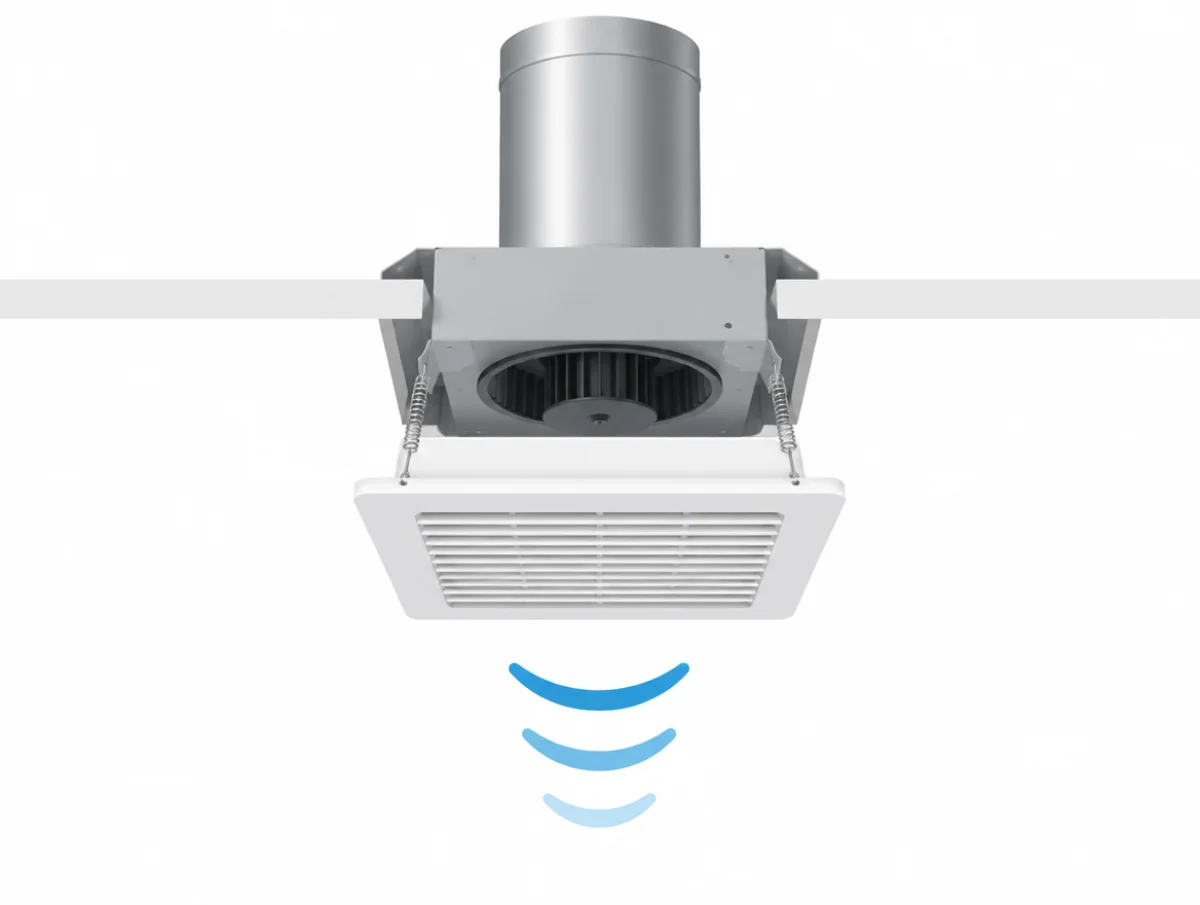
Most bathroom fan boxes print a sone figure measured against 0.1 inch of resistance, and Panasonic says typical home installations usually run above 0.25 inch. That gap explains a lot. A fan that sounded fine in the store meets its first real duct in your ceiling, and much of what makes it loud lives in the attic rather than in the fan.
The order of attack is cheapest first. Take the grille down, clean it and the blower wheel, and check that the damper swings freely. Past that the fixes move up into the attic, to duct size, elbows and how firmly the housing is fastened, and finally to a new motor or a quieter fan. Broan-NuTone, Panasonic, Delta Breez, Air King and Homewerks supply every step, from a ten minute clean to the jobs that need someone above the ceiling, and they also say when a fan needs a part or a call to the maker.
Why is my bathroom fan so loud?
Four causes come up again and again: dust on the wheel and grille, a rattling damper or loose part, a duct that is too small, long or bent, or a worn motor.
Broan-NuTone sums up the list in a May 2024 article titled Help! My Bath Fan Sounds Like a Lawnmower!. The fan "might have loose parts that need to be fixed", may have "dust build-up on the motor", or the motor "may need to be replaced."
A question many owners ask turns up in the Homewerks FAQ: "Why does my fan sound louder than the display in the store?" The answer names the duct run length, the number of bends and the size of the room. A fan on a shelf has no duct at all.
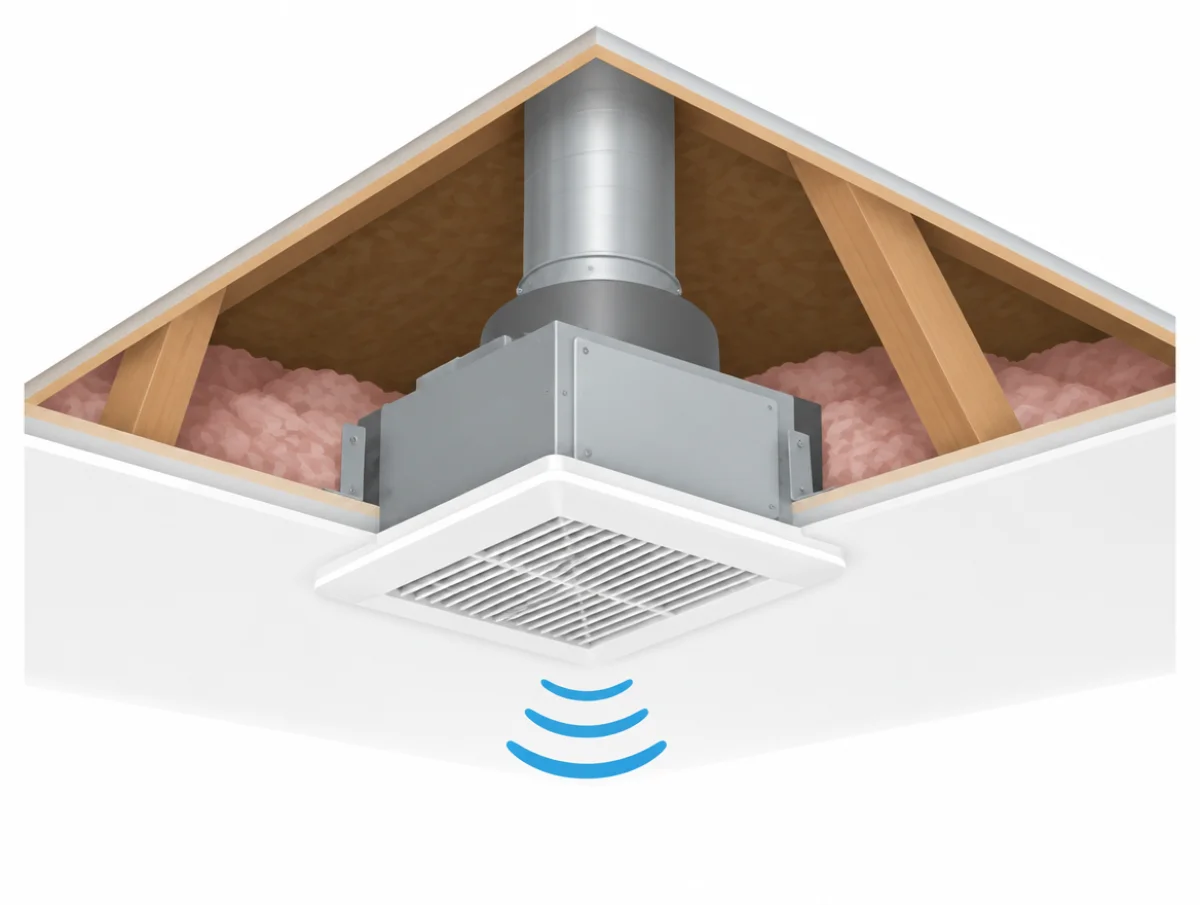
Panasonic explains why the duct counts for so much. Long or complicated duct runs raise static pressure, the resistance the fan pushes against, and its homeowner FAQs put typical home installations usually above 0.25 inch of water, well past the 0.1 inch behind the box figure.
Seven fixes, quickest first
- Switch the power off, drop the grille, wash it and vacuum the housing and wheel.
- Check that the damper at the outlet opens and closes freely.
- Check that the motor, wheel and housing are tight and nothing rubs.
- In the attic, look for a crushed duct, a reducer or an elbow right at the fan.
- Replace an undersized or kinked duct with one the size of the fan outlet.
- Fit a replacement motor kit where the maker sells one for your housing.
- Replace the fan with a lower sone model.
Does cleaning a bathroom fan make it quieter?
On an older fan, yes. Broan-NuTone's troubleshooter sends a fan of five years or more straight to cleaning, and answers a loud or buzzing fan of one year or more the same way, with the grille and fan assembly.
The steps in the Broan-NuTone troubleshooter are simple: "Lower or remove the grille and vacuum the interior of the unit with the dusting brush attachment." Because the grille catches most of the lint, it "should be cleaned at a minimum of once per year."
Dust and debris build up on the blades and motor over time, "affecting performance and lifespan," according to Panasonic's maintenance article. Its method is to squeeze the metal tension clips to lower the cover, wash the cover in warm water with dish soap, vacuum the motor and blades with the wand, then wipe the blades with a dry or damp cloth.
What the manuals rule out while cleaning
No solvents, no soaking the motor, and no working with the power on. Delta Breez and Panasonic both ask for routine maintenance at least once a year, and both list what to avoid.
"Routine maintenance must be done every year," reads Panasonic's WhisperGreen Select installation instructions, which put switching power off at the service panel first, allow no gasoline, benzene or thinner, and add "Do not immerse motor in water when cleaning." Resin parts should not be soaked in water over 140 °F. The grille must be dry before it goes back up.
Delta's BreezSignature installation manual sets the same rules in different words: "Do not allow water to enter the motor", no harsh chemicals, and no metal parts in water. Its grille comes off by squeezing the springs and pulling down, then goes in the sink.
Why does my bathroom fan rattle?
Three things, in the makers' troubleshooting: a damper that sticks or flaps, a motor or wheel that is loose or rubbing, or a housing not fastened firmly to the joists.
Air King's help article on a weak fan doubles as a rattle checklist. With the grille off and the fan running, the blade should be rotating freely with "no obvious issues (slow rotation, wobble, rubbing)." Then: "Make sure the fan motor and or blower are installed securely and fully plugged in."
A stuck or damaged damper
The damper is often the culprit. Broan-NuTone and Delta Breez both list it among their noise checks, and Air King wants the damper in the fan outlet to open and close freely with nothing in the way.
"Is the damper stuck?" is the question Broan's troubleshooter asks of a fan five years old or more. The flap is closed with the fan off and opens when the fan runs. "If it's stuck, try freeing the flap and clean if needed. If this doesn't resolve the problem, the damper will need to be replaced." For a fan a year or more old that stays loud after cleaning, the troubleshooter asks whether the damper moves freely and sends a stuck one to support.
A Broan damper that sits slightly open is working as intended. "Our dampers are specifically designed to remain open slightly when the fan is off," the help center explains, so heat from the light can escape into the duct, and any backdraft in the duct closes the flap.
To get at the damper on an Air King, cut the power first, because "You will need to remove the fan's motor/blower to inspect the damper." In Delta's troubleshooting table, a damper "not working properly or damaged" is a cause of a fan that seems louder than it should, and a damaged one is a call to Delta customer service.
A damper banging in the wind is a gap in the documents. None of the five makers covers it. Panasonic, Delta and Air King each call for a roof cap, wall cap or soffit vent with a backdraft damper of its own, and Air King asks owners to check that the outside damper opens and closes with the fan running.
Fasten the housing to the joists
Vibration usually means a housing that is not screwed down, or a motor plate and blower that are not seated. Delta's answer for a loose housing is short: "Be sure the fan is securely attached to your ceiling joists." Its installation steps screw the housing to the joist in new construction and use suspension brackets where joists sit 16 to 24 inches apart.
On a ceiling slope, Air King allows mounting "only on a slight slope, and the unit should be securely mounted into the ceiling studs," according to its help center. Air King also recommends that all units be installed by professional installation techs.
The duct decides much of the noise
"The ducting has a strong effect on the air flow, noise and energy use of the fan." That line is Panasonic's, and Broan-NuTone, Delta Breez, Air King and Homewerks each tie noise to duct size, length or bends.
For a new installation that is noisy, Broan's troubleshooter goes straight to the duct under the heading "Shorten the duct run". It wants the shortest path outside with the fewest turns, asks owners to "ensure correct duct diameter is used", and warns against mounting an elbow directly onto the fan housing.
Homewerks needs one sentence: "A shorter duct run is better for performance and noise level." Panasonic's installation figure rules out four layouts by name, "Successive bending", "Excessive bending", "Squeezed duct" and "Bend close to duct adaptor."
Use duct at least as wide as the outlet
Bigger is allowed. Smaller is trouble. Panasonic and Delta Breez recommend 6-inch round duct for the fans in their manuals here.
Broan-NuTone does not hedge about going smaller. Asked whether a smaller diameter duct can be used, its help center answers: "This is not recommended. It will cause the fan to run harder, greatly reducing the CFM performance of the fan and create excess noise." Going larger gets a different reply in a second answer: "Yes, larger diameters will result in improved performance."
A reducer between the fan outlet and the house duct may make the fan's noise "louder than normal," Homewerks warns, and its fix is a house duct matching the fan outlet. A 6-inch collar reduced to 4-inch duct "will greatly reduce airflow" on Air King fans, and the same goes for 4 to 3 inch.
The published figures show how big the gap can be. Pushing 110 CFM against 0.25 inch, Delta's BreezSignature is rated 2.0 sones through 4-inch duct and 0.8 sone through 6-inch, as our bathroom exhaust fan guide shows. At that same pressure, Panasonic rates its WhisperFit DC at 1.2 sones moving 111 CFM through 4-inch duct, and 1.5 sones moving 94 CFM through its 3-inch adapter.
Keep the first elbow 2 to 3 feet away
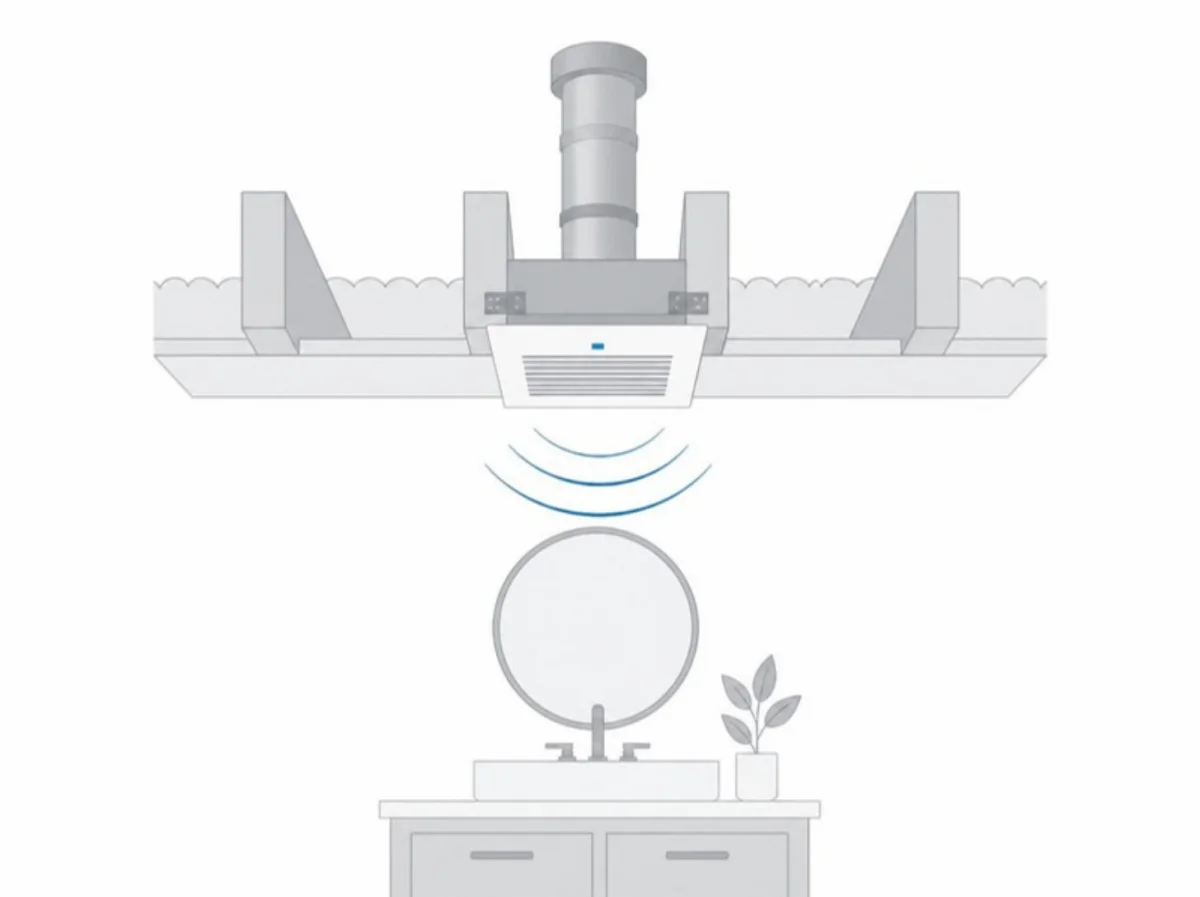
The installation drawings from Panasonic and Delta Breez both put a straight run before the first elbow, and Delta's troubleshooting adds that no sharp bend should be closer than 18 inches.
Delta's drawing marks "2~3 ft straight run before elbow" and Panasonic's "2-3 ft straight run before elbow". Delta's figure also labels "Elbow near the body" as a fault, with a minimum of 18 inches, and its table reads: "Be sure you do not have any sharp bends in duct closer than 18 in. to the fan discharge."
Homewerks and Broan agree without giving a number. Homewerks wants no "bend or elbow right at the connection to the outlet or fan housing", and Broan says never to mount an elbow directly onto the housing.
Is flexible duct louder than rigid duct?
It is more restrictive, by the account of Broan-NuTone and Air King, and both prefer rigid where it fits. Yet Panasonic and Delta Breez still draw a short piece of flexible duct at the fan.
Rigid duct offers less resistance to airflow. "It is recommended, where possible, to use rigid duct," Broan's help center advises, and "If flexible duct is used, be sure the duct is as straight as possible." Air King goes further: "Any length of flexible ducting is considered twice as restrictive as smooth rigid ducting." Pull flexible duct as tight and smooth as possible, with nothing compressed or pinched, and step up a diameter on a very long run. Air King's duct length article follows the prescriptive duct size table in ASHRAE 62.2.
The two views fit together. Panasonic and Delta both label a "Short piece of flexible duct" that "helps alignment and absorbs sound" between the housing and the rigid run, which gives a short flexible connector at the fan and rigid duct for the long run.
A fan too big for the room
A fan sized well above the room can be louder than it needs to be. "CFM too great" is on Delta's list of causes for a fan that seems loud, and Homewerks ties a matched CFM to lower noise.
The correction from Delta is "Be sure the CFM rating on the fan matches the size of your room." Homewerks puts a number on it: "if you have an 80 sq. ft. bathroom, you should have an 80 CFM fan to help with performance and noise." Panasonic's FAQ uses the same rule of about 1 CFM per square foot.
Fans with selectable airflow turn this into a switch rather than a purchase. Panasonic's Pick-A-Flow selector and similar settings on Delta and Broan models let an installer drop to a lower CFM, which the maker sheets rate at fewer sones, and our Panasonic sones page and Delta Breez sones page list the figure for each setting.
The room needs air coming in, too. Air King wants at least 1/2 inch of clearance under the bathroom door, and Homewerks suggests opening the door or window a little when the fan struggles to clear the room.
Humming and speed controls
A bathroom fan can hum on a control it was not built for, and here the makers split. Panasonic and Delta Breez warn that solid-state speed controls cause a motor hum, while Broan-NuTone sells a speed control for its fans.
Panasonic's instructions read: "Do not use this unit with any solid-state speed control device. Solid state controls may cause harmonic distortion which can cause a humming noise in the motor." Delta's manual rules out using the fan "with any other solid-state control device", for the same reason.
Broan takes the other side for its fans. Its speed control lets you adjust sound and CFM "anywhere from 100% down to 20%", a Broan product manager writes, so a 4.0 sone fan can run anywhere from 4.0 sones down to 0.8 sone. Airflow drops with the sound.
The answer depends on the fan in your ceiling.
Check your installation instructions before adding any control, and use the maker's control where it offers one. Delta asks owners to contact its customer service before using an external timer or dimmer switch.
Can you replace just the motor in a bathroom fan?
On many Broan and NuTone fans, yes. Broan-NuTone sells upgrade kits that put a new motor, blower wheel and grille into the existing housing without new wiring or drywall work, and its troubleshooter ends at motor replacement.
The BKR60 QuicKit is the kit the lawnmower article points to. Its page rates it at 60 CFM and "3.0 Sones", claims it is "Up to 50% Quieter", and says it installs "in 10 minutes with no wiring, cutting or drywall repair." The archived copy from July 12, 2026 lists $59.00.
Housing size decides whether it fits. The BKR60 is listed for 7-1/2 by 7-1/4 inch and 8-1/16 by 7-3/8 inch housings on named Broan, NuTone, Nautilus and Aira models, and it does not fit 8 by 8-1/4 inch housings. Find the model number in your housing before you buy.
One more test comes before a new motor. Broan's troubleshooter asks whether the motor still makes noise when plugged into a wall outlet, and if it does, the answer is "Replace the motor", through the Broan-NuTone parts store. Panasonic goes the other way: "Do not disassemble the unit for reconstruction." Its site offers no motor kit for owners that we could find.
When a new fan is the better fix
If the fan is clean, fastened, on the right duct and sized for the room, yet still too loud, replace it. Broan's advice for a lower sone rating starts with a new fan anyway.
The spread between models is wide. Air King's AS and ASLC economy fans are rated up to 5.5 sones in our Air King sones page, while Broan's EVOLVE PTE511RK stays at 0.9 sone moving 110 CFM against the tougher 0.25 inch pressure, per our Broan sones page. On Broan's chart, 1.0 sone is about a running refrigerator.
A new fan does not have to mean opening the ceiling. Panasonic's WhisperFit DC is "Designed for renovation and retrofit projects", installs from below the ceiling on existing duct, and fits a 5-5/8 inch housing into 2 x 6 joists. Its 1.2 sone figure is on 4-inch duct, the size most older bathrooms have.
Old duct still matters. "Fans installed with existing ducts may not achieve their rated airflow," Panasonic cautions, and Delta's manual agrees, which means a new fan on an old, kinked duct inherits the duct's problems and the attic checks above still apply.
Signs it needs the maker or a technician
A damaged damper, a motor that stays noisy plugged straight into a wall outlet, a new installation that stays loud after the duct checks, or a fan that shuts itself off. Those are the points where the makers stop handing out steps.
A damaged damper is a call to Delta Breez customer service. Broan's troubleshooter, for a new installation still noisy after the duct run is shortened or a damper that will not move freely, ends by asking where you live so it can route you to support. A motor that is noisy on a wall outlet gets a replacement motor.
Delta's FAQ describes a lock protection feature. The fan powers off when the impeller is locked abnormally, for example by built-up dirt, tries to restart in 5 to 10 seconds, and stays off if it is still blocked; on models with an indicator, the light "will blink if the impeller gets obstructed."
Wiring is the other line. Panasonic, Delta Breez and Air King each say to cut the power before any work. Disassembling the unit "may cause fire or electric shock," Panasonic warns, and Air King recommends professional installation techs. Homewerks takes calls at (877) 319-3757.
Guides for choosing a quieter fan
These compare bathroom fans on published sone figures, with the test pressure and duct size behind each one, so a replacement can be chosen for the duct you already have.
Our quietest bathroom exhaust fans ranks fans on the tougher 0.25 inch figure, and the small bathroom guide does the same for 50 to 80 CFM fans on 4-inch duct. Fans with extras are covered separately: humidity sensor fans and fans with a light.
By brand, see Broan, Panasonic, Delta Breez and Air King. A fan that got louder slowly over the years fits the pattern in why appliances get louder, and the sone scale itself is explained in how quiet is quiet enough and sones vs decibels.
Broan's archived pages, Air King's help desk
Broan-NuTone's main website refused our automated requests, so its articles and the BKR60 page are cited from Internet Archive copies of Broan's pages, dated in the sources. Its help center loaded directly, and the Fan is noisy troubleshooter was stepped through on November 10, 2026. Air King's help center is hosted on the help desk of its parent company, Lasko, and linked from Air King's site. Hunter's bath fan pages link no installation manual, and Homewerks installation manuals turned up only on retailer sites, so neither appears here beyond the Homewerks FAQ.