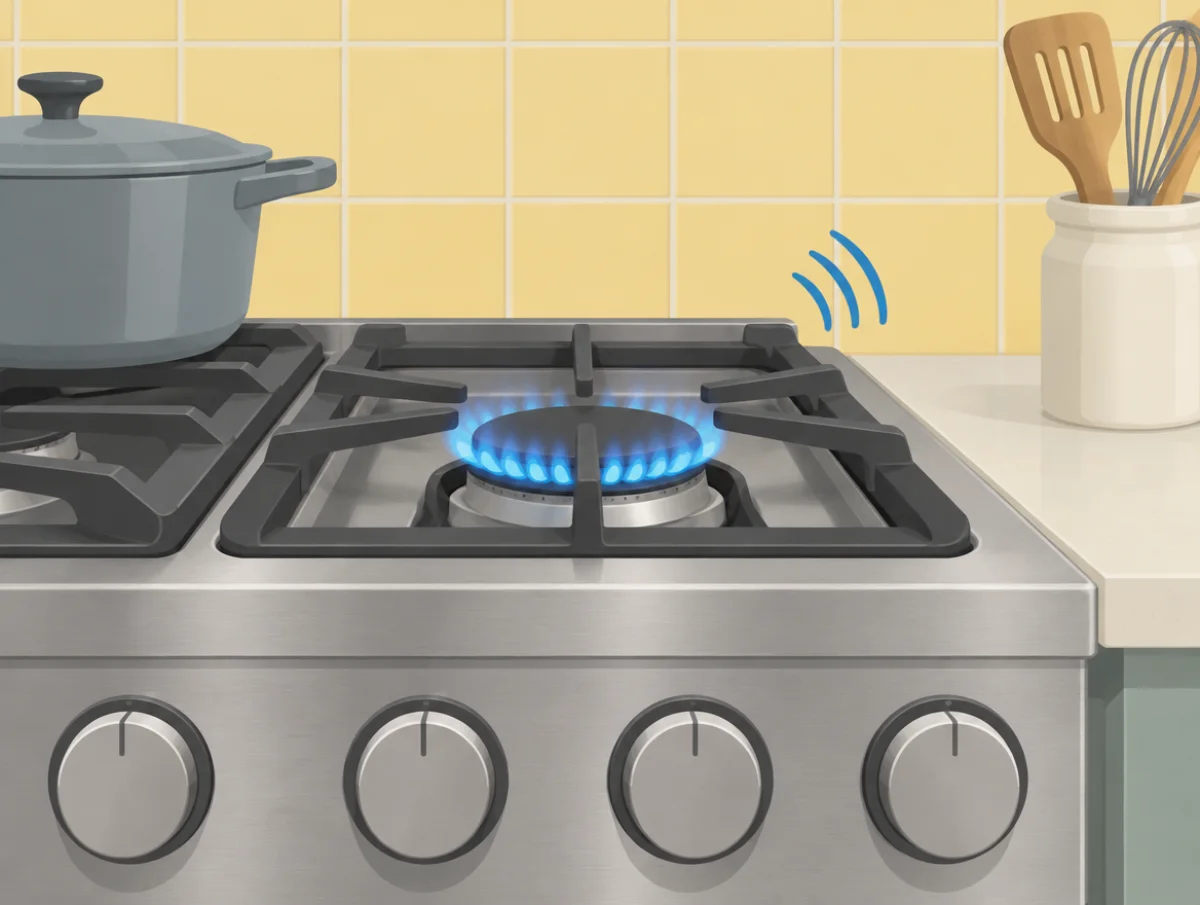
Nearly all gas stove clicking comes from the spark igniters, and a short run of ticks each time you light a burner is the stove working as designed. The worry starts when the ticking keeps going after the flame is up, or begins by itself with every knob off. Water is the usual reason. A boilover or a soaked sponge leaves moisture in the burner head or in the switches behind the knobs, and the igniters fire until it dries.
Lit burners have their own sounds: a soft whoosh or pop as the gas catches, a hum or faint whistle while it flows, a small pop as it goes out. GE Appliances, Whirlpool, Maytag, Samsung, Frigidaire, Bosch, Thermador and Wolf each describe some of them in support pages and manuals, all read on November 16, 2026. Oven igniters, relays and fans are covered separately in oven noises explained.
| Sound | Cause a maker names | First step |
|---|---|---|
| Ticks while lighting, then stops | Spark igniter lighting the gas (GE, Samsung) | Nothing |
| All burners tick when one is lit | One spark module for every igniter (GE) | Nothing |
| Ticking runs on after a spill or cleaning | Wet burner or wet knob switches (Whirlpool, Maytag, Samsung) | Dry it out |
| Ticks while the flame is lit | Cap off center, a draft, an oversized pan (Wolf, Whirlpool) | Reseat the cap, calm the draft |
| A click about once a minute on simmer | ExtraLow relighting (Thermador) | Nothing |
| Ticks with every knob off | Moisture, a stuck knob, outlet wiring (Whirlpool, Wolf, Thermador) | Dry, free the knob, then service |
| Whoosh or pop at ignition | Gas catching (Wolf) | Nothing |
| Popping from a lit burner | Wet burner (Whirlpool) | Dry it, refit the cap |
| Hum or soft whistle | Gas flowing (Wolf, Samsung, Bosch) | Nothing |
| Rumble, tall or loud flames | Setting, cap, fuel or conversion (Wolf, Frigidaire, GE) | Check the cap, then the installer |
| Hiss with a gas smell | Possible leak | The manual's gas smell steps |
Which gas stove sounds are normal?
A few seconds of ticking while a burner lights, a soft whoosh as it catches and a steady hum or faint whistle as gas flows all count as normal in the makers' own pages. So does a small pop when you turn a burner off.
Wolf's burner noise page covers most of that list at once. "It is possible to hear a whooshing or popping sound from any type of gas burners when the burner ignites on start-up and reignites during use," it reads, and "a similar popping noise is also audible when the burner flame extinguishes." Burners also "make a constant humming sound when in use as gas flows to the burner."
Other makers agree on the hum. Samsung's range sounds page treats a high pitched whistle or hum from a lit gas range as "the sound of the gas going through the system." The Bosch NGM5458UC manual puts "A soft whistling noise while the burner is operating" under normal behavior.
Settings and fuel change the pitch. "Depending on fuel source, burner size, and temperature (simmer, low, medium high) some vibration or rumbling noise may be heard; this is normal," according to Wolf's flame quality page. Samsung adds a quirk of its double burners: at certain flame levels the gap in the outer ring can make "a puffing sound," which goes away if you nudge the knob up or down a little.
Why does a gas stove keep clicking after a spill?
Water has reached the spark. A wet burner head, wet ports or damp switches behind the knobs keep the igniters firing, and the remedy those five makers give is drying, not parts.
GE's ignition article is blunt about it. With moisture in the ignition port and flame ports after cleaning, "The burner will continuously click and will not ignite until the ports are clear and the burner dries out." Its routine: cut the power, shake the water out of the heads and caps, then let them air dry or sit "in a warm oven for 30 minutes" before going back on. Expect some patience on the first try. GE says a burner "can take up to 10 or 12 clicks" to light.
Whirlpool and Maytag reach for a hair dryer on cool. Whirlpool's gas range clicking page has owners pull the knobs and blow air onto the knob shafts, where the switches sit, while Maytag's cooktop page aims at the burner and the knob shaft area together. Samsung warms things up instead, running the cooktop or oven, or unplugs the range and leaves it for a couple of hours or overnight. Thermador dabs damp igniters with a dry cotton swab and picks off any lint left behind.
Bosch disagrees about the knobs. Its manual warns that humidity can get inside if the knobs come off during cleaning, and asks owners to leave them in place. On a Bosch, dry the burner parts and stop there.
A cap sitting crooked keeps the spark going
The second common cause is a cap that is off its seat. "The burner cap must be seated on the burner base to light and perform properly," reads the same Whirlpool page, which wants it flush with the base and barely able to slide side to side. Caps also belong on their matching bases; Whirlpool notes the base and the underside of the cap may carry a mark showing which go together.
GE adds the electrode. With every burner off and cool, lift away the grate, cap and head and look at the white ceramic tip: if it does not sit flush with the cooktop, press it down with a clockwise twist. Clogged ports come next. Whirlpool clears them with a straight pin and rules out wooden toothpicks, which "can break off and prevent proper gas flow." Wolf's SRT rangetop page does the opposite and suggests a toothpick for food in the burner holes. Use the tool your own manual names.
Ticking while the flame is lit
Some of it is designed in. Several burners relight themselves when the flame dies or dips, and each relight brings a few clicks. The rest comes from anything that keeps flame from reaching the igniter, such as an off-center cap, a draft or a pan that is too big.
Thermador explains its own case most clearly. On the ExtraLow setting the flame cycles on and off, and "Whenever the flame is reignited, a clicking sound will occur (approximately every 60 seconds)." The Thermador troubleshooting page calls this normal. Whirlpool's and Maytag's burners with a reignition feature spark when a spill, wind or a ventilation draft puts the flame out, then stop once it is back, and both admit a little sparking on a low setting. Wolf gives no interval: "There is no set time between reignition." What worries Wolf is change, and relights that "have shortened considerably" call for an inspection.
Your own hood can be the draft. A downdraft vent "may disperse the flame away from the spark igniter," leaving it sparking beside a burner that is already lit, by Whirlpool's account on its clicking but not lighting page. Turn the blower down or the flame up. Wolf's advice runs the other way for an overhead hood: keep it on for more airflow, and with a charbroiler, start it five minutes beforehand.
Pan size counts. "Large pans can starve the burner of oxygen, causing the flame to lift and the ignitor to click," reads Wolf's clicking guide. If the ticking stops when you turn that burner down, the pan is too big for it.
GE draws a firm line. Its electric ignition page says that if the igniters, griddle aside, "still click after lighting and turning the knob to the heat position, the range needs service."
Clicking with every knob turned off
This points at the switches behind the knobs or at the electrical supply. Moisture comes first for Whirlpool, Maytag and Samsung; a stuck knob and the outlet are next on Wolf's and Thermador's lists.
Start with the knobs. Wolf has owners push each one in and let go: "The knob should spring back into place and stop clicking." Thermador says a knob stuck or pushed down causes sparking in the OFF position, and that on cooktops bought after September 2018, holding a knob down past the child lock position keeps the spark running. Then reset the power. Wolf turns the breaker off for 30 seconds before retesting.
Wiring is the last home check. Wolf asks owners to test the outlet's polarity when sparking is constant, and "If the product sparks when not in use, consult an electrician." Thermador gives electrician advice for a burner that clicks with its knob at ON, after turning off the main gas. For one that clicks at OFF, it also checks that the supplied regulator was fitted with its arrow pointing to the appliance. One brief exception is harmless. Thermador igniters may spark "once or twice" when power first arrives or returns after an outage.
If none of that stops it, GE's instructions are the safest default: with all knobs off and the clicking still going, unplug the range or switch off its breaker. "The gas should also be turned off until a service person can check the range."
A whoosh or pop as the burner lights
Both are on Wolf's normal list, at start-up, at every relight and as the flame goes out. A pop from a burner that has been wiped down or boiled over is a different matter.
Whirlpool's noisy burner page for natural gas ranges blames a popping burner on water from a spill or cleaning. Dry it completely and put the cap back. Thermador sets a matching limit for smell. "It is normal to smell gas for up to 4 seconds after igniting the burner," its page reads, and a smell that outlasts ignition means the main gas goes off and a service visit is booked.
Roaring flames start with the cap and the fuel
When a burner roars with a tall flame, check the knob setting and the cap first, then the gas type and any conversion. The makers order it that way.
Frigidaire's gas range manual gives three causes for a surface flame that is too high: a knob set to high, caps not seated, and an "Incorrect L.P. conversion." A misplaced cap can also make flames "shoot out of the burners" on Bosch cooktops and let a burner give off a gas odor. Regulators matter as well. Thermador blames tall or uneven flames partly on a supplied regulator that was never installed, while Wolf asks owners to confirm nobody added an external one, since its units have a regulator inside.
Propane behaves differently from natural gas. On LP units, Wolf expects "an initial tall flame" at the first start-up of the day, from a build-up of gas and the nature of propane, and calls it normal. GE and Bosch both treat yellow tips on the outer cones as normal for LP, and soft blue flames as the natural gas standard. A flame that is "very large or yellow" points to an "Improper air to gas ratio" in GE's GGS500PV manual, and on a propane range GE's fix is to contact the technician who installed it or made the conversion.
Wrong gas, or a conversion gone wrong
GE ships that range set for natural gas and says conversion to propane is work for "a qualified technician," adding that "The agency performing this work assumes responsibility for the conversion." Whirlpool's LP flame page says a propane cooktop with poor flames "may have been converted improperly; call for service."
Wolf shows how to check what you have. Its wrong gas type page says a natural gas unit lists no gas type after the model number on the serial tag, an LP unit shows "-LP" there, and a properly converted unit carries a conversion tag nearby. Bought used? Look for that tag before anything else. "If a product is running on the wrong gas type, discontinue product use immediately," Wolf adds; damage is unlikely, but soot can form.
Can you adjust the air shutter yourself?
Not on a sealed cooktop burner. "There are no burner parts under the cooktop to clean, disassemble or adjust," reads the Bosch manual for its sealed burner model. The shutter appears on oven burners. A 2007 GE gas range manual shows one on the bottom oven burner, turned with a Phillips screw, and says that if flames lift off the ports the opening should be reduced gradually "until flames are stabilized." The current GE, Frigidaire and Whirlpool pages quoted here send cooktop flame problems to an installer or service instead.
Humming and whistling from a lit burner
A steady hum or soft whistle while gas flows is normal at Wolf, Samsung and Bosch. A hum that follows the vent fan is the vent: "Cooktops equipped with a downdraft vent system may make a humming noise when the vent operates, which is part of normal operation," says Whirlpool's humming page.
Owners of Frigidaire ranges will find no humming entry in the gas range manual cited here. The one place it mentions noise is the first burn, broil on high for 15 minutes and then bake at 350°F for 45 more, during which "Some noises and odors may occur." A hum from inside the oven body rather than the burners usually belongs to a fan, which the oven noises page sorts out.
Hissing with a smell of gas
Treat it as a leak. Do not go looking for the source, and do not try a burner to see whether it lights.
GE's manual prints this list under "What to do if you smell gas," and Frigidaire's carries the same steps: "Do not try to light any appliance." "Do not touch any electrical switch; do not use any phone in your building." "Immediately call your gas supplier from a neighbor's phone. Follow the gas supplier's instructions." "If you cannot reach your gas supplier, call the fire department."
Bosch is direct about where a faint smell comes from. Its manual says that "If you smell gas, your installer has not done a proper job of checking for leaks," and tells owners to shut off the unit and call an authorized service provider. If a burner goes out and gas escapes, Bosch says to open windows and doors and wait for the gas to clear. Wolf, for a burner that will not shut off or a gas odor that persists, says to turn off the gas supply to the unit, and warns that a gas company or plumber may be needed.
Small leaks have small causes too. Thermador lists a knob not fully off and a cap out of alignment as reasons for a gas odor, and Bosch puts "Burner emits gas odor" among the results of a misplaced cap. Neither changes the order of things: if the smell stays after the knobs are off, the gas goes off and someone qualified comes out.
When to stop and book a technician
Each row repeats what that maker prints.
| Sign | Maker | What it asks for |
|---|---|---|
| Igniters tick after the burner is lit and turned to a setting | GE | Service; with all knobs off, unplug and shut the gas off meanwhile |
| Ticking that drying, reseating and a breaker reset do not cure | Wolf | Factory Certified Service |
| Sparking with nothing switched on | Wolf | An electrician |
| A burner that clicks with its knob at ON | Thermador | Main gas off, a qualified electrician |
| Moisture clicking that will not clear | Samsung | Request service |
| Flames very large or yellow on propane | GE | The technician who installed or converted it |
| Poor flames on a converted LP cooktop | Whirlpool | Call for service |
| Range running on the wrong gas | Wolf | Stop using it, book a conversion |
| Relights coming much more often | Wolf | An inspection |
| Gas smell that outlasts ignition | Thermador | Main gas off, a service visit |
Other kitchen noise pages
The fan above the stove has a page of its own. Range hood noises explained covers rattles, whistles and a damper banging in the wind, and how to make a range hood quieter deals with a hood that drowns out the burners. If you are replacing one, our quietest range hoods guide compares sone ratings.
Switching fuel? Induction makes a different set of sounds, from pan buzz to a cooling fan, and induction cooktop noises explained goes through them.