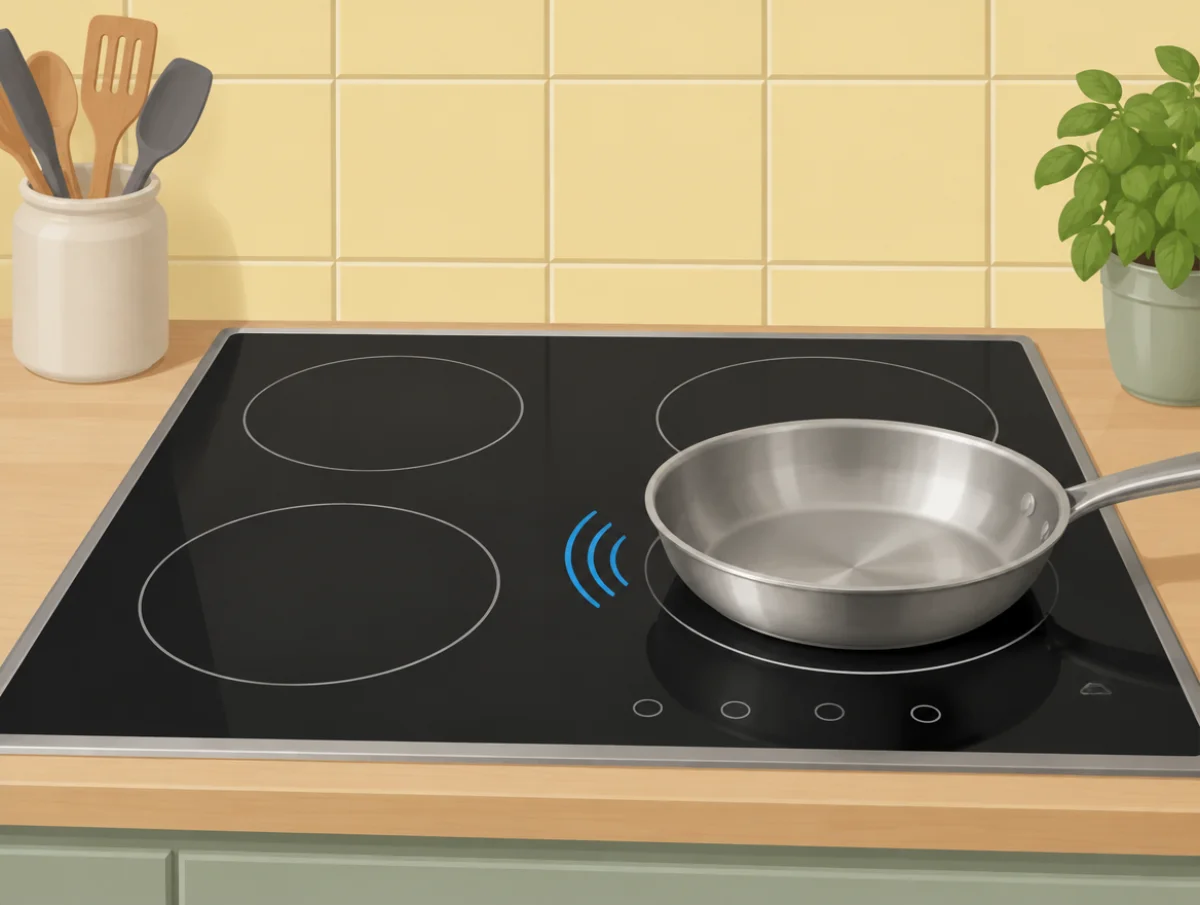
Induction cooktop noises start in the pan. A coil under the glass creates a magnetic field that heats the pan directly, and GE explains that "The process generates vibrations in the cookware that can create audible and inaudible (higher frequency) sounds." That is where the hum, buzz, crackle and whistle come from.
Nine makers' support pages and manuals agree on the list. GE, Whirlpool, KitchenAid, Samsung, Frigidaire, Bosch, Thermador, Miele and Wolf each describe some mix of humming, buzzing, crackling, whistling, clicking and fan noise as part of normal use. The Bosch and Thermador manuals sum it up: "These noises are normal for induction technology. They do not indicate that there is a fault." What follows sorts the sounds by cause, with the fixes the makers print and the few signs they treat as a fault.
Why does my induction cooktop buzz or hum?
An induction cooktop hums or buzzes because the pan vibrates in the magnetic field, and the sound grows with the power level. GE, Whirlpool, KitchenAid, Samsung, Frigidaire, Bosch, Thermador and Miele all treat it as normal.
Start with the power level. Whirlpool's induction humming page puts the cause at "the amount of energy that is transmitted from the appliance to the cookware" and adds: "This sound will quiet or go away when the power is turned down." Samsung's low pitched hum "will get louder as the power level is raised." Miele's noise page gives the same rule for buzzing, and the Bosch NIT5460UC manual describes "A deep humming noise similar to a transformer" at high power.
GE is the most direct, on its humming page: "A humming sound while cooking or boiling on an induction cooking surface is normal." Frigidaire's owner support answer is shorter still. "Some cookware can hum or buzz when used in induction cooking."
High settings have a limit built in. Bosch and Thermador manuals note that the cooktop "may temporarily reduce the power automatically to protect the fragile parts of your appliance and to prevent the appliance from producing excess noise." A zone that eases off by itself during a long boil is following that design.
The pan sets most of the volume
Weight, base construction, flatness and size decide how loud a pan is on induction. GE, Wolf, Samsung, Whirlpool, Thermador and Miele all point at the cookware first, and none of them treats a noisy pan as damage to the cooktop.
GE names the materials: "Heavier pans such as enameled cast iron produce less noise than a lighter weight multi-ply stainless steel pan." Heavier runs quieter. The size of the pan and how full it is also change the sound level, by GE's account. On Samsung's sound list, buzzing depends on "what material the cookware is made of," and "No damage is being done, but you can switch to other cookware if desired."
Wolf's induction noise answer explains why two pans never sound alike, then gives the most concrete pan advice of any maker we found:
- A smooth, flat bottom
- A dry pan base and a dry zone
- Food or water in the pan before heating
Each item has a reason. "Logos or ridges on the bottom of the pan may increase noise," Wolf writes. An empty pan is worse still: the boil dry feature raises power to sense food, and "The noises will be louder."
Pans that are only partly magnetic cause trouble of their own. Whirlpool suggests a magnet test and warns that some pans have only part of the bottom in ferromagnetic material, so those areas "may heat up at different levels or with lower temperatures." Thermador's Freedom Induction manual adds a quieter hum when "The cookware may be too small for the cooking position or not suitable for induction cooking," and the fix is to use larger cookware or move it. Bosch builds a cookware test into the NIT8061UC: a cup of water in the pan, and the zone display rates how well that pan heats.
What is the crackling sound under my pan?
Crackling comes from pans built in layers, such as tri-ply or sandwich bases. KitchenAid, Whirlpool, Bosch, Thermador and Miele all trace it to the layers vibrating against each other, and all call it normal.
KitchenAid's humming and crackling page gives the mechanism: "The noise is caused by vibrations in the joint faces between the different layers." The sound may change with the amount and type of food, and KitchenAid suggests another power setting or another pan. Whirlpool's clicking page files the same sound as a cracking when you start to cook.
Miele explains when a layered pan crosses from crackle to rattle. If the base layers "are less than perfectly joined, the cookware may vibrate," and Miele's only remedy is different cookware.
Why does my induction cooktop whistle?
A whistle usually means two zones at top power together, or an empty pan on a live zone. Bosch, Thermador, GE, Samsung and Miele each describe one of these setups, and each fix starts with the power level.
Bosch and Thermador, both BSH brands, print the same text. A quiet whistle "can be heard when the cookware is empty" and stops once food or water goes in. A louder one may arise "if you are operating two cooking zones at the same time and at the maximum power level," and it fades when you turn down. Lower one zone first.
GE describes the neighbor effect on adjacent elements. Pan noise from two burners "may interact and produce a low whistle or intermittent" hum, and raising or lowering either level can remove it. Pans that cover the whole element ring stay quieter. Samsung hears a high pitched hum when pans of two different materials sit on two zones at once. Miele ties whistling to connected zones running together with sandwich base pans on them.
Clicking at low settings comes from the controls
Clicks at a low setting come from the electronics and controls holding that level. Miele, Wolf and Frigidaire describe the sound as normal, and Wolf adds that high settings often stay silent.
"The electronics may produce a clicking sound, especially at lower power levels," Miele writes. Wolf hears "a pulsing, buzzing, or clicking noise" on low power but not on high, and puts it down to the magnetic fields in use. Its page is blunt about repairs: "Service will not be able to stop or correct this normal, operational noise." Frigidaire's quick start guide for its induction ranges says "The controls click as they cycle to create even cooking temps in the oven and on the cooktop zones."
Thermador adds the pan. "Occasional clicking when activating or moving an item of cookware is completely normal," its manual reads, along with other random noises that have nothing to do with the cookware.
Why does the cooktop fan keep running after I turn it off?
A cooling fan inside the cooktop protects the electronics, and it runs until they cool, even with every zone off. GE, Whirlpool, Samsung, Bosch, Thermador, Miele and Wolf count that afterrun as part of normal operation.
GE's fan page ties it to a temperature sensor and to the top setting: "The sensor will also turn on the fan any time the element is put in Power Boost (the High setting)." It also confirms that the fan "won't turn off until the temperature gets lower." Whirlpool's cooktop fan page has the fan running at various speeds by temperature, sometimes "for an extended period of time," which it calls "part of normal operation." The induction range version counts oven use as a trigger too.
It does not always sound like a fan. Samsung describes it as "a normal fan noise, buzzing, hissing, or whirring," and Miele as a hum that starts "When the appliance is being used intensively." Miele's verdict is three words long: "No remedy required."
How long it runs
Wolf is the only maker we found with a temperature. Its cooling fan page has the fan switching on and off at set internal thresholds, and its fan cycling page gives the stop point: "Cooling fans turn off after the unit temperature drops below 100°F." How long that takes depends on how long the unit was on, the number of burners, pan size and room temperature.
Ventilation matters as well. Whirlpool lists overheating and shutting down, and longer heating or boiling times, as results of poor ventilation, and sends owners to the installation instructions for venting details.
A hum or click with the cooktop switched off
A faint hum at rest is a normal Cooktop Lock function on Whirlpool induction models. Clicking at rest points to pans left on the glass in Wolf's answer, and Wolf fans can also cycle on while the unit is idle.
Whirlpool's cooktop and range pages both describe "a low-level hum that may be noticed in very quiet environments." To quiet it, turn the Cooktop Lock on when you finish cooking: switch off every burner, then hold the lock key for 3 seconds. Holding it for 3 seconds again unlocks the cooktop.
Wolf has three causes for sounds at rest. "Induction-ready cookware stored on the cooktop when not in use may cause clicking," so clear the glass first; if that fails, turn the circuit breaker off for 10 seconds, back on, and retest. Its fans may cycle with the unit idle, "more often if the cooktop is installed in an area of direct sunlight." And on its dimmer and solar page, Wolf asks for an electrician to check frequency, voltage, phase and wiring if a dimmer switch or solar panels seem to change how the cooktop behaves.
Beeps are a separate matter. Frigidaire's ranges sound alert tones when anything sits on the cooktop controls.
Buzzing in your earbuds while you cook
GE's headphone page covers a buzz only the cook hears. Active noise cancellation tries to cancel the pan's high frequency sounds and can amplify them when it cannot keep up, which comes through as static or buzzing in the earbuds. GE's fix is to "turn off any Active Noise Cancellation features for your personal listening device" while cooking.
Is a loud pop from an induction cooktop normal?
None of the induction pages we read lists a single loud pop. The nearest normal sounds are the cracking of a layered pan as cooking starts and, on a full range, Samsung's thumping as metal parts heat and cool.
Samsung files thumping or banging under the expanding and contracting of metal parts in the range. If it is "significantly louder than normal," Samsung asks owners to request service. Frigidaire's answer for induction ranges agrees that temperature changes during preheat and cool down make parts of the range expand and contract. An empty pan on a live zone is another candidate, given Wolf's warning that empty pans make the cooktop louder.
Look at the glass. Bosch and Thermador both print the same warning: "If the surface is cracked, switch off the appliance to avoid the possibility of electric shock." They say to do that at the circuit breaker rather than the main switch, never to cook on a broken cooktop, and to contact an authorized service provider immediately.
When induction noise means a fault
Wolf sets the clearest rule of the nine: noise that grows over time is a repair. "Normal operation would not cause normal noise levels to change," its page reads, so a cooktop that gets louder month by month needs Factory Certified Service.
Before booking a visit, the makers' own checks cover most cases:
- Lower the power level, since most hums and whistles fade at a lower setting.
- Try a heavier, flat, fully magnetic pan that covers the zone.
- Clear the glass of stored pans and dry the pan base.
- Reset power at the breaker for 10 seconds, as Wolf suggests for clicking at rest.
Some symptoms skip the list. Wolf sends a fan that never shuts off, or whose runtime "seems excessive," straight to service. Whirlpool offers service if a hum carries on after the power and cookware checks. Samsung treats banging that is much louder than usual the same way, and a cracked glass top goes to service before anything else, by the Bosch and Thermador manuals.
One limit applies the other way. Wolf notes that showroom units have burner operation disabled, so a cooktop that was silent in the store tells you nothing about how it sounds with a pan on it.
Other kitchen noise pages
On an induction range, the oven carries separate fans that also run after cooking; oven noises explained covers how to tell them apart. A hood over the cooktop may start its own fan from heat sensors, which range hood noises explained walks through, and our quietest range hoods guide ranks hoods by their published sone ratings.
None of the induction pages above prints a decibel figure for cooktop noise. For appliances whose makers do publish one, see the quiet open plan kitchen page. All quotes on this page were rechecked against the maker sources on November 14, 2026.