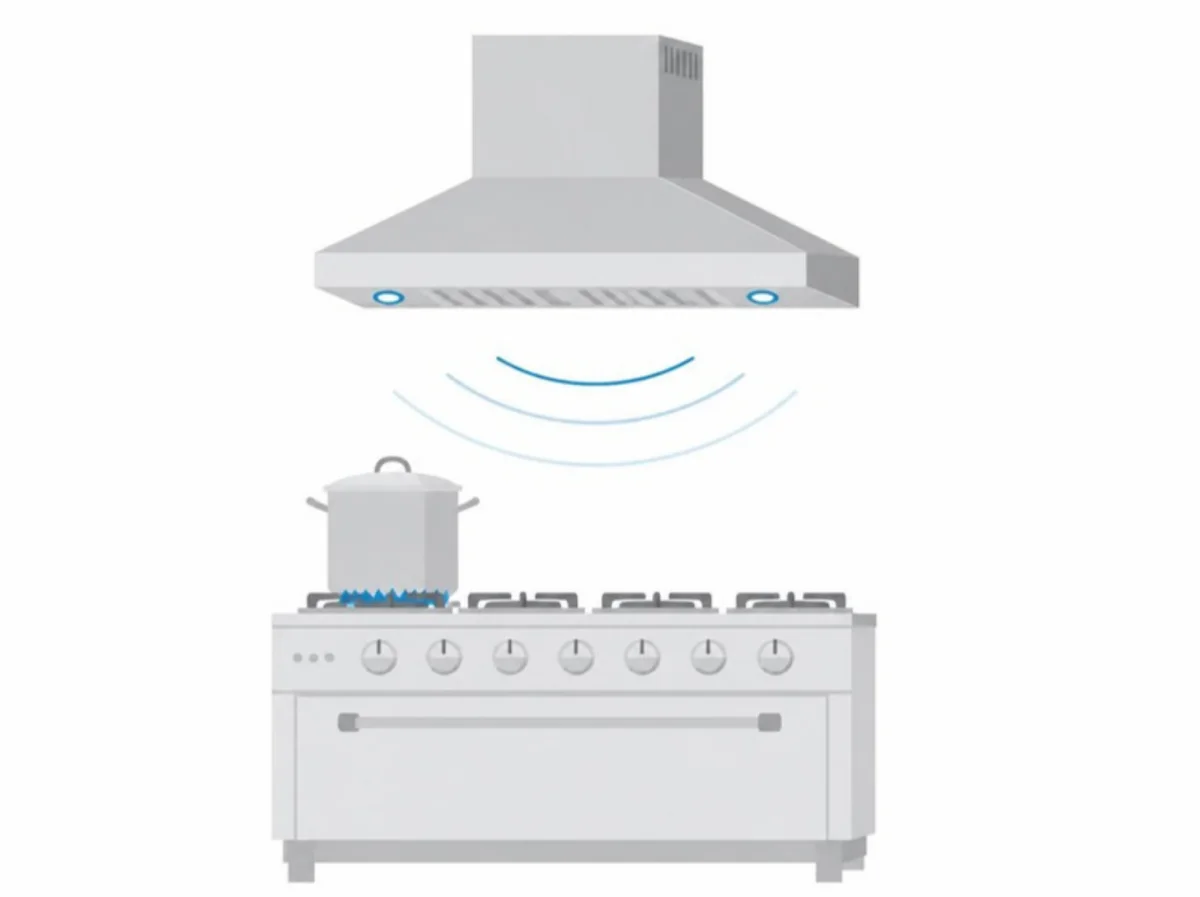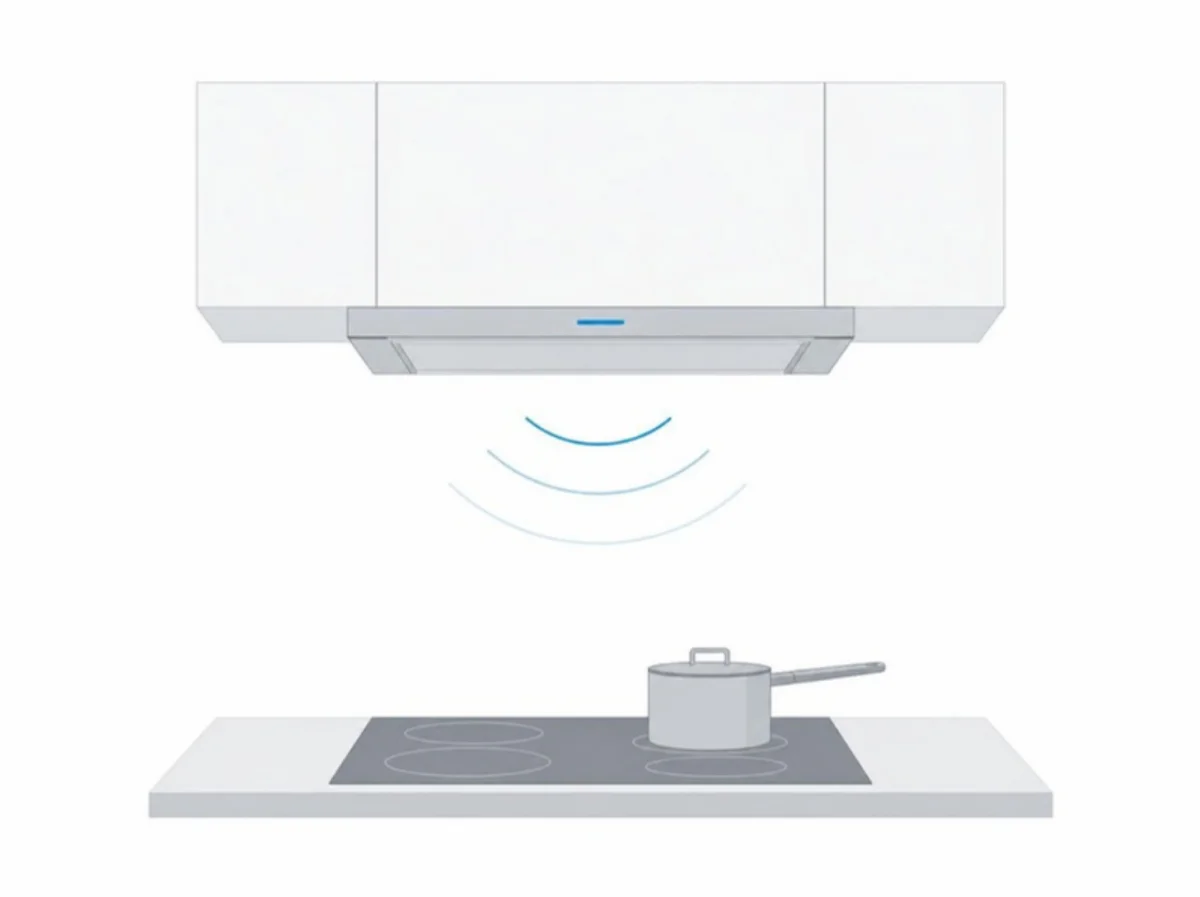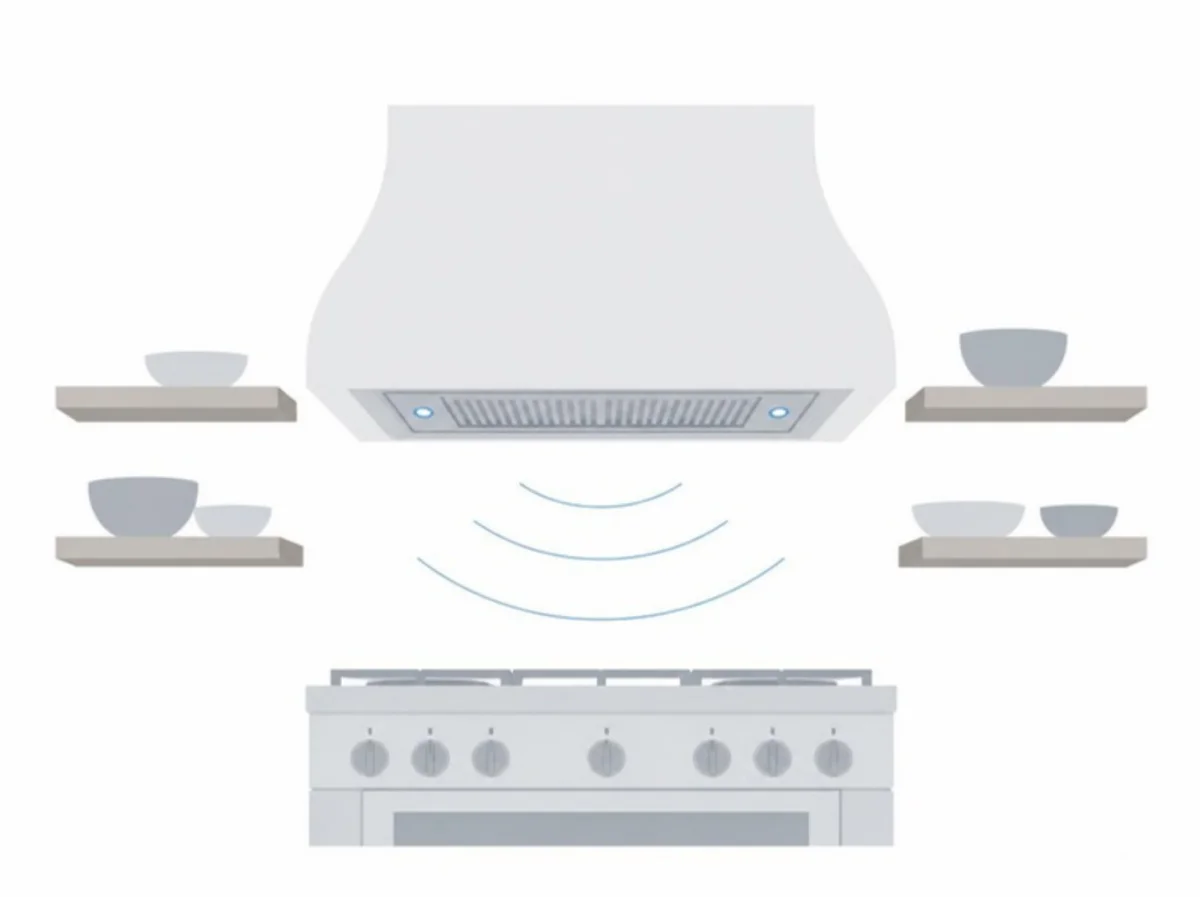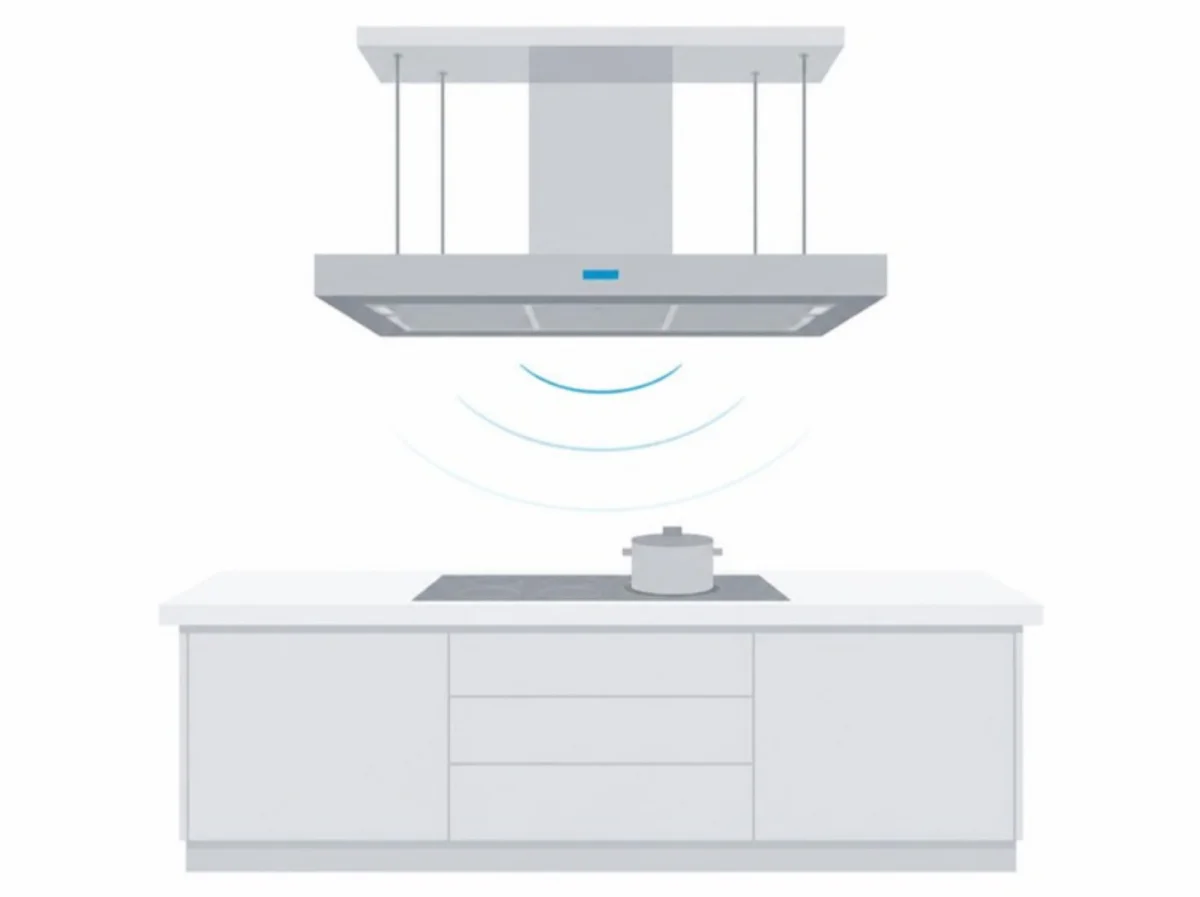
A range hood making noise is, most of the time, simply pushing air through a filter and out along a duct, and how loud that sounds depends as much on the duct as on the hood. Broan-NuTone, Zephyr, GE, Whirlpool, Bosch, Wolf, FOTILE and KOBE all publish help pages, FAQs or manual entries on hood sounds, and they name the same few causes.
The sounds those makers treat as faults make a short list: grinding, a high-pitched whine, violent shaking and a motor that keeps stopping on its own. A roar on high, a whistle, a rattle or a fan that starts by itself usually has an ordinary cause that the maker spells out.
Below, every sound gets its own question, with the maker's explanation, its suggested check and the point where it says to stop and call for service.
Is it normal for a range hood to make noise?
Yes, every range hood makes noise, because its blower has to drive air through filters and a duct. Broan-NuTone rates its hoods in sones and says that the lower the value, "the more comfortable the listening environment."
Bosch's UK support page gives five reasons a hood gets louder: a high fan speed, blocked filters, improper installation, obstructed ducting and worn parts. Only the last, where "Aging parts can lead to unusual sounds", sends owners to Bosch Customer Support for an inspection.
Wolf, the cooking brand of Sub-Zero, opens its answer about a noisy hood with "Many factors could contribute to poor ventilation noise", and nearly every factor it lists is in the ductwork. Read together, the makers treat a steady loudness as an installation or cleaning matter, and a new grind, whine or knock as a matter for the blower.
Why is my range hood so loud?
A range hood that is loud on every speed most often has ducting that is too small, too long or too bent, a clogged grease filter, or a fan set higher than the cooking needs. Broan-NuTone's first check for a loud hood is the duct size.
Duct that is too small or too winding
Broan-NuTone's answer to a loud hood is one step: make sure the ducting matches the size for your model, which "varies between models", so the manual is the place to look. Its duct FAQ rules out 4-inch dryer duct and plastic duct, and puts the minimum on most hoods at 3 1/4 by 10 inches, the equal of 6-inch round.
GE's manual for its JVX under-cabinet hoods lists "Loud or abnormal airflow noise" with the cause "Wrong duct size used in installation", and warns that "GE Appliances service technicians cannot correct this issue if installed improperly." The same manual says the duct "has a strong effect on the air flow, noise and energy use of the fan."
Broan prefers smooth metal duct to flexible metal duct, because "The ridges found in flexible metal duct create turbulence and will diminish airflow." Its duct length answer says to use "the shortest route with the fewest turns possible", and that 45° turns beat 90° turns. GE's JVX manual rules out flexible ducting of any type.
Wolf's list of noise causes reads like an installer's checklist: "A 90° elbow directly off the ventilation hood's transition", under a foot of straight duct after that transition, too many elbows, several transitions, duct smaller than recommended and duct that is not rigid. Where any of those break its guidelines, Wolf says "a qualified HVAC professional may need to review the ventilation installation."
KOBE gives 50 feet as its maximum vent length, "depending on model and installation", and asks for at least 12 inches of duct above the hood before a 90º elbow turns toward a side wall.
Dirty filters and missing makeup air
Bosch says "Clogged grease or carbon filters force the fan to work harder, creating noise." How often to wash them varies by maker. Bosch UK says every 2 to 4 weeks, Broan says aluminum mesh filters go in the dishwasher "approximately every month depending on the amount of usage", and GE's JVX manual says every 6 months, or as needed.
GE's troubleshooting chart files loud airflow noise under more causes than duct size: a damper blade on the wall or roof cap that has not opened, dirty filters, and "Insufficient makeup (replacement) air", which it says exhausting appliances need "to operate to rating." Broan quotes building codes that call for makeup air on systems "capable of exhausting in excess of 400 cfm".
The speed you pick
Bosch's advice is to "Use lower speed settings for everyday cooking and reserve higher speeds for heavy smoke or odors." Boost speeds are the loudest of all, and some end on a timer: GE's JVX hoods run Boost for 10 minutes after you hold the Hi pad for 3 seconds.
Why is my range hood making noise when it is off?
A range hood that runs or hums while switched off is usually doing so by design, through a heat sensor, a timed fresh air mode or a delayed shut-off. Wind working a damper is the other common cause, covered in the next section.
Heat sensors that start the fan
Broan-NuTone says certain hoods carry Heat Sentry, which "automatically turns on the fan blower speed to high when excessive heat is detected." A second Broan answer says it steps up to the next speed or the top one, and "Once the temperature has been reduced, the hood will turn off or return to the last setting used."
GE's Kitchen Hub works the same way. Its heat sensor starts the fan on low when it detects excessive temperatures above the cooktop, and the fan cannot be switched off "until temperatures return to an acceptable level." GE says a fan that comes on by itself "does not necessarily indicate a need for a repair."
Pairing is a third trigger on GE models. A JVX hood linked through Chef Connect to a compatible range or cooktop turns its light and fan on when the cooktop sends a command, at whatever default sync settings are stored; GE ships the fan sync set to off.
Timed fresh air modes
Some hoods start themselves on a schedule. Zephyr says its Clean Air feature "is designed to turn the hood on every 4 hours for 10 minutes", and that the display flashes "A" and then "1" while it is active. Zephyr points to the owner's manual for switching it off.
KOBE's ECO Mode "runs the range hood on QuietMode™ setting for 10 minutes every hour to remove excess moisture, microscopic particles and odor." A KOBE hood that runs quietly for ten minutes at a time with nobody cooking is likely in that mode, so the manual is the first stop before any service call.
Delayed shut-off and thermal cut-outs
Several hoods keep running after you press off, on purpose. FOTILE's JQG7501 manual describes a DELAY button that stops the hood two minutes later, when the smoke baffle plate closes automatically, and the EMG9030 manual offers 2, 5 or 10 minutes. GE's JVX Auto Off pad, held for 3 seconds, stops the fan after 15 minutes.
A motor that keeps stopping and restarting is another matter. FOTILE says its thermal overload turns the motor off when it overheats and back on once it cools, and that a motor which "continually turns off and restarts" needs its authorized service center. GE's chart says such a fan is "probably overheating", that this "can be harmful to the motor", and that the filter may be excessively soiled.
Why does my range hood damper flap or bang when it is windy?
Range hood damper noise on a windy day comes from wind pushing the flap in the wall or roof cap open and letting it drop. Zephyr and Wolf both name wind, and both point to the installation, not the hood.
Zephyr's troubleshooting table lists "Damper flapping with high winds" and answers: "Contact your hood Installer. Check outside wall cap to make sure it is installed properly." Wolf calls the same sound a metal tapping, which "may be damper being forced open by wind and a secondary damper installation may be required to resolve."
A damper can also make a running hood louder. GE's chart says the blade on the wall or roof cap may not be open, and that "Damper blades may flip over and will not fully open when this happens", leaving the fan noisy and weak. GE's fix is to make sure the damper swings freely and set it back to its original position.
KOBE says most of its hoods arrive with a damper fitted, and GE's JVX instructions place the damper pivot nearest the top back edge so the damper can move freely. A damper that rattles or sticks after installation falls under Zephyr's advice to call the installer.
Why is my range hood rattling or vibrating?
Range hood rattling while the fan runs most often means something has worked loose: cover screws, mounting fixings or ducting. Whirlpool and Bosch both blame loose parts first, and Whirlpool adds worn motor bearings.
Whirlpool's rattling article says a rattling kitchen exhaust fan "is likely to have loose or defective components that must be rectified." Its steps start "After switching off the power supply": check the fasteners on the cover, remove the cover to look for loose parts, and tighten or replace what you find.
Whirlpool then checks the motor. It says the motor shaft "should not move at all" when wiggled, and that any movement means worn bearings and a motor that needs replacing. "Do not attempt to lubricate or repair the motor", Whirlpool adds, since a motor that is not working properly "must be replaced."
Bosch's UK page says "Loose fixtures or misaligned ducting can cause vibrations and rattling sounds", and suggests checking that the hood is securely installed and tightening screws, with a professional for complex problems.
FOTILE's JQG7501 manual lists a hood that "vibrates violently" among the malfunctions to watch for on the test run after installation. If it happens, FOTILE says to "unplug the hood immediately and re-check the installation process", and to contact its authorized service center as soon as possible if the malfunction continues.
GE's care section sets the ground rule for any of these checks: "Be sure the circuit breaker is off and all surfaces are cool before cleaning or servicing any part of the vent hood."
Why is my range hood whistling?
A whistling range hood most often has air leaking or squeezing past something: a filter out of place, loose tape on a duct joint or an open seam. Zephyr's troubleshooting table says to reposition the filters and check those joints.
Zephyr's exact advice for whistling during blower operation is "Reposition filters and check duct taped joints on vent system for loose tape or open seams." Wolf lists "Vent hood whistles" among the complaints on its noisy hood page and answers with the same duct checklist it gives for a loud hood: elbows, transitions, undersized duct and duct that is not rigid.
GE's installation steps cover the duct side: keep the run and the number of transitions and elbows to a minimum, "Maintain a constant duct size", and seal every joint with duct tape against leaks. Broan adds that when remodeling or changing hoods, the ductwork should never be reduced below the size the hood specifies.
Why is my range hood humming, whining or buzzing?
A range hood hum that rises and falls with the fan speed is the blower at work, and it is what a sone rating measures. A high-pitched whine is different: Zephyr sends that one straight to its Technical Support.
Zephyr's table has a single line for "High pitched whining noise during blower operation", and its whole answer is "Please contact Technical Support." There is no owner check for it.
A motor that has started to growl or hum harder than before falls under Whirlpool's bearing test in the rattling section. Bosch says worn parts should be inspected and replaced through Bosch Customer Support, and Broan's answer to motor noise says "The problem could be related to the fan blade or motor."
A hum while the hood is switched off is usually one of the automatic runs above: a heat sensor, Zephyr's Clean Air mode, KOBE's ECO Mode or a delayed shut-off counting down.
For a buzz from the lights, none of the makers we read has a dedicated article. Zephyr says to contact Technical Support if all the lights flicker, and GE's chart puts early bulb failure down to "Light wattage is too high", with the fix to fit the correct wattage.
Why is my range hood fan making a grinding noise?
A grinding range hood fan points to the blower, such as a fan blade that is not seated or an impeller that grates as it turns. Zephyr and Wolf both send it to service, and FOTILE says to unplug the hood.
Zephyr lists "Grinding noise during blower operation" with one answer: contact Technical Support. FOTILE's JQG7501 manual names "The impeller grates while rotating" and "The motor makes strange sounds" beside violent vibration, with the same order to unplug the hood, recheck the installation and call its authorized service center if the problem continues.
Broan's one owner check for motor noise is the fan blade. It says to remove the filter and inspect the blade, and that the motor post should stick through the blade by about a quarter of an inch. Wolf says "If a functional problem with the ventilator or blower exists, no further troubleshooting advice is available", and sends owners to Factory Certified Service.
How do you reduce range hood noise?
Range hood noise reduction, in the makers' advice, is mostly about the installation and habits: a full-size duct that runs short and straight, clean filters, a damper that swings freely and the lowest speed that clears the smoke.
Broan says not to add an in-line or external fan to a hood that already has its own power unit, since that kind of boost "will not be effective" and the tampering voids the warranty. For anyone who wants the motor away from the kitchen, it says "there are hood products made for that type of installation."
When the hood itself is the source, a quieter model is the remaining fix. Our quietest range hoods guide ranks hoods on certified sones at full power, the quietest under-cabinet range hoods page does the same beneath a cabinet, and our Zephyr range hood sones page lines up Zephyr's printed ranges against HVI's certified figures.
How loud is a normal range hood?
A normal range hood is rated in sones, and on their top setting even the hoods sold as quiet in our guides carry certified ratings of 5 to 13 sones. On Broan-NuTone's scale, 4 sones is TV listening volume and 6 is a sporting event.
Broan's scale runs from 1 sone, "The refrigerator running in your kitchen", through 3 sones for a face-to-face conversation, to 5 sones, a "busy restaurant at dinner time." Sones are linear, so an 8-sone hood sounds twice as loud as a 4-sone one; our sones vs decibels page explains the scale.
Speed changes everything. FOTILE's Pixie Air UQG3002 holds the lowest certified high-speed figure we found among complete hoods moving over 400 CFM, 4 sones on a round 7-inch duct while moving 470 CFM, while the low number printed on most boxes comes from the slowest speed.
Where makers print decibels, they are mostly sound pressure levels. FOTILE's JQG7501 manual gives 39 dB(A) on low, 49.2 on medium and 54.3 on high (1.2, 3.9 and 6 sones), and the EMG9030 manual 40.5 to 56.5 dB(A), both to IEC 60704. KOBE describes QuietMode as "40 Decibels (1 Sone)". Why a sound power figure and a sound pressure figure cannot be compared gets its own page, sound power vs sound pressure.
Are range hood sone ratings certified?
No, not always. Of the 62 range hood and insert models in our catalog on October 26, 2026, 49 appear in the Home Ventilating Institute's certified directory, and 13 carry sone figures that only their own makers stand behind.
We took those counts from the fact sheets behind our range hood and insert guides, where each entry quotes the maker's spec sheet next to its HVI listing, if it has one. Bosch's HUI80553UC sits in both catalogs and is counted once. The numbers describe the hoods we track, not every hood on sale.
The 13 without a listing include GE's Profile PVX7300SJSS, Bosch's 800 Series HCP80641UC chimney hood, KOBE's IN26 insert, Vent-A-Hood's BH128SLD liner and two Hauslane models. Hauslane prints 1.5 to 7.0 sones with no speed attached to either end, so there is no telling which setting the quiet figure belongs to.
Certification covers the working speed and the high speed, and little in between. On 14 of the 62 spec sheets, Broan and Best print figures for the middle speeds and mark them as not HVI certified, such as the 3.0 sones at 270 CFM on medium for Broan's EBS1304SS slide-out hood.
Sones are the common unit. Every model but one gives a sone figure; FOTILE's 42 inch EA06C island hood prints only 41, 50 and 55 dB. Seven more put decibels beside sones: five FOTILE hoods, KOBE's insert and Vent-A-Hood's liner, whose page calls its decibel values approximate equivalents.
Two hoods are comparable only at the same certified speed and the same duct, which is how our range hood guides line them up. A self-reported range, or a decibel figure set against a sone figure, cannot settle which hood is quieter.
How did we put this range hood noise guide together?
Our range hood noise page is built from eight makers' own help pages and manuals. It quotes Broan-NuTone's Help Center answers, Zephyr's troubleshooting table, GE's JVX owner's manual and Kitchen Hub article, Whirlpool's vent hood rattling article, Bosch UK's cooker hood noise page, Wolf's noisy hood answer, FOTILE's JQG7501 and EMG9030 manuals and KOBE's FAQ. Vent-A-Hood's site showed a holding page instead of content, so it is not quoted.
We did not install, switch on, open up or repair any range hood, damper or duct for this page. Any step here that touches the power, the motor or the blower comes with the maker's own conditions attached. On filter washing, where the makers give different intervals, each one is listed.