An oven fan is often loudest once the cooking is finished. "Most ranges and wall ovens feature a cooling fan for the electronic oven controls," by GE Appliances' count, and that fan keeps blowing after you switch off. Many also have a convection fan inside the cavity that can spin even on a plain Bake setting. GE, Whirlpool, Samsung, LG, Frigidaire, Bosch, Miele and Wolf describe the fans they fit as normal.
The makers that cover fan faults draw the line at a fan that rattles, scrapes, squeals or never stops. This page sorts the normal sounds from the ones makers send to a technician, using their own support pages and manuals.
Two fans, and the oven door tells them apart
Open the door. A convection fan stops when the door opens; a cooling fan carries on. That one check, printed by Whirlpool, GE, Samsung and Wolf, tells you which fan you are hearing.
Whirlpool's convection range page puts the test in one line: "If the fan noise stops when the door is opened, you hear the convection fan operating. If it does not stop, you hear the cooling fan." Its wall oven page adds that a convection fan running "with the oven door open" is not normal.
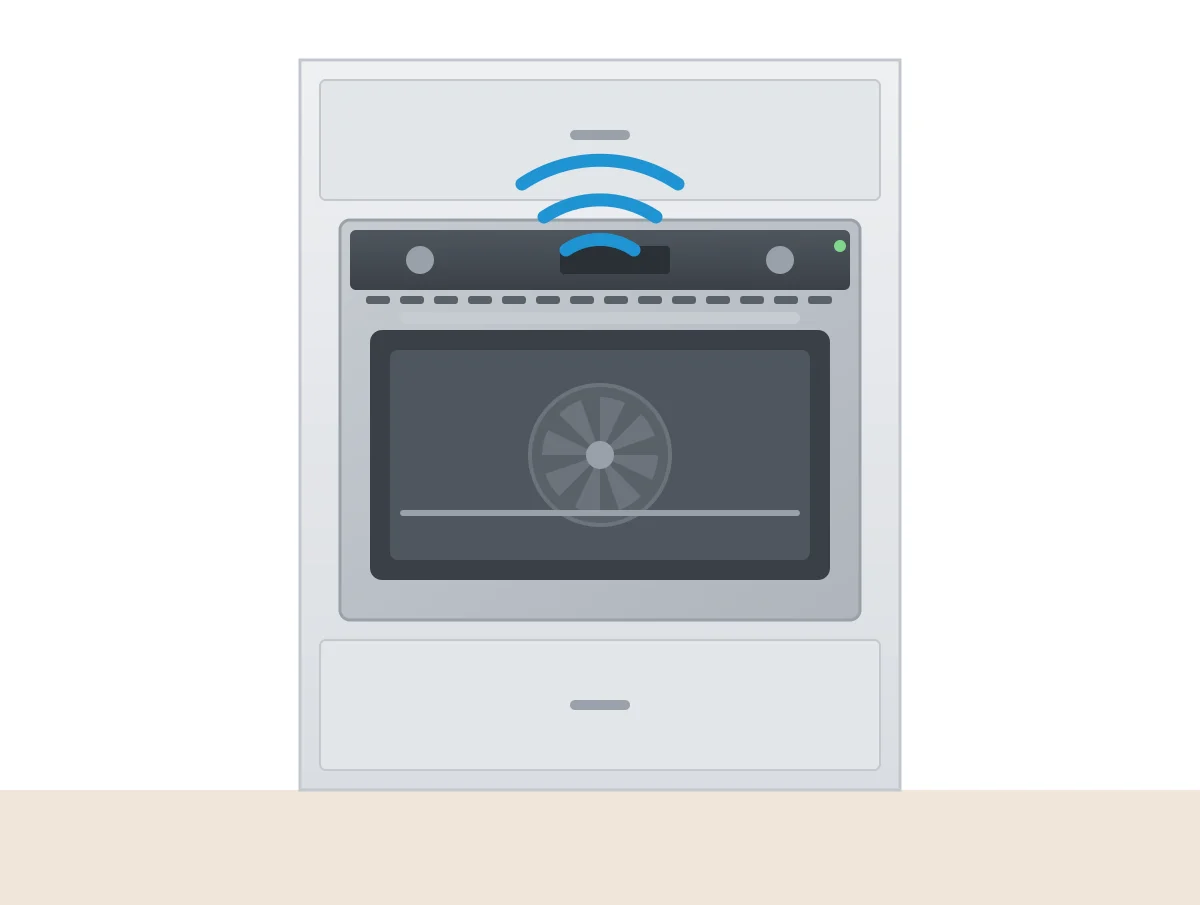
The two fans do different jobs. The convection fan is the visible one on the back wall, moving hot air around the food. The cooling fan sits out of sight, often near the controls, and pushes warm air out of a vent; on Miele's HR1924 range the vents sit between the door and the control panel. "The cooling fan is not visible, but you will hear it running whenever the electronics get hot," according to Samsung's oven fan page. It also notes that some models have more than one convection fan. Wolf points out that its cooling fans "sound similar to the convection fans", which is why the door test helps.
Not every oven has both. GE's fan noise page reads: "Gas and Dual-Fuel Free-Standing Ranges do not have cooling fans." Those are GE models whose numbers start with letters such as JGB, PGB, GGF and P2B.
Why does my oven fan keep running after the oven is off?
It is cooling the electronic controls, and it stops only when the oven has cooled. GE, Whirlpool, Frigidaire, Bosch, Miele and Wolf all describe this run on as normal, and none of them treats it as a fault by itself.
The fan is usually under thermostat control, not a timer. "The cooling fan may run throughout the entire bake cycle and continue even when the oven is off," reads GE's page on a fan running too long, which ends: "This is considered normal operation." On many GE wall ovens the fan runs in every cooking function, "even during a time bake or delay start setup before the oven actually turns on."
Whirlpool and its sister brands use near identical wording. The cooling fan "can run for extended periods depending on the internal and external temperatures," and it "Keeps the electronic controls cool during oven functions such as BAKE, BROIL, or CLEAN." KitchenAid's commercial range page has the fan running "for an extended period of time until the internal temperature of the cavity reaches safe levels."
Frigidaire answers the same question on its owner support site: "The fan may stay on after you have finished baking and turned the oven off." In Bosch's 500 Series manual the troubleshooting table reads "This is normal" for a cooling fan running with the oven off, and the quick reference guide for its wall ovens answers with "No action required."
How long makers say the cooling fan runs
Only three makers put a number on it, and the numbers differ:
- GE: "15 minutes up to even 2 hours, depending on how hot the oven was."
- Wolf: audible "up to 45 minutes depending on how long the oven was on, at what temperature, etc."
- Miele: off below 160°F (70°C) on the default setting, or "after approx. 25 minutes" on the timed one.
Whirlpool gives factors, not minutes. Its wall oven page lists the size of the kitchen, the amount of furniture in it, how long the oven was on and the temperature it was set to. Wolf adds that "If the bake stone was used, the fan may run longer," and that an oven can take several hours to cool completely because of its insulation.
Miele also explains why the fan runs on. In the HR1924 range manual, the cooling fan keeps going "to prevent humidity from building up in the oven, on the control panel or in the surrounding cabinetry." That is the reason Miele advises against the time controlled setting when food is left in a warm oven, since it can lead to condensation on the control panel, countertop and cabinets.
A fan that starts while the oven is off
Heat from the cooktop can trigger it too. Samsung writes that "Either the oven or the cooktop can create enough heat for the cooling fan to come on," and Frigidaire's quick start guides for its electric and gas ranges both say different fans run to cool parts of the range "even when it’s off." On a microwave and wall oven combination, Frigidaire's installation instructions add that after high temperature cooking "the fan will continue to run after the oven is turned off."
Why is my oven fan making noise when heating up?
That is usually the convection fan helping the preheat, even on a non convection setting. Whirlpool, GE, Samsung, Wolf and Bosch all describe it, though gas and electric ovens start the fan at different times.
Whirlpool states it outright: "It is normal for the convection fan in your Whirlpool oven or range to run during non-convection cycles." Its reason is to "help optimize preheat times, provide uniform oven temperature, and improve baking and cooking performance." Wolf's convection fans "operate during oven preheat in any mode", and for a convection fan running in a mode that does not use it, the Bosch wall oven guide answers "This is normal in some modes while the oven is preheating."
Timing is where the makers part ways. On electric models the fan comes on immediately at Whirlpool, and Samsung runs it during preheat on electric ovens only. Gas models wait. Whirlpool's gas convection fans start "After approximately five(5) minutes", GE's do "not start until preheat is reached," and on Samsung gas ovens the fan does not run during preheat at all. GE adds that on its gas ranges the fan "will cycle off every time the oven calls for heat."
Convection fan hum is part of the cycle
A low hum that comes and goes during convection cooking is the fan cycling on a schedule set by the control. GE, Samsung, LG and Wolf each describe the on and off pattern as normal.
Samsung gives the most exact pattern. During convection cooking its fan "runs for about 10 seconds, then turns off for about 40 to 60 seconds," and the fans "are not completely silent, but they are generally quiet." LG's range noise page files a humming sound in convection bake and roast modes as normal and adds that the fan "will cycle on and off periodically during oven operation."
GE's electric ovens with Precise Air convection go one step further. The fan reverses direction while convection baking, which GE says produces more evenly browned baked goods, and "It is normal for the fan to cycle on and off frequently during the convection cooking cycle." Wolf's ovens with two convection fans may alternate them or run both at once, depending on the mode.
What is the clicking or ticking in my oven?
Usually relays or the temperature control switching elements on and off, or a gas igniter sparking. GE, Samsung, LG and Whirlpool all list these clicks as normal.
GE explains why a new oven clicks more than an old one. "You may hear the heating elements in a newer oven click on and off much more frequently than in older ovens," reads its clicking page, because the control holds a tighter temperature. Samsung puts clicking or cracking during use down to circuit relays switching, with a volume that varies by model "depending on how many relays and their location within the range." On LG ranges, control panel clicking is normal because "every mode is making clicking noise for safety operation."
Gas ovens add the igniter. On Whirlpool gas ranges "The ignitors will click several times until the flame is detected," a tick its clicking page likens to "tapping a nail on a piece of glass." It can come back every one to three minutes during the cycle. The same interval applies to a soft whoosh as the gas lights, and there may be a single pop as the gas valve opens, "similar to a suction cup pulled off a piece of glass." Both are normal on Whirlpool's list.
Clicking from the cooktop with every knob off
On a gas range, that points to the cooktop igniters rather than the oven. Samsung traces continuous clicking with no knob at LITE to "moisture on the ignition switches behind the knobs." Its fix is to heat the cooktop or oven, or unplug the range and let it dry "for a couple hours or overnight," and to request service if the clicking continues.
Popping and banging as the metal heats
Pops, cracks and the occasional bang come from steel and porcelain expanding as the oven heats and shrinking as it cools. GE, Whirlpool, LG and Samsung all class this as normal, within limits.
GE's normal sounds page lists "Crackling," "popping," or "oil canning" sounds among them. LG pins down the timing: knocking usually happens 10 to 15 minutes into a bake or broil cycle and again after it ends, as the bottom of the cavity expands and contracts. Whirlpool adds a cause owners can fix. Some ranges have a removable oven bottom that makes noise if it is not seated properly, and the cure, with the oven cool, is to set its front against the front frame and lower the rear into place.
Samsung sets the limit. Thumping or banging from metal parts is normal, but if it is "significantly louder than normal", Samsung asks owners to contact its support center. The racks can make noise as well. LG traces a rattle when the door shuts to racks shaken by the impact, and Miele's manual suggests a few drops of cooking oil on the shelf runners when racks make a noise going in and out.
Is a rattling or squealing oven fan a fault?
Yes. LG, Samsung, Whirlpool and Wolf all send a rattling, scraping, squealing or rubbing fan to service, and none offers a home fix for it.
The wording varies by maker:
- LG: rattling "can be sign of a problem with the fan motor or the fan housing"; clanking or scraping means a fan blade problem, since a dented blade "can interfere with chamber."
- Samsung: "squealing, grinding, or squeaking, especially when it stops or starts."
- Whirlpool: a convection fan should not "make a rubbing/metal-on-metal noise when operating."
- Wolf: a convection or cooling fan "making rubbing, squawking, rattling, banging, or high pitched noise" when the noise is unusual or cooking has been affected.
People often blame worn fan bearings for a squeal. None of the maker pages we found uses the word; they describe the sound and stop at a service visit. LG adds a rough loudness test for any other oven noise: if it is enough to "interrupt conversations or TV viewing," service is needed.
When to call for service
Call the maker's service line when a fan never stops, never starts, or makes any of the sounds above. Several makers ask for one reset first:
- Whirlpool: "If the cooling fan runs for a significant amount of time, cycle the power to the appliance to reset the control."
- Wolf: reset power at the circuit breaker and retest; if a fan still will not turn off, contact factory certified service.
- Samsung: request service "If the cooling fan never turns on or never turns off."
A fan that does not run at all also counts. Wolf's fan not working page says an oven fan that is "not working as expected" needs service. Check the obvious first: after preheat, Wolf's convection fans run only in a convection mode, and on Wolf gas ranges they are switched by a Fan switch above the oven door. Wolf's cooling fans have no switch at all, "as they turn on as a safety measure to prevent overheating."
New ovens get some slack. Frigidaire's quick start guides say that during a first 30 minute bake at 350°F, "it’s normal to experience some noises and smoke."
Other kitchen noise pages
A fan running above the range after the oven is off may not be the oven at all. Range hoods and over the range microwaves have heat sensors that start their own fans, covered in range hood noises explained and microwave noises explained. For a hood that is simply too loud, see how to make a range hood quieter and the sone ratings in our quietest range hoods guide.
None of the oven pages and manuals above gives a decibel figure for a fan. The quiet open plan kitchen page covers kitchen appliances that do, air fryer noises explained covers countertop air fryers, and why your appliance got louder covers fans that get rougher with age. Every quote here was checked on November 13, 2026.