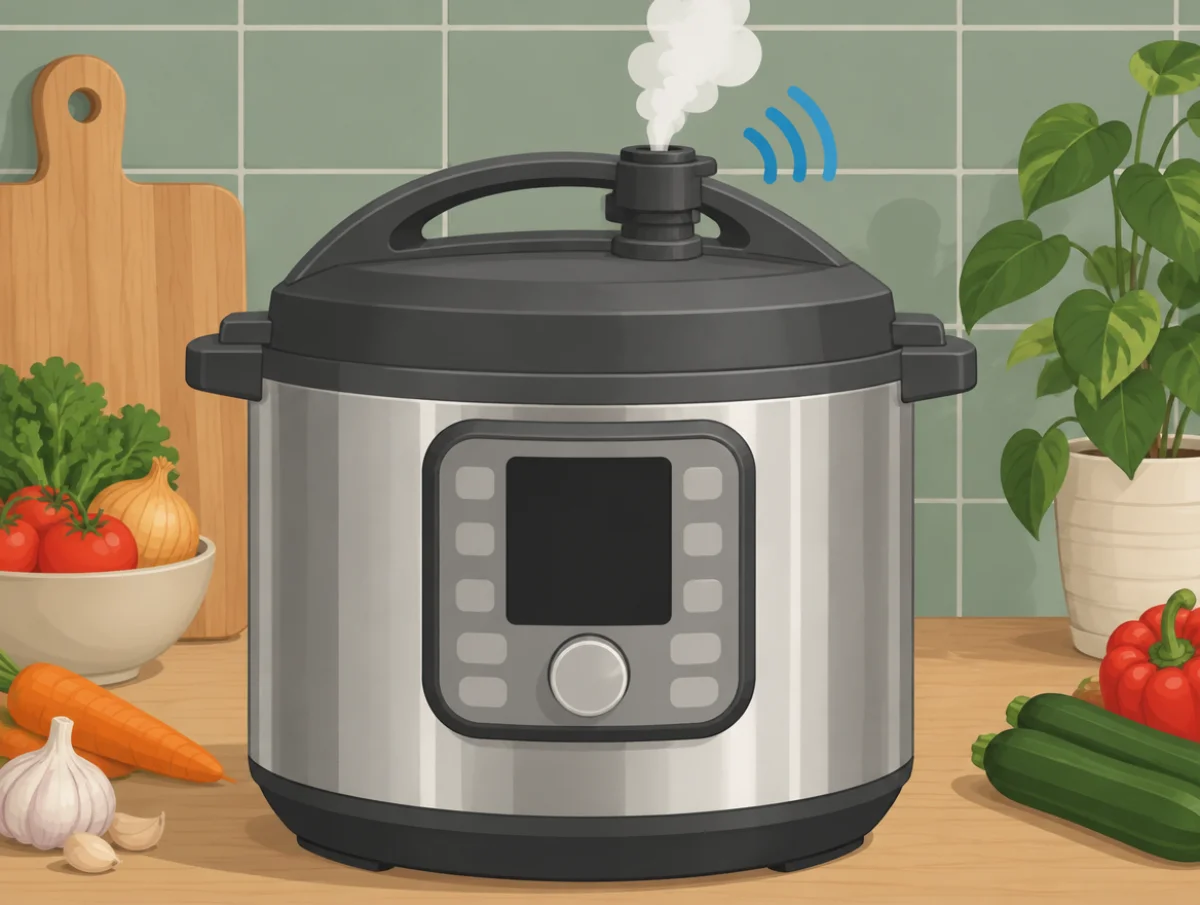
Pressure cookers are meant to make some noise. Steam has to leave while the pot heats up, a stovetop regulator rocks or whistles to bleed off extra pressure, and an electric base clicks as its heater switches. The sounds that matter are the ones that change: steam that never stops, steam from the rim of the lid, a whistle every few seconds, or a beep paired with a Food Burn message.
The explanations here come from manuals and support pages by Instant Brands (the Instant Pot Duo and Rio manuals and the Instant Pot FAQ), Presto, Hawkins, Breville, COSORI, Midea, Tefal and Fissler, all read on November 16, 2026. Ninja's and Crock-Pot's US sites refused automated requests that day, as did Kuhn Rikon's FAQ and T-fal's US site, so none of them is quoted. Tefal is the name T-fal's cookers carry outside North America, and its international FAQ is used instead.
| Sound | What the makers say it is | What to do |
|---|---|---|
| Soft hiss or wisps of steam early on | Air leaving and pressure settling (Presto, Breville) | Nothing; wait |
| Small hiss during cooking | Cooker regulating excess pressure (Instant, COSORI) | Nothing |
| Steam pouring for 3+ minutes | Seal, valve or handle problem (Instant) | Turn off, unplug, inspect |
| Steam from the lid edge | Sealing ring missing, dirty or damaged | Turn off; reseat or replace the ring |
| Clicking or light crackling | Heater or pressure board switching; wet pot bottom | Dry the outside of the inner pot |
| Rocking or jiggling weight | Regulator venting excess pressure (Presto) | Turn heat down to a slow rock |
| Whistle | Full operating pressure (Hawkins) | Turn heat down and start timing |
| Float valve pops up | Pressure has built (COSORI) | Leave the lid shut until it drops |
| Food Burn alert with beeps | High temperature at the pot bottom | Turn off, release pressure, check the pot |
| Sputtering at release | Foamy or starchy food in a quick release | Use natural release next time |
Which pressure cooker sounds are normal?
Early steam, a small hiss while cooking, occasional clicks from an electric base and a steadily rocking or whistling weight on a stovetop model are all normal. Makers treat steam that keeps flowing, or leaks from the lid edge, as a fault.
Timing matters as much as the sound. Instant's FAQ says an Instant Pot can take "anywhere from 10 to 40 minutes or longer" to reach pressure, and the Duo manual says up to 30 minutes, longer with frozen food. Hissing during that wait is part of it.
Hissing while the pot comes to pressure
On electric multicookers, a short hiss is the valve trimming pressure. The Duo and Rio manuals file "Minor steam leaking/hissing from steam release vent during cooking cycle" under "This is normal; no action required," and the Rio manual names the cause: "Cooker is regulating excess pressure."
COSORI's CO601 manual reads the same way, with one extra check: a switch left on Vent also hisses. Breville goes further. Its Fast Slow Pro book says the valve "will occasionally release steam" as pressure builds, calling it "the cooker stabilizing its internal pressure and is a normal occurrence."
Stovetop cookers vent at the start too. Presto's instructions explain that the air vent/cover lock "may move up and down a few times when cooking first begins as it automatically exhausts air from the pressure cooker. Steam will be noticeable. This is normal." A little moisture under the regulator in those first minutes is expected as well, because the regulator is cooler than the rest of the pot.
When the steam means stop
Three minutes is the line Instant draws. The Duo manual says to turn the appliance off if steam leaves the steam release valve or float valve "in a steady stream for longer than 3 minutes," and to turn it off straight away if steam escapes from the sides of the lid.
The FAQ adds a practical step: record a short video, then turn the cooker off and unplug it. Once it has cooled, Instant's checklist runs around the lid. Is the float valve fitted, with a silicone cap free of gouges? Is the sealing ring seated behind its wire rack and not stretched? Does the inner pot sit flush when turned upside down on a flat surface? Is the steam release handle pushed fully onto its post and set to sealing?
Other makers point to the same few parts:
- COSORI: a loose, dirty, warped or broken sealing ring, a lid not locked, or a warped pot rim.
- Midea: a dirty or worn float valve gasket when steam leaks from the float valve.
- Breville: a gap between lid arm and lid, a loose sealing nut, or a cracked silicone gasket.
- Presto: a sealing ring shrunk "after prolonged use," or nicks in the body rim.
Steam that gushes from a valve already set to Seal is a different fault. COSORI and Instant both suspect the pressure sensor and send owners to customer support; Both also suggest flicking the switch to Vent and back to Seal, in case the valve is simply not seated.
Why does an Instant Pot click or crackle?
The clicking is the heating element cycling. Instant's FAQ answers the question directly: "This is normal. The clicking sound is the heating element turning on and off to regulate internal temperature and/or pressure."
The Rio manual describes it as "the sound of power switching and expanding pressure board when changing temperatures." COSORI uses almost the same words for its CO601, and Midea's MPC601SNA manual calls a "cluck" sound normal while the cooker works.
Crackling has a second cause you can fix. Both Instant and COSORI list a wet bottom on the inner pot as a reason for the noise. Dry the outside of the pot after washing, and check that the plate in the base is dry before you drop the pot in. If liquid has spilled into the base itself, Instant's advice is much more involved: let it cool, wipe the element, turn the base upside down to air dry for 72 hours, then run a water test. Oil or fat in the base means stop using the cooker altogether.
The float valve pops up, and that is the point
A small click or tap from the lid partway through preheating is usually the float valve rising. COSORI's manual says it "will pop up once enough pressure has been created," and Midea's says the same thing in fewer words: as pressure rises, the float valve ascends.
It drops again when pressure is gone, and the lid stays locked until then. Instant's FAQ is firm about forcing it: if the float valve is still up or the lid resists, "this indicates that the appliance is still pressurized," so leave it closed.
A float valve that never rises is worth a look. COSORI blames food on the valve or its cap, too little liquid, or a valve caught by the lid lock. Midea adds steam leaking elsewhere, which sends the cooker to its service center.
Rocking, jiggling and whistling on a stovetop cooker
Stovetop cookers are louder by design, because a weight sitting on the vent pipe is the pressure control. How it should sound depends on the maker.
Presto wants a slow, steady rock
Presto's regulator "relieves excess pressure through the vent pipe as it rocks back and forth." When it starts rocking, cooking time starts, and the heat comes down to "maintain a slow, steady rocking motion."
A frantic jiggle is too much heat. If the regulator rocks vigorously, Presto warns, excess steam escapes, liquid evaporates and food may scorch; the cooker can go dry, and then the regulator stops rocking. Silence after a hard rattle is therefore a warning, and Presto's instruction is to take the cooker off the heat. A rocker that stops because the heat was turned down too far just needs more heat.
A Hawkins whistles once, then less often
Hawkins describes the build in two stages: "at first a very low hissing sound of steam from the pressure regulator," then steam at full force until "the pressure regulator lifts with a whistling sound." That whistle is full operating pressure, so turn the heat down and start the clock.
After that, whistles should be occasional. Hawkins's FAQ says to cut the heat further if the cooker whistles "more than 4 whistles per minute," and to raise it slowly if no steam appears for a few minutes. Counting whistles as a timer is a habit Hawkins discourages: it "may give you the wrong time," food may not cook through, and the pot risks drying out and fusing its safety valve.
Tefal hisses, Fissler shows rings
Tefal's cookers hiss rather than whistle. Its Sensor FAQ says cooking begins "when the pressure regulator valve allows steady release of steam, making a regular hissing noise," and that no pressure at all for the first 5 minutes is normal. Another answer in the same FAQ describes the full-heat sound as "a constant whistling sound," the cue to turn the heat down.
Fissler leans on a visual cue instead. On the Vitaquick, rings on the valve show the cooking level, and its pressure cooker guide explains the colors. If the red ring shows, "the temperature in the pot is too high and the Pressure Cooker automatically starts releasing steam." Lower the heat until the green ring returns.
What do the beeps and the Food Burn alert mean?
Most beeps are progress reports. The Instant Pot Duo beeps once when it reaches pressure and starts cooking, and 5 times when the timer hits zero. Continuous beeping with a code on the display means a fault.
Food Burn is the one people ask about most. The Duo manual defines it as "High temperature detected at bottom of cooking pot," after which the cooker lowers its own heat. Starch stuck to the bottom is the usual culprit, because it blocks heat from spreading. Instant's FAQ lists two more causes for its BRN message: too little thin liquid (1 cup for a 3 quart, 1 ½ cups for a 6 quart, 2 cups for an 8 quart) and a steam release handle left on venting or not pushed down. Its prevention tip is short: "After sautéing, deglaze the inner pot."
COSORI's fix matches. Turn the cooker off, release the pressure, look at the bottom of the pot, and add liquid if there was too little.
Breville uses a sound it calls the cooker alert for lid locking, unlocking and the end of each cycle. If a Fast Slow Pro drops into keep warm without finishing, its manual says to add water and restart.
Sputtering and spitting at release
A quick release is loud by nature. Instant describes it as "a jet of steam" from the top of the steam release handle, and food that foams can come out with it.
Instant's FAQ says quick release "can cause splattering" with oatmeal, beans, porridge and soups, and should not be used for fatty, oily, thick or high-starch foods. Natural release suits those dishes and is far quieter, because pressure falls slowly with the valve left on Seal; the Duo manual allows "up to 40 minutes or more" for it. Breville's Auto Pulse option sits in between, releasing pressure "in bursts" partly to stop starchy foam "from spraying out of the release valve."
Fill levels prevent most spitting. Instant, Presto and Hawkins all cap the pot at two thirds, and at half for food that foams or expands, such as rice and dried beans. Instant's list of foamers, which "can foam, froth and sputter, and clog the steam release pipe and valve," includes applesauce, cranberries, pearl barley, oatmeal, split peas, noodles, macaroni, rhubarb and spaghetti.
Can you make an Instant Pot quieter?
Yes, a little. Turn off the routine beeps, choose natural release over quick release, and keep the sealing ring and float valve cap in good shape so the pot seals fast. Covering the valve to muffle it is ruled out.
On the Duo, sound is set from Standby: hold the minus button until the display reads SOFF, or the plus button until it shows S On. The manual adds that "Audible safety alerts (beeps) cannot be turned off." The COSORI CO601 has a Buzzer On/Off setting of its own.
The towel trick is dangerous. Instant's FAQ is blunt: "DO NOT cover or obstruct the steam release valve/handle and/or float valve with cloth or other objects." Its manual also keeps the cooker off and away from a stovetop, so the counter is where it belongs.
Seal parts wear. A gasket that does not seal lets steam out around the lid and can stop the cooker reaching pressure, by Tefal's account. Instant says to replace the sealing ring every 12 to 18 months or sooner and to check it for cuts and stretching before every use. Presto sets two years for the ring and overpressure plug, and Tefal says yearly.
On a stovetop cooker, the quiet setting and the correct setting are the same: the lowest heat that keeps a Presto rocking slowly or a Hawkins whistling occasionally.
When to stop and call the maker
Turn the cooker off when steam pours for more than 3 minutes, leaks from the lid edge, or gushes from a valve set to Seal. The same goes for a burning smell, a buzzing or vibrating base, or any part forced out of the lid.
Midea's list is explicit. If the cooker heats abnormally with a bad smell, or there is "abnormal noise or vibration" when powered, it says to stop using it and have it repaired by an authorized center. Presto says not to run a cooker with continual leakage, and to call its Test Kitchen at 1-800-368-2194 if the overpressure plug is ever forced out. Hawkins treats a fused safety valve as a sign of boiling dry, a blocked vent or too much flame; replace it with a genuine part once the cooker is cool.
Tefal's answer to any safety system going off is to switch off the heat, let the cooker cool, then check and clean every working part and the gasket. Stuck after that? Its FAQ sends the whole cooker to a service center.
More kitchen noise pages
The same heating element clicks appear in our air fryer noises page, and rumbles and pops from boiling water are covered in electric kettle noises. If your stovetop cooker sits on induction, the hob may be the buzzing part: see induction cooktop noises. Stovetop cookers vent where a range hood can catch the steam, and the quietest range hoods guide compares them by published sones and decibels. Planning a whole open kitchen? Start with our open-plan kitchen page.