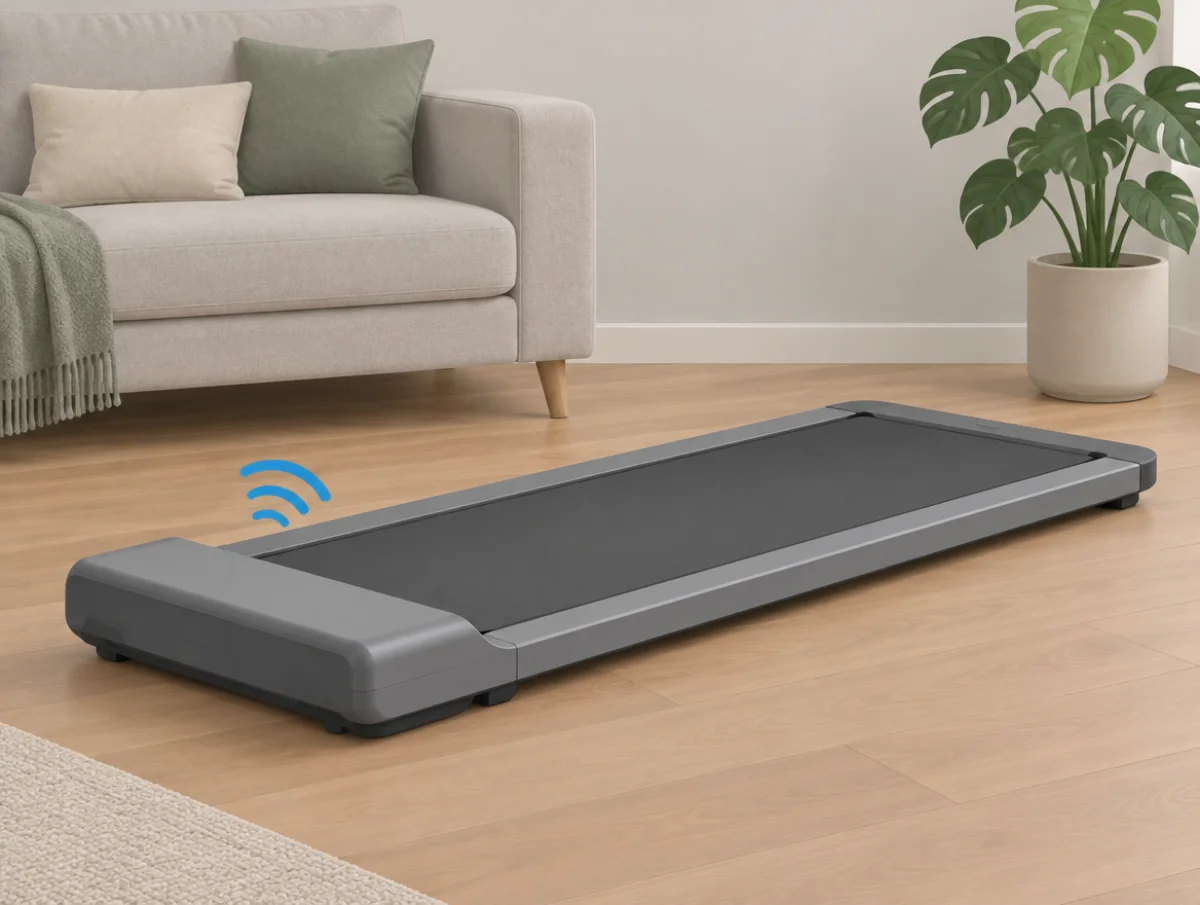
Walking pads are built around one short belt sliding over a thin deck, and that belt explains most of the noises owners ask about. Dry, it squeaks. Off center, it scrapes a side rail. Too slack and it slips under each step; too tight and the motor strains with a high hum. Outside the belt, the usual culprits are loose screws, a bare hard floor, and now and then the motor itself.
The makers' own help pages, blog guides and manuals behind this page come from WalkingPad (KingSmith's brand), UREVO, Egofit, Sunny Health & Fitness, LifeSpan, DeerRun and Costway, all read on November 14, 2026. Sperax's US site was password-protected that day, Goplus's site would not load, and Bluefin's FAQ covered only its vibration plates, so none of those three is quoted.
| Sound | Cause a maker names | First step |
|---|---|---|
| Squeak or rub | Dry walking belt (WalkingPad) | Lubricate as the manual says |
| Scrape at one edge | Belt off center (UREVO, WalkingPad) | Center it with the rear bolts |
| Slam or thud | Pad straight on the floor (WalkingPad) | A treadmill floor mat |
| Slap or knock | Loose drive belt (WalkingPad) | Inspect it, or call support |
| Rattle | Loose screws or parts (WalkingPad) | Tighten what you can reach |
| Strained, high-pitched hum | Belt too tight (UREVO) | Ease both bolts evenly |
| Sharp metallic whistle | Motor carbon brushes (WalkingPad) | Support, if it lasts days |
| Grinding friction | Motor cover touching the belt (WalkingPad) | Support |
| Beeping | Oil reminder or error code (Sunny, UREVO) | Read the display |
Which walking pad sounds are normal?
A walking pad hums steadily, the belt whirs, footsteps land softly and the frame buzzes a little on a hard floor, by WalkingPad's account. All of it should rise slightly with speed and stay the same from week to week.
That list comes from WalkingPad's noise article, which adds that these sounds "shouldn't become noticeably louder over time." Change is the warning sign, then. A pad that was quiet in spring and grinds by autumn needs attention even if the new sound is soft.
How loud is normal? WalkingPad's FAQ puts its walking models "generally" under 65 dB, and its apartment guide gives 45 to 55 decibels for its apartment treadmills. Neither page names a speed, a distance or a walker. The figures every maker prints, and what each one actually covers, are compared in our quietest walking pads guide.
Squeaking points to a dry belt first
Friction between belt and deck is the commonest squeak. WalkingPad's table pairs a dry walking belt with "Squeaking or rubbing," and its lubrication article says that friction makes the machine noisy and loads the motor.
Checking takes a minute and no tools. Unplug the pad, lift the belt, and feel the deck in the middle: dry or rough means it is due, slightly slick means it can wait. Costway's lubrication guide runs the same test on the underside of the belt, where "Wet" means leave it and "dry" means oil it.
If the squeak outlasts the oil, look elsewhere. WalkingPad blames "uneven application, a misaligned belt, or worn components" for noise that continues after lubrication. UREVO's maintenance article treats squeaks and grinding the same way: check the belt for misalignment or wear, and expect the motor or internal parts to need service if adjusting does nothing.
How much oil, and how often
Each maker below calls for silicone or ships its oil in the box, and each one asks for a different quantity on a different clock.
| Maker and model | Amount | How often |
|---|---|---|
| WalkingPad, lubrication article | One to two drops under the belt | About every 3 months at 2 to 3 sessions a week; up to monthly for heavy daily use |
| WalkingPad, maintenance guide | A thin, even line each side | Every 3 to 6 months, or about 150 miles |
| UREVO SpaceWalk 5L | 5 to 10 mL | About every 200 km |
| Egofit M1 and M1T | One ounce | Every 3 months regardless of use, or 50 hours |
| Sunny SF-T722076 | Oil on both sides of the deck middle | Before first use, then every 188 miles |
| LifeSpan, all treadmills | One ounce | Once every three months |
| Costway | 15 to 30 ml through a filling port | When the belt underside feels dry |
Two WalkingPad pages give two schedules, and UREVO goes further. Its SpaceWalk 5L manual says about every 200 km. Its belt slipping article says every 3 months or 30 to 50 hours. Its maintenance article says to oil the belt and motor once a week. Nobody else in the table comes close to weekly, so treat the manual in your box as the rule and the blogs as background.
Starting points differ too. The Egofit manual says the belt "comes pre-lubricated from the factory," while the Sunny SF-T722076 manual prints "The running belt must be lubricated before the first use!" DeerRun ships a "Silicone Oil Bottle" with the Z10 but prints no schedule on its product page.
The wrong product does damage. "Certain household oils, such as WD-40, vegetable oil, or general-purpose silicone sprays, are not suitable for treadmills," WalkingPad warns. Egofit asks for 100% silicone and rules out aerosol silicone sprays "which include additives and petroleum distillates."
Too much is its own fault. UREVO prints "it can cause belt slippage if you spray too much," and WalkingPad says excess oil can leak onto the floor or reach the electronics. Afterward, most makers run the pad empty and slow to spread it: UREVO's FAQ says 5 to 10 minutes of idling, LifeSpan about 3 minutes at 3 mph.
Loosen the belt first, or never?
Makers split on this. UREVO's SpaceWalk 5L manual loosens the belt to oil it, while WalkingPad and Sunny forbid touching the tension during the job. Follow the manual for your model, because each method suits its own deck.
UREVO has owners turn both idler roller screws counterclockwise until the belt lifts easily, then spray the middle of the deck and turn the screws back the same number of turns. Its tip is to "mark the number of hex tool rotations." WalkingPad's article says the opposite, "Do not loosen the belt to lubricate," and Sunny's manual puts it in capitals: "DO NOT LOOSEN OR MAKE ANY ADJUSTMENTS TO THE RUNNING BELT WHILE APPLYING LUBRICANT."
Rubbing and scraping mean the belt has drifted
A belt that wanders toward one side rubs the rail. UREVO's SpaceWalk 5L troubleshooting table lists "Friction noise" with the cause "Walking belt off center," and WalkingPad pairs misalignment with "Rubbing or scraping."
Why does it drift? WalkingPad gives three reasons: an unstable center of gravity, walking off center, and a pad "stored on its side." That last one matters for a machine that lives under a sofa or upright in a closet. UREVO adds pushing off harder with one foot and an uneven floor, thick carpet included.
The fix is the two bolts at the rear, a quarter turn at a time, but the makers set it up differently:
- UREVO SpaceWalk 5L: unplugged, quarter turns, then 1 to 2 minutes of running between tries.
- Egofit M1 and M1T: running at 3 mph, watched for two minutes after each turn.
- Sunny SF-T722076: on level ground at 3 to 5 mph.
- UREVO's slipping article: 1 to 2 mph with nobody on the belt.
On Egofit and Sunny pads, the bolt on the side the belt drifted toward goes clockwise and the other goes counterclockwise. Egofit warns that turning one side more than the other while tensioning causes drift in the first place.
Why does a walking pad belt slap or slip?
Slapping usually means something is loose. WalkingPad links "Slapping or knocking" to a loose drive belt, the small belt between motor and front roller, while a walking belt that hesitates under each step is too slack or too dry.
UREVO's FAQ says a belt that stops when you step on it "is often resolved by tightening the running belt." Egofit's routine is to set 3 mph and turn both tension bolts half a turn clockwise with the 6 mm Allen wrench, retesting each time, and never more than 2 full turns per side. UREVO's SpaceWalk 5L uses half turns as well, then a 1 to 2 minute walk at under 1.0 km/h, and warns the belt "should not be adjusted too tightly, otherwise it will be damaged."
There is a simple test for the middle ground. Lift the belt at its middle: WalkingPad's maintenance guide says it "should rise about 2 to 3 inches," UREVO gives the same 2 to 3 inches at one edge, and Sunny's manual puts the right tightness at 50 to 75 mm off the board. Three makers, one answer.
Overdo it and the noise changes. UREVO describes a "strained, high-pitched humming sound" from the motor as a sign the belt is too tight, and says it strains the rollers, bearings, motor and control board. If the belt still slips after correct tension and fresh oil, UREVO suspects that drive belt to the front roller and sends owners to support. A belt that shakes rather than slips gets oil first on UREVO's FAQ, then after-sales.
Rattles start with screws and the floor
Loose hardware rattles. WalkingPad lists "Rattling or knocking" from loose screws or parts, and an uneven floor for "Excessive vibration or louder footstep noise." Tighten what you can reach and level the pad before anything else.
Schedules vary again. WalkingPad's guide checks bolts monthly, UREVO's maintenance article weekly, and Sunny's manual just says to "Inspect and tighten bolts regularly." Egofit's only levelling instruction is that the pad "sits stable and even on the floor."
Then listen to where the rattle is. A sound that follows the belt, once per lap, may be the joint. UREVO says "All UREVO treadmills feature a connection point on the belt," and Egofit's manual calls the seal line "a perfectly normal part of treadmills." Neither describes a sound, so a click that keeps time with the seam is worth a video to support.
Motor buzzing, whining and whistling
A steady motor hum is normal. A sharp metallic whistle, a grinding rub or a buzz that is new are not, and WalkingPad sends all three to support or inspection.
The WalkingPad FAQ is specific. Motor carbon brush whistling, which it calls a "very sharp metal whistling sound," and odd noises from either drum go to support if they continue "for a couple of days." A motor cover rubbing on the belt, which it describes as a "magnetic friction sound," goes straight to support. Its noise article adds motor buzzing, humming or grinding to the stop-and-inspect list.
Strain is the other cause. "If the treadmill is overloaded, the motor may sound strained," WalkingPad notes, so check the weight limit on the label. Long sessions count too: WalkingPad suggests no more than an hour at a time on walking machines, and a pad showing "rest" has stopped itself; switch it off and let it cool for half an hour.
A burning smell with the noise is UREVO's cue to oil the belt, then look at the motor head, small belt and fan for anything sucked in. If the smell stays, it says the motor may need replacing.
Beeps are the pad talking
Most beeps are messages, not faults. Sunny's SF-T722076 beeps every 10 seconds and shows an "OIL" icon after 188 miles; oil the deck, then hold STOP for 3 seconds to clear it.
Error beeps are different. UREVO's SpaceWalk 5L sounds its buzzer with an error code, and the manual says "you MUST stop your workout immediately." One of its codes, E04 for over current, lists an overtightened belt or "lack of lubricant" among the causes, so a belt that groaned before the alarm fits the pattern. WalkingPad says E codes after delivery may come from transport: switch off for about 10 minutes and restart. Codes such as E02, "motor abnormality," that come back go to support.
Notes for UREVO, KingSmith and Sperax owners
UREVO's first answer to noise is oil: add lubricant under both sides of the belt and let the pad idle 5 to 10 minutes. For a belt that slips or deviates, its FAQ asks owners to contact customer service for model-specific steps.
KingSmith's WalkingPad support wants evidence. For any sound outside its four groups, the FAQ asks for a detailed description or a video, which beats any written account of a click.
Sperax publishes nothing we could find on noise, and its US site was locked when this page was written. Use the manual packed with the pad, and keep the oil bottle that comes with it.
How do you keep a walking pad quiet for downstairs neighbors?
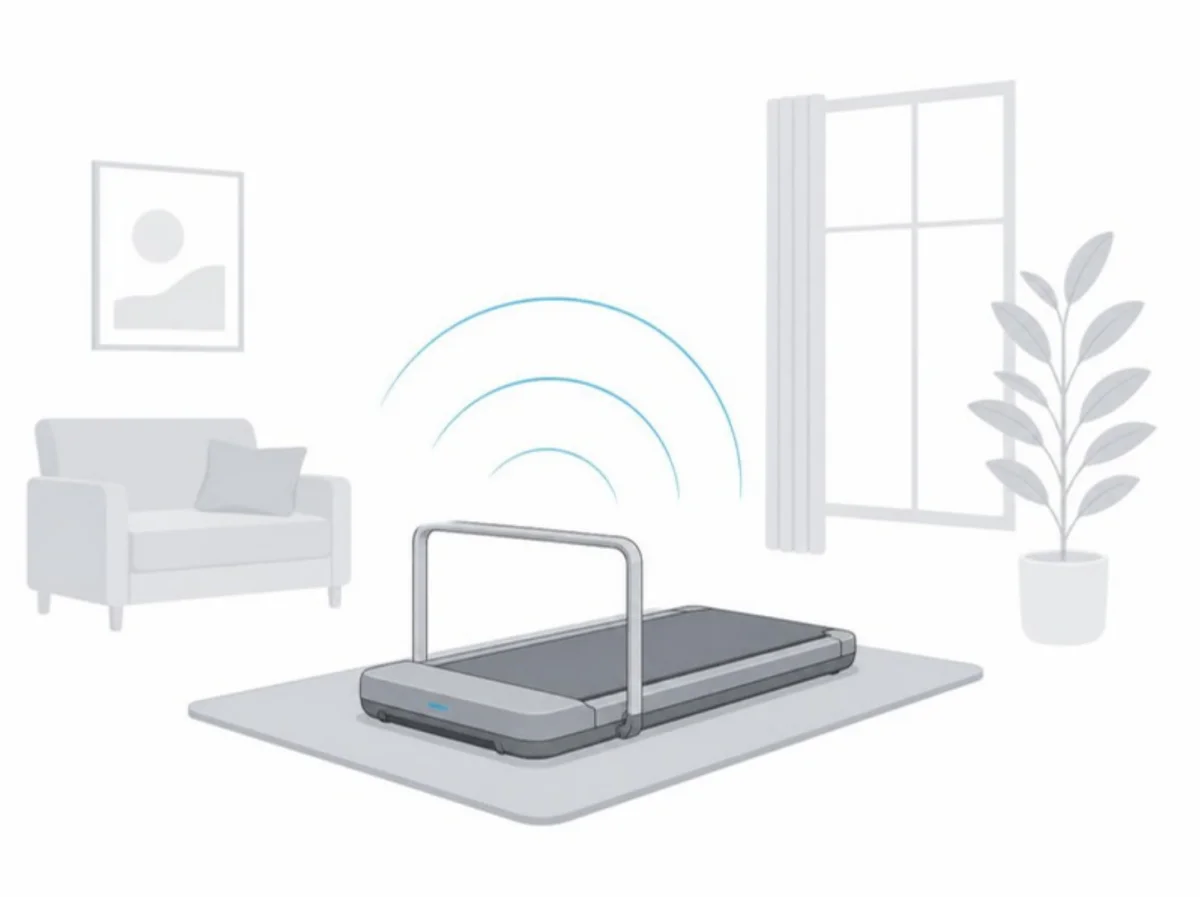
Put a rubber mat under it, keep it off shared walls, walk smoothly at modest speed in cushioned shoes, and avoid early mornings and late evenings. That is WalkingPad's advice; no maker gives a decibel figure for any of it.
WalkingPad's apartment guide splits the noise three ways: the motor, your feet, and vibration passing into walls and floor. Its advice is to set the pad "away from shared walls or interior walls," and that a rubber mat "can help dampen vibrations and reduce noise caused by the motor and belt." Speed matters, since faster walking brings more footstep impact, and heavy heel strikes are louder on hard floors.
Carpet is not the answer. WalkingPad advises against long carpet because it reduces stability and increases vibration. Sunny wants "a solid, flat level surface" with a protective cover, and no surface that blocks the air openings.
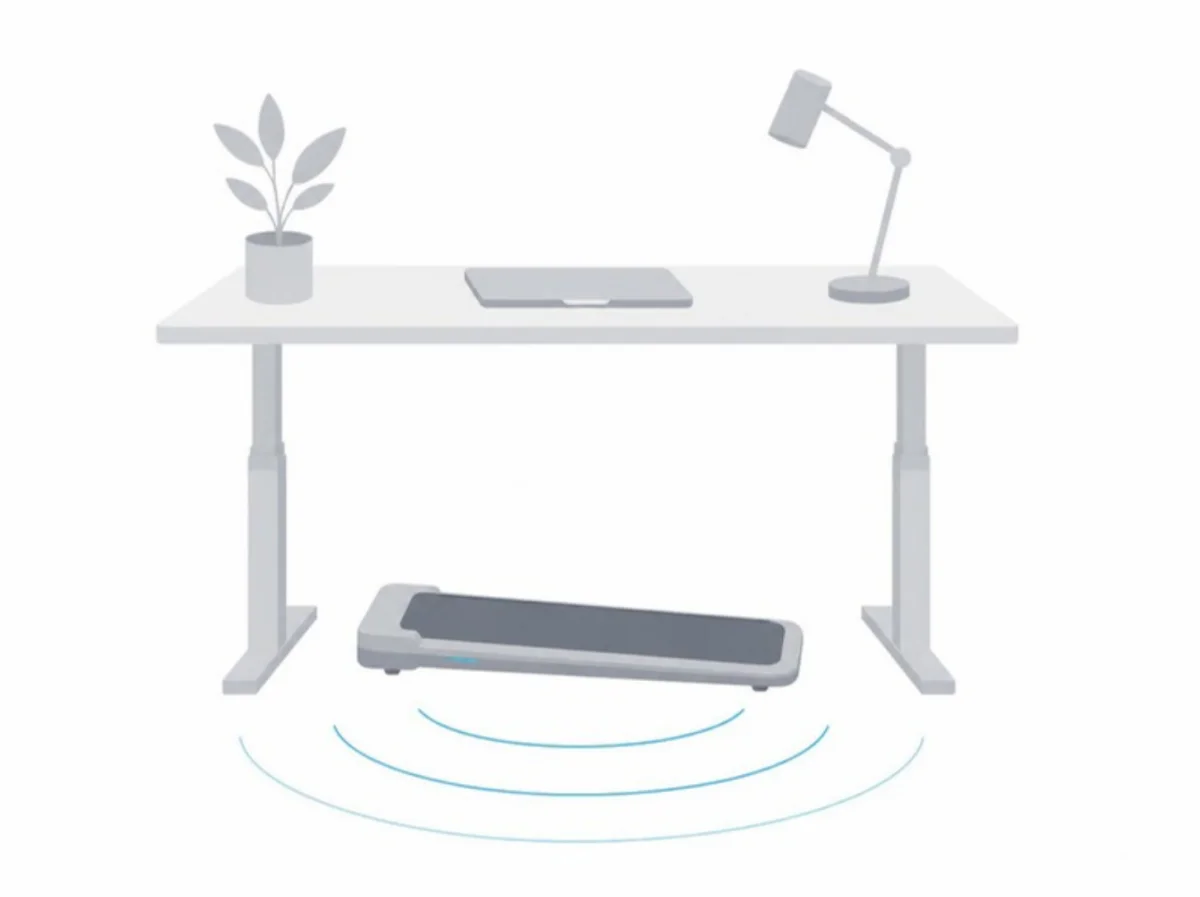
DeerRun's foldable mat, 59 by 27.5 inches and 6 mm of PVC, is "Specially designed to minimize noise, making it perfect for apartments and shared spaces." DeerRun stops there, with no measurement. For the building itself, our guide to a quiet apartment covers floors and shared walls, and planning a quiet home office covers the desk the pad sits under.
When to stop and call support
Stop when the sound is grinding or metal on metal, when there is a burning smell, when the belt slips without warning or the motor cuts out. A sudden jump in noise and shaking that a level floor does not cure belong on the same list.
That list is WalkingPad's. Sunny's manual is stricter: unusual noises during exercise mean "discontinue use of the equipment immediately and do not use until the problem has been rectified." UREVO's buzzer rule covers any error code. And WalkingPad's general advice for the motor brush whistle is patience for a couple of days, then a support call.
Where to go next
Owners of full-size machines will find levelling, deck care and incline creaks in how to make a treadmill quieter. If you are choosing a new pad, the quietest walking pads guide sorts each maker's decibel claim by what it covers, idle, empty or at top speed, and the apartment treadmill guide covers larger machines.