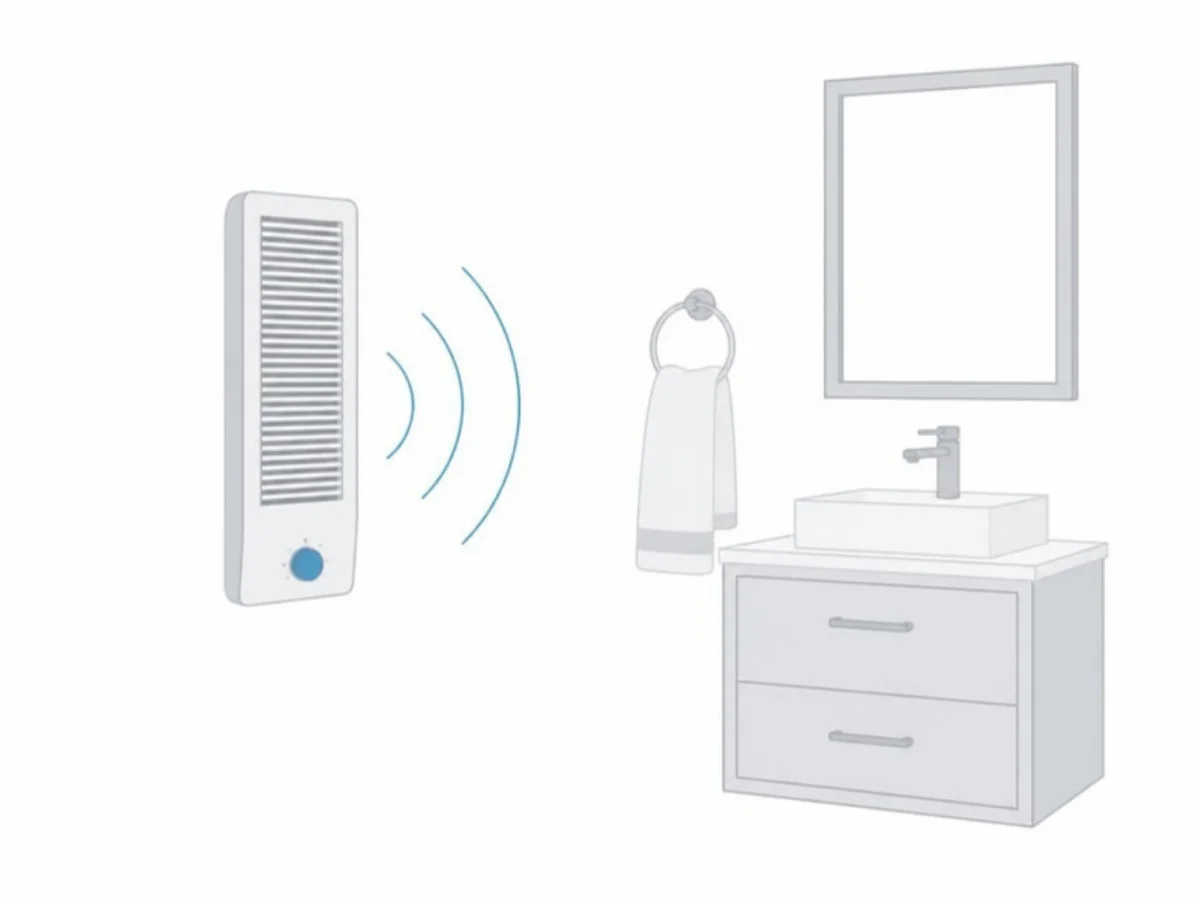
Nearly every sound an in-wall heater makes comes back to its fan. A small motor pulls room air across a hot element and pushes it out of the grille, and that motor can gather lint, drift out of line, run slowly on the wrong voltage or keep spinning after the heat has stopped. Cadet puts the normal result at roughly 50 decibels one meter away.
The other sounds are clicks. A thermostat knob clicks when it switches, warm metal pings as it grows, and a safety limit clicks as it cuts the power. Each of those has a meaning that the makers spell out, and a few of them call for the breaker rather than a screwdriver.
The causes and fixes below come from owner's guides, installation manuals and help pages by Cadet, King, Marley, Stiebel Eltron, Dimplex, Stelpro and Dreo. Gas wall furnaces are not covered here. Fanless baseboard heaters have their own page, baseboard heater noises, and portable units are in space heater noises.
A fan heater is never silent, and the makers put numbers on it
Cadet compares its wall heaters with a fridge in a help article titled A baseboard or wall heater?, then gives a figure: "household noises are usually at 40 decibels and the noise level of a wall heater is approximately at 50 decibels at a distance of one meter away from the heater."
Stiebel Eltron publishes two A-weighted figures for its CK Premium heaters in the CK Plus and CK Premium manual: 37 dB(A) on the base heating stage and 48 dB(A) at full power. The CK Trend manual gives 49 dB(A). Neither document names a measuring distance, so these sit beside Cadet's figure rather than against it.
Speed changes the sound more than anything else. Dreo answers "Why is my heater generating so much noise?" on its wall heater support page with "The higher the gear setting of the space heater, the louder the noise will be," and asks owners to turn the speed down first. Dreo's lowest-setting figures, 28 dB for the 517AS and 34 dB for the 739AS, are on our bathroom wall heater guide.
Why does my wall heater keep running after it turns off?
A wall heater that blows for a few minutes after the heat stops is cooling its element on purpose. Cadet, Marley, Dimplex and Dreo all build in a fan delay, and Marley treats a fan that stops instantly as a wiring fault.
Cadet lists "The fan is dispersing this air after shutdown" in its troubleshooting FAQ as one reason a heater seems to blow cold air. The fuller answer is in a help article on cold air: "Some of our heaters have a timed-delay switch built in that automatically operates the fan for a short time after the elements are turned off." The cool breeze "may persist for another five minutes or so to blow out the warm air inside the unit."
The Energy Plus runs longer. Its owner's guide describes "a cool down feature that will run the fan for up to 10 minutes after switching to NO HEAT mode or if set point is reached and mild outdoor temperatures create low demand." Cadet adds "This is normal," and explains that the air "may feel cool, but is actually room temperature residual heat moving into the room."
Plug-in wall heaters do a shorter version. Dreo's 739AS manual notes that when you switch it off, "it will continue to blow air for 30s to close the air outlet." That outlet is a fin the heater moves itself, and Dreo warns that "Moving the outlet fin manually could lead to malfunction and risk of fire."
When the fan stops the instant the heat does
Marley reads that as a fault. Its WHB1000 Series manual describes a fan delay control that runs the fan on "to remove residual heat after thermostat has turned heating elements off," and warns, in capitals, that if the fan shuts off immediately the "thermostat wiring is incorrect and must be changed."
The reason given is wear: the fan must delay "to expel residual heat to prevent premature aging of internal heater components." The same manual forbids a remote thermostat on that model, because wiring that defeats the delay "can result in overheating and permanent damage to heater." If the fan began stopping early after a thermostat change, that new wiring is where Marley's warning points.
A delay at the start, too
Some heaters click on and wait before the fan starts. Dimplex explains that "Some models use a fan delay that allows the element to preheat before blowing warm air." A short pause between the click and the airflow is therefore expected on those models.
Noise with the heater switched fully off
None of these makers covers a sound from a wall heater that is switched off at the breaker or has been cold for hours. A neighbouring circuit, a relay elsewhere in the house or a separate fan are all outside what their manuals discuss, and this page does not guess at them.
Why is my wall heater clicking?
Most wall heater clicks are the thermostat switching or metal moving as it heats and cools. Repeated clicks every few seconds usually mean the heater and its wall thermostat are set up for different kinds of heat.
The knob click is part of setting the room temperature. Cadet's Com-Pak owner's guide tells you to turn the knob all the way up, then, once the room feels right, "turn the knob to the left, just until it clicks and the heater turns off." Marley's WHB1000 instructions use the same routine, turning the knob back "slowly until thermostat clicks off." From then on the thermostat clicks each time it switches the element.
Electronic controls switch as well: on Stiebel Eltron's CK heaters the set temperature "is maintained by periodic heating", which means the element turns on and off through the day.
Pinging and popping as the heater warms
A light ping or pop as the element and housing heat up is metal expanding. Dimplex calls "A slight clicking or pinging sound" normal "as metal parts expand and contract when heating," and draws its line at noise that becomes "loud or persistent". Then it wants the heater checked for a secure mounting and for anything blocking it.
No wall heater maker here gives a separate cause for a single loud pop, and the baseboard page covers the same expansion ticks in more depth for fanless heaters.
Clicking on and off every few seconds
Rapid cycling is a thermostat setting more often than a fault. Stelpro's Sonoma fan heater guide warns that "If the thermostat stays in baseboard mode, the fan heater will run intermittently and may overheat," and its troubleshooting table answers frequent on and off cycling with one line: make sure the wall thermostat is in fan mode.
Cadet prints the matching fix for its TH401 and TH106 digital thermostats, along with its rule of thumb for a heater too big for the room. Both are covered on our thermostat noises page, alongside the 15-second cycles that line-voltage thermostats run on baseboards.
Dreo wall heater clicking
Neither Dreo manual quoted here mentions a click. What the 739AS manual does describe is cycling in ECO mode: "When the ambient temperature reaches the set temperature, the heater will turn off automatically in 30 seconds," and it restarts on low or high power as the room cools. For a heater that keeps stopping, Dreo's remedy is to raise the target or move to Heat mode.
The beeps are a separate sound, and the 517AS manual mutes them from the remote or the Dreo app.
Why is my wall heater buzzing or humming?
No maker here has a troubleshooting row called buzzing or humming. The nearest rows describe a fan that runs slowly, which Cadet traces to the wrong supply voltage or a motor that is defective or out of alignment.
Cadet's Com-Pak chart has a row for a fan or motor that "doesn't spin or spins slow." The first cause is a 120 volt circuit feeding a 240 volt heater, and the remedy is a heater that matches the circuit. The second is "Defective motor or motor out of alignment," with the answer "Replace motor." Cadet's FAQ gives the same two checks for a motor running slowly, plus a clean heater. Neither cause is a cleaning job.
The mismatch the other way round is dangerous. Cadet's voltage article warns that "If you hook up a 120 volt heater to a 240 volt circuit, it will fail," because it puts out four times its rated heat. The voltage is printed on the heater's rating label, and Cadet suggests photographing the old heater's label before you remove it.
A steady low drone can also be correct behaviour. The Energy Plus has a variable speed blower that "will auto adjust, based on the room requirements and heat output" and may keep running slowly once the room is warm. Its own troubleshooting chart calls a low fan speed and low heat output "normal for this energy saving heater."
High-pitched whines and squeals have no entry in any of these documents. What Cadet does print, in both owner's guides, is "Do not lubricate motor," which rules out oiling the motor on its heaters.
Rattling, scraping and a fan that sounds rough
Dust and lint are where the makers start. Cadet asks for a cleaning at least every six months, and its cleaning steps end with a listening test: run the heater for a few minutes and "listen to make sure it sounds like it is running smoothly."
The steps, in short, from Cadet and the matching page in King's FAQ:
- Switch off the heater's breaker and confirm with a voltage detector that the power is off.
- Pull the thermostat knob off gently before taking the grille away, or the thermostat can be damaged.
- Blow out the heater with an air compressor, a vacuum on blow or a hair dryer, and never canned air.
- Hold the fan still while you blow, since a blade spun by the air stream can damage the motor.
- Wash the grille in soapy water and let it dry completely before refitting it.
Holding the fan also protects the blade. Cadet's Energy Plus guide asks you to hold it "to avoid damage or bending" while you blow debris through the element. That warning about bending is the only mention of a damaged blade anywhere in these documents; none of the troubleshooting charts has a row for one.
Loose screws, wires and grilles
Grille screws go in snug and no tighter. Cadet's advice is to "just screw them in snug, do not bury them to prevent stripping or damaging the grill," and Marley's WH Series manual asks for the grille pulled flush to the wall with "DO NOT OVERTIGHTEN SCREWS" printed beside it.
Wiring can rub too. Cadet's installation steps make sure none of the wires "are caught between the motor and the wall can", and Marley wants all wiring "securely routed away from fan and element." No maker here addresses a wall can that has worked loose in the stud bay; that is an installation question for an electrician.
On a Dreo, the first physical check is the filter. Its support page lists "Check if the filter was assembled well" for a noisy heater, and asks owners to send a short video so Dreo can judge whether the sound is abnormal. The 739AS manual also lists loud noise among the signs that should send an owner to its troubleshooting page or to customer support.
A heater that clicks off and stays off
When a wall heater stops with a click, goes cold and will not restart, the high-temperature limit has usually tripped. Cadet, Stiebel Eltron and Stelpro all point first to blocked airflow or built-up dirt.
Cadet's FAQ says that if the manual reset trips, "the heater probably needs to be cleaned or it's blocked." The reset differs by model. On the Com-Pak you turn the power off at the panel and "Allow 20 minutes to cool" before restoring it. On the Energy Plus you press a button through the grille with a ball-point pen, and Cadet says to "listen and feel for a click, indicating it has been reset."
Other makers reset with time. Stiebel Eltron's CK heaters restart "within a few minutes (cooling period)" once the cause is gone, and Stelpro has you clear the inlets, then "Wait 10 minutes, then turn the power back on or turn up the setpoint temperature." Marley's WHB1000 lights a red warning light behind the grille and has a reset button above it. Dreo shows F2 for overheating, and its fix is to wait until the heater cools down before restarting it.
Clearance is the usual cause. Cadet wants nothing within 3 feet of the grille, plus 6 inches of space at each side and above, and adds in its clearance article that an obstruction "can damage the heater or cause its safety feature to trip."
Heat for a moment, then nothing
A heater that warms briefly without the fan turning and then cuts out is reacting to a fan that will not move. The Energy Plus chart gives two causes, "Defective motor or internal connection." and "Fan is jammed.", with the fix of clearing the obstruction, checking the fan spins freely and pressing reset.
When the sound means a fault
Some noises end the troubleshooting. King asks you to turn the heater off and call its technical support if smoke "is heavy, persists after the initial heat-up period, or is accompanied by abnormal noise or odor." Cadet's instruction for a heater "glowing red or repeatedly getting unusually hot and shutting off" is to turn off the circuit breaker at once.
Repeated trips are the other line. The Com-Pak guide says "If the high-temperature safety shutoff trips more than once a day, replace the heater." Marley warns against continuing to use a heater whose safety control repeatedly operates after being reset, and its backup thermal fuse is "one shot": once it blows, the heater must be repaired by a qualified person.
Beyond cleaning, the makers hand the work over. Cadet asks that "Any service other than cleaning should be performed by an authorized service representative," and Marley's WH manual reserves any servicing beyond simple cleaning that needs disassembly for qualified service personnel. Each maker's cleaning steps begin by cutting the power, at the panel or at the plug.
Quieter heaters and related pages
For a replacement chosen on published figures, the quietest wall heaters for bathrooms rank Stiebel Eltron and Dreo models each against their own maker's numbers, and Dreo space heater decibels covers the rest of Dreo's heaters. Larger rooms and workshops are covered by the quietest space heaters and the quietest garage heaters, and a ceiling heater with an exhaust fan is ranked in the quietest bathroom fans with heaters.
Thermostat clicks and short cycling are on the thermostat noises page, and central systems are in furnace noises explained.
Sources, and what could not be read
Every passage above was read on November 23, 2026. Cadet's Com-Pak and Energy Plus owner's guides are Cadet's own PDFs, read in copies hosted by Home Depot and Lowe's because Cadet's product pages did not offer their downloads to our requests. King's PAW installation manual is published as outlined artwork with no readable text, so only King's FAQ is quoted. Broan's website refused our requests, and we found no TPI wall heater manual on TPI's own site.
No wall heater was installed, run or opened for this page. Sounds that the manuals skip are named as gaps above rather than filled with guesses.