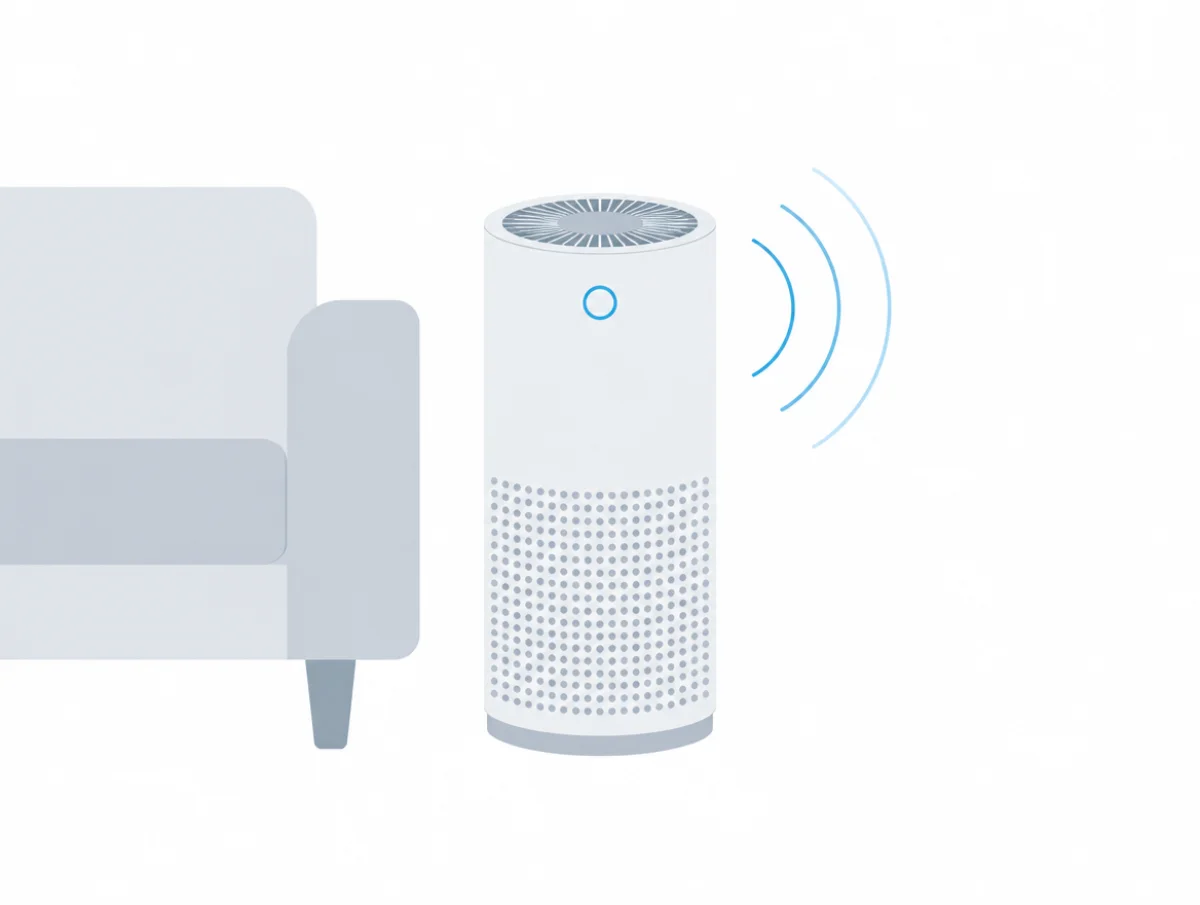
An air purifier making noise is, nearly always, a fan running at the speed it was set to, or the speed its sensor chose. Levoit, Coway, Blueair, Winix, Dyson, IQAir, Alen and Medify all describe airflow that gets louder as the fan speeds up, and a few name other sounds: a chirp from Winix's PlasmaWave, a click when a Dyson tower changes airflow direction, and a fan that stops and starts again in Coway's eco setting.
The sounds the makers treat as faults form a shorter list. A new filter still sealed in plastic, a purifier on a soft or sloping surface, an object caught inside, grinding, and any strange sound that arrives with a smell or smoke all appear in the manuals, each with the maker's own instruction.
Everything below is quoted from the makers' manuals and support pages, along with any limits each maker puts on it. Where no maker explains a sound, we say so.
Is it normal for an air purifier to make noise?
Yes. A purifier pulls room air through a filter with a fan, and every maker we read treats that airflow sound as normal. Blueair's support page says units set to a high speed "produce more noise because they function at faster rates."
Blueair's remedy is the obvious one: "On low fan speed, the air purifier should be quieter." Levoit's Core 300S-P manual makes the same trade plain: "Fan speed III is the loudest, but cleans air the quickest."
The room changes what you hear. Blueair's Blue Signature page says sound "may echo more" in rooms with hard surfaces, high ceilings or little furniture than in carpeted, furnished ones.
Dyson's loud noise step for its Pure Cool tower says noise "can be amplified by the surface the machine is placed on", and that the tower sounds louder on a wooden table than on a carpeted floor. Its advice is to try another surface.
If the low setting is still too loud for a bedroom, our page on quiet and sleep modes covers what those settings change.
Which air purifier sounds do the makers call normal?
The makers call a fan that ramps up and down in auto mode normal, along with a chirp or buzz from Winix's PlasmaWave, a click when a Dyson changes airflow direction, and the chimes and beeps of the controls.
A fan that speeds up and slows down by itself
Auto mode is the usual reason a purifier gets louder with nobody touching it. The Core 300S-P manual says its sensor adjusts the fan to the air, and "if the air quality is bad, the fan will automatically be set to high speed."
Blueair's DustMagnet page describes the cycle: "When pollution levels creep up, the fan increases speed, and once the air is cleaned it returns to a low speed." A louder fan in auto mode is the purifier answering its own particle sensor.
Dyson's unusual noise page explains a fan that stays high while the display shows green. It says the machine is "constantly seeking to maintain a good air quality", and that in rooms with leaky windows it "must work harder". That only happens in auto, and Dyson's fix is to switch to Manual mode.
Several makers offer a gentler auto. Levoit's Quiet Auto Mode "never uses the highest fan speed to avoid making too much noise", per the Core 300S-P manual. Blueair says that in Night mode "the fan speed will only increase to the medium level to keep noise levels low."
IQAir's Atem X manual offers three smart modes. Its Quiet mode "limits the maximum fan speed to level 5", while Max mode "rapidly changes the fan speed and does not limit the maximum fan speed."
Coway's Mighty2 manual says Smart mode switches itself into sleep after the room has been dark for more than 3 minutes, "so that it can reduce noise and power", and back again after 5 minutes of light.
Chirping or buzzing from an ionizer
Winix is the one maker we read that describes a sound from its ionizing feature. Its FAQ says that "when the room is very quiet, you may hear a chirping or buzzing sound" from PlasmaWave, and calls it normal.
The FAQ says the sound comes "from large particles passing through" PlasmaWave and "does not signify product failure", and files it under "Small Flickering noise". The 5510 manual prints the same explanation next to the PlasmaWave button.
If the chirp bothers you, Winix's answer is to switch PlasmaWave off with that button. The 5510 manual adds that Sleep Mode disables PlasmaWave on its own, "but it can be turned back on."
Other makers fit ionizers without describing any sound. Alen's BreatheSmart 45i manual has an "ozone-safe ionizer" button, Medify's MA-40 manual an ionizer button, and Rabbit Air's MinusA2 a negative ion generator. None of those manuals mentions a crackle or buzz.
Clicking, chimes and beeps
A click from a Dyson tower is usually the airflow switching. Dyson's clicking noise page says "When your purifier switches from front to rear airflow there may be a clicking sound as the motor adjusts direction."
Dyson adds that this "is not an indicator of anything wrong with your machine." Coway's Airmega 300 and 400 manual describes a click you want to hear: "You will hear a clicking sound when the cover is closed well."
The electronic sounds are deliberate. Coway's Mighty2 plays a chime when Smart mode starts on first power-up, Medify says the MA-40 "will beep" when plugged in, and Winix's FAQ has you hold the filter reset button "until you hear the beep".
Outside those moments, none of the documents we read explains a steady, repeating click during normal running. Treat that one as a rattle and work through the checks under rattling below.
Why is my air purifier loud after a filter change?
A new filter still in its plastic wrap is the cause the makers name first. Levoit and Blueair both list leftover packaging under noise problems, and Levoit adds a filter that is not properly in place.
In Levoit's troubleshooting table, the first fix for "Air purifier makes an unusual noise while the fan is on" is "Make sure the filter is properly in place with plastic packaging removed." The Core 300S-P safety page explains why it matters: with the wrap left on, "The air purifier will not filter air, and may overheat, causing a fire hazard."
Blueair's Blue Pure 411i Max manual lists "The plastic sealing is still on the filter" as a cause of too much noise, and says to take the filter out and check the plastic cover is gone. Its support page adds that refitted filters should be "seated properly".
Blueair's cylinder models have one more part to put back. Blueair calls the noise shield a part "surrounding the motor", asks owners not to throw it away, and offers a replacement "If you accidentally disposed of it". The 411i Max manual has you lift it off during a filter change and place it back on top of the new filter.
Other makers flag the wrap at setup. Coway's 300 and 400 manual says "you must remove the plastic wrapping of the inserted Max2 filters on both sides", Winix's A230 manual says to remove "the protective vinyl", and Medify's manual says it in capitals.
Rabbit Air's MinusA2 manual says its filters are "packaged in plastic" and asks you to unwrap them "before using the unit". Coway's Mighty2 table links a forgotten bag to odor rather than noise: "The filter may still be in its packaging."
Why is my air purifier suddenly so loud?
A clogged filter, a higher fan speed, or auto mode reacting to dirtier air are the reasons the makers give for a purifier that has grown louder over weeks or months.
Blueair says that when filters or pre-filters are "very clogged or dirty, the engine might not get sufficient airflow, which may result in increased noise levels." Its fix is to vacuum the purifier and fabric pre-filter with a soft brush attachment, wash the fabric pre-filter, and replace the main filter when the indicator turns red.
Levoit makes noise a signal for a new filter. The Core 300S-P manual says you may need to replace it if you notice "Increased noise when the air purifier is on", along with decreased airflow, unusual odors or a visibly clogged filter. Its troubleshooting table also lists replacing the filter as a fix for unusual noise.
The top setting is loud by design. Coway says its Mighty2 Turbo mode runs faster than the manual speeds and "consumes more energy and may produce noise." If someone in the house changed the speed or turned auto on, that alone explains a louder purifier.
When a purifier seems louder with no setting changed, our page on why appliances get louder covers wear and dust in general.
Why is my air purifier rattling or vibrating?
A soft, uneven or sloping surface is the first cause the makers give for rattling and vibration, followed by an object caught inside. IQAir also names movement during shipping and an internal part needing attention.
IQAir's HealthPro Plus XE support page says "rattling, grinding, wobbling, or excessive vibration may be caused by shipping movement, improper placement, or an internal component that requires attention." It asks you to check the surface and the filters, and to contact IQAir Customer Care if the noise persists.
Winix manuals say "Flimsy or slanted surfaces may result in abnormal noise and vibrations" and ask for hard, flat surfaces only. Levoit wants "a hard, flat, level surface", Medify "a firm, leveled surface", and Blueair a stable, level one "to avoid vibration or rattling".
Blueair's checklist goes further. Unplug the purifier, look inside through the top on its Blue models, check the inlets and outlets for objects or dust, and make sure nothing sits on top of or leans against it. Leave at least 4 inches (10 cm) around it. Dyson asks you to check the base for debris or obstructions.
The makers split on objects inside. Winix's FAQ says to look through the air vent, turn the unit upside down to shake out whatever is caught, "Do not try to open the unit", and tighten any loose screws you find.
Levoit takes a stricter line. Its table says "The air purifier may be damaged, or a foreign object may be inside. Stop using the air purifier and contact Customer Support", and ends with "Do not try to repair the air purifier." Follow the manual for your own brand.
Why is my air purifier making a high-pitched or whistling noise?
Dyson is the only maker we read that gives steps for a whine or whistle, and those steps are a restart and a check of the power lead. No manual we read explains what causes a whistle.
Dyson's whining or whistling page says to unplug the tower and leave it for 10 seconds, "Ensure the power cord is plugged into the centre of the base", then plug it back in and retest. If the noise has not stopped, the page moves you on to further help from Dyson.
For other brands, the general unusual noise checks apply. Blueair's list covers dust or objects at the inlets and outlets, filters that are not seated, and something leaning against the purifier, all of which change how air moves through it. If the pitch stays after those checks, contact the maker.
Why is my air purifier making noise when it is off?
A purifier whose fan has stopped may still be in standby. Dyson, IQAir and Levoit keep sensors running when the fan is off, and Coway's eco setting stops the fan in clean air and starts it again later.
Dyson lists "Humming noise when turned off" as its own troubleshooting step. Continuous monitoring sends air quality data "even when you have turned the purifier off", and "The sensors have small fans that maintain airflow".
Dyson says those fans "should not cause any audible noise interference". If you hear them anyway, turn off "Collect data when in standby" in the app, or hold the Auto button on the remote for five seconds.
IQAir's HealthPro XE manual separates its standby states. In networked standby, "Fan is off and the sensors remain active." Holding the power button for about 3 seconds gives standby without network, where "Fan, Wi-Fi and sensors are off."
Levoit's Core 400S-P manual says that in Standby Mode "The laser dust sensor will still detect the surrounding air quality". It does not describe a sound from it.
Coway's eco setting can look like a purifier switching itself on. The Mighty2 manual says that in Smart mode, if the air stays Good for more than 10 minutes, "the fan stops automatically to save energy", then restarts when it detects pollution or after 30 minutes.
Which air purifier noises mean you should unplug it?
A strange sound together with a smell or smoke, a grinding noise, and a fan that is damaged or blocked are the cases the makers single out. Coway, Alen and Levoit all say to cut the power first.
Coway's Mighty2 manual says to disconnect the plug "if strange sounds, smells, or smoke come from the product" and to "Contact the customer service center immediately for instructions." The MightyS manual says the same of "a strange noise, burning smell or smoke".
Alen's 45i manual says "Disconnect power immediately if you notice strange sounds, smells, or smoke." Coway also says "Do not operate the product if the motor fan fails to operate or is damaged", and its E2 code means "The fan motor may be malfunctioning, or its rotation may be impeded by an obstruction", a call for customer service.
Levoit's table, quoted above, says to stop using a purifier that may be damaged or have an object inside, and not to repair it yourself. Its manual says the same of a damaged power cord.
Dyson sends a grinding or grating noise straight to its support team with no home checks: "Please call us to resolve this problem." Winix's FAQ says that if the fan is the source of the noise, the unit "needs to go through WRA process" with Winix.
Coway adds a rule for the filter door: "Always turn off the product and unplug the power plug before accessing the components inside the product."
How loud is a normal air purifier?
A normal air purifier is rated at roughly 22 to 55 decibels in the manuals we read, from its lowest fan speed to its highest. Few makers say how far from the unit they measured.
Levoit's spec tables give a "Noise Level" of 22 to 54.5dB for the Core 300S-P, 24 to 52dB for the Core 400S-P and 24 to 55dB for the larger EverestAir, with no distance or test stated.
Blueair's DustMagnet manual lists 22 to 45 dB for the 5210i and 5240i and 30 to 50 dB for the 5410i, 5415i and 5440i, as "Sound pressure according to GB/T18801". Medify gives the MA-40 at 40.5 dBA in Sleep Mode and on speed 1, 50.3 on speed 2 and 53.3 on speed 3.
Those top figures are what a purifier sounds like on full speed or when auto mode ramps up, so a low reading on the box says little about the noise at its highest setting. Our dBA explainer and decibel chart help you read those numbers.
To compare models by their published figures, see our quietest air purifiers guide. The Levoit air purifier decibels and Coway air purifier decibels pages list every current model from those two brands with the condition each figure was given under.
How do air purifier makers measure their decibel ratings?
Air purifier decibel ratings rarely come with a method. Of the 95 purifiers in our catalog when we counted on October 26, 2026, 4 state a measuring distance and 6 name a test standard; the rest print numbers alone.
Our tally uses the purifier fact sheets behind our guides, which quote each maker's product page, spec table or manual. Two Rabbit Air models listed twice, once as an AAFA edition, are counted once. The totals cover the purifiers we track, not every model on sale.
All four with a distance are IQAir models, the GC MultiGas XE, the Atem X and the two HealthPro XE machines, and each gives its figures at 3.3 feet, or 1 meter. The six with a standard include Blueair's DustMagnet 5440i, footnoted to China's GB/T 18801, and IQAir's Atem Earth and Atem Eco, tested to EN ISO 11201.
Seventeen purifiers publish only the low end. Sixteen Winix models give a minimum noise level, such as 22 dB for the C710, with no figure for any faster speed, and LG gives the PuriCare 360 a single 23 dB figure in Sleep Mode.
A low-end figure says nothing about turbo, or about auto mode ramping up when the sensor reads dirty air. When two ratings rest on different conditions, such as sound pressure at 3.3 feet against a bare number, we do not rank one purifier against the other.
How did we put this together?
QuietSpecs built this guide to purifier sounds from maker documents only. We used the support pages of Blueair, Winix, Dyson and IQAir, and the owner's manuals for Levoit's EverestAir, Core 400S-P and Core 300S-P, Coway's Airmega Mighty2, MightyS and 300 and 400, and Blueair's Blue Pure 411i Max and DustMagnet.
We also used Winix's 5510 and A230 manuals, IQAir's HealthPro XE and Atem X manuals, Alen's BreatheSmart 45i manual, Rabbit Air's MinusA2 manual and Medify's MA-40 manual. Dyson's steps come from its Irish support site for the Pure Cool tower. Honeywell's support pages did not load for us, so Honeywell purifiers are not covered.
We have not switched on, listened to, measured, opened or repaired any air purifier for this article. A sound that no maker explains is reported as unexplained here, and nothing was taken from owner forums, store reviews or repair sites.