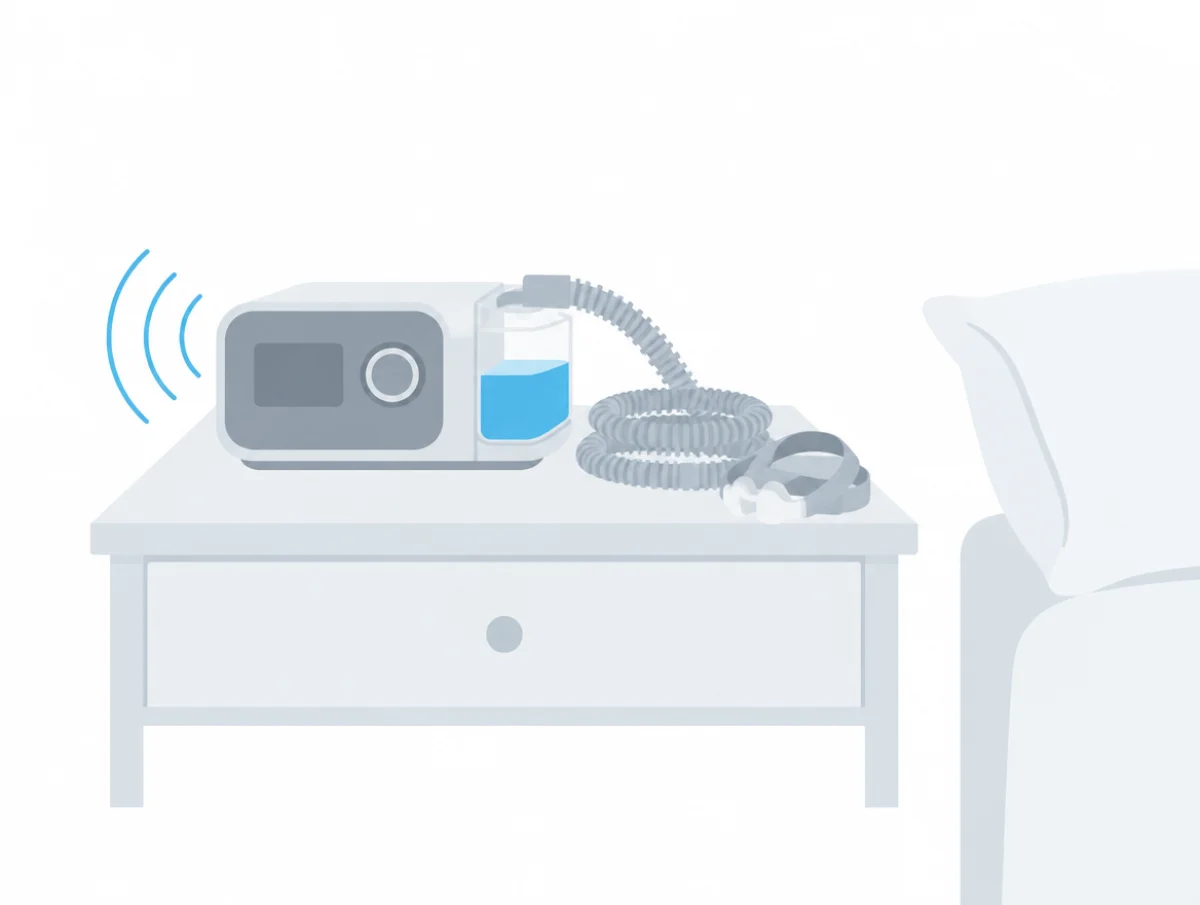
A CPAP making noise is usually telling you where air or water is escaping. ResMed, Philips, React Health, Fisher & Paykel Healthcare and Transcend all expect a steady rush of air from a working machine. What they treat as a problem is whistling or hissing from a leak, gurgling from water in the hose, and any unusual or harsh sound from the machine itself.
This page sorts the sounds by where you hear them: at the mask, in the hose, and from the machine or humidifier. Each cause and each remedy is quoted from the makers' own user guides and support pages, with the conditions they attach.
One rule runs through all of it. A CPAP or APAP machine is a prescription medical device, and your pressure, ramp and pressure relief settings belong to the clinician who prescribed it. Nothing here asks you to change them. When the makers say to call someone, it is your equipment supplier, your clinician or the maker's service team, and we name which.
Is it normal for a CPAP machine to make noise?
Yes, a CPAP machine makes a soft, constant airflow sound by design. ResMed describes it as "continuous and comfortable white noise" and says "Treatment should not be louder than a whisper".
A mask also vents air on purpose. Fisher & Paykel says "a certain amount of air leakage is normal to adequately flush out the air you are breathing out." That steady puff from the vent holes is not a fault, and the makers warn against covering it.
The volume also follows the pressure. ResMed's mask noise page says "Some increase in noise is normal as your air pressure increases." An auto-adjusting APAP such as the AirSense 11 AutoSet changes its pressure through the night, so the sound can rise and fall with it.
What ResMed does not count as normal is anything loud. Its advice is that if your equipment is noisy, "some of the parts might not be connected properly, causing air to escape", and that you can usually trace the noise to "the machine, humidifier, tube or mask."
How loud is a normal CPAP machine?
A home CPAP declares between 25 and 31 dBA under the ISO 80601-2-70 test, according to the maker figures in our quietest CPAP machines guide. The test runs in a sound booth with no mask fitted.
ResMed's AirSense 11 user guide declares 25 dBA with the side cover and 27 dBA with the HumidAir 11 tub, each with an uncertainty of 2 dBA, in CPAP mode. The travel AirMini declares 29 dBA, and its masks add their own vent figures of 15 to 19 dBA under ISO 17510.
ResMed confirms the travel unit is louder: "approximately 2dBA louder than an AirSense 10". It adds that "noise perception can be subjective".
Transcend's Micro 510 manual declares 31 dBA at 10 cm H2O and warns that booth figures "do not represent the sound levels a user will experience during sleep", because mask type, fit, leak rate, pressure and distance all change what you hear.
Fisher & Paykel puts it in plainer terms: most current machines have "a decibel (db) rating of about 30, which is equivalent to the sound of a whisper. By comparison, snoring can rate from 60 to 80db." For what those numbers mean on a log scale, see our dBA explainer.
Why is my CPAP mask whistling or hissing?
A whistling or hissing CPAP mask is usually leaking around the cushion, not venting. Fisher & Paykel lists "hearing or feeling air leaks above what is intentionally necessary for exhalation" as a sign of excessive leak, which it says "can negatively impact the performance of your mask".
What do the makers say causes mask leak noise?
Mask leak noise comes from a cushion that is misfitted, moved or the wrong size, per ResMed and Fisher & Paykel. Both AirSense 11 and AirMini guides list "Mask may be fitted incorrectly", and the AirMini table heads that row "Air is leaking from around my mask / Mask is too noisy".
ResMed's noise checklist for care providers says "A high unintentional leak can also be a possible noise source originating from the mask." It then has the provider check whether the leak is from the mouth, which can call for a different mask type.
Overtightening makes it worse rather than better. Fisher & Paykel says "Try not to overtighten your mask. It should be worn as loose as possible without excessive leaking."
How do the makers say to stop a noisy mask leak?
Refit the mask while the air is running, using the maker's fitting steps. Fisher & Paykel says to "Reposition the mask by pulling it away from your face and resting it back again until the mask seals well and feels comfortable", and to re-adjust the straps around your head.
ResMed's AirSense 11 guide says to see your mask user guide, "run the mask fit function or refer to the Mask Fit video in the myAir app." Philips's DreamStation manual points to its Check Mask Fit function in the same way.
Wear also counts. Fisher & Paykel says to "Watch for wear and tear as the mask or parts of the mask may need replacing." For persistent leaks it sends you to your healthcare provider, who "can help provide you with guidance on different seal sizes or mask types."
Fisher & Paykel also says "Ensure that you are using the right pressure. If you are unsure what that is, consult with your healthcare provider." That check is for the provider to make, not a dial for you to turn.
Is a full face mask louder than a nasal mask?
Yes, on ResMed's AirMini a full face mask can sound louder. ResMed says the F20 connector for AirMini lacks the diffuser vent of its N20 and P10 connectors, so "some patients" find the full face mask "louder than the nasal and pillow masks."
It adds that this "perception of noise may be heightened by the proximity of the vents to the face". The AirMini guide's own ISO 17510 figures agree: 19 dBA with the F20 connector and mask, against 15 dBA for the N20 or P10.
Some masks have a fabric diffuser that wears out. Fisher & Paykel's Eson nasal mask instructions say the diffuser "should not be washed or rinsed" and to replace it "if it becomes noisy or deteriorates. It should last two to three months."
Why is my CPAP machine whistling when the mask fits?
A CPAP machine that whistles with a good mask seal usually has a leak at the humidifier tub, the hose connection or the air inlet. Philips and ResMed each list these in their own troubleshooting tables.
Philips's DreamStation manual has a row titled "I hear a leak or whistling sound coming from my therapy device or humidifier (not related to mask leak)." It names three causes: the air inlet "may be obstructed", the humidifier or tube "is not fully connected", and the humidifier seals "are not fully seated or are missing."
Its fix is to check the inlet is clear and the filters "are free of debris and properly inserted", confirm the humidifier and tube are connected and not leaking, and confirm the lid seal and dry box seal are in place, gently pressing around the seals "to reseat them."
ResMed's Air Solutions troubleshooting guide answers the same question for care providers. It says to check for "a crack in the humidifier tub", then to ensure "that the intentional leak holes are free of water drops, the tubing is dry and the mask is water-free on the inside."
Its last step concerns the hose. ResMed suggests a ResMed tube "as tubes from other companies make noise", and its provider checklist says "Connecting a ResMed tube may resolve the noise." If your hose came from elsewhere, ask your supplier which tubing your machine's maker approves.
Why is my CPAP hissing after cleaning?
A CPAP that hisses after cleaning has usually gone back together with a gap somewhere. The makers' reassembly steps and leak checks all point at the joints you just took apart: tub, seals, hose ends and mask cushion.
The AirSense 11 guide lists "There is excessive leak" with two fixes: "Adjust the mask and headgear" and, because "Air tubing may not be connected properly", "Connect firmly at both ends." Its reassembly steps have you check the outlet connector "is inserted correctly" before connecting the tubing firmly to the air outlet.
For the tub, the same guide says that if it leaks, "Check for damage and reassemble the humidifier tub correctly", and that the side cover "should click in place." It says to replace a tub that is "leaking or has become cracked, cloudy, or pitted", or whose seal "is cracked or torn."
ResMed's provider checklist adds that a tub "not in the proper position" may "cause additional noise while the machine is running." Its fix is to remove the tub, check for cracks, reinsert it and test again.
Why is my CPAP making a gurgling noise?
A CPAP gurgling noise is almost always water condensed in the hose, which the makers call rainout. ResMed says rainout "occurs when heated air cools in your tubing and reaches your mask as water".
ResMed says it can wake you through "the feeling of water on their face and/or the gurgling in the tube that condensation can sometimes cause." The AirSense 11 guide defines it as "water droplets in the heated air tubing and mask."
React Health ties it to the bedroom. Its Luna G3 APAP manual says condensation in the tube comes from "cold ambient room temperature and high humidifier output", and that it "is more likely to occur as the difference between the air tubing temperature and room temperature increases."
How much water in the hose is normal?
A few drops in the hose by morning is normal, per React Health's Luna G3 manual: "If there are only a few condensed water droplets inside the tubing in the morning after therapy, it means that the humidity level is appropriate".
A lot of water is the sign to act on. React Health says "a lot of condensed water droplets inside the tubing and/or mask" means the humidity is too high. Transcend, whose Micro has no water tank, blames droplets in the mask on "Excess condensation from breathing" and says to "Run drying mode after therapy."
What do the makers say to do about rainout?
The makers list four fixes for rainout: keep the machine below your head, warm the hose, follow the user guide on humidity and tube temperature, and drain the tube. ResMed and React Health also send you to your supplier for help with settings.
Placement comes first. React Health says the device "must be placed on a flat surface at a level lower than the patient's head on a bed, so that the condensation flows back to the water chamber rather than remain in the tubing causing rainout."
Philips gives the same instruction for the DreamStation: place it "at a level lower than your sleeping position", away from "forced air vents, radiators, air conditioners", and keep the humidifier "below the breathing circuit connection at the mask".
Then keep the hose warm. ResMed calls a heated tube "recommended", since it "can sustain that air's optimum temperature until it reaches your mask." Without one, ResMed says to ask your sleep specialist or "home medical equipment (HME) supplier about a standard tubing wrap".
React Health's troubleshooting table says to "Place the tubing under the quilt or use the tubing cover", to "Hang the tubing loosely", and that "the lowest part of the tubing should be lower than the patient's head."
Humidity and tube temperature are comfort settings in the user guides, separate from your prescribed pressure. ResMed's AirSense 11 guide says that in Climate Control Auto, the machine "Protects against rainout". In Manual, it says "Rainout protection is not guaranteed" and lists its own order of adjustments.
ResMed's guide says that if rainout occurs, "first try increasing the tube temperature", and "If the air temperature becomes too warm and rainout continues, try decreasing the humidity." React Health says to drain the tube and lower the humidifier setting level. ResMed's blog adds that "Your doctor or HME can help you set the temperature of your tubing and the level of humidification".
If water does get into an AirSense 11 hose, the guide lists "There may be water in the air tubing" as one cause of its Error 4 message, with the fix "Empty the water from the air tubing", then disconnect and reconnect the power adaptor.
Why is my CPAP machine getting louder?
A CPAP machine that gets louder over weeks most often has a clogged filter, a poorly seated tub or a worn mask, per Fisher & Paykel and ResMed. Fisher & Paykel says to check "your filter is unblocked and clean" first.
Fisher & Paykel goes on: "make sure your mask is working and fitting properly, as an ill-fitting or dysfunctional mask can cause noisy, excessive air leakage." For a machine that is simply too noisy, it adds checks on the hose connection, the filters and whether "the humidifier is running with enough water."
ResMed's provider checklist says to "Check the filter for any clogs, which may cause noise issues." The AirSense 11 guide says "The air filter is not washable or reusable", and to "replace it every six months", or "more often if there are any holes or blockages by dirt or dust."
React Health's Luna G3 table has one line for "The device is too noisy": "The tubing is not connected properly", fixed by "Reconnect the tubing properly." ResMed's AirMini guide adds a second cause for a noisy mask: "The AirMini system may be assembled incorrectly."
If the noise persists after those checks, Fisher & Paykel says "there could be a problem with the equipment, and you should contact your CPAP supplier to check it is working correctly." ResMed says to "consult your physician or equipment provider if the problem continues." For louder appliances in general, see why appliances get louder.
Is a humming, rattling or squeaking CPAP normal?
No maker we read lists humming, rattling, squealing or a motor whine as a normal CPAP sound. ResMed, Philips and React Health instead class any unusual or harsh sound from the machine as a reason to stop using it.
ResMed's AirSense 11 guide says to "Discontinue use and contact your care provider or ResMed Service Center" if the "device is making unusual sounds". The AirMini guide repeats it: "discontinue use and contact your care provider or your ResMed Service Center."
Philips's DreamStation manual says that if the device "is making unusual or harsh sounds", you should "disconnect the power cord and discontinue use. Contact your home care provider." React Health's Luna G3 manual says to "discontinue use. Contact your healthcare provider."
The one vibration ResMed names is in the hose. Its glossary defines conducted noise as noise "created from therapy equipment", and "the vibration you might hear or feel in the tube." It does not call that a fault, and it gives no fix for it beyond the connection and tubing checks above.
Do not look for the source inside the case. ResMed says "Do not try to open the device", and React Health says "Never attempt to open the enclosure of the device."
When should you stop using a noisy CPAP?
Stop using a CPAP and contact your provider when the machine makes an unusual or harsh sound, has been dropped, has water inside its case, or is damaged. ResMed, Philips and React Health all list those conditions in their warnings.
Each maker names the contact. ResMed says your care provider or the ResMed Service Center. Philips says your home care provider. React Health says your healthcare provider, and to contact them "immediately" if the device malfunctions. Fisher & Paykel says your CPAP supplier.
A noise that comes with a change in how therapy feels belongs with your clinician too. React Health's manual says that if apnea symptoms come back, there are "many causes" including "poor mask fit", and to "Contact your physician for assistance." Settings changes are theirs to make.
How are CPAP noise levels measured?
CPAP noise levels are declared from a bench test with no mask fitted, most often under ISO 80601-2-70. Of the 14 CPAP and bilevel machines in our catalog, counted on October 26, 2026, 10 name that standard for the measurement.
The count uses the user manuals and spec sheets quoted in our CPAP and BiPAP guides, so it covers the 14 machines we track, not every model a supplier can provide. The 4 that do not name ISO 80601-2-70 are React Health's two Luna G3 machines, Philips's DreamStation 2 and Fisher & Paykel's SleepStyle.
Thirteen of the 14 declare two figures, a sound pressure level and a sound power level, each with an uncertainty of 2 dBA. The SleepStyle specification sheet is the exception, with a single "Noise Level 28.0 ± 1.5 dBA" and no test pressure or standard beside it.
Only 4 of the 14 say what pressure the machine ran at during the test: Transcend's two Micro machines at 10 cm H2O and React Health's two Luna G3 machines at 10 hPa. The other 10 leave the pressure out, which matters because ResMed says noise rises with pressure.
Mask noise is rated even less often. ResMed's AirMini is the only machine of the 14 whose guide rates its masks, under ISO 17510, so for the other 13 the vent sound at your face has no published figure. None of these numbers is a reason to change a setting; pressure stays with your clinician.
Will a quieter CPAP machine fix the noise?
A quieter CPAP machine lowers the motor and airflow sound, but leaks and rainout follow you to any machine. The makers' own fixes above work on whatever you own, so start there.
For a new machine, our quietest CPAP machines guide ranks models by declared ISO 80601-2-70 figures. If you use a bilevel machine, see the quietest BiPAP machines. Either way, the machine and its settings come through your prescription and your equipment supplier.
If the machine is quiet but the room is not, Fisher & Paykel suggests "moving the machine away from your bed", within the reach of your hose. Our quiet bedroom page covers the other sources of night noise.
How did we put this CPAP page together?
Five CPAP machine manuals and support articles from two makers are the basis of this page. We read the troubleshooting tables, warnings and humidifier sections of ResMed's AirSense 11 and AirMini guides, Philips's DreamStation manual, React Health's Luna G3 APAP manual and Transcend's Micro 510 manual, with ResMed and Fisher & Paykel support articles.
We have not worn, run, opened, listened to or repaired any CPAP or APAP machine, mask or humidifier for this page. Every cause and remedy is the maker's, with its conditions. We do not give medical advice, and nothing here replaces your clinician or equipment supplier.