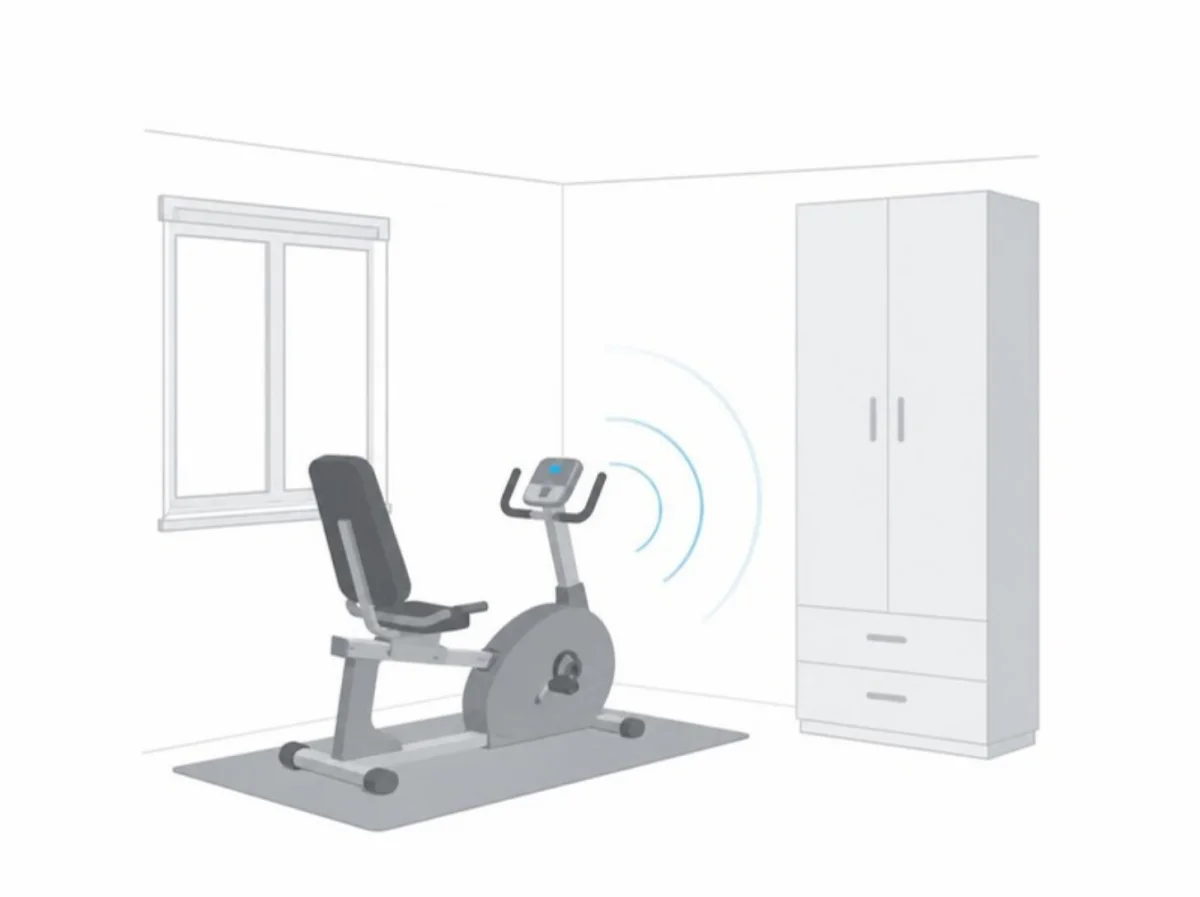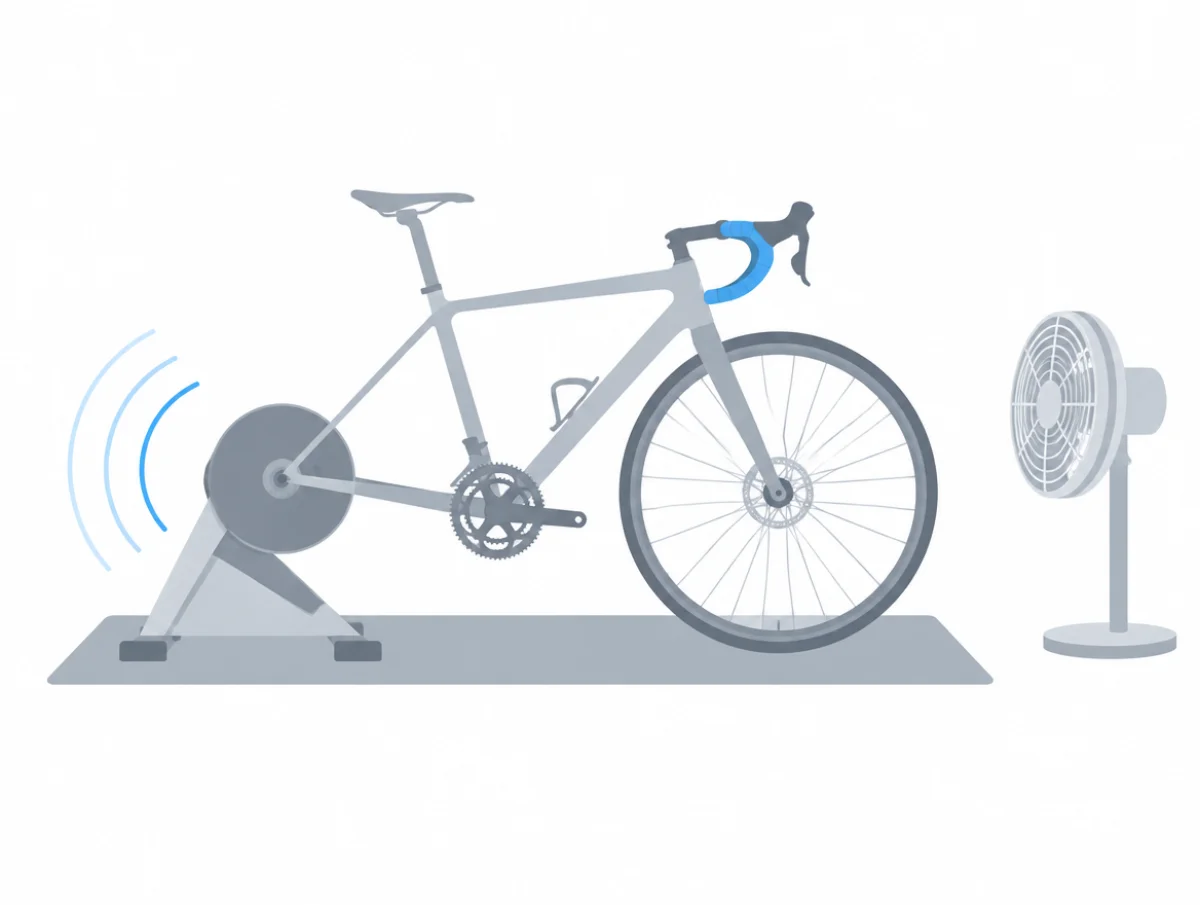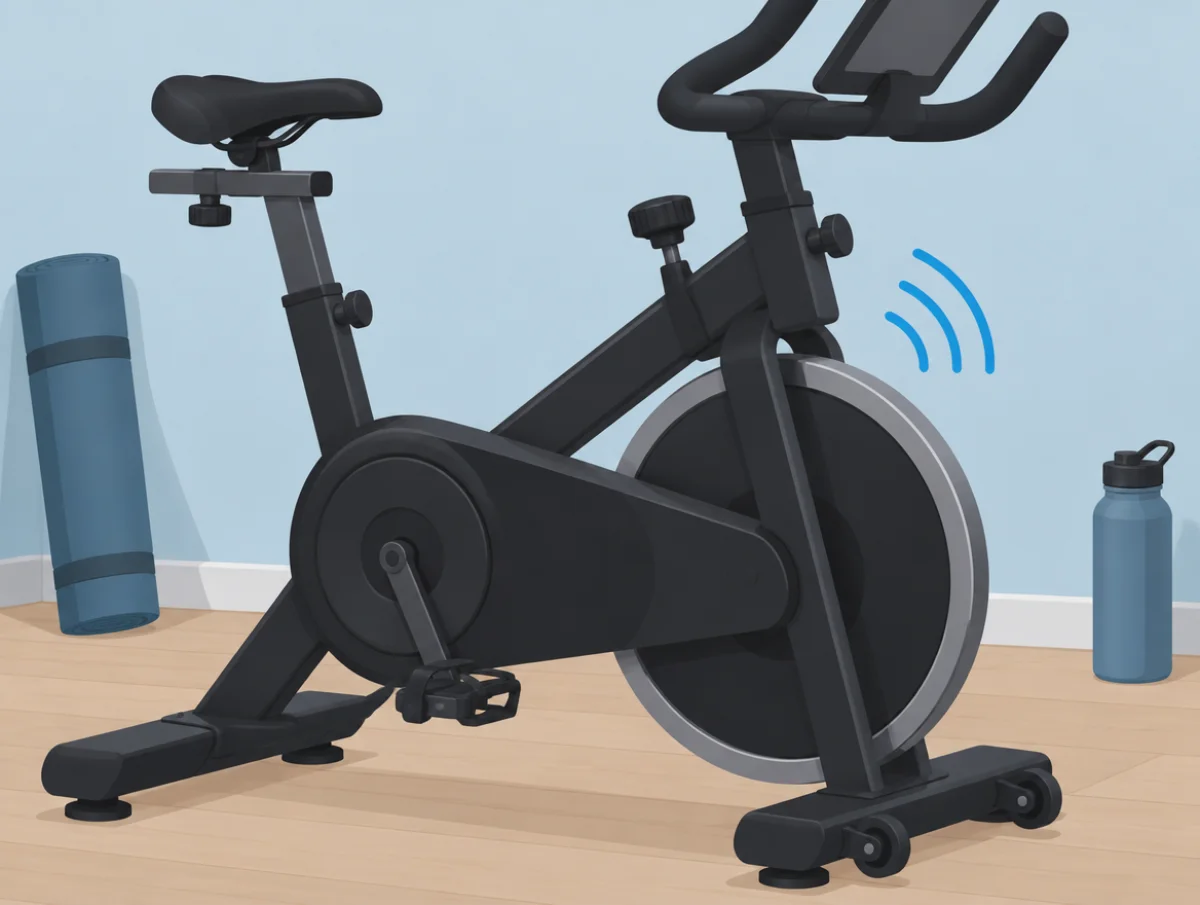
Exercise bike noise nearly always starts where your feet are. A click on every turn of the cranks, a squeak that comes and goes, a knock from somewhere in the frame: the troubleshooting tables in Schwinn's manuals and the help articles from Echelon, Peloton and BowFlex all send owners to the pedals, crank arms and loose bolts first. The belt, the flywheel and the resistance system come later.
This page is built from owner's manuals, service manuals, support articles and maintenance guides published by Schwinn and BowFlex, Peloton, NordicTrack, Echelon, Sunny Health & Fitness, Keiser, Life Fitness (for its Cybex bikes), MERACH and FED Fitness, which sells YOSUDA bikes. It covers spin bikes, uprights and recumbents, with magnetic or friction resistance. Most of the Life Fitness bike noise articles sit behind a sign-in, so only one is quoted.
Why does my exercise bike click when I pedal?
Usually because of a pedal. Exercise bike clicking that keeps time with the cranks points to the pedal threads, the pedal body or a loose crank arm, and every maker here that names clicking points to the pedals.
Three Schwinn manuals carry the same row. In the tables for the IC4 spin bike, the 170 upright and the 270 recumbent, "Clicking sound when pedaling" is answered with "Remove pedals. Make sure there is no debris on threads, and reinstall the pedals." The IC4 manual adds that a pedal "should be tightened securely to crank arm" and that the joint must not be cross-threaded.
MERACH has a four-step list under "If you are experiencing pedal noise" on its troubleshooting page. Check that the left and right pedals are on the correct sides. Check that both are tight. Look for pedal screws that have slipped or been damaged, and make sure the crank is tight too.
Swapped pedals are easy to miss. The left pedal is reverse-threaded, which is why Schwinn, BowFlex, Echelon, Sunny and MERACH all remind owners that it tightens counterclockwise.
Pedals work loose over time
New bikes settle in. Peloton's pedal article recommends "tightening your pedals after your first few rides", and because "Pedals on any stationary bike should be replaced regularly to avoid failures that can result from wear and tear," it asks Bike and Bike+ owners to replace them every year.
How often to check varies a lot. Echelon wants the pedals inspected "before each ride for any looseness or deformation". BowFlex says VeloCore pedals "should be checked weekly". The IC4 schedule is weekly for the pedals and monthly, or every 20 hours, for the crank arms, and Keiser asks M3i owners to re-torque the pedals to 35 ft-lbs every week in the first month. MERACH's checklist is monthly.
One habit can loosen them. On a fixed-gear bike such as the IC4, Schwinn's manual says "do not back, or reverse, pedal. Doing so may loosen the Pedals". Echelon looks at the other end of the joint: "There should not be a gap or exposed thread between the pedal and the crank arm."
Cleats and pedal tension
If you ride clipped in, the shoe is part of the pedal. Echelon's maintenance page asks owners to "tighten the cleat down as needed", and Peloton's pedals have tension screws on the back for when "your shoes start to feel loose in the pedals". Peloton adjusts them with a 3 mm Allen key, a quarter turn at a time. Neither maker ties a loose cleat to a click in so many words, but both include the cleat in the pedal check.
Squeaks from the pedals, seat or frame
A squeak has more possible sources than a click does.
Pedals are again the first suspect. "As pedals come loose, you may hear a squeaking sound, or it might feel a little off as you cycle," according to the Sunny Health & Fitness pedal guide. Its fix is to hold the pedal bolt with a spanner while tightening the nylon nut with an adjustable wrench.
The posts are next. For Echelon, "Applying a silicone lubricant to the handlebar post and seat post will solve any squeaks!" Schwinn's IC4 schedule has a weekly check for smooth seat operation, with the instruction to "sparingly apply a thin coating of silicone lube" if needed, and a firm note: "Do not use petroleum based products."
A squeak from the frame can be a floor problem. Life Fitness has a support article for Cybex 525, 625 and 770 bikes that squeak while pedaling, and the cause it names is the rear levelers. Owners should check that they "are not bottomed out or mushroomed" and adjust them "until the bike is stable with no rocking."
Leveling works the same way across brands. The NordicTrack studio cycle manual has you turn the feet under the rear stabilizer "until the rocking motion is eliminated." Keiser's M3i stands on three fixed feet plus one adjustable foot at the left rear, which you screw out "until it just comes in contact with the floor." There is a limit, by Schwinn's account: levelers "may not be able to compensate for extremely uneven surfaces," and the bike should then move to a level area.
What makes a knocking or clunking sound?
Loose hardware, or the flywheel nuts. Exercise bike knocking in Echelon's support pages comes from loose fixings on the pedals, seat and handlebars, and on its Connect bike from "The nuts on the wheel", which need "a simple adjustment".
That Connect answer comes with a caution in Echelon's app FAQ: "do not over tighten - follow the tightening instructions carefully." The same advice appears in Echelon's connected bike guide, which points to a video for the steps.
Echelon's general noise article runs in three steps. First stability: a flat, even surface, a different spot on the floor or adjusted feet, and "If your bike is on a carpet, try putting an equipment mat underneath it." Then every fixing from top to bottom, because "Loose fixings on pedals, seats and handlebars can cause ‘clicking’ and knocking noises." Then the pedals.
BowFlex's VeloCore guide is the most detailed list of what to tighten. It covers the stabilizer fasteners, the handlebar and seat post knobs, the bolts at the base of the console mast, the pedals and the three flywheel shroud screws on the left of the flywheel. A noise that shows up only in Lean mode gets its own step: lock the Lean Lock Knob, take off the lower pivot shrouds and add "a few drops of silicone lubricant to the pivot point." If the noise survives all of that, BowFlex sends a small repair kit, which it says "will be shipped at no additional cost to you."
MERACH's own words for the problem are blunt. Vibration loosens bolts over time, and "Loose parts lead to weird noises, wobbly rides, and eventually broken components."
Grinding, rubbing and squeaking around the cranks
Schwinn has a dedicated IC4 guide for grinding, squeaking and rubbing from the pedal area. It works from the flywheel outward.
- Tighten the flange nut that holds the flywheel to the frame, using a 16 mm socket.
- If the noise remains, tighten the crank nuts on the crank arms.
- Remove the pedals and turn the crank arms by hand.
- If that is quiet, spray the pedal threads with WD-40 and refit the pedals.
- If the cranks still make the noise with the pedals off, check the belt for noise and damage.
The reason for step one is in the guide: "Squeaking noises can occur when the flange nut attaching the flywheel to the frame is not tight enough." A noise that returns after step four gets a short answer from Schwinn, which is a new pair of pedals.
Bearings are the other grinding source makers mention. MERACH's maintenance guide asks owners to "Listen for bearing noise (grinding or squeaking)" at the flywheel and to check it for wobble, and it files bearing replacements under jobs that need help. Keiser has M3i owners apply LPS #3 to the left bottom bracket bearing during assembly.
Is a magnetic exercise bike supposed to make noise?
A little, but nothing should scrape. A magnetic exercise bike brakes the flywheel with magnets that never touch it, so a scraping or rubbing sound means a part has moved. NordicTrack calls magnetic resistance "the quietest resistance type available".
MERACH's guide puts the likely cause in brackets: "Listen for any scraping sounds (magnets might be too close)". Schwinn's 170 service manual shows how tight the gap is on that upright. With the resistance at its highest setting, the closest point on the brake magnet sits within 3.0 mm (1/8 inch) of the flywheel, and the last step checks that "the Brake Magnet and Flywheel do not touch." That is a service procedure with the shrouds off and the power on, so on most bikes it is a job for the maker's support line.
What remains on a magnetic bike is the drivetrain and the frame. NordicTrack's apartment advice says these bikes make noise at normal cadence that is "generally well below a normal conversation," and points to vibration as the larger concern.
Felt pads squeak on friction bikes
Friction bikes press a felt pad, sometimes leather, against the flywheel, and the pad dries out. NordicTrack puts it plainly: friction resistance "creates more noise and wears down over time."
Sunny Health & Fitness still sells friction bikes and writes the clearest rules. Its single pad guide lists three signs that the pad needs lubricating:
- rough resistance that is "tough to pedal"
- a flywheel "making a squeaky noise when you tighten the resistance"
- a bike owned for more than 90 days
For bikes with two pads, such as the SF-B1401, the dual pad guide sets a schedule of every 2 to 4 weeks. "Brake pads that squeak and stick when applied to the flywheel need to be cleaned and lubricated immediately." You loosen the tensioner, wiggle each pad out of its bracket, scrub it, apply a silicone-based lubricant and slide it back. There is a shortcut on single pad models: oil the wheel, raise the resistance so the pad touches it and pedal until the felt soaks up the oil.
Schwinn's IC3 service manual gives the same job for its felt brake: "Saturate the Brake Pad felt (D) with silicone lubricant. Wipe off the excess lubricant to prevent drips and stains." Lubricant only goes so far. Sunny says to replace pads that are visibly worn, or very worn on a bike one to two years old, and MERACH asks friction bike owners to check pad wear every few months.
Belt, chain and flywheel sounds
Belt drives are the quiet kind, and they need no oil. "Belt-drive bikes don't need any oiling," according to MERACH, while a chain does: every 2 to 3 months with bike chain lube by MERACH's schedule, and monthly with a chain lubricant on Sunny's.
A belt that slips makes its own noise, and Schwinn's slip test needs no tools. Pedal at about 20 RPM, then suddenly accelerate as hard as you can. "If the Pedals slip, the belt needs to be adjusted." The NordicTrack manual uses a different trigger, pedals that slip "even when the resistance is adjusted to the highest setting", and adjusts with a half turn of the adjustment nut on each side. On the IC3, a correctly tensioned belt has only 0.25 inch (0.64 cm) of give at the midpoint between the pulleys, or twists only a quarter turn, by the service manual's measure.
Echelon wants the belt looked at every 5 to 6 months, by removing the right side frame cover and shining a flashlight on it while turning the pedals by hand. Its tension fix is a quarter turn of the tension nut, followed by a test ride, because careless adjustment risks "premature belt fraying and damage."
Recumbent bike clicking and seat squeaks
A recumbent bike clicks for the same reasons an upright does. Schwinn's 270 manual carries the identical "Clicking sound when pedaling" row, along with a reminder that the cranks must sit "at 180 degrees from each other".
The sliding seat is what sets a recumbent apart. The 270 table has a row for a seat assembly that "shifts / squeaks when in use", with a short answer: "Check hardware that attaches Seat assembly, and fully tighten hardware." The weekly schedule adds a check that the seat slides smoothly, with a very thin coat of silicone lubricant if it does not. Weekly is also when the 270 manual wants the pedals and crank arms checked. A recumbent has levelers in two places, on the rear stabilizer and on the frame rail, and the frame rail one has a locking nut to tighten once it is set.
How do you make a spin bike quieter in an apartment?
Level it, tighten it and put a dense mat under it. NordicTrack names a high-density equipment mat as "The single most effective upgrade for apartment cycling" and calls vibration, more than sound, the bigger variable.
Its apartment guide adds riding habits:
- "Ride in moderate resistance rather than grinding on maximum settings, which generates more vibration"
- "Maintain even cadence rather than sudden surges and stops"
- avoid building quiet hours if your floor is thin
The building matters. "Older buildings with thinner concrete construction or wood-subfloor units may transmit more," NordicTrack warns, and heavier flywheels, 18 to 30 pounds by its range, "tend to vibrate less at moderate speeds." Echelon's mat advice is for carpet. FED Fitness sells its YOSUDA GF1 mat on the promise that it "prevents the equipment from shaking and slipping". Not one of them puts a decibel number on the difference a mat makes.
The rest of the job is everything above: level feet, tight pedals, quiet posts. Our guide to a quiet exercise bike for an apartment covers which bikes print noise figures, and the quiet apartment guide looks at how sound and vibration travel between flats.
WD-40, thread locker and how tight is tight
The makers do not agree, so the manual for your bike should decide.
WD-40 splits them. Schwinn's IC4 guide sprays it on pedal threads, and Sunny names it as the silicone-based lubricant for felt pads. MERACH's answer to whether you can use it is "Not recommended! WD-40 is a cleaner, not a lubricant." On one point Sunny and MERACH line up: neither wants WD-40 on a drive chain.
Thread locker pulls the other way from lubricated threads. Keiser installs M3i pedals with Loctite 242 and warns that skipping a thread locking compound, or crossing the threads, "will damage them, and could result in serious injury to the user." Echelon recommends threadlocker on pedal threads only "if the equipment is used more than 2 to 5 times a week," and MERACH suggests a drop of blue thread locker for anything that keeps coming loose.
Tightness splits them too. BowFlex says VeloCore pedals "should be very tight". MERACH's line is "You don't need to crank them super tight - just snug." Keiser gives a number, 35 ft-lbs with a torque wrench, and Peloton warns that a thick-jawed adjustable wrench can make adjustments difficult or damage the bike.
When should you call the maker?
When tightening and leveling do not stop the noise, when a part looks worn or damaged, or when the fix means opening the drive. Echelon, Schwinn, Peloton and BowFlex all send an unsolved exercise bike noise to their support teams.
Echelon asks for three things: proof of purchase, the serial number and a video of the noise. Its maintenance schedule also tells owners to stop at once if a pre-ride pedal check finds a problem: "Cease using the equipment immediately and call customer service if any issues are found." Peloton's noise page starts with a troubleshooting video and the toolkit that came with the bike, then a contact link, and its support pages list (866) 679-9129.
The IC4 guide ends with Customer Care at 1-800-605-3369, and a replacement part "will be provided to you at no cost assuming your machine meets the warranty eligibility requirements." A new IC4 belt also needs a 25 mm crank puller to get the crank arms off, which is reason enough to call before ordering one.
Several manuals take worn parts out of service. Keiser: "do not use the equipment until all repairs have been completed and thoroughly tested." NordicTrack says to replace worn parts immediately, and the IC4 manual asks for a check before each use for "loose, broken, damaged, or worn parts". Upkeep also protects the warranty. MERACH's warranty excludes "Repair for any noises such as but not limited to squeaks clunks, thumps, or grinding resulting from poor or lack of preventive maintenance."
How loud should an exercise bike be?
Quieter than talking, if you take NordicTrack's description of magnetic bikes, though few makers print a number. In our apartment bike guide, published exercise bike figures range from MERACH's "under 15dB" to 45dB, and none names a cadence or distance.
Peloton, Schwinn, BowFlex and NordicTrack print no figure for the bikes that guide checked. Smart trainers, which turn a road bike into an indoor bike, are rated more precisely, and four models in our smart trainer guide tie at 56 dB at 25 km/h. When a bike gets louder with age, the fix lives in the maintenance schedule rather than the spec sheet.
Related reading
Treadmills share the floor problem and many of the fixes, and how to make a treadmill quieter goes through the manuals for them. Rowers are covered in the quietest rowing machine guide. For any machine whose noise crept up over the years, why your appliance got louder has the checks.