Before you blame the motor, close the door, pull the manual release and push the door up by hand. Chamberlain's noise check splits the job in two that way, and most of the time the racket turns out to belong to the door: dry rollers and hinges, a chain or belt at the wrong tension, loose fasteners. Genie, Skylink and Ryobi trace garage noise to the same short list. Sommer and Marantec, for their part, sell drives they call maintenance-free.
The fixes below run in the order a homeowner can try them, with the makers' disagreements set side by side. Each quote comes from a maker's manual, support article or product page. None of the steps touches the springs, which every maker keeps for a trained door technician.
Some noise comes with the largest door in the house
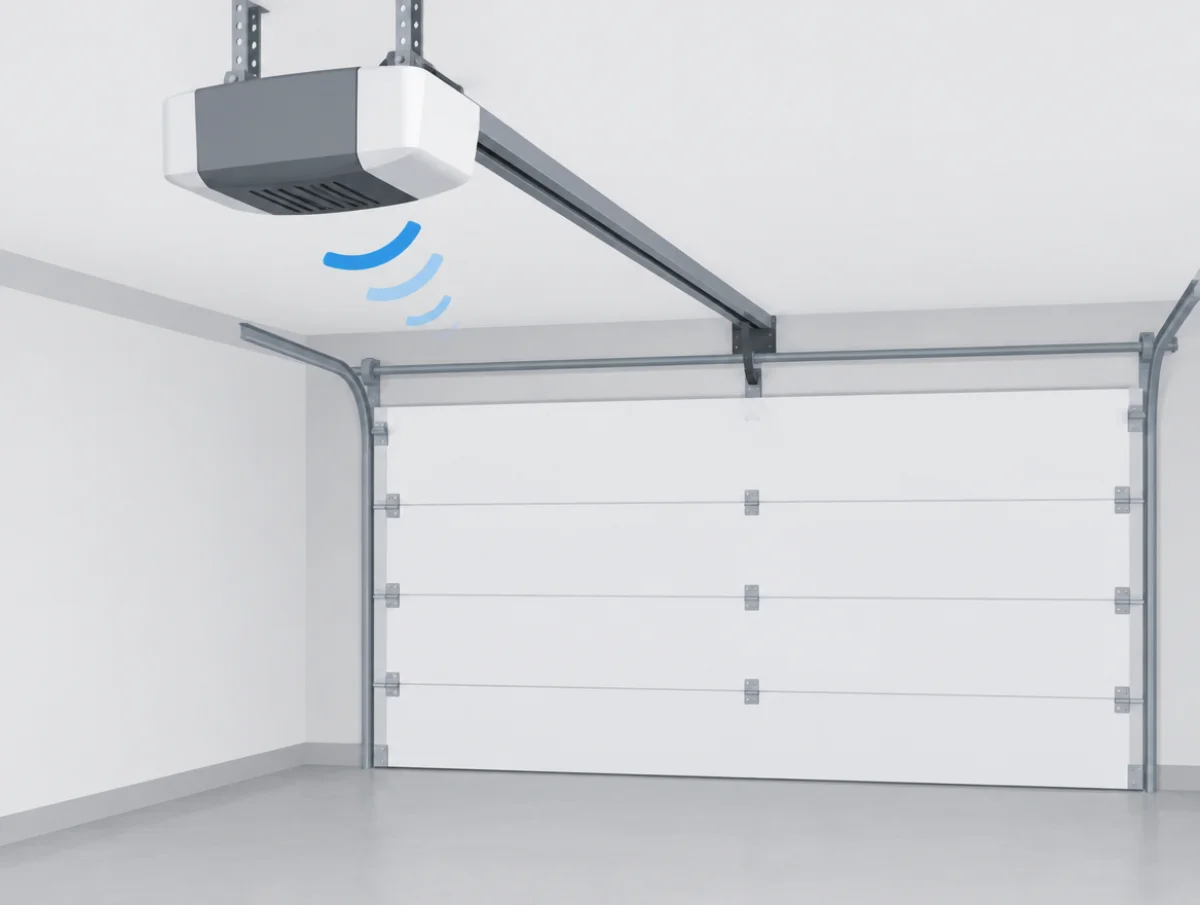
An opener moves the heaviest moving object in most homes along a long metal rail fixed to the ceiling, through rollers, hinges and dozens of fasteners that can each squeak or rattle.
Chamberlain admits as much in its noise troubleshooting article: "Understand that the garage door is the largest door in the home so some noise is inevitable." A door can weigh "hundreds of pounds," Genie's maintenance page points out, and the springs carry all of it.
Genie also sets the standard to aim for: "Your door should be quiet as it opens or closes." New noises the door "did not make before" mean "it is time for maintenance and, in some cases, repairs." A garage under a bedroom carries those sounds further, and the room side of that is in our guide to quiet bedrooms.
Test the door and the opener separately
Chamberlain's sequence has three steps.
With the door closed, pull the manual release and move the door by hand: "It should move smoothly and be balanced." A noisy door at this stage means "You may need to lubricate the door hinges and rollers." Then run the opener from the remote with the door still disconnected. If the opener alone is loud, check the drive tension, or on a screw drive, "Make sure the screw is lubricated."
Quiet apart but loud together points to the installation. The header and door brackets need to be in the right places, and the opener "properly angled down away from the header above the door."
Only release the door when it is closed. Never disconnect it while open, Chamberlain's maintenance article warns, because "A weak or broken spring could cause the door to fall unexpectedly." And unplug the opener before any of this: disconnect "ALL electric and battery power" before service. If you work with the door up, Genie wants the track clamped under a roller "to prevent the door from slipping down."
Does lubricating a garage door make it quieter?
Yes. Lubricating the door's moving parts "helps reduce noise and wear," according to Chamberlain, and Genie, Skylink, Ryobi and Chamberlain all name rollers and hinges as the parts to do. How often is another matter:
| Maker and document | Parts to lubricate | How often |
|---|---|---|
| Chamberlain maintenance article | Rollers, bearings and hinges | Once a year |
| Ryobi GD200 manual | Rollers and hinges | Each year |
| Genie wall mount manual | Rollers and hinges | Monthly |
| Skylink ATOMS manual | Rollers and hinges | When needed |
| Skylink service page | Rollers, bearing and hinges | During a monthly check |
Use "a small amount of a garage door lubricant," Chamberlain advises, and "Wipe away excess lubricant." Genie's maintenance page goes part by part, and the material decides what each part gets. Metal rollers with unsealed bearings are cleaned with an old toothbrush and then greased. Nylon rollers are different: "Do not lubricate nylon roller bearings only spray lubricant into and around the roller stems." Metal hinges get oil "where they pivot," but "Do not lubricate plastic hinges because the lubricant could break down the plastic." The J bar, where it pivots at the door and at the carriage, gets lubricant too, and so does the lock.
Should you lubricate garage door tracks?
No. Chamberlain, Ryobi and Skylink all say to leave them dry. Ryobi's GD200 manual prints "DO NOT ADD LUBRICANT TO TRACKS", and Skylink wants the tracks cleaned with no lubricant on them.
Genie cleans rather than greases. Vacuum loose debris, spray the tracks with disc brake cleaner, then wipe away the cleaner "and any grease or debris that remains." One Genie blog post on replacing an opener does list "poor lubrication on the track" as a cause of slow running, so Genie is not fully in step with itself; the maintenance page is the more detailed of the two.
Chamberlain's monthly check is that the tracks "are clear of debris and do not appear bent or damaged." Straightening a bent track is not a homeowner job in Chamberlain's account. Call a door professional.
Grease, oil, and what to keep off the plastic
Makers name a type of lubricant, never a brand. Skylink and Genie's wall mount manual want "light weight general purpose grease" on rollers and hinges, and Chamberlain names white lithium grease for the rail.
Genie prefers products made for garage doors, and frames the choice as one "between the two types of garage door lubricant, either penetrating oil or grease". Grease, it adds, "helps prevent friction and keep your door operating smoothly and quietly." Ryobi's caution runs the other way. Never let "brake fluids, gasoline" or "penetrating oils" reach the opener's plastic parts, which those chemicals can "damage, weaken or destroy".
The rail, chain and belt are where makers disagree most
Chamberlain greases rails that need it. Genie oils chains but never belts. Sommer, Ryobi and Marantec say their drives need nothing at all.
| Maker | What the maker says about the drive |
|---|---|
| Chamberlain and LiftMaster | Rail: white lithium grease every 2 to 3 years, if the opener requires it |
| Genie | Chain drive: lubricate the chain; belt drive: do not lubricate |
| Ryobi GD200 | Lubricated for the life of the unit; no further lubrication |
| Sommer evo+ | Chain and rail maintenance-free; must not be oiled or greased |
| Marantec Synergy | Pre-tensioned rails, "completely maintenance-free" |
For a rail that does need it, Chamberlain's method is to disconnect power, wipe off the old grease with a clean rag, apply "a thin layer of white lithium grease to the rail where the trolley moves", then restore power. Though "it is rare," the internal gears may also need lubrication, checked by taking off the opener's side panel with the power unplugged.
Sommer's ban has an electrical reason. On the evo+, the carriage "is supplied with safety low voltage via the chain and the rail," and oil or grease "will greatly reduce the conductivity". The Ryobi GD200 manual describes an opener lubricated "for the life of the unit under normal operating conditions." With answers this far apart, read the manual for your own opener before reaching for grease.
Some screw drives need lubricant and some do not
On a screw drive that is noisy by itself, Chamberlain's first check is the lubricant on the screw. Genie sells a lubricant that "reduces noise and improves performance on any screw drive garage door opener".
Its own newer screw drives are the exception. The screw comes "pre-lubricated from the factory," according to Genie's screw drive article, and the new design "has no metal to metal contact, which means they are less noisy and require no additional maintenance or lubrication." For the schedule, the lubricant listing sends owners back to their manual.
A slack or tight chain makes sprocket noise
If the chain or belt "is either too loose or too tight, sprocket noise may result," Chamberlain warns. Genie connects groaning or slapping to slack, and Skylink warns against over-tightening. Each prints a different target:
| Maker and drive | Tension target in the maker's words or numbers |
|---|---|
| Chamberlain chain, T-rail | Chain 1/2 inch above the base of the rail at its midpoint |
| Chamberlain chain, square rail | Chain 1/4 inch above the base of the rail at its midpoint |
| Chamberlain belt | Tension spring approximately 1-1/4 inches |
| Genie chain or belt | About a quarter inch from the bottom of the rail |
| Ryobi GD200 belt | About a 1/8 inch gap between the belt and the edges of the intermediate rail |
| Skylink ATOMS manual | Approximately 5/16 inch (8 mm) above the base of the rail at its midpoint |
| Skylink service page | Approximately 1/2 inch (13 mm) above the base of the T-rail |
Skylink's two pages contradict each other, so go by the manual for your model.
All of them start by releasing the door from the opener. Some droop with the door closed is normal, Chamberlain's chain article notes, and a chain that returns to position when the door opens needs no adjustment. After any tension change the safety reversal system "MUST be tested": the door has to reverse on contact with a 1-1/2 inch object, or a 2x4 laid flat. The belt article repeats the rule. Go gently, too. Genie cautions against overtightening, "as it could lead to a break."
Marantec ships its rails pre-tensioned. Sommer sets tension once at installation, to a mark on the chain tensioner, and neither offers owners a tension routine.
Tighten the hardware, but not the red bolts
Rattles often stop here. Genie's troubleshooting for noisy operation opens with "Be sure all fasteners are tight", Ryobi wants a weekly check for loose parts, and Sommer goes over the door, ceiling and header screws once a year.
Genie's list covers hinge fasteners, strut fasteners, track bolts, jamb brackets, the J bar and the brackets holding the opener to the ceiling. "Operate the door up and down to assure that the rail and garage door opener do not move," then tighten loose nuts and replace rusted fasteners. Every door, Genie adds, should have a bracket reinforcing the opener attachment to the wall. Ryobi's weekly round covers "the power head, rail, brackets, door arms, track, and rollers."
The tightening stops at the spring hardware. Never adjust "any fasteners that are painted red or otherwise identified as requiring service by a professional only," Genie warns, and call a professional before removing the bottom roller brackets, which are "under extreme tension."
One maker sells a vibration kit
That maker is Chamberlain. Its 041A8420 Vibration Reduction Kit comes up only "after ensuring proper door maintenance and drive tension," and the older 89LM isolator is discontinued.
The kit is small. Open the light lens and "Place a foam pad on each end panel," the installation sheet says, so the pads sit between the lens and the end panel. Which noise the pads address is never stated. They sit at the light lens, not between the rail and the ceiling.
The noise article still names the Vibration Isolator G89LM, though Chamberlain's instructions page marks the 89LM discontinued. Genie, Skylink, Ryobi, Sommer and Marantec publish no isolator or pad that we could find, and none says rubber mounts from another source are safe to fit.
Is a belt drive opener quieter than a chain drive?
Ryobi, Genie and Marantec all say so. The GD200 manual calls Ryobi's belt drive "quieter than traditional chain drive models," and Genie recommends belt drives as "ideal for garages close to living spaces".
According to Genie's quiet opener guide, its belts are steel reinforced, "the low-vibration belt ensures quiet operation," and belt drives "require no lubrication". Marantec's Synergy brochure credits a "steel-cable infused, polymer belt drive system" and DC motors.
Sommer builds chain openers and claims quiet anyway. On its operators page the motor carriage "moves itself along a tensioned chain," and the evo+ page calls the drive "extremely quiet, low-wear". Not one of these makers prints a decibel figure comparing belt with chain. How big the gap is, nobody knows.
Is a wall-mount jackshaft opener quieter?
Genie markets its wall mount as "ultra-quiet," and the design gets rid of the ceiling rail by sitting beside the torsion spring. There is no decibel figure comparing wall mount with ceiling mount.
The Genie 6172H-O "Mounts to the side of the door's torsion spring" and frees the ceiling. The limits are strict: "Not compatible with reverse wound springs, low headroom setups, extension springs, or one-piece doors." The wall mount manual restricts it to "a residential sectional door with front torsion springs."
Marantec calls its side-mounted RDD series "perfect for spring-balanced" custom, architectural and wind-loaded doors, with a footnote: "Regular checkups and maintenance of the door and springs required." Neither maker claims a side mount will fix a noisy door. Both still need a balanced door on sound springs.
Leave the springs and cables alone
The springs, cables, cable drums and anything fastened to them hold the door's weight under high tension, and every maker sends that hardware to a trained door technician. Their warnings:
- Chamberlain: "Never loosen, move, or adjust garage door springs, cables, pulleys, brackets, or related hardware."
- Genie: "Never try to adjust the garage door torsion springs".
- Genie wall mount manual: "DO NOT attempt to repair or adjust door springs or any hardware".
- Skylink: "DO NOT try to remove, repair or adjust springs or anything to which door spring parts are fastened."
- Ryobi: "Have a qualified service person make repairs to cables, spring assemblies and other hardware."
- Sommer: "If a door is incorrectly balanced, springs may break suddenly."
Lubricating springs is another split. Genie's maintenance page does spray torsion springs lightly "to decrease friction between coils," warns owners to practice "extreme caution" near them, and links a clicking or whirring sound to springs that may need it. Chamberlain lists springs among the parts not to repair or adjust yourself and never mentions oiling them.
When does a noisy garage door need a technician?
When it binds, runs unevenly, fails a balance test, or hums briefly without moving. Chamberlain, Genie, Skylink and Ryobi all send those to a trained door professional.
A brief hum can mean "The Springs May Be Broken" in Chamberlain's hum troubleshooting, and the answer is "Contact a trained door technician". On its screw drives, a hum that lasts longer than 5 seconds may mean "The rack may be stripped". Grinding on a Genie screw drive points to a carriage or coupler that needs replacing, per the Genie troubleshooting page.
Stop using a door that is damaged, sticks, binds or moves unevenly, Chamberlain says. Ryobi wants the door or springs repaired "by a qualified service person" if the door will not move smoothly by hand. Rollers last "five years to seven years" in Genie's estimate.
How do you check a garage door's balance?
Release it from the opener while closed, lift it by hand to about halfway, and let go. Genie and Skylink expect it to stay put, though the Genie wall mount manual allows a slow drift.
That manual raises the door 3 to 4 feet; if it "opens or closes rapidly," contact a trained door system technician. Skylink's service page wants the door "supported entirely by its spring" at several heights. Adjusting spring tension yourself "is too dangerous to perform without training," Genie concludes.
How loud is a garage door opener?
Almost nobody says. Sommer alone gives a number: "< 59 dBA" for the evo+ opener alone, a ceiling with no distance stated.
Ryobi calls the GD201 "Ultra-Quiet" by name, Genie calls its belt drives "ultra-quiet," and Marantec's Synergy 300 sell sheet claims an "Ultra quiet DC motor", all without numbers. We tried to build a buying guide ranked by published figures and found too few to rank, so there is no opener guide.
The decibel chart sets 59 dBA against familiar household sounds, and dBA explained shows why a reading with no stated distance says little by itself.
Other garage noise has its own fixes
A compressor, a heater, a fan or a workbench often makes more noise than the door. For tools, the workshop noise guide explains the figures power tool makers declare, and making an air compressor quieter covers the loudest machine in many garages. For comfort, we rank the quietest garage fans and the quietest garage heaters by their makers' numbers.
An opener that was quiet for years and is now loud may simply be wearing; the common patterns of wear are in why your appliance got louder.
LiftMaster appears on this page only through the Chamberlain Group support site it shares, since Chamberlain's and LiftMaster's product pages refused our requests and the LiftMaster wall mount manuals would not open. The Sommer evo+ manual is a Sommer USA document on a file server we could not tie to Sommer's main site, and Ryobi's manuals sit on the file server its help pages link to. Craftsman sells openers too, but its support site had no opener maintenance pages to quote.