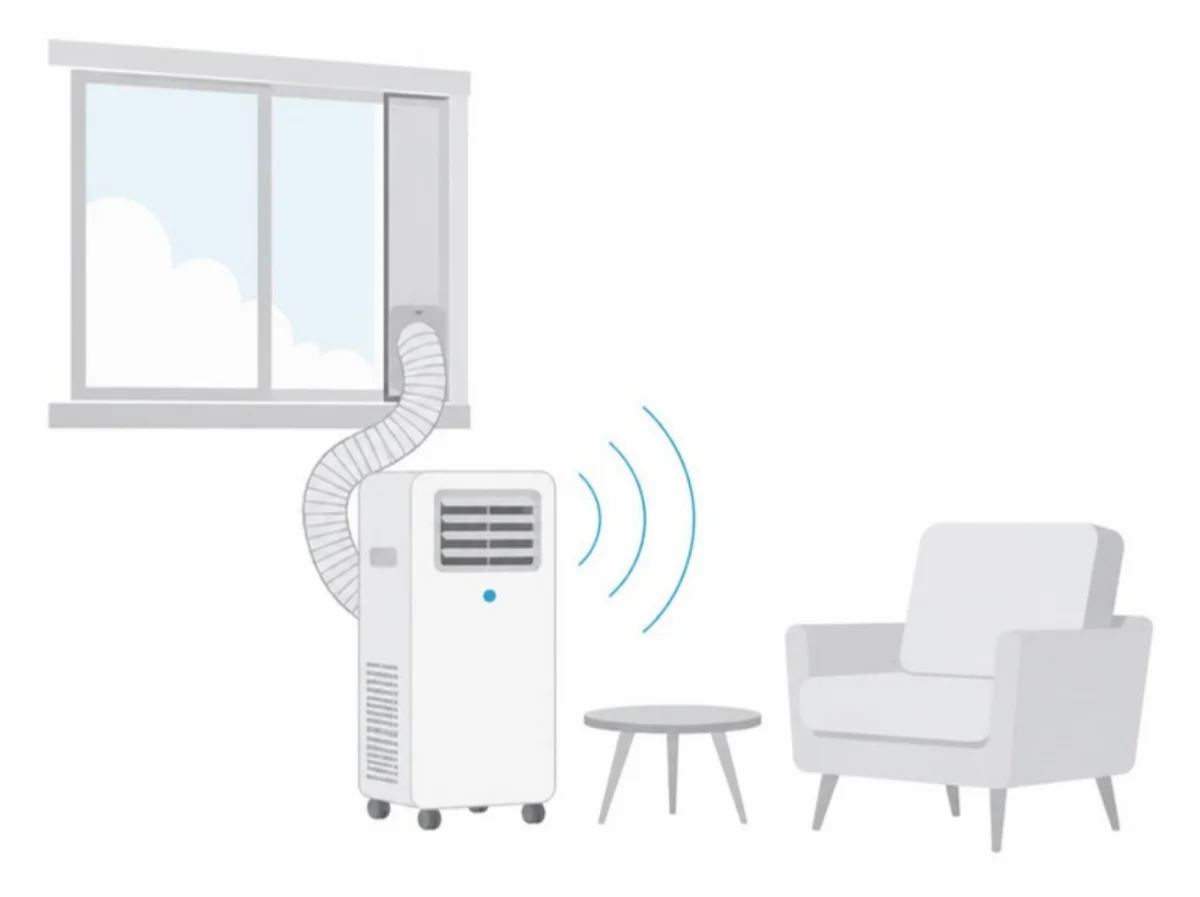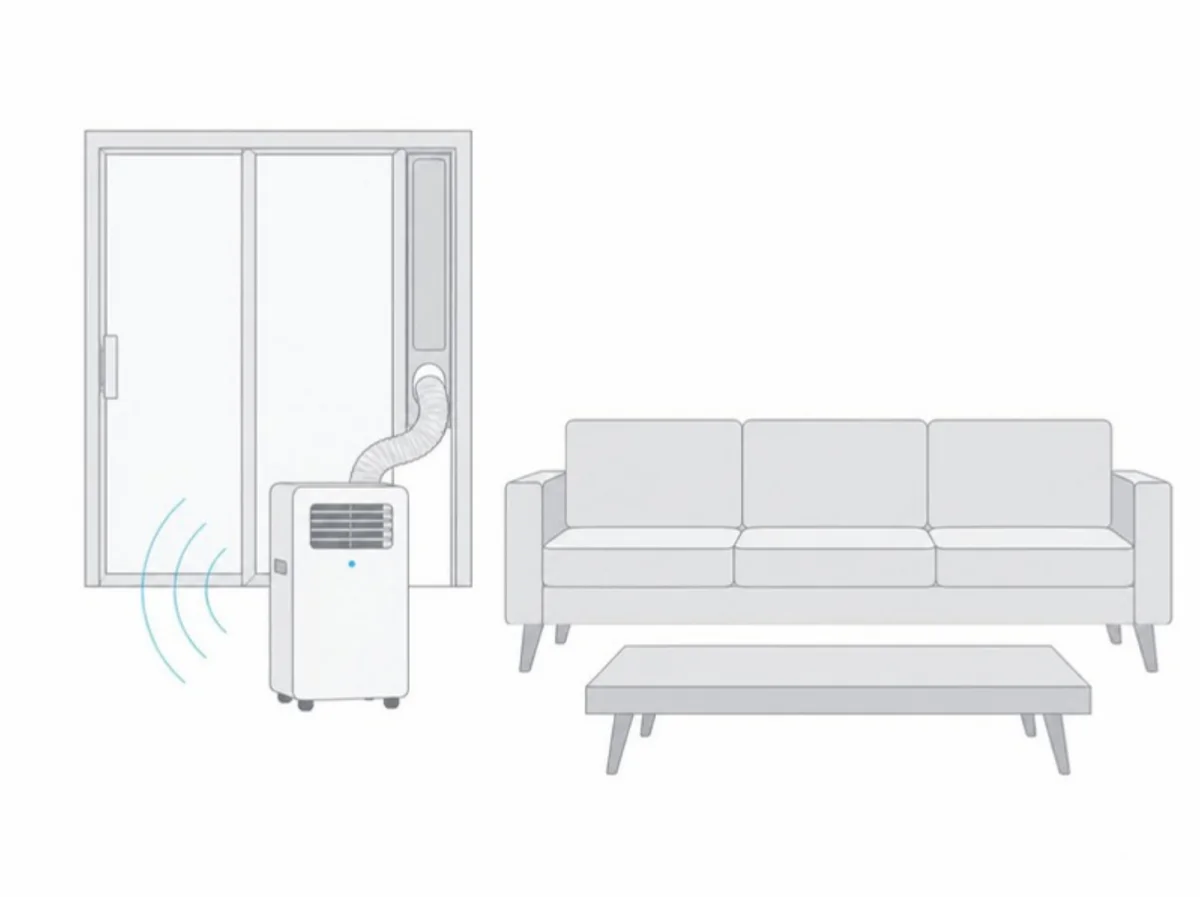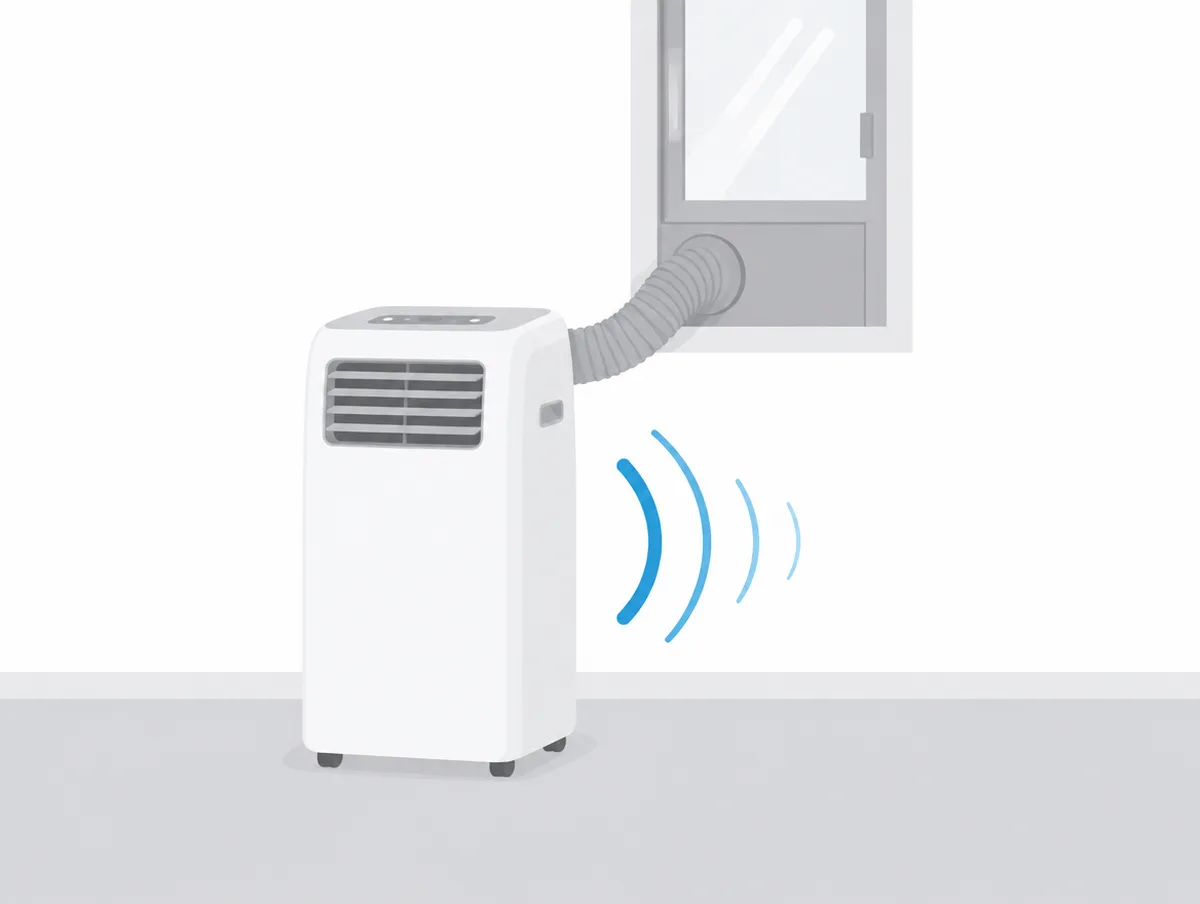
Learning how to make a portable AC quieter starts with a fact the manuals take for granted: the compressor, both fans and the water tray all stand in the room with you. What an owner controls is the setting, the floor, the hose and the filter.
Midea, LG, Frigidaire, Whynter, Toshiba, GE, Danby, De'Longhi, BLACK+DECKER and Dreo each print part of the advice below in a manual or on a product page. The steps run from a button press to a reinstall, then cover what the makers forbid and the sounds they hand to a technician.
To name a gurgle, ping or hum first, our window AC noises explainer covers sounds that portables share with window units.
Why are portable air conditioners so loud?
Portable air conditioners are loud because the whole refrigeration system stands on your floor: compressor, condenser fan, room fan and condensate tray. A window unit leaves part of that outdoors; a portable sends only its hot air out.
Whynter's ARC-1230WN manual lists the sounds an owner should expect: a compressor that may pulse or whine, water that may splash, refrigerant that may gurgle, and fan noise from vents at the front and back. It also warns that "Noise reflecting off hard surfaces such as a floor or wall can make the sounds seem louder than they actually are."
That leaves a small share of the sound within an owner's reach.
How loud is a normal portable AC?
A normal portable AC is rated from the low 40s to the high 50s in decibels on its maker's sheet, depending on fan speed. None of the makers below states how far away the reading was taken.
| Maker and model | What the maker prints |
|---|---|
| LG LP1419IVSM | 53 dBA high, 50 medium, 47 low, 44 Sleep (front) |
| Frigidaire FHPC082AC1 | 53 dBA high, 50 dBA low |
| Whynter ARC-1230WN | 56.5 dB high, 49.5 medium, under 42.5 low |
| Danby DPA050E2BDB-6 | 54 dBs high, 51 dBs low |
| Midea Duo MAP12S1TBL | As low as 42 dBA, no speed named |
| Dreo 740S | 42 dBA at the lowest speed, from Dreo's own lab |
| BLACK+DECKER BPP10WTB | 58 dBA "on highest setting" |
| De'Longhi portables | About 55 dBA normally, 50 dBA in Arctic Whisper mode |
The LG spec sheet is the useful one here, because it prices each step down: 6 dBA from high to low, and 3 more in Sleep. Dreo footnotes its 42 dB as "Tested by DREO internal lab at the lowest speed setting", and De'Longhi's FAQ gives round numbers.
Toshiba is the one maker we read that says how its noise information was taken. Its TAPX08W5HWT manual bases it on an un-extended exhaust duct, no window slider adaptor, Cool mode and High fan. For why makers' figures rarely compare cleanly, see comparing decibel ratings.
What is the quickest way to quiet a portable AC?
The quickest way to quiet a portable AC is a lower fan speed. Frigidaire and LG answer a complaint about noise while cooling the same way: rushing air is normal, and if it bothers you, step the fan down.
Frigidaire's FHPC082AC1 guide and LG's online manual both print "If too loud, set to lower FAN setting" in their troubleshooting tables. The spec sheets show what that buys: 6 dBA on the LG and 3 on the Frigidaire.
Low fan has a price on the hottest days. Whynter lists low fan speed as a cause of weak, barely cold airflow, and Frigidaire says a unit that turns on and off rapidly in extreme outdoor heat needs a faster fan to move air through the cooling coils more often.
Does quiet mode make a portable AC quieter?
Yes, where a portable has one. GE's APHS07 and APHS08 manual says Quiet mode reduces "the noise of the unit while cooling" and names it the setting for nighttime cooling. GE prints no decibel figure for it.
In the GE manual, Quiet chooses the fan speed by itself, and pressing the speed button puts the unit back in plain Cool. After switching Quiet off, GE says to wait 3 minutes before restarting.
De'Longhi's Arctic Whisper mode, on one model, is the only quiet setting with a maker's figure: about 50 dBA, 5 below its usual portables.
Does sleep mode make a portable AC quieter?
Yes on LG's LP1419IVSM, which lists 44 dBA in Sleep against 47 dBA on low fan. Most other portable sleep modes, as their makers describe them, only raise the set temperature over the first hour and then hold it.
LG's Sleep also switches the control panel off and shuts the unit down after 1 to 12 hours. Midea's Duo raises the setting 2°F after 30 minutes and 2°F more after another 30, then keeps it for 7 hours. Whynter's version adds 1°F to 2°F once, and Toshiba's matches Midea's two steps.
BLACK+DECKER pairs "sleep mode for quiet operation while you rest" with 58 dBA "on highest setting" in the same bullet, without saying which figure sleep mode reaches. Frigidaire's Sleep locks the fan on Auto. Our sleep and quiet modes explainer compares these timers across appliances.
How do you stop a portable AC from beeping?
Portable AC beeps, in the manuals we read, come from three places: the unit confirming a remote signal, the tray-full alarm, and on some models the buzzer itself. Midea's and Toshiba's remotes carry an LED button for the display.
Midea's Duo manual says its LED button turns the display "and air conditioner buzzer on and off (model dependent), which create a comfortable and quiet environment." Toshiba's LED button turns the display on and off. On the LG, holding Mode for 3 seconds steps the panel from 100% to 50% to off.
Eight beeps in a row are not a setting. On Midea, Whynter and Toshiba units they mean the water tray is full, and only draining it stops them.
Where should a portable AC stand to run quieter?
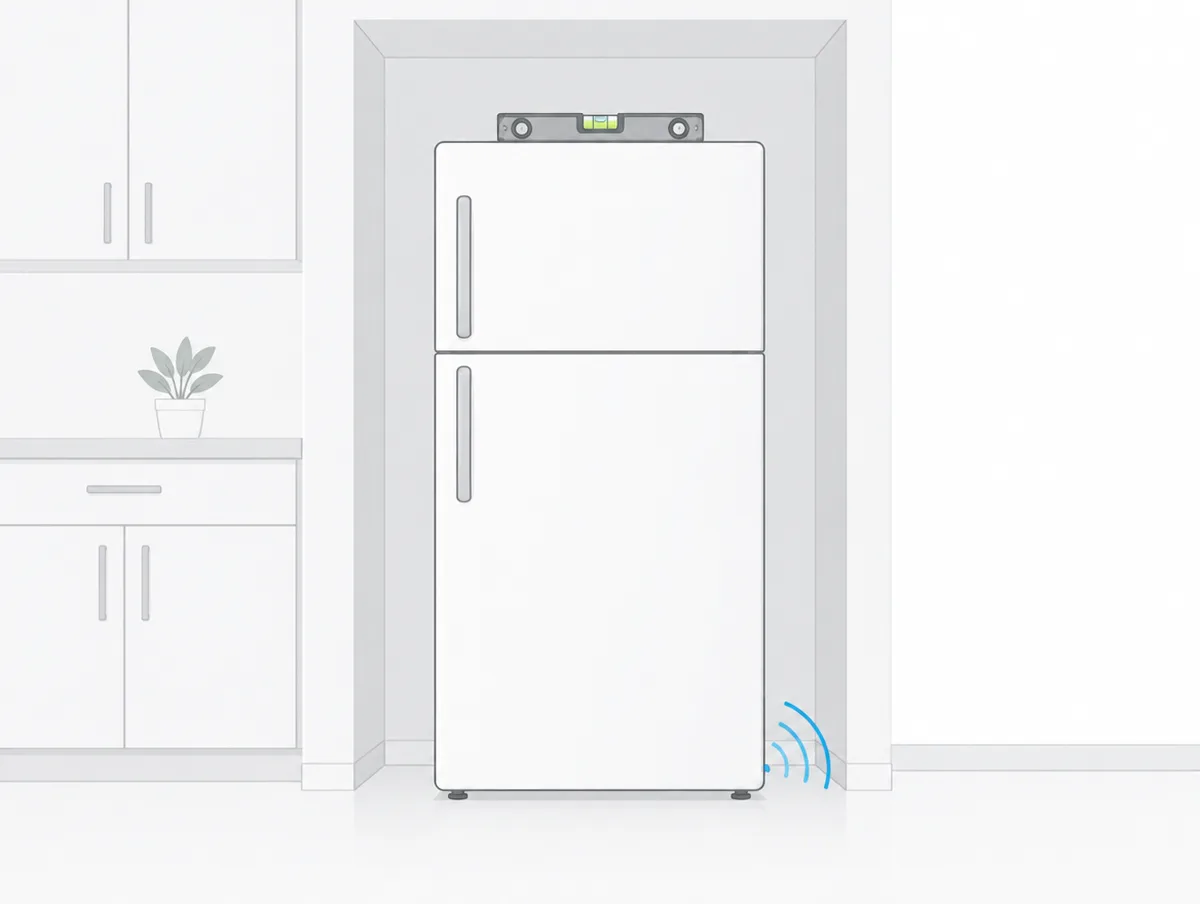
A portable AC should stand on a flat, level, solid floor, clear of walls, curtains and furniture. Frigidaire, Midea, Danby, Toshiba, Whynter and BLACK+DECKER each link an uneven or weak floor with vibration or extra noise.
Frigidaire lists vibration among its normal sounds and blames it on an uneven floor; its fix is to "Move or support appliance correctly on even surface." Danby's manual says "Make sure the appliance is level to minimize noise and vibration." BLACK+DECKER asks for a floor strong enough to hold the unit's weight, "for low noise and vibration while in operation."
The clearances are where the manuals part ways:
| Maker and model | Space the manual asks for |
|---|---|
| LG LP1419IVSM | At least 8 inches on all sides |
| Midea Duo | 9.8 inches from the nearest wall, nothing within 20 inches of the hose |
| Whynter ARC-1230WN | 9.8 inches from the wall, louver 19.7 inches from obstacles |
| Toshiba TAPX08W5HWT | 12 inches from the wall, outlet 19.7 inches from obstacles |
| Danby DPA050E2BDB-6 | 17.7 inches front and sides, 20 inches behind |
| Frigidaire FHPC082AC1 | 31.5 inches front and back, 19.7 inches each side |
| GE APHS07 and APHS08 | 20 inches from the exterior wall, 30 inches on other sides |
No maker on that list says the extra space lowers the noise; each gives it for airflow and proper cooling. GE adds that drapes, curtains and blinds must stay clear of the unit, and LG warns against parking it beside furniture that could block the vents.
Can you put a portable AC on carpet?
No maker we read recommends carpet or a pad as a noise fix. Whynter warns against using its wheels on thick carpet, because the unit could tip, and every manual asks for a level, firm surface.
Whynter's remark about hard floors sits in its list of normal noises, not its installation steps, and suggests no rug or mat. Danby asks for "a smooth, level floor that is strong enough to support it and all included accessories."
How do you make a portable AC compressor quieter?
A portable AC compressor cannot be quieted by its owner, according to the makers: its chatter is listed as normal, and the cabinet is closed to owners. Owners can only change how often it starts and stops.
LG and Frigidaire both say "Today's high efficiency compressors may have a high pitched chatter during the cooling cycle." Whynter describes a pulsating or high-pitched sound. All three file it under normal sounds.
Starts and stops are where settings matter. LG and Frigidaire name a dirty filter first among the causes of a unit cycling on and off rapidly. Restarts also come with a pause: Whynter has a 3 minute lockout, BLACK+DECKER a 3-minute delay after settings change, and Frigidaire about 4 minutes after a mode change.
Midea, Whynter and Toshiba add a constant fan option, set by holding the fan button for 3 seconds in Cool or Dry. With it on, the fan keeps running while the compressor cycles; with it off, the fan stops when the compressor does. None of the three says which is quieter.
The compressor type matters more, and it is fixed at purchase. Whynter credits its NEX inverter with "a much quieter operation"; our inverter compressors explainer covers why.
Does the exhaust hose make a portable AC louder?
No maker we read says a long hose adds noise, but each asks for a short, straight hose, and Toshiba bases its noise information on an exhaust duct that has not been extended.
| Maker | What the manual says about the hose |
|---|---|
| LG | About 35.5 inches or less after installation, shaped into an inverted U at the window |
| Frigidaire | Stretches from 15 to 59 inches, but keep it to the minimum needed, with no sharp bends or sags |
| Midea Duo | "Do not add extension to the exhaust hose(s)!" |
| Danby | No extension; the unit was tested only with the hose it ships with |
| Whynter | As short as possible, never overextended or bent |
| Toshiba | Not overextended or bent; with a 3 meter extended duct the unit may not work above 95°F |
LG explains the inverted U: it lets rain or condensation drain out through the window. LG also says not to bend the hose downward when the window kit is not fitted. Danby's manual answers a hose too short for the room with a second fan to carry the cool air further.
The space beyond the window panel counts too. Midea and Whynter want no objects within 20 inches of the hose, and Toshiba asks for 500 mm of clear space around the hose outlet.
Does sealing the window kit make a portable AC quieter?
No, not in the makers' words. LG says its window foam keeps air and insects out, GE says its foam pad decreases heat loss, and neither claims the foam cuts sound.
LG cuts its window gap insulation to length, stuffs it between the sashes, and suggests "no residue" duct tape around the panel for a tighter seal. It also fits a security bracket to stop the window being opened. GE asks for its foam seals and foam pad to be cut to fit the window kit.
A loose panel is a different matter. Midea's troubleshooting table covers a window kit whose top leans forward out of the track, and the fix is to fit its brace properly. Whynter says the exhaust adapter on a sliding window must sit away from the wall.
Why does my portable AC sound like water?
Portable AC water sounds are normal, by the makers' accounts. Whynter says water running from the evaporator to the tank may splash, LG puts pinging or swishing down to droplets hitting the condenser, and six makers call gurgling refrigerant flow.
Midea, Danby, Toshiba, Frigidaire, Whynter and LG all describe the gurgle as refrigerant moving through the unit. Midea's table says "This sound is caused by the refrigerant flow inside the unit and is normal." None of them offers a setting that stops it.
LG's online manual explains the pinging as "Droplets of water hitting condenser during normal operation." Some designs keep more water in play: Dreo describes its 740S as drainage-free below 90% humidity. No maker we read offers a way to silence that water.
Does draining a portable AC make it quieter?
No, not the splashing: no maker says an empty tank runs quieter. Draining ends a different noise, the tray-full alarm, which is 8 beeps and P1 on Midea, Whynter and Toshiba units.
LG shows FL instead and switches off until the tank is emptied. Midea, Whynter, Toshiba and Danby stop cooling but keep the fan running, which the Midea manual calls normal.
A continuous drain avoids the alarm. Whynter says its gravity drain hose must run straight down, with no kinks or bends, or the water will not drain. Frigidaire says no part of the hose should sit higher than the drain outlet.
Portable heat pumps add a pump. For the ARC-1230WNH, Whynter says "To reduce pump drain noise, make sure to attach the drain hose adaptor to the open end of the drain hose", held with the supplied zip tie. Midea's Duo can lift heat-mode condensate up to 6 feet and calls a fan that starts slow in heat mode normal.
Does cleaning the filter make a portable AC quieter?
Yes, by three makers' troubleshooting tables. Midea, Danby and Toshiba each list a dirty or blocked filter as a cause of a noisy unit, next to an uneven floor. Midea and Toshiba name dust and animal hair.
Midea, Danby, LG and Toshiba ask for a clean every two weeks, and Frigidaire asks for weekly cleaning of its two filters. Whynter and LG light a reminder after 250 hours. LG says to use water no hotter than 40°C, and Midea says to unplug first and to wipe the grille now and then in homes with pets.
Past the filter, the makers draw a line. LG says the interior "must only be cleaned by an authorized service center or a dealer", and Frigidaire says its unit "contains no user-serviceable parts."
How do I make my Midea portable AC quieter?
A Midea portable gets quieter, by the Duo manual, from a flat and level floor, a clean filter, a hose that is neither stretched nor bent, and the LED button that darkens the display and, on some models, the buzzer.
The Duo's troubleshooting table names only two causes of a unit that is "noisy and/or vibrates too much": a floor that is not level and a filter blocked with dust or animal hair. It asks for 9.8 inches to the nearest wall and nothing within 20 inches of the hose.
Midea's Duo product page says "as low as 42 dBA" without naming a speed. Our Midea decibel guide lists every figure Midea publishes.
How do I make my Toshiba portable AC quieter?
A Toshiba portable follows the same core steps in its TAPX08W5HWT manual: an even surface, at least 12 inches from the nearest wall, a hose neither overextended nor bent, and a filter cleaned every two weeks.
Toshiba's troubleshooting table blames a noisy, vibrating unit on uneven ground or a blocked filter, and calls gurgling normal. Its LED button turns the display off, and its sleep mode raises the setting by 2°F twice in the first hour.
Toshiba's Canadian product page carries a Midea America (Canada) copyright line, and its noise advice reads much like Midea's. We found no portables on Toshiba's US site.
What should you never do to quiet a portable AC?
Portable AC makers rule out covering or boxing the unit, blocking its grilles or hose, lengthening the exhaust hose, plugging into an extension cord, and opening the cabinet. A noise cover breaks the first of those rules.
Midea's manual says "Do not cover or obstruct the inlet or outlet grilles." Whynter says the exhaust hose "should never be covered or blocked, as this can become a fire hazard", and Frigidaire says not to block the intake grille, discharge area or outlet ports.
On power, LG says "Do not use an extension cord with this portable air conditioner" and rules out surge protectors and multi-outlet adapters. Midea, Whynter, Toshiba, Danby and Frigidaire also forbid extension cords.
Leave the cabinet shut. Midea and Whynter say not to remove any fixed covers, GE says "Do not drill holes in the unit", and Frigidaire warns against heavy pressure on the radiator fins. Danby adds that a dislodged exhaust hose can cause extreme overheating, so a hose rerouted to cut noise must stay firmly attached.
Which portable AC noises mean you should call for service?
Portable AC noises that need service, in the manuals, are strange sounds that arrive with a smell, smoke or sparks, a tray-full code that returns after draining, and a unit that has been dropped or damaged.
LG says to unplug at once for "a strange sound, a chemical or burning smell, or smoke" and contact its customer information center. Midea and Whynter say to disconnect the power if strange sounds, a smell or smoke come from the unit, and Whynter adds to contact the maker or an authorized technician. Frigidaire says to stop the unit, unplug it and call an authorized servicer for sparks or a burning smell.
Midea and Toshiba say to call for service if the P1 code keeps returning after draining. Midea and Whynter say never to run a unit that has been dropped or damaged.
Many current portables use R32, a flammable refrigerant. The Frigidaire, Whynter, Midea, Toshiba and LG manuals each carry R32 warnings, and LG says anyone breaking into the refrigerant circuit should hold a valid certificate to handle refrigerants safely.
When is a quieter portable AC the only fix?
A quieter portable AC is the only fix once the unit sits level, the filter is clean, the hose is short and straight, and low fan or quiet mode is still too loud. The noise left is the machine.
The lowest printed figures belong to inverter models from LG, Midea, Whynter and Dreo, and our quietest portable air conditioners guide compares them on the makers' own numbers. For a large room run on medium and high most evenings, the living room portable guide ranks those speeds.
If your window and lease allow one, a window unit puts part of the machinery outside: see the quietest window air conditioners and the U-shaped and saddle designs. Our page on making a window AC quieter covers the fixes for those.
Which documents are these portable AC steps based on?
Portable AC makers' own owner's manuals, spec sheets, product pages and FAQs are the basis for every step above, from the ten makers named at the top, all listed in the sources below.
The manuals were Midea's Duo MAP12S1TBL, LG's LP1419IVSM online manual, Frigidaire's FHPC082AC1 guide, Whynter's ARC-1030WN and ARC-1230WN manual, Toshiba's TAPX08W5HWT, GE's APHS07 and APHS08, and Danby's DPA050E2BDB-6. The decibel figures come from LG's spec sheet, Danby's specifications and the makers' product pages, as recorded in our catalog.
Some documents stayed out of reach. Honeywell's portable AC store, run by its licensee JMATEK, returned an error on October 28, 2026, so Honeywell advice is missing. We found no maker-hosted manual for the Dreo 740S, a current De'Longhi Pinguino or the BLACK+DECKER portables.
We did not level, drain, vent or listen to a portable AC for this page; every fix is a maker's word, untried by QuietSpecs. Where two manuals disagree on a clearance or a hose length, both appear.