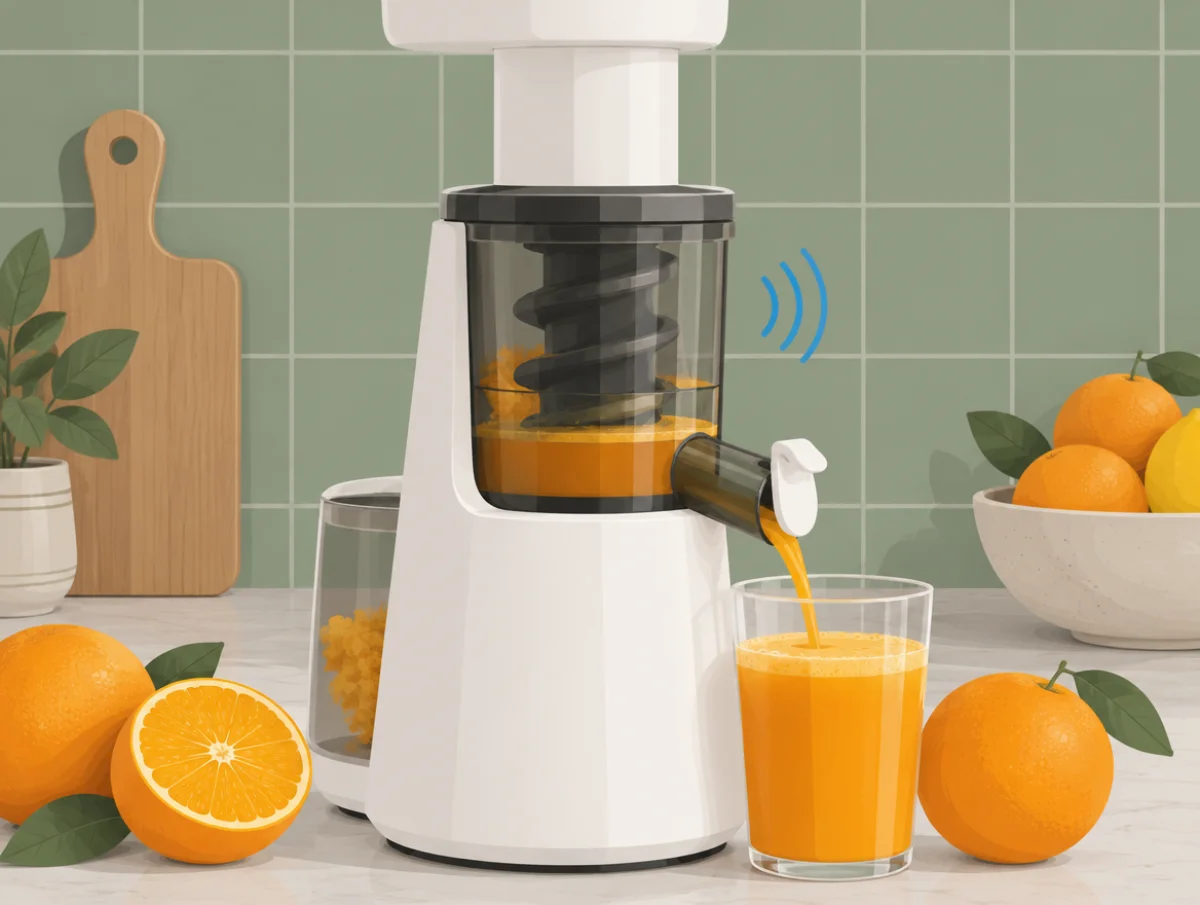
Juicers make two families of noise because they work in two different ways. A slow juicer, also sold as a masticating or cold press juicer, turns an auger slowly and squeezes produce against a screen; its sounds are squeaks, clicks, thumps and the crunch of hard vegetables. A centrifugal juicer spins a mesh basket at high speed, so its trouble shows up as shaking and roaring.
These answers come from manuals and help pages by Hurom, Omega, Breville, Kuvings, Nama, Hamilton Beach, Tribest, Ninja and Philips, all opened on November 19, 2026. Ninja's support site refused our requests, so its FAQ is quoted from an Internet Archive copy of September 5, 2025. Cuisinart's US site returned errors on every juicer page we tried, so it is not quoted. The Philips answers come from its Australian and Irish help sites, as the US one returned an error.
| Sound | What makers say causes it | First step |
|---|---|---|
| Squeak or chirp while juicing | Auger friction, fibrous produce (Hurom, Ninja, Tribest) | Keep juicing; normal |
| Click at start-up | Drive shaft locking onto the auger (Nama, Ninja, Hurom, Omega) | None; normal |
| Grinding with the chute empty | Auger running with no food (Tribest, Breville) | Add produce or switch off |
| Thumping from twin gears | Small variations between gears (Tribest Greenstar) | Normal when even; check alignment if loud |
| Louder crunch with carrots or beets | Hard or tough produce (Hurom, Omega) | Cut pieces smaller |
| Centrifugal shakes or roars | Pulp in the basket, basket seated wrong, damaged basket (Breville, Hamilton Beach, Philips, Omega) | Unplug, clean and reseat the basket |
| Stops, beeps or runs backward | Overload, jam, safety timer, auto reverse (Ninja, Hurom, Omega) | Reverse, then cut produce smaller |
Squeaking and chirping from a slow juicer
A squeak from a slow juicer during juicing is friction, and four makers here file it under normal. The auger rubs against its seal, the strainer or the chamber as it crushes produce, and fibrous ingredients make it louder.
Hurom's H101 manual gives the plainest version in its repair checklist, against a "squeak-squeak" sound: "This is produced by the friction between screw packing and chamber. This is normal."
Ninja ties the sound to what goes in the chute. Its FAQ for the JC100 and JC151 cold press juicers answers the squeaky noise question this way: "When the auger is breaking down fibrous ingredients like apples, celery, herbs and leafy greens, the unit will sometimes make this noise. This is normal and not a cause for concern."
Tribest covers two designs. The Slowstar manual has "There may be some squeaky friction noise while in use," adding that the user "should not worry about it." For the twin gear Greenstar 5, the GS5-2 manual counts "a squeaking or chirping sound" during juicing as normal as well.
When the squeak happens with nothing in the chute
That one is different. Breville's Big Squeeze instruction book, in the Australian and New Zealand edition we found on Breville's server, explains that "The friction noise from the juicing screw and the strainer will disappear when ingredients are inserted into the juicer." The same table warns that running empty raises the noise "and also can lead to damage."
Tribest's older Greenstar Elite manual has a test. Assemble the machine without the twin gears and screen and switch it on. "If you hear squeaking, your drive shaft may need more lubrication." Use can continue meanwhile, and lubrication instructions come from a service center.
Why does my juicer click when it starts?
A click as a slow juicer starts is the motor's drive shaft locking onto the auger. Nama, Hurom and Omega explain it that way, and Ninja also calls a click before juicing normal.
Nama's help article, filed under the J2, is cheerful about it: "Not to worry, that clicking sound is completely normal! It happens as the metal drive shaft on the motor base clicks into place to connect with the auger." Ninja's FAQ reads a click before juicing as a sign the unit is "working properly and ready to begin juicing."
Hurom's H70 manual and Omega's Effortless Batch Juicer manual put it almost word for word. On the Omega, "It is the sound of the motor being assembled with the auger. This is not a malfunction."
A click that repeats mid juice, with the auger stopped, belongs to the jam section further down.
Grinding, thumping and gear noise
A grinding sound from a slow juicer most often means it is running with nothing to crush. On a twin gear juicer, an even thump is normal and a loud or rough one points to misaligned gears or something hard caught between them.
The Slowstar troubleshooting table answers "Seems like the Duoblade Auger is grinding" with "Operating the Slowstar without feeding any food may cause the Duoblade™ Auger to grind." Breville's Big Squeeze tips open the same way: "Operating the juicer without ingredients can cause damage to the screw."
Twin gear machines such as the Greenstar keep a rhythm of their own. Switched on with no produce, "You may hear a repetitive thumping sound, which is normal," because the two gears are not perfectly identical. When the gears sound noisy rather than rhythmic, Tribest's checks are short:
- Gears lined up using the alignment dots.
- No hard material lodged in the gears.
- No visible damage; if there is, stop and contact a service center.
Hard seeds raise the stakes. Hurom's H70 manual warns that with "foreign substances or solid matters" inside, such as persimmon seeds, "parts may be damaged more seriously when attempting a reverse rotation so contact the Customer Service Center and request for after-sales service." Breville's Big Squeeze table says the same of hard seeds in general, and Tribest asks for seeds out before juicing.
Why is my juicer so loud with carrots and apples?
Hard and tough produce is louder to crush. Hurom and Omega both say so in their troubleshooting tables, naming apples, carrots, cabbage, celery and beets, and both call the extra noise natural rather than a defect.
"It is natural for certain extent of sound to occur when ingredients are being crushed," reads Hurom's H70 table. With hard or tough produce, "the extraction noise may be louder compared to Juicing sounds of softer ingredients." Omega's batch juicer manual has the same entry.
Size matters as much as hardness. The Big Squeeze book wants nothing "over 3cm in thickness" in the chute when noise starts as food goes in, and adds that "The noise can occur if the juicer is operated on an uneven or slanted surface." Nama's help center says fiber wrapping the processing blade is normal with fibrous produce, and its fix for next time is chopping greens smaller before juicing.
Breville's centrifugal books add a habit for mixed batches: "Alternating soft and hard ingredients may help avoid this," meaning pulp building up in the basket.
A centrifugal juicer that shakes, roars or walks
Shaking and loud running on a centrifugal juicer usually trace to the spinning basket. Pulp clogging its mesh, a basket not seated on the drive, a damaged basket and too much food at once are the causes Breville, Hamilton Beach, Philips and Omega name.
Breville puts the rule near the front of its Juice Fountain Cold XL book. "If the juicer stops due to improper operation or if there is excessive noise, shaking, or vibration, turn the unit OFF and allow the filter to stop spinning completely." Then unplug it, take it apart, clean every component and reassemble it properly.
Hamilton Beach starts with the mesh. Its Big Mouth Pro guide lists one cause for a machine that vibrates excessively, "Buildup of pulp in mesh of strainer basket," cleared by switching off, unplugging and brushing the basket. "If machine vibration continues after cleaning, this could be a sign of a damaged strainer basket."
Philips adds the seating. On its vibration page, "The ribs in the bottom of the filter have to fit properly onto the driving shaft of your juicer." A filter that is damaged shakes too, and Philips lists what to look for: "Cracks, crazes, a loose grating disc or any other irregularity may cause it to malfunction." Any crack means no more use and a call to its consumer care team.
Omega's high-speed juicer manual is the one that mentions feet. Its row for "ABNORMAL VIBRATION OR LOUD NOISE" names an extraction screen installed wrong, too much food, and "UNSTABLE PLACEMENT OF PRODUCT OR CAME OFF OF FOOT PAD."
A cracked basket is not a noise problem any more
Breville and Hamilton Beach both forbid using a damaged basket. Breville's line is "Do not use if there is any damage or deformation to the filter mesh." Hamilton Beach explains why: a bent or damaged basket "could break into small pieces and cause personal injury and/or damage the appliance."
Slow juicers shake a little too
Not every wobble on a slow juicer is a fault. Hurom's H70 table says "The product may wobble slightly due to the motions of its motor," more with carrots, potatoes, radishes and beets than with watery fruit. Tribest calls a little juice container shake "completely normal" on the Slowstar, and designs the Greenstar to "wiggle and flex while juicing to prevent damage to other parts of the machine."
Kuvings draws the line at excess. Its FAQ page answers a juicer that vibrates excessively with "Stop the juicer and reassemble the juicer properly. In particular, make sure the juicing screen is properly seated and no parts are broken." Breville's Big Squeeze book also warns that "Vibration during operation may cause the appliance to move," so keep it back from the counter edge.
Why did my juicer stop, beep or start reversing?
A slow juicer that stops mid batch has usually jammed on too much food or tripped its motor protection. Some stop on a timer, and Omega's batch juicer reverses itself before carrying on.
Reverse is the standard cure for a jam, and every slow juicer maker here builds it in. The details differ:
- Ninja: hold REVERSE; after a beep and a pause of 3 to 5 seconds, the auger turns backward.
- Kuvings: hold reverse for 3 to 5 seconds, then switch back to forward, a few times.
- Nama J2: turn and hold the knob to REV.
- Hurom H101: reverse for 3 to 5 seconds, then back to on.
- Breville Big Squeeze: REVERSE, OFF, FORWARD, two or three times over.
- Tribest Slowstar: off first, then reverse, then on, up to three times.
Let the auger stop before you reverse it. Breville and Tribest both warn that switching direction while it still turns can cause a malfunction.
Some stops are deliberate. The Hurom H70 and the Omega batch juicer both carry a timer that ends operation about 5 minutes after the start; "Press the switch again to restart operation," the Hurom table says. If the Omega's auger stalls, "the product automatically rotates in reverse and then starts normal operation again." If that happens too often while straining, the Omega shuts itself down early to protect the motor.
A beep and a stop on a Ninja means overload. "The unit was overloaded with ingredients. Wait 2 minutes, then press START/STOP to resume juicing."
Centrifugal machines stall rather than jam. Breville's books blame wet pulp under the cover, pushing too hard, loading food before the motor is up to speed, and a speed too low for hard produce. An overload light that flashes during use "indicates the motor speed is slowed down to an inefficient level." Breville's limit for a straining motor is short: "do not operate continuously for more than 10 seconds at a time."
How long can a juicer run before it overheats?
A slow juicer typically runs about 30 minutes before it needs a rest, or 20 on Nama's J2. Centrifugal juicers rely on overload cutouts needing 10 to 30 minutes of cooling, and Omega allows 5 minutes of continuous running on its high-speed model.
| Juicer | Run limit the maker prints | Rest or reset |
|---|---|---|
| Nama J2 (slow) | Up to 20 minutes | 1 to 2 minutes |
| Hurom H101 (slow) | 30 minutes | About 5 minutes |
| Tribest Slowstar (slow) | 30 minutes | 5 minutes; an hour if the motor stopped |
| Tribest Greenstar 5 (twin gear) | Up to 40 minutes | 10 minutes; 30 if the cutout tripped |
| Breville Big Squeeze (slow) | 30 minutes | 30 minutes; 30 to 60 after an overload stop |
| Omega high-speed (centrifugal) | 5 minutes per cycle | 20 to 30 minutes after a stop |
| Breville Juice Fountain Cold XL (centrifugal) | Overload cutout | At least 30 minutes, dial OFF |
| Breville Juice Fountain Cold (centrifugal) | Overload cutout | 10 to 15 minutes unplugged |
| Hamilton Beach Big Mouth Pro (centrifugal) | Overload cutout | 15 minutes unplugged |
| Philips centrifugal juicers | Overload cutout | About 15 minutes, then the reset button underneath |
Philips is the only maker here with a button to press afterwards.
Its stop during use page says to unplug, wait about 15 minutes, "Then press the overload protection button on the bottom of the motor unit."
Burning smell and noise together
A smell on the first few runs is expected by Hurom, Omega and Philips. A smell that arrives later with smoke, heat or unusual sound is the point where Hurom and Tribest say to stop at once and contact service.
Hurom's H330 manual covers both halves in two sentences: "If the device produces any unusual sounds, excessive heat or smoke, stop using it immediately and contact the Customer Service Center. The smell experienced when using a new product will naturally go away over time." Tribest's Slowstar manual matches it: "Stop operating the Slowstar if strange noises, excessive heat, or smoke is noticed."
Philips offers a cause. Its smell and smoke page explains that a juicer may smell or smoke "if it has been used too long or with very hard ingredients, e.g. leek." The fix is switching off and waiting 60 minutes, then calling Philips if it continues.
When to stop juicing and call the maker
Stop when a part is cracked or broken, when hard seeds or a foreign object may be inside, when noise comes with smoke or heat, and when a cleaned, reassembled juicer still shakes or roars. Each maker draws that line in a slightly different place.
- Breville: any problem its troubleshooting table does not fix.
- Hamilton Beach: vibration that survives a cleaning, which may mean a new strainer basket.
- Philips: any crack or damage to the filter, or a juicer that keeps stopping after cooling.
- Hurom: a hard seed or foreign object in the chamber, and any smell with smoke.
- Tribest: damaged twin gears, or strange noise with heat or smoke.
- Kuvings: a clog that reverse does not clear.
- Omega: hard seeds or other solid matter in the batch juicer's chamber.
Omega's high-speed manual sums up the repair side: "This appliance has no user serviceable parts."
Even Tribest's lubrication advice for the Greenstar Elite drive shaft comes through its service centers.
Can a juicer be made quieter?
Only a little, by the makers' accounts. Their advice is about technique, a level surface and clean parts, and Breville is the one maker here with a speed setting built to cut the noise.
Breville's Juice Fountain Cold XL has a Quiet speed that, in the book's words, "allows you to extract juice at a significantly lower noise," recommended for softer produce before switching to Boost for harder pieces. Kuvings USA puts its slow juicers at about conversation level, and Hurom's support page promises "You will only hear a quiet hum" from augers turning at 43 or 80 rpm.
Real decibel figures are scarce. Our quietest juicers guide found one tied to a standard, Santos's 64 dB for a commercial cold press juicer measured 1 m away under load, and Hurom's blog estimate of roughly 53 dB for its H310. Breville, Kuvings, Nama, Omega, Tribest and Cuisinart publish none for their home machines.
More kitchen noise reading
Most juicers live next to a blender. If yours is the louder of the two, start with how to make a blender quieter, and see the quietest blenders when it is time to replace it. Squeals and jams in a burr grinder are sorted out in coffee grinder noises explained, with figures in the quietest coffee grinders guide. A stand mixer that knocks or grinds is covered in stand mixer noises explained.
Wear can make any motor and auger noisier over the years, a slow change explored in why your appliance got louder. The decibel chart runs from a 30 dB whisper upward, which helps place a juicer's hum against ordinary conversation.