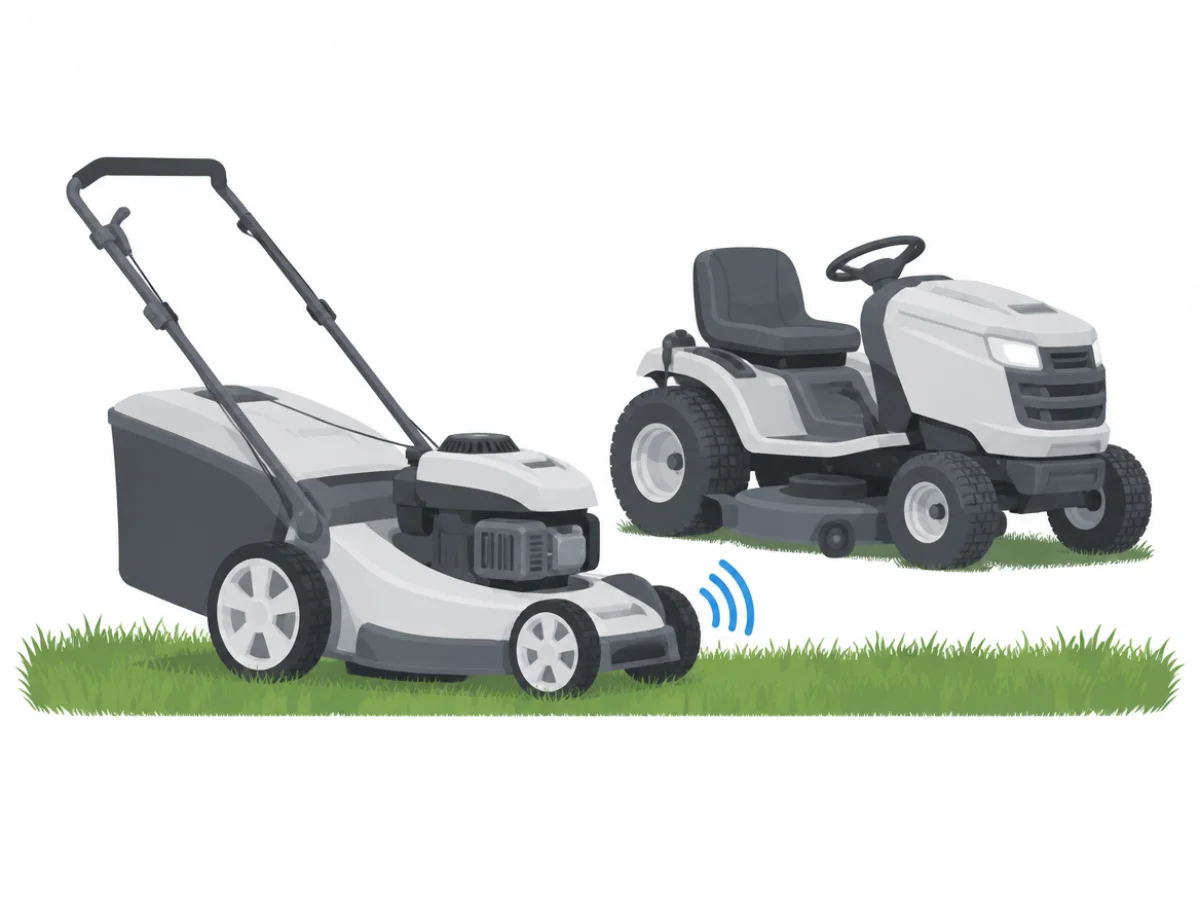
Of all the sounds a lawn mower makes, one gets the same answer from every maker: a rattle or a new vibration, above all just after the blade hits something, means stop the engine or motor and look. Honda's manual treats vibration as a sign of serious trouble, and the other seven makers here agree.
Everything else is less urgent and easier to place. A gas engine roars through its muffler, a battery mower changes its note with each blade speed, and a riding mower adds belts, pulleys and a starter, each with its own sound when it goes wrong. Squeals usually lead to a belt. Clicks lead to the battery. Pops lead to fuel and to how the engine was shut off.
The causes and fixes here are quoted from owner's manuals and support pages by Honda, Toro, Briggs & Stratton, Cub Cadet, Husqvarna, John Deere, EGO and Ryobi, with the models each document covers. Where they are silent, as on the whine of a battery motor, that is noted too.
Exhaust is most of a gas mower's noise
Small engine noise "is caused by hot gases being forced out of the cylinder during each exhaust stroke," in the words of Briggs & Stratton. Its muffler page describes the muffler's job as "to reduce that exhaust noise", and then admits it wears: "After a season or two, soot build-up and cracks or holes can cause the muffler to stop working properly." A gas mower that has grown louder over a few seasons fits that description well.
Cub Cadet separates ordinary from not. A loud mower "can indicate underlying issues that need attention," and the five causes it names are engine mounting, the exhaust, loose or worn belts, dull blades, and a lack of regular maintenance.
Battery mowers are different. Blade speed sets much of the sound, and EGO's LM2200SP manual offers three of them, TURBO, 2 and 1: "Mode 1 provides the lowest noise level and longest runtime from your battery pack." Mode 2 is the default.
Stop for a rattle or new vibration
Honda, Toro, EGO, Ryobi and Husqvarna all give the same order. Shut the mower off, disconnect the spark plug or the battery, and inspect it for damage before mowing again.
The HRN216 owner's manual puts it most directly: "If the blade hits something, or if the mower starts to vibrate, stop the engine immediately, disconnect the spark plug cap, and check for damage." The explanation follows: "Striking objects may damage the blades, bend the crankshaft, and/or break the mower deck or other components. Vibration usually indicates serious trouble."
Toro's wording in its 22in Recycler manual, for models 20332 and 20334, is close to Honda's: "If the mower strikes an object or starts to vibrate, immediately stop the engine, disconnect the wire from the spark plug, and examine the mower for damage." Its safety section adds "Vibration is generally a warning of trouble."
On a battery mower the battery takes the place of the plug wire. EGO's instruction is to "immediately stop the motor, remove the battery and check for the cause". Ryobi's RY401018 manual has you stop the motor, remove the start key, and "check immediately for the cause."
Riders are no exception. "Stop and inspect the equipment if you strike an object," reads Husqvarna's YTH1542XP manual, and John Deere's LT150 and LT160 manual files its checks under "Too Much Vibration" in the mower part of the troubleshooting chart.
Why is my lawn mower making a loud rattling noise?
Usually the blade: loose, bent or out of balance. Grass and debris packed under the deck come next, then loose engine mounting bolts and a worn or cracked muffler.
Honda's vibration table starts with "Grass and debris lodged under the mower deck", fixed by cleaning out the deck, and "Blades loose", fixed by tightening the blade bolts. Blades that are bent or "unbalanced by improper sharpening", and "Mechanical damage, such as a bent crankshaft", are not owner jobs: "Take the mower to an authorized Honda servicing dealer for repair."
The other tables read much the same, with a few additions:
| Manual | Causes it lists for vibration |
|---|---|
| EGO LM2200SP, "There is excessive vibration." | Loose blade set, unbalanced blade set, bent blades, bent motor shaft, "The mower is set to cut too much grass at once." |
| Husqvarna YTH1542XP | "Worn, bent or loose blade", "Bent blade mandrel", "Loose/damaged part(s)" |
| John Deere LT150 and LT160 | "Debris on mower deck or in sheaves", "Damaged drive belt", "Damaged sheaves or sheaves out of alignment", "Blades out of balance." |
For EGO's last cause, raising the deck to a higher cutting height setting is the fix. Husqvarna's zero turn support page sums up the whole table in a sentence: "Excessive sound or vibration is usually due to a faulty installed or damaged blade assembly."
Balance protects the engine as well as the cut. "An unbalanced blade causes vibration that could damage the motor drive unit," Ryobi warns, and to Husqvarna one "will cause excessive vibration and eventual damage to mower and engine." Husqvarna goes further than the others on sharpening: "We do not recommend sharpening blade." If you do it anyway, keep the blade balanced.
The blade bolt and the muffler
The bolt has to be tight, tighter than most people guess. Toro's figure for the 22in Recycler is 60 ft-lb (82 N-m), and the manual warns "A bolt torqued to 60 ft-lb (82 N-m) is very tight." Torque differs by model, and several of these manuals cover older machines, so take the number from the manual for your mower.
Two rattles live away from the blade, by Cub Cadet's account. An engine "not properly seated or secured within the mower" can lead to "excessive vibrations and noise", which means checking the engine mounting bolts. At the back: "Check the exhaust pipe and muffler for any cracks, holes, or signs of damage."
The muffler has a simple test. Take it off while it is cold and shake it, and "there should be little or no noise heard". A lot of noise or loose debris means it "has probably deteriorated inside & is in need of replacement." Briggs & Stratton also traces the cracking back to the blade, since it "is usually from an outside source of vibration such as an unbalanced blade".
Why is my riding lawn mower screeching or squealing?
Usually a slipping belt. John Deere draws the distinction that matters here: a squeal "definitely means the belt is slipping", while a chirp at idle is harmless.
Deere's belt wear and maintenance guide describes squeal as "a high-pitched howl or rasping sound that occurs during acceleration or when the belt is near or at overload." Then the cause: "The cause is usually a lack of belt tension." A squeal that carries on after the belts have been checked and tensioned points to an overloaded drive.
The squeak is a separate sound, "very much like the chirping of a bird or a dry bearing", most likely "on cold, damp mornings or under dusty conditions." Here the guide's warning is about the owner rather than the mower: "Squeak itself is harmless, but is frequently mistaken for belt slippage", and belts then get tightened until they or the bearings are damaged. For either noise, one shortcut is out: "Never apply belt dressing or oil as a means of eliminating this noise."
That guide covers belt drives across Deere machines, not a single mower. Tension settings come from your own manual.
Belts that are "loose, worn, or damaged" can "create noise as they move or slip during operation," Cub Cadet adds, and should be inspected and replaced if needed. On the YTH1542XP, V-belts get checked "after 100 hours of operation", and there is nothing to adjust: "The belts are not adjustable. Replace belts if they begin to slip from wear."
Deck belts that come off or break on Husqvarna's zero turns get a support page of their own. Its checks are done "with mower off and spark plug wire removed to prevent starting": debris on the deck and drive, worn belts, loose fasteners, and "Inspect all pulleys for wear or damage."
A screech from a deck spindle or bearing has no entry anywhere in these pages. John Deere's chart covers it only in general terms: "If you are experiencing a problem that is not listed in this chart, see your John Deere dealer for service."
Why does my lawn mower click but not start?
On a riding mower, check the battery first. Husqvarna's YTH1542XP table for "Engine clicks but will not start" runs from a weak or dead battery to corroded terminals, loose or damaged wiring, and finally a faulty solenoid or starter. Its help page on the symptom wants a battery voltage that "should be no less than 12 volts DC", and a recharge "at 6-10 amperes for 1 hour."
For 12 volt starting systems, the Briggs & Stratton starter page looks first at a "Discharged / defective battery or faulty electrical connections", then at "the safety interlocks, starter motor switch (open circuit), or solenoid." Its rule for any electric start is short: "use short starting cycles (five seconds maximum). Wait one minute between starting cycles." And before the starter takes the blame, "the engine itself should be thoroughly checked first", meaning a fouled spark plug or fuel trouble.
Interlocks come before parts. On the LT150, the list for "Starter Does Not Work Or Will Not Turn Engine" begins with "Brake pedal is not depressed." and "Mower Engagement Lever is in ENGAGED position." Corroded terminals, an uncharged battery and a blown fusible link follow, and the fusible link goes to the dealer.
A pop at shutdown is afterfire
The two words mean different moments. To Briggs & Stratton, backfire is "a loud bang, poof, explosion, etc., while the engine is running or while shutting down", and afterfire "occurs after the engine has been shut off."
Backfire through the carburetor "will not harm the engine at all!" Most of it comes from slowing the engine down too fast. The other causes on the list are fuel with "higher blends of alcohol", a carburetor "set too lean", the muffler's construction, and "Higher than normal engine temperatures". Some cannot be cured: certain carburetors backfire "due to the sensitivity of internal transitional passages", a condition Briggs says cannot be corrected. For the rest, lower the engine speed slowly, follow the fuel advice or switch to fuel with low or no alcohol, and adjust the carburetor.
Afterfire is a habit. "Shutting off the engine at high RPM" is the cause, and the cure is to let the engine cool "by idling the engine down with proper speed (15-30 seconds)". There is one exception: "If equipped with an anti-afterfire solenoid, shut engine off at full throttle".
Husqvarna asks the same of its tractor. Throttle to slow, then "allow to idle for 30 seconds before stopping engine", or the engine may "backfire".
John Deere's LT150 chart has two checks for "Engine Backfires": "Faulty spark plug." and "Operator raising off of the seat." A knocking engine gets a separate entry, with "Stale or low octane fuel", an overloaded engine and low engine speed.
Battery mowers rattle for the same reasons
When a battery mower suddenly sounds rough or shakes, EGO and Ryobi find the same faults a gas mower has: a loose, bent or unbalanced blade, or too much grass at once.
A whine or hum from the motor is not listed by any of them, as normal or as a fault. The manuals deal with vibration, overload and blade speed.
Ryobi's RY401018 table has a single noise entry, "Mower vibrating at higher speed." One cause is a blade that is "unbalanced, excessively or unevenly worn", and the fix is a new blade. The other is a "Bent motor shaft", which has to be "repaired by an authorized service center before restarting."
EGO lists the bent shaft under excessive vibration too, with "Contact EGO Customer Service." as the fix. Heavy grass changes the sound in another way. Overload the LM2200SP and "the motor will stop and the mower status indicator on the dashboard will flash orange", so slow your stride or raise the cut height. If the overload protection keeps tripping, the safety section says to "contact EGO Customer Service or your closest EGO service center."
Mode 1 stays the quiet setting, at a price: "Higher blade speed will significantly affect runtime."
When the dealer has to look
Bent metal is the usual line. Honda sends bent or damaged blades, blades unbalanced by poor sharpening, and "Mechanical damage, such as a bent crankshaft" to an authorized Honda servicing dealer. A bent motor shaft goes to EGO's customer service or, on a Ryobi, to "an authorized service center". Husqvarna's fix for a "Bent blade mandrel" is a new one.
Toro and EGO both want damage repaired before the next start. Toro: "If you strike a foreign object, stop and inspect the machine. Repair, if necessary, before starting." EGO: "Thoroughly inspect the mower for any damage, and repair the damage before restarting and operating the mower."
A noise that survives every check goes to the dealer too. "When you have checked all the possible causes listed and you are still experiencing the problem, see your John Deere dealer." For exhaust damage, Cub Cadet points owners to its dealer locator to "schedule a service appointment", and Briggs & Stratton says to "consult your local Briggs & Stratton service dealer".
Whatever the check, shut down first the way your manual says. "Never make any adjustments or repairs with the engine running," Toro insists.
How loud is a normal lawn mower?
Roughly 79 to 84 dB(A) at the operator's ear for a battery walk-behind, going by the European declarations collected in our mower guides. US makers rarely print a mower noise figure at all.
In the quietest lawn mowers guide, seven of eight battery walk-behinds fall between 79 and 84 dB(A) for the operator. STIHL's gas RM 655 V declares 84, level with some of its battery models. The battery lawn mower guide also ranks that class on guaranteed sound power.
Riders sit a little higher. EGO's four battery riders in the riding mower guide give 82.5 dB(A) up to 84.3 at the seat, and no gas rider we checked prints a figure. The robot mowers we checked print 55 to 65 dB.
All of these rate a whole machine, not a rattle or a squeal, and none of the eight makers sets a decibel threshold for a fault. The sound power explainer separates a figure at the ear from a guaranteed rating, and the decibel chart puts both beside everyday sounds.
Brand figures and related pages
The EGO, Husqvarna, Ryobi and Greenworks outdoor tool pages list each maker's noise figures by model. Keeping a quiet yard sets mowers beside the blowers and trimmers the neighbors also hear. Small engine exhaust on a different machine is the subject of how to make a generator quieter, and why appliances get louder covers machines that grow noisier with age.