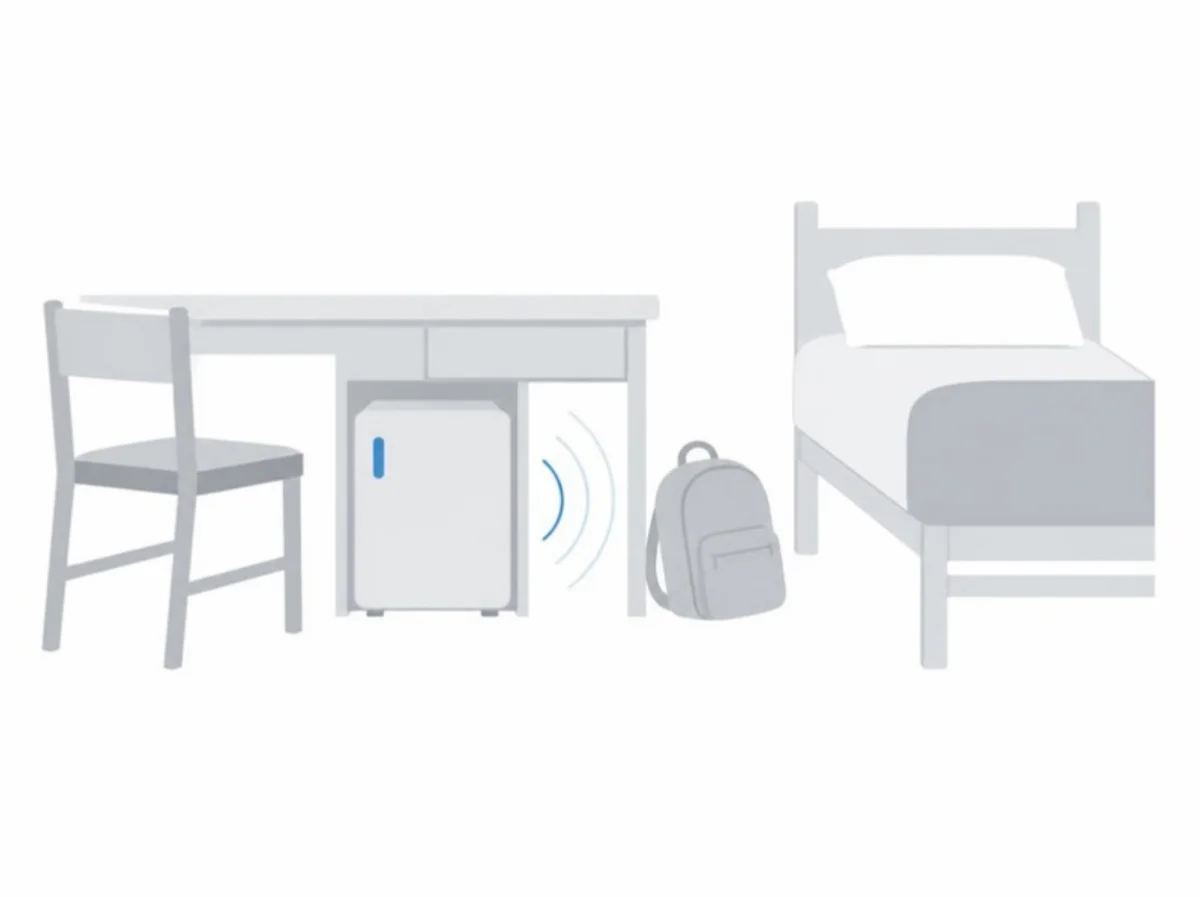
"Danby mini fridges operate at a sound level between 35 and 46 decibels." That is about as specific as any compact fridge maker gets, and Danby does not say how far from the fridge it measured. It compares the range to "a soft whisper", which it puts at 30 decibels, and to rainfall at 50. Everything else on this page is about the character of the noise, which tells you more than a decibel figure would.
Most of it has one of three sources. The compressor runs, refrigerant moves, or the cabinet shakes against whatever it stands on or leans toward. Thermoelectric cubes add a fourth, the fan that pushes heat out of the back.
The causes and fixes come from Danby's FAQ and DAG033A5BDH manual, Galanz's GLR33M**R10 manual, BLACK+DECKER's BCRK43 manual, Midea's refrigerator FAQ and a Frigidaire use and care guide for compressor models, and from Cooluli's FAQ and product page and AstroAI's 4 L and 6 L manuals for thermoelectric coolers. The Midea and Frigidaire lines are written for refrigerators in general, not compacts alone. Insignia, Igloo, Magic Chef and hOmeLabs had no maker-hosted manual or support page on noise that we could reach, so they are absent. Pages were read on November 11, 2026.
Ice makers, defrost heaters and dispenser buzz belong to the refrigerator noises guide, and most of that does not apply to a dorm cube or a 3 cubic foot two-door.
Compressor or thermoelectric decides what is normal
A compact refrigerator has a compressor, refrigerant and a sealed cooling system like a kitchen fridge. In Danby's words, "A mini fridge is a simply a compact version of a regular refrigerator designed for smaller spaces."
A thermoelectric cooler, often called a Peltier cooler, has none of that. Cooluli describes how its units work: "Thermo-electric units have two sides, so when a DC electric current flows through the device, it moves heat from one side to the other to cool that side." A fan then clears the heat.
Your manual or product page will name the type. Cooluli and AstroAI sell thermoelectric coolers; the Danby, Galanz and BLACK+DECKER manuals quoted here are for compressor fridges.
A hum means the compressor is running
On a compressor model, humming is expected. Midea's FAQ, written for all its refrigerators, gives the longest list of normal sounds anywhere in these sources: "gurgling of refrigerant, humming of the compressor, bang of the ice breaking off the evaporator, clicking of the ice maker, buzzing of the fan motors and slushing of the defrost water." A basic compact fridge with no ice maker or fan will make only some of those.
A hum that keeps coming back is fine too. Danby's FAQ takes the question "My compressor comes on often. Is this normal?" and answers that it is. "If your mini fridge is too cold, you can adjust your temperature to increase the warmth, and your compressor will not turn on as frequently."
Why does a mini fridge click, pop or crack?
Pops and cracks are refrigerant at the moment the compressor starts. BLACK+DECKER's BCRK43 manual, a copy hosted by the retailer Zoro, lists "Popping or cracking sounds" with the cause "When compressor comes on" and the answer "This is a normal sound of coolant flowing through condenser coils." It offers no fix because none is needed.
The single click is harder. No compact maker explains it.
Full-size makers do: GE ties a click to the temperature control turning the fridge on and off, covered in the refrigerator noises guide. Whether the same part clicks in your compact is something only its manual can confirm.
Gurgling is refrigerant changing state
Every compressor maker here calls the gurgle normal. Refrigerant makes it "as it changes from a liquid to a gas and back again," Danby explains.
The Danby DAG033A5BDH manual files it in the troubleshooting table under "Refrigerator makes a gurgling noise when operating", with a short answer: "This noise is completely normal." Galanz's GLR33M**R10 manual lists it among "normal conditions": "The flow of refrigerant through the coils can cause a noise."
A thermoelectric cooler should not gurgle at all. It cools with a DC current across two sides, and neither Cooluli nor AstroAI lists a fluid sound among its normal noises.
Why is my mini fridge rattling or vibrating?
Usually it is not level, or it is touching something. Galanz gives exactly those two causes, "Refrigerator is on an uneven surface" and "Refrigerator is touching a wall", and two fixes to match: "Adjust the leveling legs" and "Move the refrigerator away from the wall."
Danby agrees that "It is important that the appliance is level to minimize noise and vibration." Its FAQ adds more for unusual noises: "Check for loose components and tighten any loose parts, clean the fan and compressor area, and ensure the fridge is level." That covers shelves and anything else that can buzz against the cabinet when the compressor kicks in.
Danby's legs are set by feel. Turn a leg counterclockwise "as far as it will go", then "Slowly turn the leveling leg clockwise until the leg sits on the floor", and repeat "until the appliance is level." BLACK+DECKER uses two front legs, turned "counter clockwise to raise or clockwise to lower your refrigerator."
Hard floors, walls and the gap behind the fridge
A hard floor can make the hum easier to hear. "Some surfaces on floors, walls, and kitchen cabinets may make these sounds more noticeable," Frigidaire's refrigerator manual admits, and the cabinet itself does little to stop it: "Energy efficient foam in the refrigerator is not a sound insulator."
Compact makers still want a hard, flat floor. Danby is direct about it: "We do not recommend placing your mini fridge on carpet. It is best to place it on a hard, flat surface to ensure stability and proper ventilation to prevent overheating." BLACK+DECKER asks for a floor that is "flat, hard, solid, and even" and adds that the fridge "should not be placed on any soft material such as foam, plastic, etc."
That leaves the gap as the thing you control. Danby asks for "5 cm (2 inches) of space between the back, sides and top of the appliance and all surrounding structures", and BLACK+DECKER's minimum behind the fridge is "Back: 2” (50mm)". Skipping it in an enclosed spot "WILL VOID YOUR WARRANTY," Danby warns. A cabinet pressed against a wall or desk also hands its hum to that wall.
How long should a mini fridge sit after moving before you plug it in?
About 6 hours upright for Danby, 4 hours for Galanz, and 24 hours for BLACK+DECKER if the fridge spent any time horizontal or tilted.
The reason is the sealed system. Standing upright "will reduce the possibility of a malfunction in the cooling system from handling during transportation," and Danby's FAQ repeats the rule for a fridge "delivered on its side": "allowing your fridge to sit upright for 6 hours before plugging it in." Galanz writes "Allow refrigerator to stand upright for 4 hours before using" and warns that during a move the appliance "can not be tilted over 45 degrees as possible damage to the sealed system could occur." The BCRK43 manual is the most cautious of the three: "If the refrigerator/freezer has been placed in a horizontal or tilted position for any period of time, wait 24 hours before plugging the unit in."
None of them links the wait to noise directly. Use the time in your own manual, and ask the maker if it prints none.
Why is my mini fridge making noise but not cooling?
Check power, the upright wait and the door before anything else. Danby's FAQ runs through it in order: "Check that the fridge is plugged in and turned on. Ensure that you allowed the unit to sit upright for 6 hours before plugging it in. If the problem persists, visit danby.com/support for further assistance."
The manual also lists why a fridge "runs continuously": a setting that is too cold, a door "not shut properly or opened excessively", "a large quantity of warm food", a nearby heat source or sunlight, and very high room temperature or humidity. Be patient with the dial. BLACK+DECKER asks owners to "Allow several hours for temperature to stabilize between adjustments."
Models with a display add two error codes, "E1: Temperature sensor failure" and "E2: Defrosting sensor failure." Unplug for 5 minutes to clear them, and "If the error code persists, contact consumer care for further troubleshooting."
A noisy thermoelectric cooler means the fan
With no compressor, the whir from the back can only be the fan clearing heat. On its Infinity 10L page, Cooluli answers a whirring question head on: "The fan makes a slight whirring sound in the Infinity-10L" and "this sound is normal." Its FAQ adds that it is "normal for Cooluli units to get slightly warm in the back."
AstroAI's 4 L manual has two checks under "Abnormal Noises": "Check for any foreign objects on the fan" and "Look for any parts that have fallen off the fridge." The 6 L manual repeats the fan check.
Give the fan room. AstroAI wants "at least 2 inches of space to allow for proper airflow" at the back and sides, and Cooluli asks for "at least a 2-inch clearance for necessary airflow and circulation."
Are thermoelectric models quieter than compressor fridges? Not reliably, on paper. The wine fridge guide shows NewAir printing 38 dB for the thermoelectric Shadow-T, one decibel under the 39 dB of its compressor built-ins. Cooluli publishes no figure for its coolers at all.
Loud but not cold is often a thermoelectric limit
A thermoelectric cooler can only get so far below room temperature. When the room warms up, so does the inside, and the fan keeps working the whole time.
Cooluli's range is "anywhere from 35° to 40° below ambient temperature", so in a 75°F room the inside sits between 35 and 40°F. The lowest temperature "depends on the ambient environment," AstroAI's manual explains, and "The cooler the ambient temperature is, the cooler the fridge will be."
If it is not cooling at all, check the switch first ("Ensure the switch is on the Cool side") and then the fan: "Check if the fan is functioning properly. Contact AstroAI Customer Support if the fridge is making any loud noises."
Placement in a dorm room or bedroom
Hard, level floor; every gap the maker asks for; no door closing it in. Those rules exist for cooling, and they also keep the fridge off the wall.
Danby adds two more. Its mini fridges "are not designed for outside installation", which it extends to "any location that is not temperature controlled", and "an extension cord may not be used."
For sleep, the type of fridge and its rated figure count for more than where it stands. The quietest mini fridges guide ranks only models with a published figure, from Summit's 32.9 dB MB41B to Midea's 42 dBA two-door, and covers college limits on size and amps. For the rest of the room, see how to plan a quiet bedroom.
When is a mini fridge noise a sign of a fault?
A loud new fridge, one that stays warm after the basic checks, or a very loud thermoelectric fan. All three go to the maker's support line.
Cooluli's instruction is short: "if you hear a very loud sound, turn off the unit, and contact Customer Support." AstroAI wants a call "if the fridge is making any loud noises." A Danby that still is not cooling, or shows an error code that will not clear, goes to danby.com/support or consumer care. Before any call, Midea asks owners to "check that the unit was installed and used correctly, according to the user’s manual before calling for service."
Leveling, moving and cleaning are the only home fixes any compact maker offers for a sound. Tilting past 45 degrees in the process can damage the sealed system, Galanz warns.
A compact fridge that was quiet last term and is loud now may simply be ageing; see why appliances get louder.
More on fridge noise
For a kitchen fridge, start with the refrigerator noises guide and the fixes in how to make a refrigerator quieter. To buy a quieter compact, see the quietest mini fridges, the quietest wine fridges and the quietest beverage refrigerators, and read the dBA explainer before comparing decibel figures.