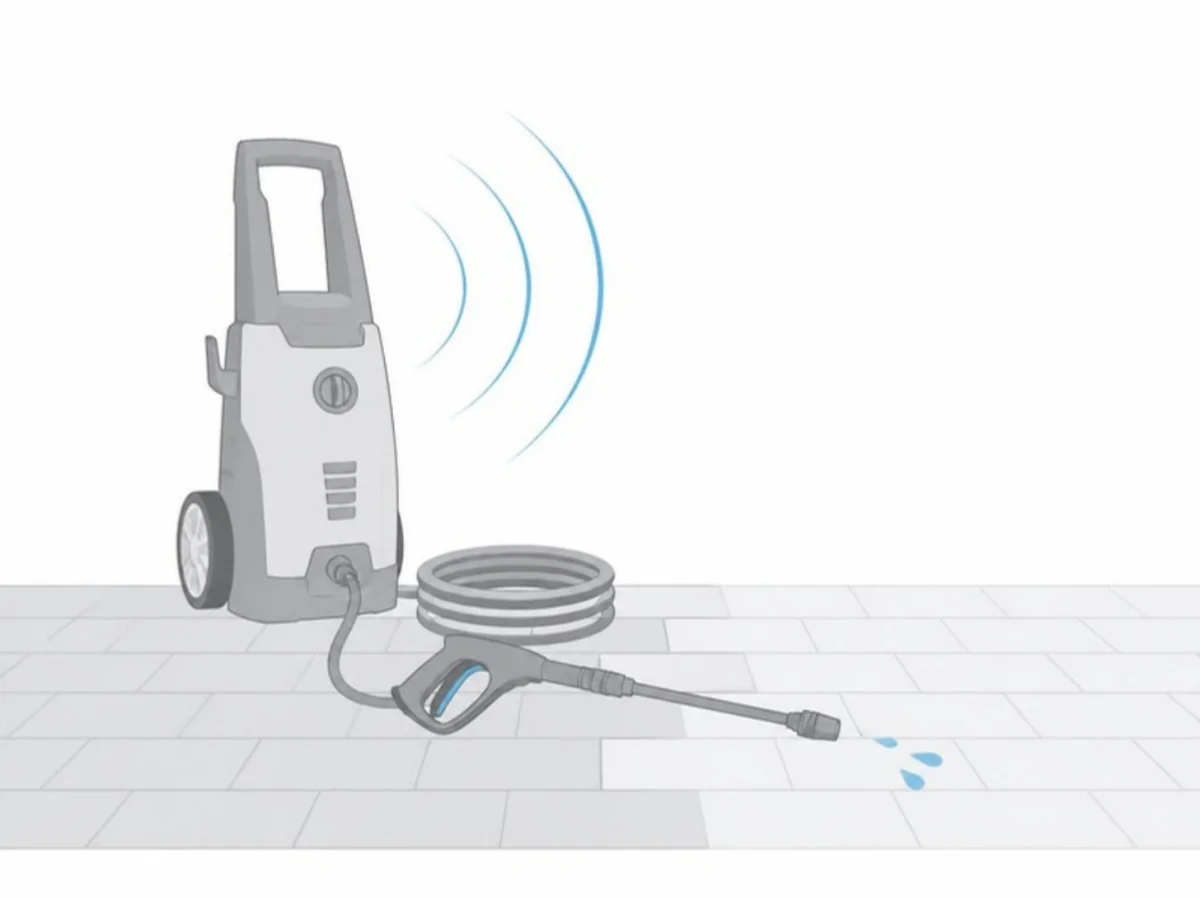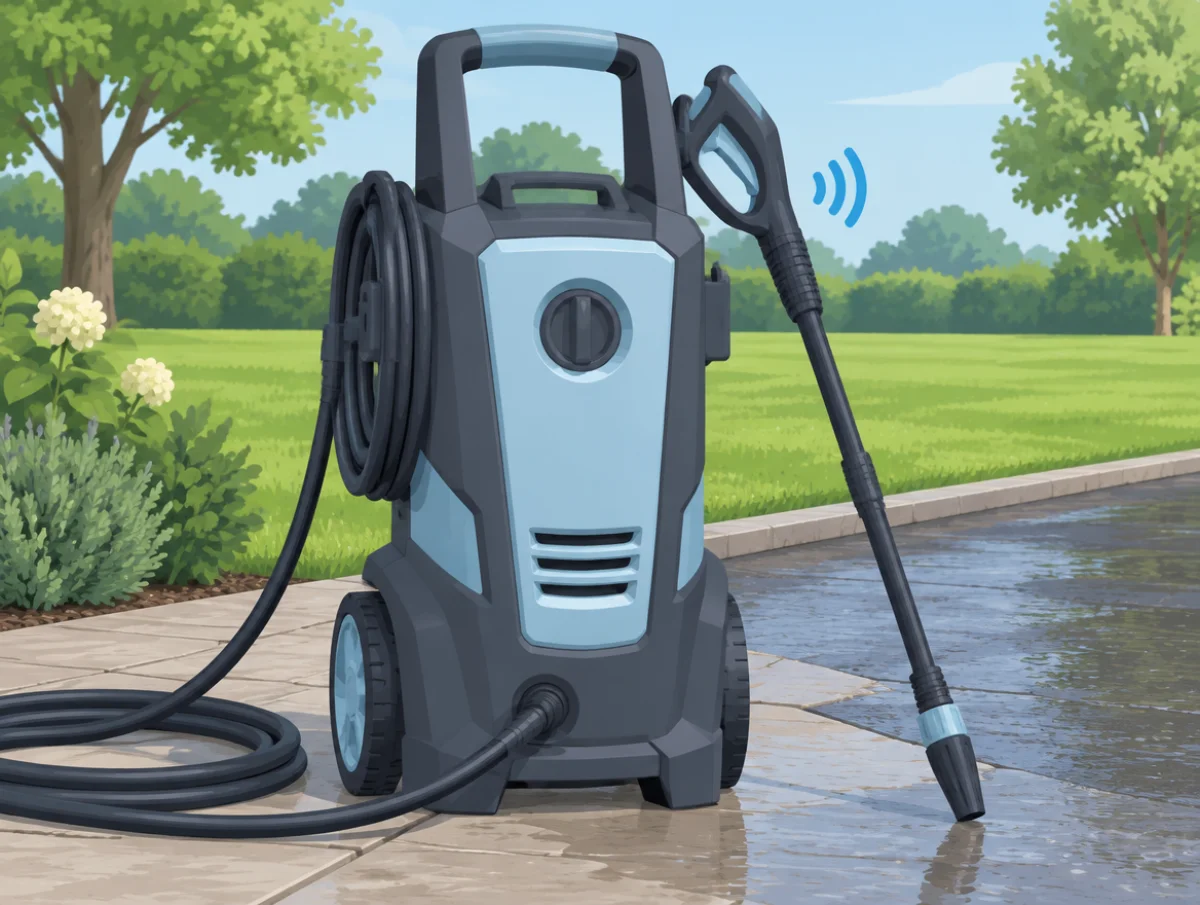
Pressure washer noise has two sources: whatever turns the pump, an electric motor or a small gas engine, and the pump itself, which forces garden hose water up to well over 1,000 psi. Most strange sounds come from the water side. A pump that is short of water, sucking air through a loose fitting, or pushing against a clogged nozzle will hum, pulse and chatter long before anything inside is broken.
The owner's manuals and help pages behind this page come from Karcher, Sun Joe, Greenworks, AR Blue Clean, Generac, Briggs & Stratton and Simpson, all read on November 17, 2026. Greenworks' US site answered with a bot check, so its manual comes from the Greenworks Canada site. Ryobi's support pages did not serve a manual, and Ryobi is not quoted.
Air compressors and household booster pumps share some of these sounds for different reasons, and each has a separate page: air compressor noises and booster pump noises.
| Sound | Cause a maker names | First step |
|---|---|---|
| Motor runs 1 to 2 seconds at switch-on | Auto start/stop self-check (AR Blue Clean) | Nothing, it is normal |
| Motor stops when the trigger is released | Total Stop or auto-stop switch (Sun Joe, Karcher) | Nothing, it is normal |
| Hum or buzz, motor will not turn | Low voltage, extension cord, trapped pressure (Greenworks, AR Blue Clean) | Plug in directly, squeeze the trigger |
| Pulsing while spraying | Clogged nozzle (Generac, Simpson, AR Blue Clean, Karcher) | Clean the tip |
| Pulsing with weak, uneven flow | Air in the inlet hose, too little water (Sun Joe, Greenworks) | Open the tap fully, purge the air |
| Motor cycles with the trigger released | Leaking pump or gun, or priming (Sun Joe, AR Blue Clean) | Look for drips, then call support |
| Chattering | Water supply, inlet screen, hot water, faulty pump (Generac) | Work down the list |
| Excess noise | Air sucked in, water too hot (AR Blue Clean) | Tighten fittings, use cold water |
| Warm water gushing with the gun closed | Thermal relief valve (Generac, Briggs & Stratton, Greenworks, Simpson) | Squeeze the trigger or shut down |
| Recoil kicks back on a gas engine | Water pressure trapped in the pump (Generac, Simpson) | Hold the trigger while pulling |
| Engine bogs when you spray | Low engine speed, dirty fuel filter (Generac) | Throttle to FAST, then a dealer |
Which pressure washer sounds are normal?
A pressure washer that goes silent when you let go of the trigger, runs for a second or two at switch-on, or spits warm water after idling is working as designed. None of those sounds needs a fix.
Electric machines shut the motor off between bursts. The Sun Joe SPX3000 manual describes its Total Stop System as "a micro-switch sensitive to water flow" that turns the motor off once water stops moving, and it puts the standby in capitals: "THIS IS NORMAL." Squeeze the trigger and the motor starts again.
Karcher's K 2 and K 3 Horizontal manual calls the same feature its auto-stop function. With the lever released, "the pressure switch switches the pump off and the high-pressure jet stops." AR Blue Clean adds a start-up quirk in the XM2200 manual: switched on, the unit runs for 1 to 2 seconds and shuts off, which it describes as normal and a sign the auto start/stop system is working.
Gas machines behave differently. The engine keeps running with the gun closed, and Simpson's 7112153 manual explains that the "Pump operates in bypass mode when spray gun trigger is not pressed." A steady engine drone with nothing coming out of the wand is expected, but only for a minute or two, as the section on warm water below explains.
Why does an electric pressure washer hum but not start?
An electric pressure washer that hums without spinning is usually short of voltage or pushing against trapped water pressure. Greenworks and AR Blue Clean both put low voltage and a poor extension cord first.
The Greenworks GPW3002A manual has a row headed "The motor buzzes, but the product does not start." Its fixes run in order: make sure only the pressure washer is on that circuit; switch off, pull the trigger to release pressure, and switch on again; unplug the extension cord and plug straight into the outlet. A machine "not used for long periods" goes to customer service.
One more Greenworks cause matches the "just hums" complaint closely. Under "Residual friction among components," the table adds that the product "might emit a humming noise." The remedy is to disconnect the water supply, power on for 2 to 3 seconds, and repeat a couple of times or until the motor starts.
AR Blue Clean's older AR610 manual prints a grid with the same symptom, "The motor buzzes but fails to start." Low voltage and a cord "of inadequate cross-section or excessive length" are on it. For a machine left unused, the remedy is "Insert the key in the hole at the rear of the electric motor and unlock," and faults in its stop system go to a service center.
Where the makers split on extension cords
Karcher's US manuals for the K 2 Horizontal to K 5 are blunt: "Do not use extension cord with this product." AR Blue Clean's XM2200 manual agrees in capitals, because a cord "defeats the effectiveness of the GFCI." Sun Joe allows one if the plug and socket are watertight, and wants cords on drums "completely unwound to prevent the cord from overheating."
The AR610 manual even prints gauges: 14 AWG up to 50 feet, 12 AWG from 50 to 100. Go by the manual for your model.
A motor that stops and will not restart
Heat is the other reason a motor goes quiet. The SPX3000 has a thermal sensor, and "The machine will restart after a few minutes when the thermal sensor has cooled." AR610 owners are told to wait 2 to 3 minutes, with a note that the thermal cutout has tripped, and to call service if it happens more than once.
Pulsing while you spray
Pulsing with the trigger held usually means a partly blocked nozzle, or a pump that is short of water or full of air. The nozzle is the cause four makers name, so clean it before anything else.
The Generac owner's manual is specific: "A pulsing sensation felt when squeezing spray gun trigger may be caused by excessive pump pressure. Typical causes of excessive pump pressure are nozzle clog or restriction." Simpson's 7123965 manual adds a reason to act quickly: if a clogged nozzle is not cleaned, "excessive pressure may develop possibly damaging the pump, or other accessories."
AR Blue Clean's manuals tie a clogged tip to the unit pulsing while spraying. Karcher files the same problem under "Strong pressure fluctuations" and cleans the nozzle from the front with a needle before flushing it through.
If the tip is clear, look upstream. Sun Joe's "Machine pulsating" row names air in the inlet hose, too little mains water, a partly blocked nozzle, a blocked water filter and a kinked hose, and warns against "long, thin hoses (minimum 1/2 in. diameter)." Greenworks pairs output that "varies high and low" with a pump drawing in air, a clogged intake filter, low voltage, and calcified parts, which it treats by running distilled vinegar through the detergent tank.
How much water is enough? The makers that print a number disagree by a wide margin, mostly because gas machines pump more:
| Maker | Minimum water supply printed |
|---|---|
| Karcher K 2 to K 5 (electric) | 2.1 gpm input |
| Briggs & Stratton (gas) | 20 PSI and 4 GPM; 25 PSI and 7 GPM for POWERflow+ models |
| Simpson (gas) | 5 GPM at 20 PSI |
Why does it turn on and off when the trigger is released?
A pressure washer motor that restarts with the gun closed is usually refilling pressure lost through a leak. Sun Joe blames a leaking pump or gun, or a broken trigger; AR Blue Clean's two manuals disagree.
In the SPX3000 table, "Machine often starts and stops by itself" has two causes, "Pump/spray gun is leaking" and "Trigger mechanism is broken," and one remedy: call the All Season Power service line at 1-866-225-9723.
AR Blue Clean is less consistent. The XM2200 manual reads: "If you hear the motor run intermittently when the trigger is not being squeezed, that is normal. The pump is priming itself so it is ready to operate when the trigger is squeezed." The XP32400 manual describes the same sound and concludes "you likely have a leak that needs to be repaired to prevent excessive wear on the motor." The AR610 grid sides with the leak, listing "Sealing defects in high pressure system or water circuit" for a motor that starts with the trigger released.
What does that mean for an owner? Dry every coupling, run the machine with the gun closed, and look for drips at the hose ends, the gun and the pump. Both AR manuals and Karcher's also say to switch off during breaks longer than five minutes, which stops the cycling whatever its cause.
The stop system is a switch: a flow micro-switch at Sun Joe, a pressure switch at Karcher. Neither maker describes the sound it makes. A single click as the motor restarts fits that design, while clicking over and over with nobody spraying is the cycling described above.
Air in the pump makes it rattle and chatter
Air trapped in the pump or inlet hose makes a washer run rough, rattle and pulse until water pushes it out. The cure at every maker here is the same: water on, trigger squeezed, until the stream runs steady.
Sun Joe has owners "press the trigger for a few seconds until water flow is steady. This will allow air to escape and discharge any residual pressure in the hose." Generac puts the step before the engine starts, telling owners to "squeeze the trigger to purge the pump system of air." Simpson's help article on a washer that makes noise and runs slow at first goes further: let the garden hose run for at least 30 seconds before connecting it, check and clean the pump's inlet screen, replace the screen if it is corroded, then hold the trigger until the remaining air is out. If you are not sure your tap can supply 5 GPM at 20 PSI, Simpson suggests a licensed plumber.
AR Blue Clean's AR610 grid is the one table here with a column for "Excess noise." It ticks three causes: two rows of air being sucked in, and water that is too hot. The fixes are to check that hose fittings are tight, check the water inlet and outlet connections, and lower the water temperature.
Generac's troubleshooting table uses the word "chattering" alongside erratic pressure, lost pressure and low water volume. Its causes run from a low-pressure nozzle and an obstructed water inlet to an inadequate supply, a kinked or leaking inlet hose, a clogged inlet screen, water over 100ºF, a blocked high-pressure hose, a leaking gun, a blocked nozzle, a faulty pump and a dirty fuel filter.
Running dry is what all of this protects against. Karcher says to "Switch off the device if it does not build up pressure within 2 min" and work through its troubleshooting list. AR Blue Clean says never to let the pump run for more than one minute after the water is turned off, and Simpson warns that a pump run without water will "severely damage the pump seals and other internal components."
Why is my pressure washer pump knocking or grinding?
The pressure washer manuals behind this page never name knocking or grinding. Their nearest rows, Generac's chattering and AR Blue Clean's excess noise, point to air, too little water, hot water or a faulty pump.
Start with the water. Generac and Briggs & Stratton both rule out a supply over 100°F, and Karcher's maximum inlet temperature is 104°F. Then purge the air as above and clean the inlet screen.
If the noise survives that, Briggs & Stratton's low pressure FAQ gives a pump test for gas machines. Take the high-pressure hose off the pump, attach the garden hose, turn on the water and start the engine. The stream leaving the pump should grow in pressure and length; "If this does not happen there is an internal pump issue." If it does, the clog is in the hose, gun, wand or nozzle.
Pump oil is where the makers part ways. Briggs & Stratton asks whether the pump oil level is low, and its pump maintenance page covers draining and refilling it, with a warning never to use oil additives or detergents unless the manual specifies them. Generac's 2023 manual says the opposite for its pump: "DO NOT attempt any oil maintenance on pump. Pump is lubricated and sealed at factory." Simpson's 7123965 pump is "a maintenance free design" with no drain or fill plugs. Check which kind you own before reaching for oil.
Frost damage is worth ruling out after a winter outdoors. Simpson's table lists a pump head or tubes "damaged from freezing" behind water leaking at the pump, and AR Blue Clean warns that water left inside can freeze, expand and leave the unit "damaged and become inoperable."
Inside the pump, owners have little to adjust. Generac's help center article on erratic pressure explains that the unloader valve on its residential washers is not field adjustable, and sends pump or unloader problems to an independent authorized dealer.
Warm water spurting when the gun is closed
A gush of warm water from the pump while the gun is closed is the thermal relief valve cooling a pump that has idled too long in bypass. Squeeze the trigger or shut the machine down.
The trigger point differs from maker to maker:
| Maker | What it prints |
|---|---|
| Generac | Relief after 3 to 5 minutes without spraying; "The pump is cooled by discharging water onto ground." |
| Briggs & Stratton | Cool down system cycles water when it reaches 125 to 155 degrees F |
| Greenworks GPW3002A | "Opening temperature is 140°F," resetting automatically |
| Simpson | Shut off the engine if the gun will be idle longer than two minutes |
Simpson's newer manual explains the risk: more than two minutes "without the spray gun trigger pulled will overheat the pump and possibly cause damage." Its 2022 manual adds "DO NOT stop spraying water for more than two minutes at a time." The newer manual also says never to tamper with the valve. Briggs & Stratton's glossary explains that the system "prevents internal pump damage."
A pop, bang or kick at start-up
A hard kick in the recoil cord of a gas washer usually means water pressure is trapped in the pump. Generac and Simpson both have owners squeeze the gun trigger to release it while starting.
Generac's warning label reads: "Recoil could retract unexpectedly if water pressure is not properly relieved from pump, creating kickback." Its recoil steps are to relieve spray gun pressure, put a foot on the unit, and hold the gun trigger while pulling. Simpson's manual has owners squeeze the trigger "to release stored pressure" if the engine has not started after two pulls. It also blames kickback on "internal engine failure, and/or improper starting techniques," and sends the first of those to an authorized service center.
Electric machines can hold pressure too. Sun Joe's purge step exists partly to "discharge any residual pressure in the hose," and Greenworks lists residual pressure as a reason the motor buzzes without starting. The jet also pushes back when it opens; Karcher's manual tells owners to hold the gun with both hands and keep a firm footing.
None of these manuals describes an engine backfire. A bang from the engine itself belongs with the engine troubleshooting below and, if it continues, with a dealer.
Rough, surging or bogging gas engines
Engine sounds have separate rows in the troubleshooting tables. Generac ties an engine that bogs under load to low engine speed or a dirty fuel filter, and rough running to the air filter, stale fuel, water in fuel or a bad spark plug.
The first Briggs & Stratton question is whether the engine is at full speed, and the answer is "Move the throttle control to the FAST." Generac sends low engine speed and an overly rich fuel mixture to an independent authorized dealer. Simpson asks owners to let the engine warm for 1 to 2 minutes, pulling the trigger now and then, and to move the choke back toward closed if the engine falters before it is warm.
Generac's electric start comes with a separate rule: short starting cycles of no more than 5 seconds, with 30 seconds between them.
When should you stop and call for service?
Call for pressure washer service when the pump leaks heavily, the motor cycles on its own, a pump test builds no pressure, or a fault outlasts the simple fixes. Every maker here names a service line or dealer.
Karcher draws the line at leaks. Minor leakage "is not a cause for concern," while major leakage goes to customer service, as does "When in doubt, or in the case of malfunctions not mentioned here." Sun Joe sends worn pump seals and a machine that starts and stops by itself to 1-866-225-9723. Simpson sends worn oil seals, worn piston packing and frost damage to 1-877-362-4271. Generac's answer to a faulty pump is an independent authorized dealer, and Greenworks takes calls at 1-855-345-3934.
How loud should a pressure washer be?
Four electric Karchers list 75 dB(A) where the user stands, and the K 2 Power Control lists 77 dB(A). No US maker publishes a figure for a gas homeowner pressure washer.
Those four are the K 2 and K 3 Horizontal, the K 4 and the K 5, and the K 4 and K 5 manual attaches an uncertainty of 3 dB(A) to the figure. Sun Joe and Greenworks publish figures of a different kind, which our quietest pressure washers guide sets out brand by brand, and our page on sound power versus sound pressure explains why the numbers cannot be lined up.
A machine that suddenly sounds louder than it did last month is telling you something even without a figure to compare. Simpson's manual also asks owners to "Always wear appropriate personal hearing and other protection during use." To see how long a given level is safe for the person holding the wand, try the noise exposure calculator.
More on pressure washers and pump noise
Shopping for a quieter machine? The quietest electric pressure washers guide compares the Karcher models that print a sound pressure figure, with notes on stop systems and cord length for small yards.
Pumps elsewhere in the house have their own pages: well pump noises covers the pump that feeds your tap, and booster pump noises covers the one that raises its pressure. For the compressor in the garage next to the washer, see air compressor noises and the quietest air compressors.