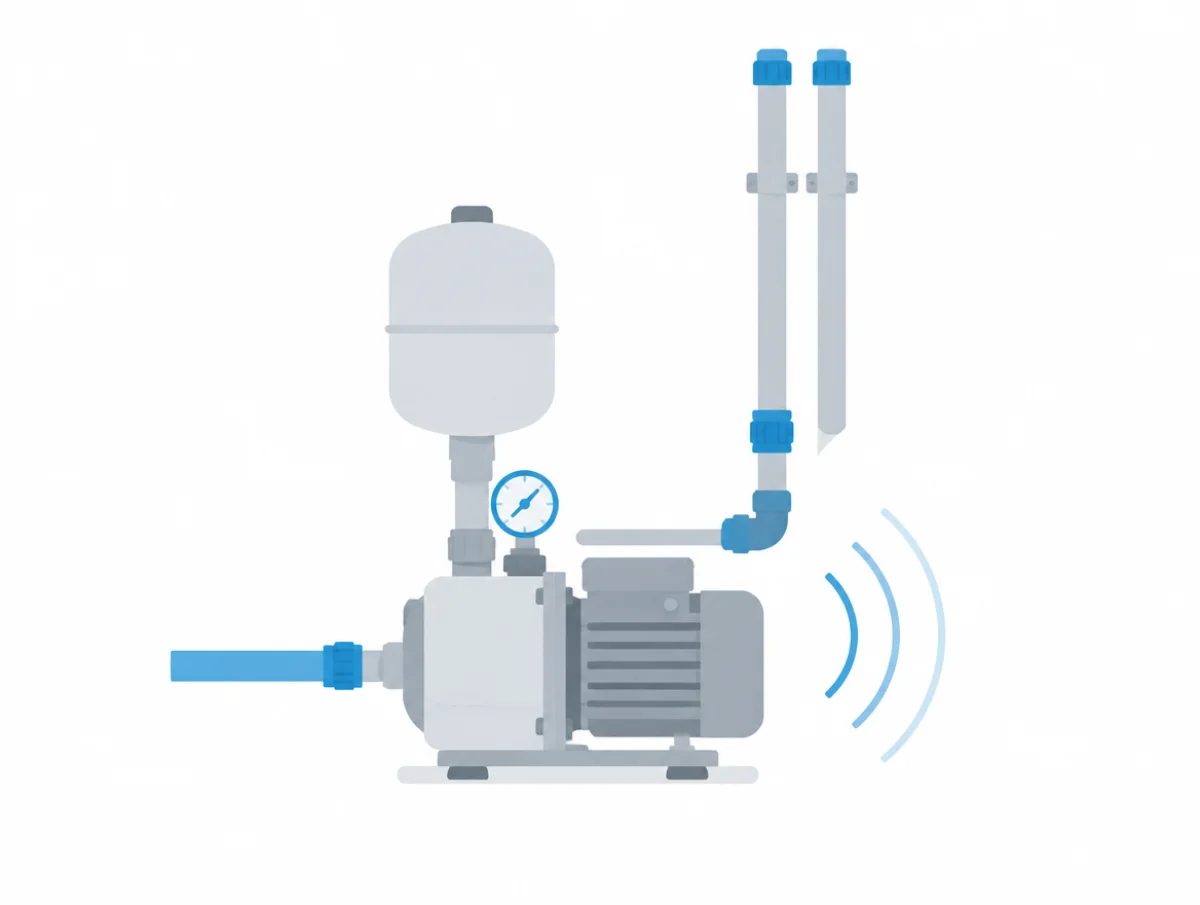
Clicking at every start is the booster pump sound that Grundfos and DAB explain first. Both trace it to the self-priming valve closing once water arrives under pressure, and both show how to lock that valve shut when the pump only boosts mains water.
A household booster sits between the water main or a storage tank and the house, and it starts whenever a tap, shower or toilet draws water. That makes its noises fairly easy to sort. Sounds at every start point to the priming valve or the tank, starts with no tap open point to a leak, and a drone in the walls points to how the pump is fixed down. Gurgling, rough running and poor pressure mean air or a starved inlet.
The causes and fixes here come from booster manuals and installation guidelines by Grundfos (SCALA2 and MQ), DAB (E.SYBOX Mini 3), Franklin Electric (VersaBoost Pro), Pentair (IntelliBoost), Red Lion (RBSS-75FC), Davey (BT Series) and Aquatec, whose CDP pumps boost the feed to reverse osmosis (RO) filters. Pool booster pumps are separate products and are left out.
A quick guide to booster pump sounds
| What you hear | Usual cause in the manuals |
|---|---|
| A click each time the pump starts | The self-priming valve closing on a pressurized inlet |
| Starts and stops with every tap shut | A leak, a leaking check valve or a wrong tank air charge |
| Gurgling or rough running after work on the pipes | Air in the pump body or a suction leak |
| Noise with weak, unsteady pressure | A starved inlet or cavitation |
| A hum carried through floors and walls | Vibration from rigid mounting and pipework |
| A bang when a tap or valve shuts fast | Water hammer |
Squealing and grinding have no row. Apart from Franklin Electric, which files "Worn bearings" under "Audible Noises" and sends them to the dealer, these manuals give those sounds no cause.
Why does my booster pump click every time it starts?
The click is the self-priming valve. On a SCALA2 or an E.SYBOX Mini 3 fed with water that already arrives under pressure, a shutter that opens for priming snaps closed at each start.
In the SCALA2 instructions, the pump "may produce a clicking noise if there is positive pressure at the inlet of the pump", and the cure is a locking pin, sold as part 99862078 in a pack of 20. With the pin fitted, "the self-priming function is not applicable". That suits a pump fed from the mains or from a tank above it, and the pin has to come out again if the pump ever lifts water from below.
DAB explains the same mechanism on the Mini 3. During priming the pump sends some pressurized water back to the suction side, and "This phase is repeated each time the pump is switched on, even already primed", until about 1 bar closes the recirculating channel. Where the inlet is already pressurized, up to 2 bar, or the pump always sits below its water, that pipe can be forced shut. The gain is "eliminating the clicking noise of the pipe shutter each time the system is switched on", at the cost of self-priming.
The job means cutting the power, draining the pump, pulling the shutter, taking off its spring and refitting the parts so the spring is compressed under the cap. In some places it is required anyway: DAB calls it "mandatory where local regulations require it".
Why does my booster pump keep turning on and off?
A booster that starts and stops with every tap shut is usually topping up a leak. Grundfos, DAB, Franklin Electric and Red Lion all list a leak or a leaking check valve for it.
Tiny leaks count. "Even just a slight leak (a few ml) can cause a fall in pressure which in turn starts the electropump," DAB warns in the Mini 3 manual. Red Lion's RBSS-75FC instructions go further, with "Even a pinhole can affect proper operation of the pump." Its test is soapy water on every joint; where bubbles form, remake the joint.
The check valve is the next suspect. Grundfos answers "The pump starts when no water is consumed" on the MQ with "Clean the valve or fit a new one", and DAB sends owners to the Mini 3's built-in non-return valve, which has its own service hatch. On the VersaBoost Pro, fault F52 lists "Leaky/stuck check valve" beside "Leak in plumbing system".
Some short runs are by design. With only a trickle drawn, the VersaBoost Pro "may cycle on and off at low speed to avoid harming the motor or pressure sensor", and an MQ keeps running for "12-15 seconds after flow stops". Red Lion's flow-switched RBSS-75FC runs in bursts when draw stays under 0.15 gpm, and the remedy printed for that is "Increase water use." Pentair adds that an IntelliBoost used where very little boost is needed "may result in cycling of the pump or fluctuations in water pressure."
Checking the tank's air charge
A wrong charge in the pressure tank causes cycling too. The MQ table pairs "starts and stops too frequently" with "Too low or too high pressure in pressure tank", and Pentair's guide answers "Pump cycles rapidly" with a damaged diaphragm or tank air pressure that is off.
| Pump | Air charge rule | Factory setting |
|---|---|---|
| Franklin Electric VersaBoost Pro | 70% of the pressure setpoint, plus or minus 2 psi | 35 psi, for a 50 psi setpoint |
| Pentair IntelliBoost | 70% of the set point | 42 psi for the 60 psi default; the tank may ship at 21 psi |
| DAB E.SYBOX Mini 3 | Setpoint minus restart drop minus 0.7 bar | 2.0 bar |
| Grundfos MQ | Fixed | 22 to 25 psi |
| Davey BT Series, added tank | 70% of shut-off pressure, or 45% when feeding RO and other low flow loads | Set by the installer |
Measure with no pressure in the system. Franklin Electric's steps start with unplugging the VersaBoost Pro and waiting at least 5 minutes, then shutting off the supply and opening a tap. DAB wants the pump disconnected and the nearest tap left open "until it no longer gives any water", and the gauge connected "very rapidly", since on a 1 litre vessel "the loss of even a limited quantity of air can cause an appreciable drop in pressure."
Water from the air valve means the diaphragm has failed. Pentair's fix is "Replace the tank", and DAB sends a broken Mini 3 vessel to its assistance service, to be replaced "exclusively by authorised personnel".
Leak alarms built into the pump
Most of these pumps can catch a leak themselves, though few ship with the feature switched on. DAB's Anti Cycling setting (AY) arrives disabled; in Basic mode it stops the pump and waits for a manual reset, while Smart mode raises the restart pressure drop "to decrease the number of starts over time". On the SCALA2 the anti cycling function has a factory setting of "off", and once switched on, a pump that "starts and stops in a fixed pattern" stops and shows alarm 3. The VersaBoost Pro logs F52, and the MQ relies on a small built-in tank "designed to minimize motor startup due to small leaks".
An alarm stops the noise without stopping the leak. Every one of these manuals points back to the pipework.
Air in the pump, and running dry
Gurgling, spitting taps and a rough note after work on the pipes usually mean air in the pump body or the suction line.
Franklin Electric ties excess noise to trapped air directly. If the VersaBoost Pro is noisy after priming, "slightly open the priming port while the unit is running at a low pressure output setting until water flows and all air is expelled from inside the unit", then close the port.
Air gets in on the suction side. "Suction leaks are the largest cause of poor pump performance and are difficult to detect," Davey writes in its BT Series instructions, and it allows only Teflon tape on the joints, never pipe dope or hemp. DAB wants a suction pipe with no goosenecks, never rising above the pump, drawing from at least 30 cm below the water surface. The SCALA booklet asks for pipes laid "so that air pockets are avoided, especially on the inlet side of the pump."
Running dry is what does damage. Red Lion is blunt: "Do not run the pump dry, which can cause overheating and damage the impeller and seals. This will void the warranty." Pentair's version is "Dry running of the pump can lead to overheating and damage to the pump."
Current boosters mostly stop themselves. The SCALA2's dry running protection is on by default and "cannot be disabled"; an unprimed pump has to be primed and reset by hand, while after a water shortage it tries eight restarts at five minute intervals. An MQ declares its alarm when flow stays under 1.6 gpm below the switch pressure, then "attempts to automatically restart every 30 minutes for a maximum of 24 hours." DAB shows BL for lack of water. A booster that stops, waits and starts again on a schedule is short of water, and the pump itself may be fine.
What does cavitation mean on a booster pump?
Cavitation on a booster pump means a starved inlet. Pentair's IntelliBoost guide pairs it with low suction pressure, and the fixes are a cleared supply, a fully open inlet valve and a sealed suction pipe.
Pentair leaves no room on it: "Never allow the pump to cavitate, as this can cause internal damage to the pump." The same guide prints the only noise remedy for an unstable pump in these manuals. When "Differential pressure in pump too low" makes performance unstable, the instruction is "Gradually close discharge shutoff until delivery pressure stabilizes and noise level drops; DO NOT close completely."
Pipe size is where Grundfos and DAB put their effort. The SCALA booklet wants an inlet pipe larger than 1 in. whenever it runs past 10 m (32.8 ft) or the suction lift exceeds 4 m (13.1 ft), eccentric reducers "with the tapered side down" and long radius bends. For weak delivery from a deep suction, DAB suggests a wider suction pipe, never smaller than 1 inch, and Franklin Electric recommends 1 inch or larger suction plumbing on the VersaBoost Pro.
None of the booster manuals describes how cavitation sounds. Wayne's well pump manuals do, with "sounds like pumping gravel", and our well pump noises page covers that case.
Humming and vibration through the house
A booster that sounds louder in the room above than beside the pump is feeding vibration into the building. The SCALA2 manual places that noise between 20 and 1,000 Hz, "also called the bass spectrum".
Grundfos gives the fullest fix. Its instructions recommend "flexible hoses" and a "vibration-damping rubber pad" under the pump, with hangers on the rigid pipes set close to where each flexible hose joins. Fitted that way, the pad, hoses and hangers "can reduce the noise experienced by up to 50 %". For the SCALA range Grundfos also sells a pump stand of expanded polypropylene that "reduces vibration and noise during operation".
Other makers work through the feet and the pipes. The VersaBoost Pro has four adjustable feet, and "All four feet should be in contact with the floor. The appliance should not wobble or tilt." On a wall it needs "anti-vibration hardware" and a structure that does not shake, never unreinforced drywall. Its answer to plumbing related "Audible Noises" is "Verify plumbing is properly secured."
DAB screws four rubber feet into the Mini 3 and has you adjust the one that does not touch an uneven floor. Davey asks for a firm base, support under heavy inlet and outlet pipes, and flexible pipe "to allow for movement between building, pump and/or water supply". Aquatec recommends flexible tubing for its RO pumps as well.
The MQ is the exception. To prevent "movement and vibrations", its manual suggests securing the base plate to "a solid foundation", a different approach from the rubber pad Grundfos recommends for the SCALA2, so follow the manual for your model.
Why does my booster pump bang when a tap closes?
A bang when a tap, toilet valve or washing machine shuts off is water hammer. A booster raises the pressure behind every valve, and Franklin Electric asks for extra hammer protection because of it.
The VersaBoost Pro manual gives the reason as "increased pressures in the application" and names "laundry connections and sprinkler systems" as places to protect. Its Pipe Fill mode builds pressure slowly in an empty system, which "can reduce water hammer in some systems", and Franklin Electric recommends that all system check valves be spring-loaded.
The tank is the other cushion. DAB lists protecting the system "against water hammer" as the first job of the Mini 3's expansion vessel. In the IntelliBoost, the tank's air section "provides a cushion to prevent water hammer", and Davey advises that "The installation of a pressure vessel will assist in reducing water hammer" where fast acting valves are fitted. Each of those cushions depends on the air charge, one more reason to check it.
No booster manual here describes a check valve that knocks. The nearest entries are about valves that stick. Pentair's guide pairs "Pump reverses when stopped" with "Check valve stuck open" and the fix "Remove and clean/replace check valve." Grundfos asks for the SCALA2's inlet and outlet non-return valves to be checked and cleaned "once a year or as needed".
Hammer from household plumbing, with no booster involved, is handled on our water heater noises and toilet noises pages.
Reverse osmosis booster pumps run differently
An RO booster such as Aquatec's CDP series feeds a filter rather than a whole house, and Aquatec designs it "for continuous duty". When it is switched on and off instead, the guidelines want "off" periods "greater than 60 seconds".
Air takes days to clear. After installation, "it may take several days of operation before all the air has been purged and the system is stabilized." Mounted on a ceiling with the pump head upside down, "air entrapment may reduce the operational performance by up to 15%". Aquatec also wants the tubing cut long enough to put no stress on the connections and a new diaphragm every 2 to 3 years. Its guidelines never mention noise directly.
Aquatec's site links no manuals, so these lines come from its CDP guidelines (IMI-102 Rev. E, dated November 1998) as posted by a water filter retailer.
Davey covers the RO case from the house side. When a Torrium2 booster supplies an RO filter it adapts to the slow demand by letting the start pressure fall lower each time, and an added tank should then be charged to 45% of shut-off pressure.
When to call a plumber, electrician or dealer
Worn bearings, a jammed impeller, a broken tank diaphragm and anything electrical go to a professional or the dealer. Leaks, the tank's air charge and the priming valve are owner jobs in most of these manuals.
Bearings are the only mechanical noise these makers name, in the VersaBoost Pro table, with the action "Contact dealer." A motor that is not free to turn, such as "a jammed impeller", goes to a Davey dealer, and DAB sends a clogged impeller to its assistance service.
Some parts stay closed. "Under no circumstances should Torrium2 controller be disassembled," Davey warns, because it holds a "spring under pressure". When an MQ still will not start after a fix, its table ends with "contact your pump supplier or Grundfos for further information."
Wiring belongs to an electrician. For the hard wired 230 V IntelliBoost, "Electrical work must be done by a qualified electrician", and Red Lion's RBSS-75FC "should be serviced by qualified electrical or plumbing personnel only." Aquatec wants wiring done "by a qualified Electrician per Local and State Electrical Codes."
Wait before opening anything up. Pentair asks for 5 minutes after disconnecting so the drive's capacitors can discharge, and adds "DO NOT assume that the capacitor is discharged."
How loud should a booster pump be?
Four home boosters carry ratings of 43 to 45 dB from their makers, two from DAB and one each from Grundfos and Franklin Electric. Each maker measured in a different way.
Our quietest booster pumps guide sets out how. The E.SYBOX is rated 43 dB(A) and the Mini 3 45, each taken 1 meter away in free field. The SCALA2 figure of 44 dB(A) is tied to a duty point instead, and the VersaBoost Pro's 45 dB comes with no conditions at all. Grundfos's other two boosters carry only ceilings, under 55 dB(A) for every SCALA1 and under 70 for the MQ.
A pump that has grown louder than it was when new, with nothing on this page to explain it, belongs with the causes in why appliances get louder. The decibel chart puts 45 dB beside everyday sounds.
More on pumps and water noise
Well systems run on a pressure switch and a larger tank, and Red Lion's RBSS-75FC "is not designed for systems using a well", so a well pump that clicks, chatters or rattles belongs on the well pump noises page. For a basement pump humming through the joists, see how to make a sump pump quieter.