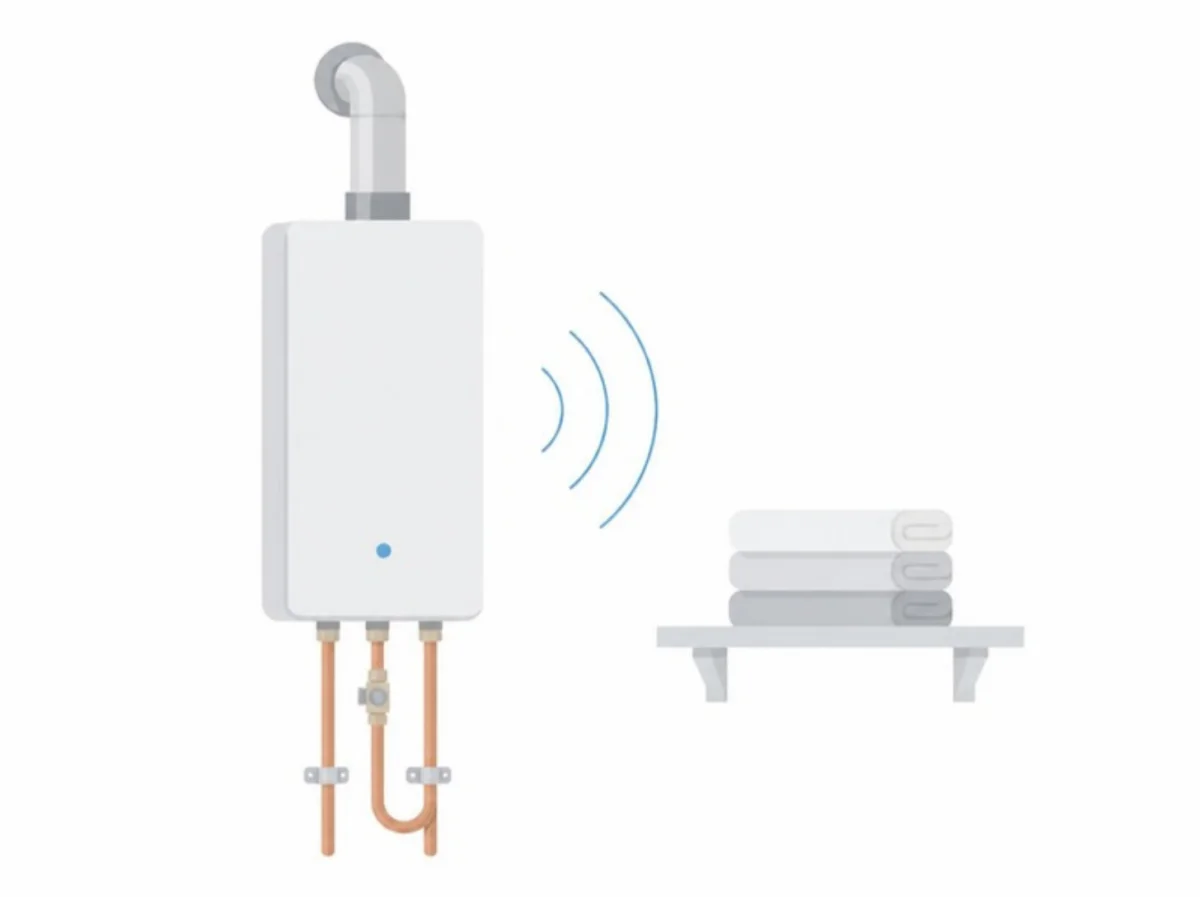
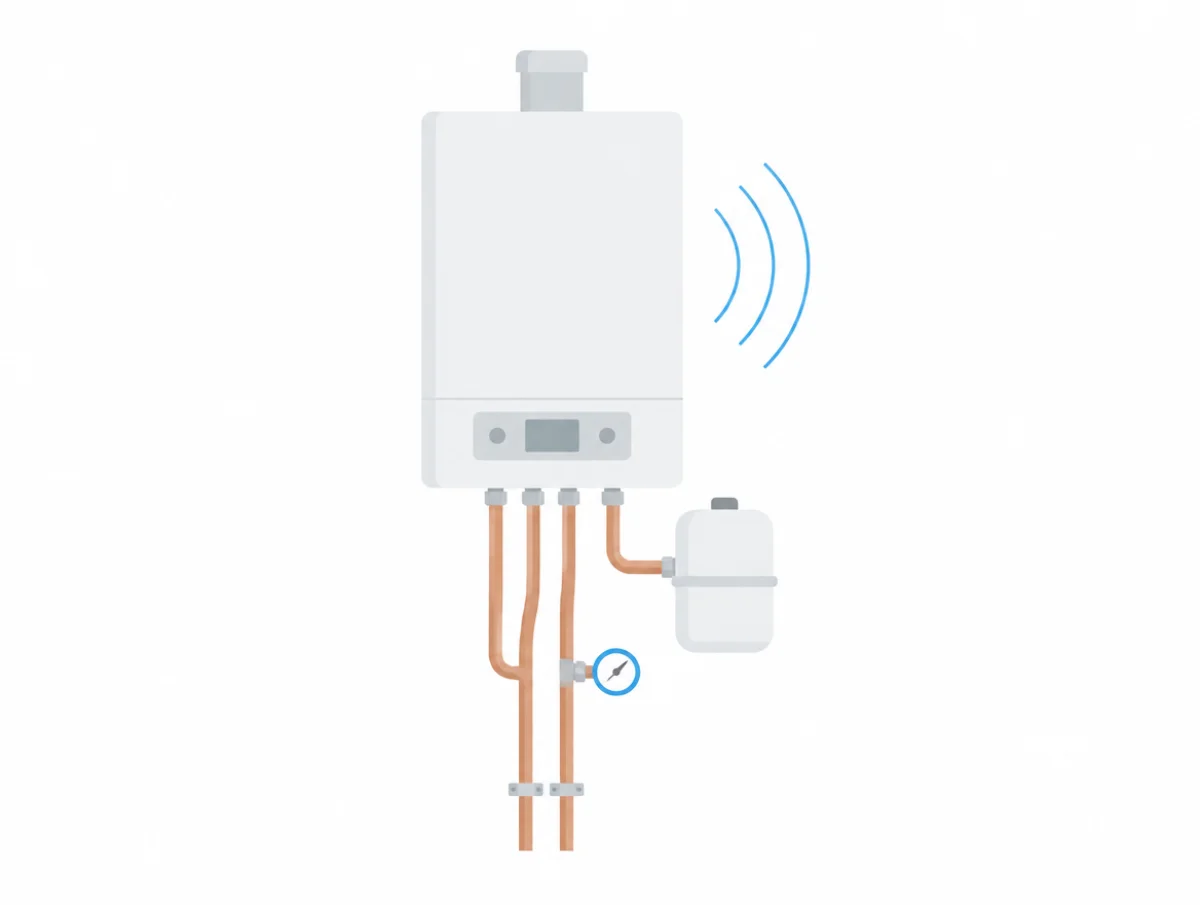
Between hot water draws a gas tankless heater should be close to silent. Rinnai's FAQ even reassures owners that one "will feel cold to the touch when the heater unit and pumps are in the rest state". Its noise gathers at the edges of a draw: a click and a buzz as the burner lights, a hum while it fires, then a fan that keeps turning for a while after the tap closes.
Makers treat almost all of that as design. Noritz's owner's guide answers fan, motor, buzzing, beeping and humming complaints in one short table, and every one of those answers describes a working unit. The sounds they flag are fewer: banging and hissing, a loud rumble on start up, a rough burner, and clicking with no flame.
Every cause below is quoted from owner's guides, use and care manuals, technician documents and support pages published by Noritz, Rinnai, Takagi, Rheem, Navien, Bosch and Eccotemp. We did not run, measure or open a tankless heater for this page. Tank heaters, sediment and heat pump models are covered in our main explainer on water heater noises.
Which tankless water heater sounds are normal?
Fan run-on, a motor whir as a tap opens or closes, a hum or buzz while firing, controller beeps and freeze protection cycles sit on maker lists as normal. Bangs, hisses, rough rumbles and clicks without a flame do not.
| Sound | When it happens | What the makers say |
|---|---|---|
| Fan running on | After the hot tap closes | Normal post-purge (Rheem, Noritz, Rinnai, Takagi) |
| Motor or valve whir | Unit switched on or off, a fixture opened or closed, sometimes with no water heating | Normal (Noritz) |
| Buzzing or humming | While the burner fires | Normal (Noritz); a brief hum on electric units (Eccotemp) |
| Fan or burner with every tap shut | Very cold weather | Freeze protection (Noritz, Takagi, Rinnai, Navien) |
| Beeping | Key presses, flush end, app pairing, scale codes | Controller signals; Rinnai LC codes call for a flush |
| Clicking with no flame | When hot water is called for | Gas, ignition or flow fault (Rinnai, Takagi) |
| Banging or knocking | When a tap or appliance valve shuts | Usually water hammer in the pipes (Rheem, Takagi) |
| Hissing or banging from the unit | During operation | Call a technician (Rheem) |
| Loud rumbling, rough burner | Start up or firing | Altitude settings, venting, seals or gas pressure (Noritz, Bosch) |
| Whistling | While water runs | Restricted flow, from Rheem's guide for all water heaters |
Loudness is a separate matter. For scale, Rinnai's residential spec sheets put a working unit at 47 to 55 dB, the range set out in our quietest tankless water heaters guide. Navien, Noritz and Takagi publish no sound level at all, and none of the seven makers gives a decibel reading that separates a working heater from a faulty one.
Why is my tankless water heater making noise when the water is off?
A tankless water heater making noise with every tap off is usually running its fan after a draw, moving its flow valves, or guarding against frost. Rheem, Noritz and Takagi each list at least one of these as normal.
Straight after a shower it is almost always the fan. A troubleshooting row in Rheem's use and care manual for non-condensing tankless heaters covers a fan that "continues to rotate after the hot water faucet is closed." The cause column reads "The post-purge cycle clears flue gases." The remedy column is two words: "Normal operation." On the Rinnai FAQ, the same run-on helps keep "constant water temperatures during rapid starting and stopping". Takagi's timing for it is on our water heater noises page.
Noritz explains the fan and a motor in its NR662-OD and NR501-OD owner's guide, a Noritz PDF on SupplyHouse's server. The motor can be heard "when turning the unit ON or OFF, when opening or closing a fixture, or after the unit has been running for a while." Its answer: "These noises indicate the proper operation of devices which are designed to let the unit reignite more quickly, and ensure the water temperature is stable." The NRC1111 condensing guide prints a shorter table, with the fan, motor and cold weather rows but no buzzing row.
A whir with no hot water running at all can be the valves. Noritz expects this too. "The valves that control the water flow through the unit move during operation and also when the unit is not heating water."
Freeze protection fires on cold nights
Frost brings a second set of sounds with every tap closed. Noritz has a row for a fan heard "when it is very cold outside", answered with "The fan may run to prevent freezing."
Takagi goes further on one model. Its owner's guide states that "The 540H Indoor model briefly fires on for about 3 seconds to provide freeze protection around the heat exchanger drum". The rest of the range relies on heating blocks, which warm up once the air around them drops below 36.5 °F (2.5 °C). They make no sound of their own that Takagi mentions.
Rinnai and Navien tie protection to the supply staying connected. Rinnai covers indoor models down to -22° F (-30° C) "as long as the appliance has both power and gas supply". The NPE-A2 user's manual says the function works whether the heater is switched on or off, provided it is still plugged in, and that closing the gas valve on A2 models limits the extra protection. Navien's older NPE operation manual also mentions "an optional recirculation mode that is used for freeze protection". A heater that fires or spins on a frosty night with nobody at a tap is doing what these manuals describe.
Is humming or buzzing from a tankless water heater normal?
Humming and buzzing are normal in Noritz's guide, which answers "a buzzing, beeping or humming noise emitting from the unit" with "This noise is a normal function of the unit." Navien also describes a steady hum while firing.
Navien's wording, with its comparison to a refrigerator, is quoted on our water heater noises page. Electric units hum as well, and Eccotemp counts a brief hum among the sounds to expect as one switches on.
The gap is a hum that changes. Noritz's maintenance list asks owners to "Check For abnormal sounds during operation." without defining abnormal, and Rheem's non-condensing manual sends abnormal sound to "a qualified service technician or plumbing contractor." Neither describes a hum that grows louder over months.
Why does my tankless water heater click but not light?
Clicking without a flame on a gas tankless heater points to the gas supply, the igniter or too little water flow. Rinnai's diagnostic code document and Takagi's troubleshooting table list the checks, and most of them are technician work.
Some clicking is part of every start. Takagi has technicians listen for a buzzing spark and then a clunk from the gas valve, both quoted on our main water heater page. The fault is sparking that repeats with no flame after it.
Takagi's table has a row for a "Unit does not ignite when water goes through the unit", and its first question there is "Is the flow rate over 0.5 GPM (1.9 L/min)?" The same row has owners clean the cold inlet filter, look for reversed or cross connected pipes and confirm the controller is on. If the incoming water is already near the set temperature, "the water heater will not activate."
Rinnai's diagnostic code document is written for technicians. It is no owner's manual. Its code 11 steps open with gas: "Verify all gas valves on the system are open." Then: "Verify all air was purged from gas lines after installation." Later, with the gas valve to the heater shut off, a technician unplugs the igniter wire and cycles the heater to "ensure you see a spark between the tip of the igniter wire and metal item on the water heater". Loose parts matter too, because "A loose flame rod is called a floating flame rod and will result in a code 11 or 12."
Clicking with a blank display
One clicking fault shows no code at all. Under water flow issues, Rinnai's document reads: "If the display is blank and clicking is coming from the water heater, disconnect the water flow servo motor." If the display then comes on, the servo is replaced, and because all of this happens inside the cabinet, treat it as a preview of what the service visit will cover.
Banging and knocking usually start in the pipes
Banging from a tankless water heater is most often water hammer, a shock in the plumbing when flowing water stops suddenly. Rheem's noise guide says banging "often points to an issue in your plumbing system rather than the heater itself."
Rheem's guide names sudden valve or faucet closure, high water pressure and loose pipes as triggers, and its first fix is "Install a water hammer arrestor". Takagi makes the same recommendation for its tankless units: "If the plumbing system is subject to water hammer, then it is recommended that water hammer arrestors be installed." Fitting one is plumbing work. Where hammer comes from in a house is covered in banging and knocking on our main page.
A bang from inside the cabinet is a different matter. The preventive maintenance list in Rheem's tankless manual has owners check for "abnormal sound during normal operation (e.g., hissing or banging noises)" and call in a technician or plumbing contractor if they hear it.
Why is my tankless water heater so loud when it starts?
A loud start on a gas tankless water heater can come from altitude settings, venting, leaky seals or gas pressure. Noritz and Bosch trace a rumbling start or a rough burner to installation details a technician sets or checks.
Noritz points to altitude. Its table answers a "Loud rumbling noise on start up or during operation" with this: "The unit may need adjustments done for installations higher than 2000ft above sea level." Owners are told to ask the installer or Noritz to confirm the dip switches are set correctly.
Bosch's Therm C 1210 ESC troubleshooting page gives a noisy burner five causes. First, "Leaky seals create improper combustion resulting in noise." Venting that is unsealed, the wrong material, or "too big in diameter or too long in run will result in unstable burner flames and noise." Too little combustion air has the same effect, and "Cross contamination between intake and exhaust may cause unstable burner flames and noise." The fifth is low gas pressure, which needs a reading from the installer or a certified gas technician. Most trace back to the installation.
Rinnai's technician document makes the vent point from another side. Its code 10 steps warn that "Bad connections may cause noise during combustion, exhaust gas leakage and a code 10."
Vibration that travels through the house
A vent pipe fixed hard to the framing can carry the heater's sound into other rooms. Rheem's tankless manual wants supports that "isolate the vent pipe from floor joists or other structural members", because "This helps prevent transmission of noise and vibration." Navien's older NPE installation manual steers installers away from 1/2 in corrugated gas connectors for a similar reason. For mounting advice, see where a tankless water heater should go to keep its normal sounds away from bedrooms.
Why is my tankless water heater whistling?
Only Rheem, of the seven makers, explains a whistle, in a guide covering every kind of water heater. High-pitched sounds "often mean restricted water flow or pressure irregularities", with "A partially closed inlet or outlet valve" first among the causes.
Rheem's first steps are to open every valve fully and check the pressure. If the sound carries on, its guide wants the unit inspected rather than left to settle. Our water heater noises page quotes the full passage.
Navien is a harder case. Whistling, a high-pitched noise and the recirculation valve are among the Navien complaints people search for, yet none of the three Navien manuals opened for this page mentions any of them. With nothing from Navien to quote, this page cannot name a cause or a fix, and a whistle from a Navien unit that will not stop belongs with its installer.
Beeps come from the controller
A beeping tankless water heater is usually confirming a button press, finishing a flush or pairing an app. On non-SENSEI Rinnai models, a beep that keeps going alongside an LC code means scale has built up in the heat exchanger.
Rinnai's code document describes LC, LC0 to LC9 as "a scale build-up in the heat exchanger" that "needs to be flushed to prevent damage." While one shows, "The controller will continue to beep." The cure is a flush. These are the only Rinnai codes that let the heater keep running. On newer models a reset at the controller buys 70 hours at a time before the heater locks out again, and Rinnai wants hard water treated so the scale does not return.
Other beeps are signals. The SENSEI RX and RXP manual gives a way "To eliminate the beeps when keys are pressed": hold the up and down arrows together for about 3 seconds until a beep, and repeat to bring them back. A beep also marks the end of the 60 minute vinegar flush, when the display reads "rnS". During app setup, "The water heater will beep once when pairing is successful", and twice if pairing mode runs out.
Noritz's optional remote sounds on every press and can be muted by holding its Power On/Off button for five seconds, though "The flow meter alarm cannot be muted." A Takagi remote beeps once when a button hold unlocks a higher temperature setting.
Electric tankless units make fewer sounds
Electric tankless heaters warm water with elements rather than a flame, so no burner lights and no combustion fan runs on. Eccotemp expects "A soft click, brief hum, or sound of moving water" as a unit activates.
For anything louder, Eccotemp's troubleshooting article gives five possible sources: "Water movement, pipe expansion, scale, vibration, or an internal electrical component". It also warns against blaming scale for every noise, since "pipe expansion, water flow, vibration, or an internal fault may be responsible." Owners are told not to open the unit to tighten wiring or inspect the elements. That is a technician's job.
Stiebel Eltron's Tempra installation manuals were checked as well. They say nothing about noise. EcoSmart and Rheem electric manuals were not part of the research.
When to turn it off and call a technician
Banging, hissing, sizzling, a burning smell or strong vibration from a tankless water heater are the makers' signs to stop and get service. Rheem and Eccotemp list them.
Some sounds mean stop. Rheem's tankless manual puts it in capitals: "DO NOT operate the water heater if you feel something is wrong with the unit." Eccotemp's stop list for electric units includes "sizzling, arcing, violent banging, or strong vibration", a breaker that trips repeatedly, and a smell of burning insulation or smoke. Its blog leaves internal wiring, element testing and sensor replacement to professionals.
Several fixes on this page are technician jobs by the makers' own account. Rinnai's ignition and flow steps happen inside the cabinet. Bosch sends gas pressure readings to a certified gas technician, and Noritz sends altitude dip switches to the installer or to Noritz. For anything involving a gas smell or the vent, follow the warnings printed at the front of your heater's manual.
Related guides and explainers
To compare models by their printed sound levels, start with the quietest tankless water heaters, including whether a recirculation pump adds noise. Tank heaters with a compressor are ranked in the quietest heat pump water heaters, and units that also heat the house are on the quietest boilers guide.
Neighboring equipment has its own pages: boiler noises, which covers combi boilers, and booster pump noises for pumps on the water line. For a heater that was quieter when new, why your appliance got louder walks through dust, loose parts and wear.