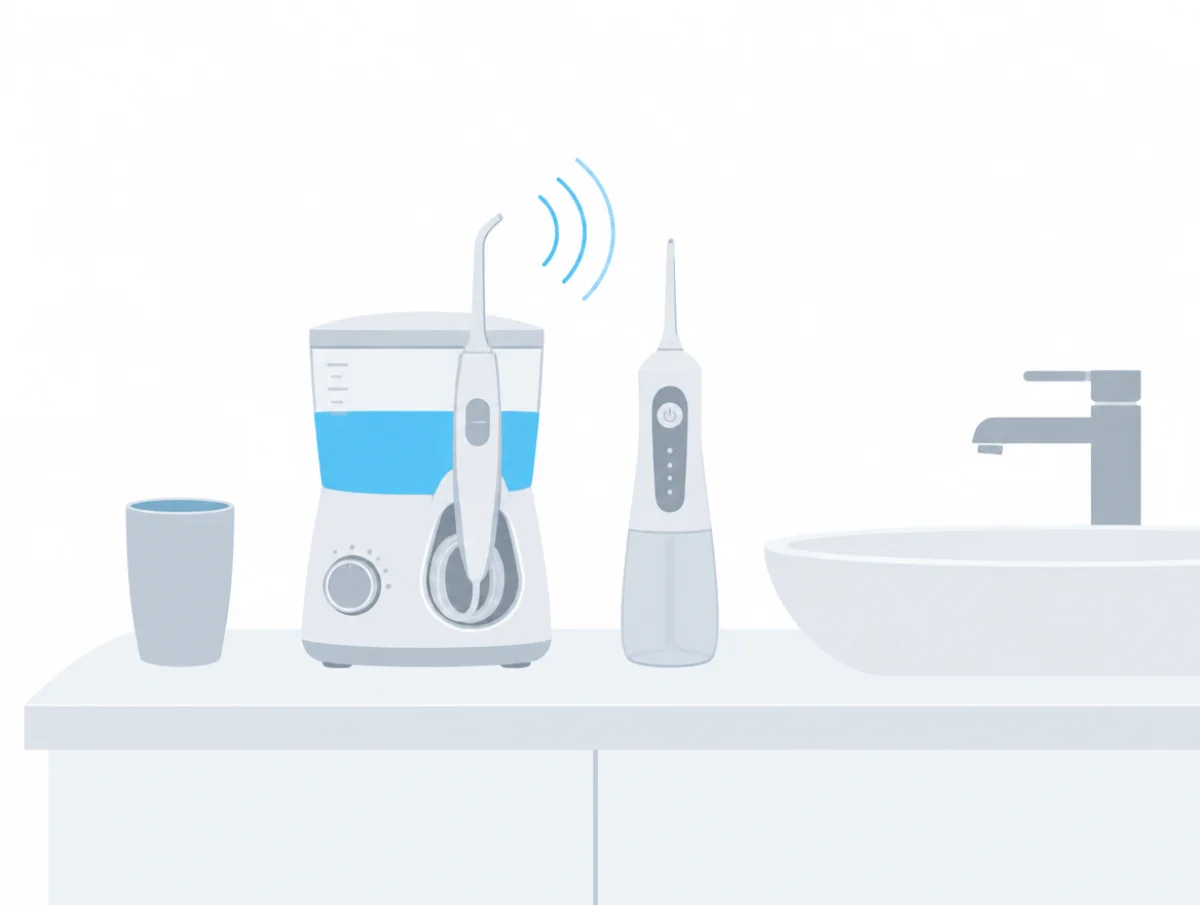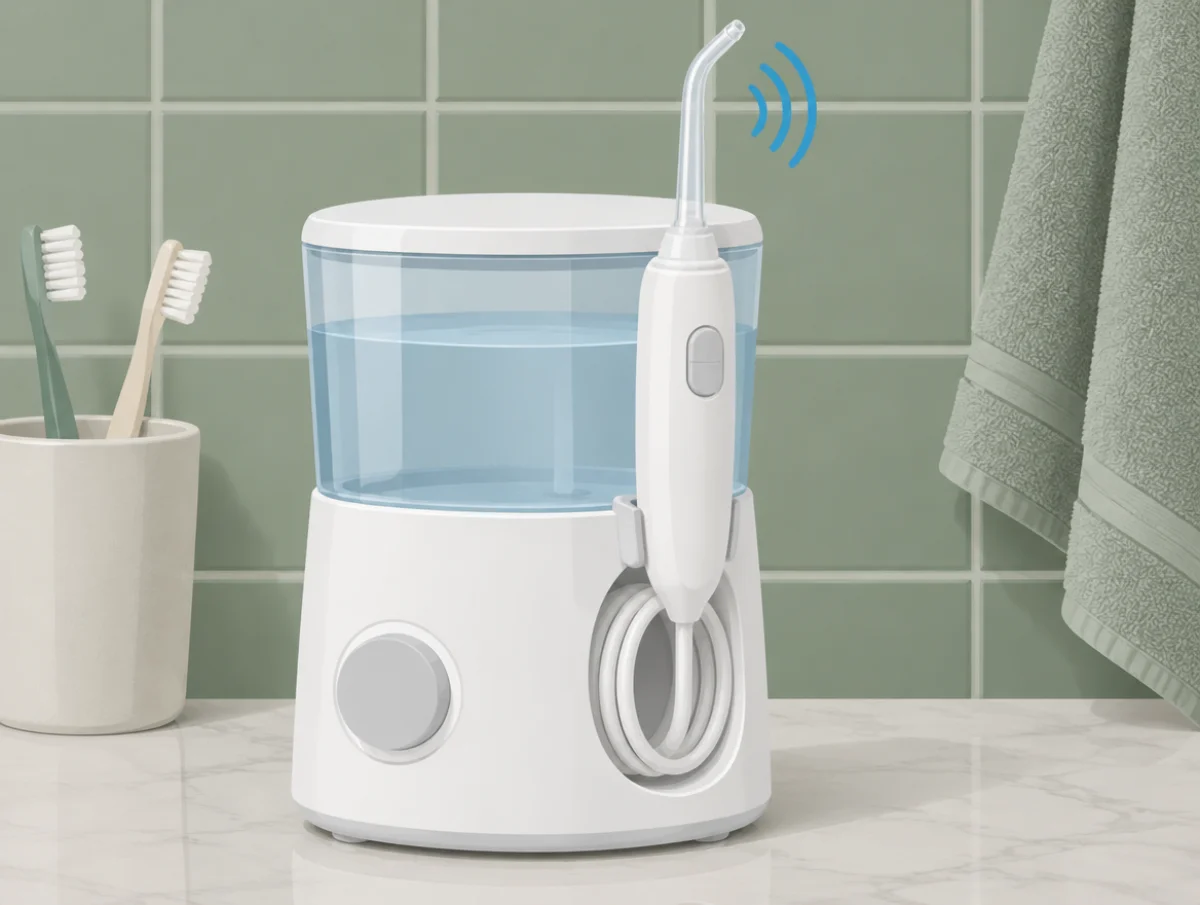
Waterpik's yardstick for a healthy water flosser is "a moderate sound level during operation, similar to an electric toothbrush." Well above that, its FAQ adds, the noise "may indicate a need for maintenance."
The noises that makers explain come back to a short list. Air sits in the pump. A reservoir, valve or switch is not where it should be. A cordless body is tilted, a timer is doing its job, a battery is fading, or hard water has left deposits inside. This page follows Waterpik's support articles and manuals first, then Philips Sonicare, Oral-B, Panasonic and BURST, with short cleaning notes from h2ofloss and COSLUS.
Two brands are missing. Bitvae and Nicwell had no troubleshooting pages we could open in November 2026.
How loud should a water flosser be?
A water flosser in good order should sound roughly like an electric toothbrush, going by Waterpik. Panasonic and Oral-B print noise figures for a few models; Waterpik and Philips print none for the countertop flossers we checked.
Panasonic declares sound power for three US models, set out in our quietest water flosser guide. Measured as dB(A) re 1 pW, the EW-DJ66 comes in at 60, the EW1511 at 71 and the EW-DJ11 at 72. Oral-B prints "Noise level: 68 dB (A)" for the Water Flosser Advanced without saying how it was measured. Sound power is the total a flosser radiates rather than the level at your ear, a difference covered in sound power vs sound pressure.
Those figures describe a flosser working normally. None of them puts a number on a fault, so the useful test at home is change: a unit that is louder than it used to be, or loud while doing nothing.
A loud buzz with no water usually means air in the pump
A water flosser whose motor runs hard while nothing leaves the tip has usually lost its prime, with air sitting in the pump and water line. Running it at full pressure into the sink pushes that air out.
"Priming removes air from the pump and water line, ensuring the flosser works effectively and delivers a steady stream of water," reads Waterpik's FAQ. Its method is to fill the reservoir, pick a high setting and run the flosser "until water flows smoothly from the tip." The WP-600 series manual for the Aquarius gives the countertop version: pressure dial to 10, handle and tip pointed into the sink, power and water on until water flows.
Philips adds a detail nobody else mentions. For a Sonicare Power Flosser that will not stream, its support article has owners point the nozzle into the sink "ensuring the handle is below the bottom of the reservoir", slide the pause switch up, set the intensity to 10 and hold for 30 seconds. A kinked hose and a clogged nozzle are the next two checks.
The Power Flosser 3000 manual gives three reasons a new unit fails to prime. The reservoir is not fully seated. The flosser was not on long enough. Or the pause switch is in the "pause" position. Its cure for the second is 30 seconds at high intensity.
Cordless flossers can be slow to draw water through their intake. "It may take some time to suck up the water," warns Panasonic's EW-DJ11 manual, whose remedy is to pour water into the nozzle port, fit the nozzle and switch on. Oral-B runs a full tank through the Water Flosser Advanced on first use and asks for the same flush again "When the device has not been used for more than one week", by its North American manual.
Check the water switch, the reservoir and its valve
If priming does not bring the stream back, Waterpik's list is short: look for blockages, make sure "the reservoir is properly seated", and confirm the Water On/Off Switch on the handle is on.
That switch can explain a buzz by itself. On Waterpik's 600 and WP-100 series, sliding it to off stops the water mid session, and both manuals add: "NOTE: Motor will continue to run."
Some Waterpik countertop reservoirs have a black valve in the bottom, which the valve article says is there "to prevent water from dripping out of the reservoir, but still allow it to flow when water flossing." When "Water pressure drops significantly, even at pressure high settings", Waterpik ends with a test. Take the valve out, set the empty reservoir on the base, fill it in place and run the unit. If the pressure returns, buy a new valve. When refitting one, the dome side goes up with the four prongs showing underneath, and the WP-100 manual asks owners to "ensure the valve is right side up" if the reservoir leaks.
Philips has a rattle of the same kind. On the Power Flosser 3000, a "Reservoir is rattling" when it is "not fully seated", and pushing it down slightly onto the base is the fix.
Running dry is hard on the motor
Oral-B is the most direct. "DO NOT leave the device turned ON for a prolonged period as this may damage the motor," warns its cleaning page, and the manual repeats that "A longer operation of the handle without water may damage the motor."
The Power Flosser 3000 protects itself. If it "was running for too long and it overheated", it switches off and all its LEDs blink; Philips asks owners to unplug it and leave it for two hours, then call customer service if the lights still blink.
Why does my water flosser sputter or spit?
A sputtering water flosser is often pulling in air rather than water. On a cordless model that means a tilted body, a nearly empty tank or a clogged tip; in a pulse mode, a rising and falling stream is intended.
Panasonic is precise about the angle. "If the main unit is tilted too much, the water does not come out from the nozzle," its EW-DJ11 manual explains, and the troubleshooting table answers "The main unit is tilted too much" with "Please use it upright." Waterpik's WF-26 instructions print "Keep unit upright during use to ensure continuous water flow," and the BURST manual asks for the same so the reservoir empties fully.
Cordless tanks are small. Panasonic rates the EW-DJ66 at about 60 seconds of water at level 5, by its European manual, and BURST tells owners to refill "After about 20-40 seconds". Expect at least one refill per session.
A tip that is partly blocked gives a weak, ragged jet. Waterpik's low pressure article soaks the tip in hydrogen peroxide or white vinegar for 5 to 7 minutes and replaces tips every 3 to 6 months, "as the tips can become clogged and/or affected by mineral deposits." Panasonic blames a poor jet on a clogged filter, or a nozzle outlet that is clogged or squashed.
Some rhythm is built in. In Philips's Deep clean mode, "Pulse Wave technology" makes the flow rise and fall, "providing a brief pause during which you can move the nozzle to the next space between your teeth." Waterpik's Hydro-Pulse Massage mode offers "a unique water pulsation pattern designed to enhance gum stimulation," and BURST's Pulse setting is a massage mode with "a little less oomph." A steady throb in those modes is the mode working.
Pauses every 15 or 30 seconds are a timer
Short, regular breaks in the stream come from a pacer that tells you when to move on. Waterpik's countertop and ION models pause at 30 seconds and 1 minute, and Philips's Cordless Power Flosser pauses every 15 seconds.
In the WP-600 manual's words, "The Water Flosser will create a short pause at 30-seconds, to remind you to move to the other arch of your mouth," followed by a second pause at 1 minute. After that "The unit will continue to run without pauses until the unit is turned off." The ION manual describes the same timer.
On the WP-600 the timer works in Floss mode only. To turn it off, press the mode button once with the unit off to wake it, then hold it for about 3 seconds until the Massage light blinks. Unplugging the unit resets it to factory settings.
The Cordless Power Flosser manual ships the pacer switched on. With the flosser off, hold the intensity button for 3 seconds: one amber flash means the pacer is off, two green flashes mean it is back on. The countertop Power Flosser 3000 has a pacer in clean mode only, toggled by holding the on/off and mode buttons together for 5 seconds.
Cordless flossers that slow down, blink or stop
A cordless flosser that sounds weaker and pushes less water most likely needs charging or fresh batteries. Waterpik's low pressure checklist ends there, with a warning for rechargeable models: "Do not run the battery down completely."
Each maker signals a low battery its own way:
- Waterpik WF-10 Cordless Select: the charge light blinks 8 times quickly after use at about 30% charge
- Waterpik ION: the light blinks 3 times quickly at about 30%
- Waterpik WF-26: a flashing white LED as the battery nears low, solid red when it is depleted
- Philips Cordless Power Flosser: flashing amber when low, then amber for 5 seconds before it switches off
- Panasonic EW-DJ66: the low battery indicator flashes once a second
- BURST: a red light, which its manual calls "only low on charge"
Battery models fade gradually. Waterpik's Cordless Express takes 3 AA cells, replaced together "when there is a noticeable change in performance", and Panasonic's answer for an EW-DJ11 that will not run includes "Batteries are dead."
A flosser that will not start at all may be locked rather than broken. The WF-26 has a travel mode, switched on and off by holding the power button for 5 seconds, and a lockout reset that takes a 20 second hold. BURST resets with the flosser plugged in and the power button held for 3 seconds. For a flosser that will not hold a charge, h2ofloss suggests a reset by charging with a different cable and plug, in its FAQs.
Waterpik's Sonic-Fusion is a special case. "The SONIC-FUSION handle is rechargeable for brushing, but the flossing function requires electric power," and the handle loses its wireless link to the base after 10 minutes apart, so the Floss button does nothing until the handle is docked and lifted again, according to its troubleshooting article.
Mineral buildup makes the pump work harder
Hard water leaves deposits in the pump, hose and tip. Waterpik's manuals say that "If left unattended, it can hinder performance," and its FAQ lists "cleaning and descaling" as a way to make a flosser operate more quietly.
Waterpik's own pages give different recipes. The WP-600 manual adds 2 tablespoons of white vinegar to a full reservoir of warm water, runs it through, then follows with clean warm water, every 1 to 3 months. The WF-10 manual uses 1 tablespoon for the cordless model. Its vinegar cleaning article uses 1 part vinegar to 2 parts warm water, once a month, and the low pressure article runs half of a 16 ounce mix, lets the rest drain out of the handle with the unit off, then runs the remainder. Follow the manual for your model.
Philips disagrees with itself on soaking time. Its manuals soak a clogged nozzle in 2 parts water to 1 part vinegar for 5 minutes, while its AirFloss article asks for "at least 30 minutes." For the internal parts, both manuals add 1 to 2 tablespoons of white vinegar to a full reservoir.
Oral-B skips vinegar on its cleaning page. After each session it empties the reservoir and runs the handle until no water is left, "to prevent any build-up or bacteria from collecting in the standing water," and it says "Tube care does not require regular cleaning." Among smaller brands, h2ofloss calls for monthly deep cleaning with a vinegar solution, and COSLUS rinses the reservoir with vinegar and water once a week.
Whistles, rattles and a sudden jump in volume
A whistling Philips AirFloss has a clogged air vent or a worn nozzle. A countertop flosser that has grown louder overall needs cleaning and a look at how it is assembled.
"On the back of your AirFloss is a small air vent in the reservoir hatch," reads Philips's whistling article, and "A clogged air vent is causing a whistling sound." Wipe along the inside edge of the reservoir door opening, the top especially, and rinse it with cold tap water. A worn nozzle can whistle too, and Philips recommends a new AirFloss nozzle every three months.
Waterpik's answer for a flosser suddenly louder than before is broad. "A sudden increase in noise could be due to a blockage, air trapped in the unit, or a malfunction." Clean it, make sure it is assembled correctly, and put a towel or washcloth under the base. "Some models also feature quiet operation modes," the FAQ adds, without naming them.
What about grinding or knocking from the pump? None of the maker pages or manuals we read describes either sound by name. The nearest is Waterpik's "malfunction", which leads to the next section.
When the noise means a fault
An odd sound that outlasts priming, reseating and descaling is a matter for the maker. Panasonic groups "abnormal sound" with heat and a burning smell as reasons to stop using the flosser straight away.
The EW-DJ66 manual lists the cases: a main unit or charger that is "deformed or abnormally hot", one that "smells of burning", and "There is abnormal sound during use or charging of the main unit or charger." The instruction then is "Immediately stop using and unplug the power plug" if the charger is in use, and "Immediately request inspection or repair to an authorized service centre."
Waterpik flossers "have no consumer serviceable electrical items", the WP-100 manual says, so a pump fault goes to Waterpik customer service on 1-800-525-2774. The 600 series carries a 3 year warranty with the original receipt. When Philips's steps run out, its support articles conclude the flosser "may be damaged internally" and send owners to a repair or exchange, and the Power Flosser 3000 has a two year warranty. BURST offers a lifetime warranty while you stay subscribed to its replacement tips, and asks for a photo or video by email.
Where to go next
If the flosser works but is simply loud, our quietest water flosser guide ranks Panasonic's three declared sound power figures and explains why Oral-B's 68 stands apart. Its brush counterpart is the quietest electric toothbrush guide, and rattles and timers on brushes have their own page, electric toothbrush noises.
Other bathroom sounds are covered in toilet noises, hair clipper noises and making a bathroom fan quieter. For any appliance that has crept louder over the years, see why your appliance got louder.