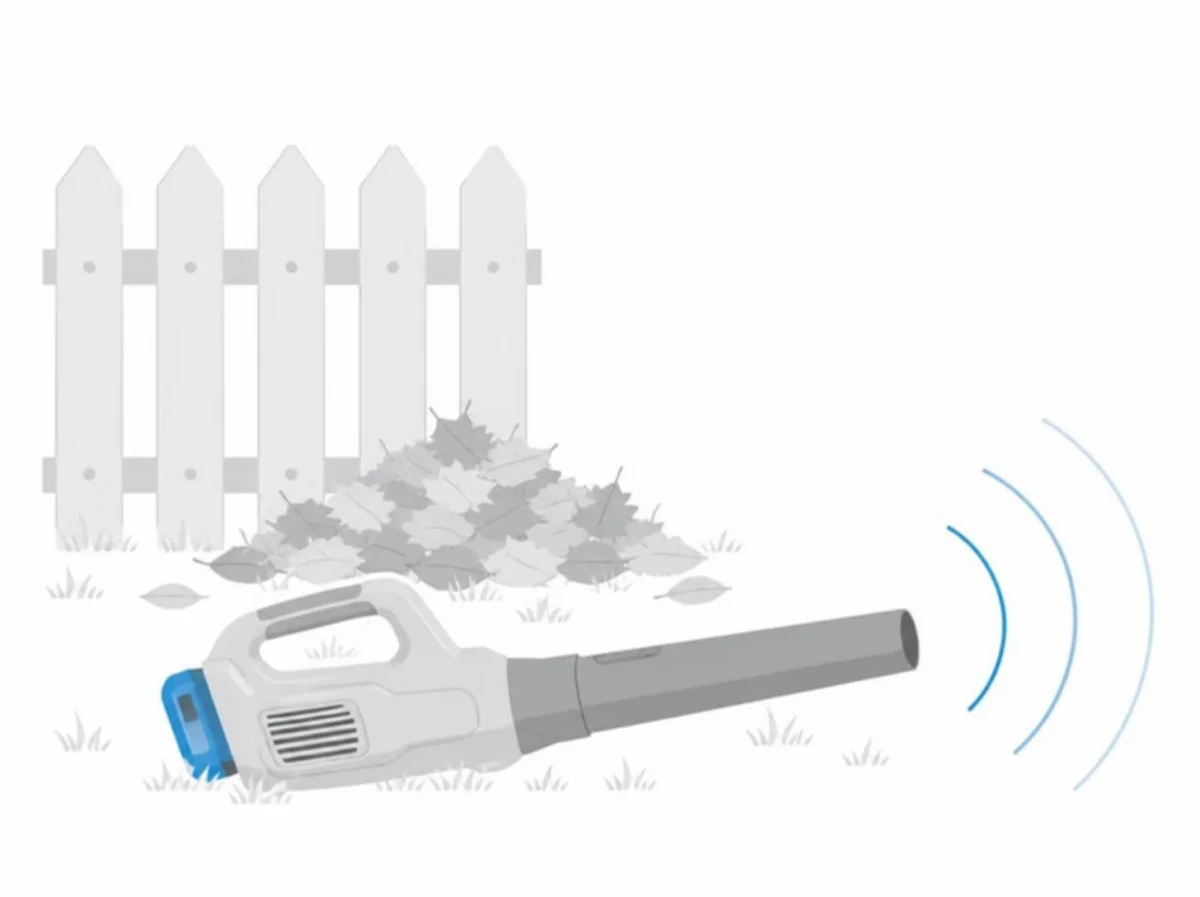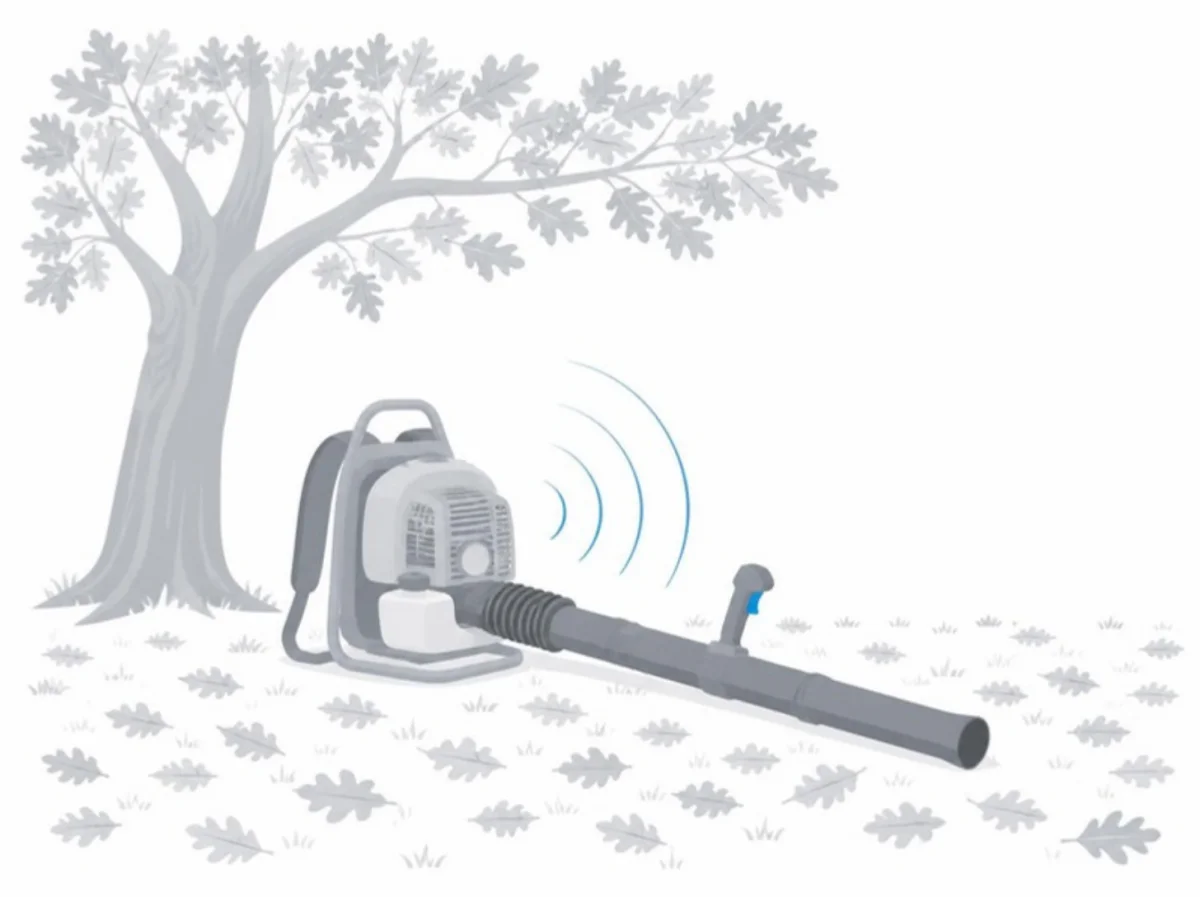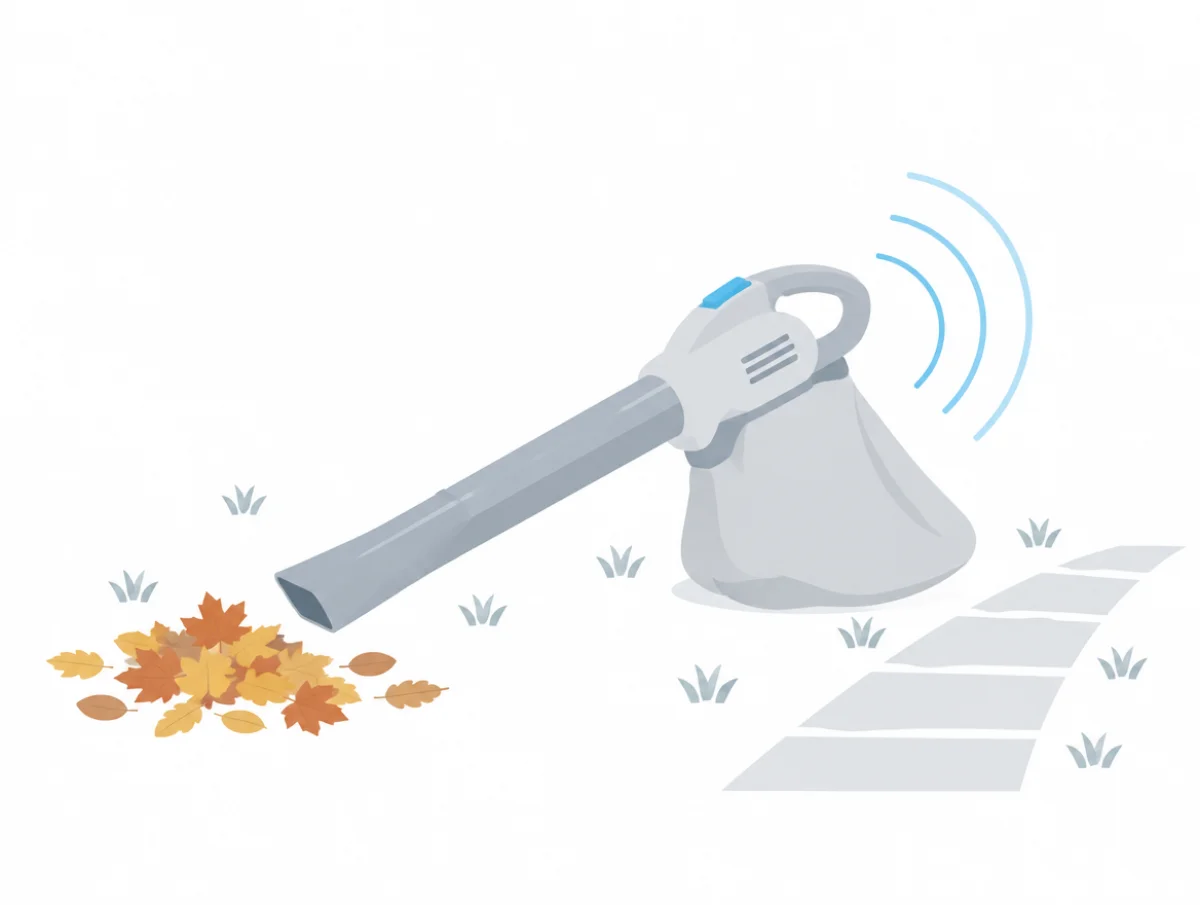
Inside every leaf blower, gas, battery or corded, a fan spins at high speed between an air intake and a tube. Most of the sounds that worry owners come from that fan and what reaches it: a rattle from a loose part or debris in the housing, a rising scream when the airflow is blocked, a change of note when an engine cannot breathe. Battery blowers add a few signals of their own, beeps and flashing lights that mean heat or overload.
This page draws on operator's manuals and support articles from ECHO, STIHL, Husqvarna, EGO, DEWALT, Makita, Milwaukee, Toro, WORX and Greenworks, read on November 19, 2026. Handheld and backpack models are both covered. Makita's English manuals come from its European site, and the Husqvarna support articles from its UK site.
One thing stands out across them. Not one of these manuals uses the words rattle, whistle, grind, surge or backfire. They speak instead of abnormal vibration, "unusual noise", blockages and lost power, so each sound below is matched to the closest entry the makers actually print.
| What you hear | Cause a maker names | First step |
|---|---|---|
| New rattle or shaking | Loose or damaged parts, worn anti-vibration elements (Husqvarna, ECHO, STIHL) | Switch off, remove the battery or plug, inspect |
| Clatter from inside the housing | Debris or a foreign object reaching the fan (STIHL, DEWALT, Toro) | Clear it with the power off |
| Rising whine or scream | Blocked tube or intake, motor over-revving (ECHO, Makita) | Clear the blockage, keep the original nozzle |
| Gas engine quieter and weak | Clogged spark arrestor, dirty air filter, old fuel (Husqvarna) | Clean the screen and filter, refuel |
| Louder exhaust | Damaged or modified muffler (Husqvarna, STIHL) | Stop using it; dealer repair |
| Beeps or red lights, then a cutout | Heat, overload or a battery fault (STIHL, Husqvarna, WORX) | Let it cool, ease off, recharge |
| Cuts out with no warning | Overload protection (Makita, DEWALT) | Switch off and restart at a lighter load |
Why is my leaf blower rattling or vibrating?
A leaf blower that starts rattling or shaking has something loose, damaged or caught in the fan. Most manuals here give the same order: switch it off, remove the battery or disconnect the spark plug or cord, then inspect before restarting.
The wording barely changes from brand to brand. STIHL's BGA 300 manual reads "Immediately switch off the blower if it starts to vibrate abnormally." DEWALT's DCBL777 and DCBL570 manuals say "remove the battery pack and immediately check", and Milwaukee's 3017-20 manual asks owners to "Inspect the blower for damage if there is excessive vibration while the blower is turned on."
Husqvarna and Makita name the sound itself. The 530iB manual says to shut off the power at once if the machine "should start making any unusual noise or vibration", then "examine for damage", "replace or repair any damaged parts" and "check for and tighten any loose parts" before restarting. Makita's DUB362 manual has the same instruction for a blower that "strikes any foreign objects", and sends a damaged one to Makita Authorized Service Centers.
Loose parts, tubes and worn mounts
Fasteners come first. ECHO's PB-2520 manual says "Check unit for loose/missing nuts, bolts, and screws" and "Do not use blower if any part is missing or damaged." Husqvarna's 125B manual puts "Tighten all nuts and screws" on its daily list.
A tube that is not fully seated can move against the housing. DEWALT's DCBL722 manual has owners push the tube on "until the tube locks engage the blower tube and an audible click is heard," then "Pull on the tube to ensure it is securely in place."
On gas backpacks, the anti-vibration elements wear as well. "A power tool with loose components or with damaged or worn AV elements will tend to have higher vibration levels," according to STIHL's BR 800 manual. ECHO's engine chart even lists vibration as the reason a carburetor drifts out of adjustment.
A scrape is the tube tip on the ground. The PB-580T manual says "Do not scrape or drag blower pipe tip when operating or transporting unit," because the worn tip can form sharp edges, and to replace the pipe assembly "if protective metal ring is worn, cracked or deformed."
Debris, a worn fan or a cracked housing
The fan is the part that suffers when something hard gets in. Sand, grass or a stray object drawn through the intake can damage it, the makers warn, and a cracked housing or intake screen lets more in.
STIHL's gas backpack manual is direct about how it happens. "Never insert any foreign object into the air intake of the machine or into the nozzle of the blower. It will damage the fan wheel." It also warns against setting the blower down at high speed, since "small objects such as sand, grass, dust, etc. may be pulled into the air intake and damage the fan wheel." EGO's LB6500 manual has the same rule: run it only over "a hard, clean surface".
Cracks matter for the same reason. On the BR 800, STIHL tells owners to "check the fan housing for damage (cracks or holes that could allow foreign objects to contact the fan wheel)" and, if any is found, to "stop using the unit and contact your STIHL dealer for repair." Its battery BGA 300 manual says never to run the blower "with a missing, cracked or worn intake screen or housing." Husqvarna's 125B checklist asks owners to make sure "the housings are free of cracks" and to clean the impeller blades weekly and monthly.
Debris can often be shaken out. For a blocked intake on the DCBL570 backpack, DEWALT says to switch off, remove the batteries and clear loose debris, and if any is left in the fan, to "gently shake the debris out" with the intake pointed down. Wait for the fan to stop first: DEWALT allows 10 seconds before the tube comes off a DCBL722.
Wear shows up as lost air rather than a new sound. EGO's troubleshooting table gives two causes when "The air velocity decreases obviously": "Excessive wearing of motor fan", which goes to an EGO service center, and an intake "blocked by debris."
Corded blower vacs and the impeller
In vacuum mode, the impeller takes the hits directly. Toro's UltraPlus 51621 manual says "Hard items such as sticks, rocks, acorns, and pine cones will damage the impeller," and that forcing the tube into a pile can clog it. "If the appliance starts to vibrate or make abnormal noise, stop it, unplug the cord, and check for the cause."
Unplug before reaching in, because Toro warns that "The impeller rotates for a few seconds after you turn off the appliance and can cut or injure fingers." A damaged impeller is a job for an Authorized Service Dealer. If the UltraPlus will not run at all, Toro's first check is that the bottom inlet cover or vacuum tube is locked in place.
Why does my leaf blower whine or scream at full speed?
A leaf blower that suddenly screams or rises in pitch may have a blocked outlet, a blocked intake or a nozzle that chokes the airflow. ECHO and Makita both link blocking to an engine or motor that over-revs.
ECHO prints the warning in its gas manuals: "To avoid engine damage due to over-revving, do not block blower pipe." Makita gives the battery version. Its list of what not to do includes blocking the inlet or outlet, with dust in a dusty area as much as by hand, and fitting "a tapered nozzle smaller than the original one". Its reason is blunt. "Increased motor revolution may cause dangerous fan breakage and result in serious personal injury."
Blocking also cooks the motor. On the 530iB, Husqvarna says "A blocked air intake decreases the blowing capacity of the product and increases the motor's working temperature. This can result in motor failure due to overheating." ECHO's gas backpack manual lists blocked air intakes among the causes of "Overheating and engine seizure".
None of these manuals explains a whistle. If yours whistles, the closest entries are the ones above: a partial blockage, or a tube that has not locked on.
Speed itself is the other half of a loud whine. "Remember, the higher the engine speed, the louder the blower noise," ECHO reminds owners, and its advice is never to use a higher setting than the task needs.
Surging, bogging or a quieter engine on a gas blower
When a gas blower hunts up and down, bogs when you squeeze the throttle, or sounds quieter than usual, the makers point to air, fuel and the spark arrestor. Husqvarna names a clogged arrestor as the most common cause of a quiet, weak engine.
Husqvarna's full throttle article describes a blower that "sounds quieter than usual" and puts the spark arrestor first: "A clogged spark arrestor is the most common cause." The screen sits in the muffler, and Husqvarna "recommends that the spark arrestor is cleaned after every 50 hours of use." Its power loss article leads with the intake instead, saying "A blocked air intake is the most common cause," and adds that "A worn or dirty spark plug can cause inconsistent power."
ECHO's engine chart covers the same ground for an engine that "runs, but dies or engine does not accelerate properly":
| Check | What ECHO finds | Remedy |
|---|---|---|
| Air filter | Dirty | Clean or replace |
| Fuel filter | Contaminants or residue in fuel | Replace filter or fuel |
| Fuel vent | Plugged | Clean or replace |
| Spark plug | Dirty or worn | Clean and adjust, or replace |
| Carburetor | Out of adjustment from vibration | Adjust |
| Cooling system | Dirty or plugged | Clean |
| Spark arrester screen | Plugged | Replace |
Low speed has a cost on ECHO engines. "Continuous low speed operation may allow fuel/oil residue to build-up on the piston and cause rapid build-up of carbon on the spark arrester screen, resulting in overheating and engine damage." The fix is to run at wide open throttle "for at least 5 minutes every hour" and check the screen after about 40 hours.
Heat makes an engine run unevenly too. Husqvarna's cooling system article lists a blower that "Runs unevenly" or "Loses power after running for a while" among the signs that the fins and vents need cleaning, always with the engine cold.
Idle is the one setting owners may touch. On the BR 800, STIHL's instruction when the engine stops while idling is to turn the idle speed screw (LA) slowly clockwise "until the engine runs smoothly." ECHO draws the line there: "Carburetor adjustments, other than idle speed, must be performed by an authorized dealer."
Popping and a louder exhaust
None of the blower makers here explains a pop or a backfire. The nearest entries concern the muffler, which both STIHL and Husqvarna say makes the engine louder when it is damaged or altered.
The 125B manual reads "Do not use an engine with a damaged muffler. A damaged muffler increases the noise level and the risk of fire." STIHL's warning covers owners who modify one: "Any modification could cause an increase in heat radiation, sparks or sound level," and muffler work belongs with a STIHL servicing dealer.
Backfire is an engine question more than a blower one, and our lawn mower noise page quotes Briggs & Stratton on the difference between backfire and afterfire and what causes each.
Why does my battery leaf blower beep or shut off?
A battery leaf blower that beeps, flashes or stops mid job is usually protecting itself. Heat, overload and a flat or faulty battery are the causes these makers list, and most have a light pattern for each.
Some stop without warning. Makita's overload protection means that when the tool draws "an abnormally high current, the tool automatically stops without any indication"; turn it off, stop whatever overloaded it, and turn it on again. Its UB001G manual adds an overheat stop, after which the blower and battery need to cool. DEWALT's Electronic Protection System guards against "overloading, overheating or deep discharge", and "The tool will automatically turn off".
EGO lists heat under a blower that "doesn't work": "The battery pack or blower is too hot." The fix is to let both cool below 152°F (67°C).
The light codes differ by brand:
| Blower | Signal | Meaning the maker gives |
|---|---|---|
| STIHL BGA 300 | 3 LEDs glow red | "Blower too hot." Let it cool |
| STIHL BGA 300 | 3 LEDs flash red | Blower malfunction; servicing dealer |
| STIHL BGA 300 | 1 LED glows red | Battery too hot or too cold |
| Husqvarna 530iB | Red error indicator flashes | "Temperature deviation." Let it cool |
| Husqvarna 530iB | Red error indicator lit | "The product needs servicing." |
| Husqvarna 530iB | Battery temperature indicator flashes | Near its limit; "Decrease the speed and/or workload." |
| WORX WG585 | One light flashes three times per cycle | A battery is hot |
| WORX WG585 | One light flashes four times per cycle | "The machine is over load." |
| Milwaukee 2824-20 | One fuel gauge light flashes 4 times | Less than 10% charge left |
The WORX WG585 manual says to "Remove tool from blowing area and try again" after an overload. On Milwaukee's 2824-20, eight flashes mean the battery is at 0% charge.
The beeps on a STIHL backpack battery
STIHL's AR L backpack batteries are the only ones here with an acoustic signal. Six long beeps mean a low charge, and "Rapid succession of short beeps" means "There is a malfunction in the battery"; STIHL's instruction is not to charge, use or store it, but to replace it. A single short beep just confirms the signal works, and three short beeps mark Bluetooth turning on or off.
Hearing protection can hide all of this. STIHL's own note: "Be aware that your ability to hear the acoustic signal may be reduced when wearing hearing protection."
None of the makers describes a motor that pulses on and off. Where yours does, the overload and heat entries above are the closest match, and easing the load is what Husqvarna, WORX and Makita ask for.
Why is my leaf blower louder than its rating?
Because a leaf blower rating is usually measured 50 feet away, for the neighbors, while you stand at the handle. On Husqvarna's 525iB Mark II the operator figure is about 20 decibels higher, and boost adds more.
Husqvarna's 525iB Mark II manual prints all three numbers for one blower. Someone standing 50 feet off hears 64.4 dB(A) on the normal setting and 66 on boost, each measured to ANSI B175.2:2012, while "Equivalent sound pressure level at the operator's ear" is 85 dB(A). Its noise data "are determined on the basis of the rated maximum speed".
Some figures carry no basis at all. Our quietest leaf blowers guide found Worx, RYOBI, DEWALT and EGO's consumer models printing a bare "dB" with no distance or standard, which cannot be set beside a 50 ft rating. It also explains why the quietest full size blower there is rated 54 dB(A) and still needs ear protection.
A worn machine adds its own noise: a damaged muffler, loose parts, debris in the fan. Running several machines at once makes any yard louder, and ECHO and EGO both advise owners to limit the number of pieces of power equipment in use at any one time. Husqvarna adds that "Using the blower to move large piles is time consuming and creates unnecessary noise."
STIHL is plain about the user's hearing. "Prolonged exposure to power tool noise may result in permanent hearing damage." The power tool noise and hearing explainer sets blower figures against the NIOSH and OSHA exposure limits, and our noise exposure calculator works out safe time at a chosen level.
When to stop and see a dealer
Stop for any new shake or unusual noise, after the blower hits something, and whenever a housing, intake screen or tube is cracked. Fan damage, a fault light that will not clear and any carburetor work beyond idle go to the maker's service network.
Each brand names its handoff. STIHL wants a dealer for a cracked fan housing on the BR 800, for three flashing LEDs on the BGA 300 and for any muffler repair. Toro sends a damaged impeller to an Authorized Service Dealer, and EGO sends a worn motor fan to an EGO service center, along with any blower that has been dropped, damaged, left outdoors or dropped into water.
Husqvarna's 530iB with a steadily lit red error indicator needs a servicing agent. Makita repairs damaged blowers through its Authorized Service Centers, and ECHO says "Have repairs done only by an authorized service dealer." The blockage entry in Greenworks' 60V backpack manual is one the owner can handle: when no air comes through, the inlet or tube outlet "has a blockage", and the remedy is to remove it. ECHO's DPB-2500 manual has the identical row.
Where to go next
For a quieter replacement, the quietest leaf blowers guide ranks handhelds on the 50 ft figure, and the quietest backpack leaf blowers does the same for larger machines. Blower vacs with the same impeller warnings appear in our leaf vacuum guide.
Brand pages collect every figure one maker prints: ECHO, Husqvarna, STIHL, EGO, Milwaukee and Makita. For the whole garden, the quiet yard overview covers mowers, trimmers and local noise rules too.