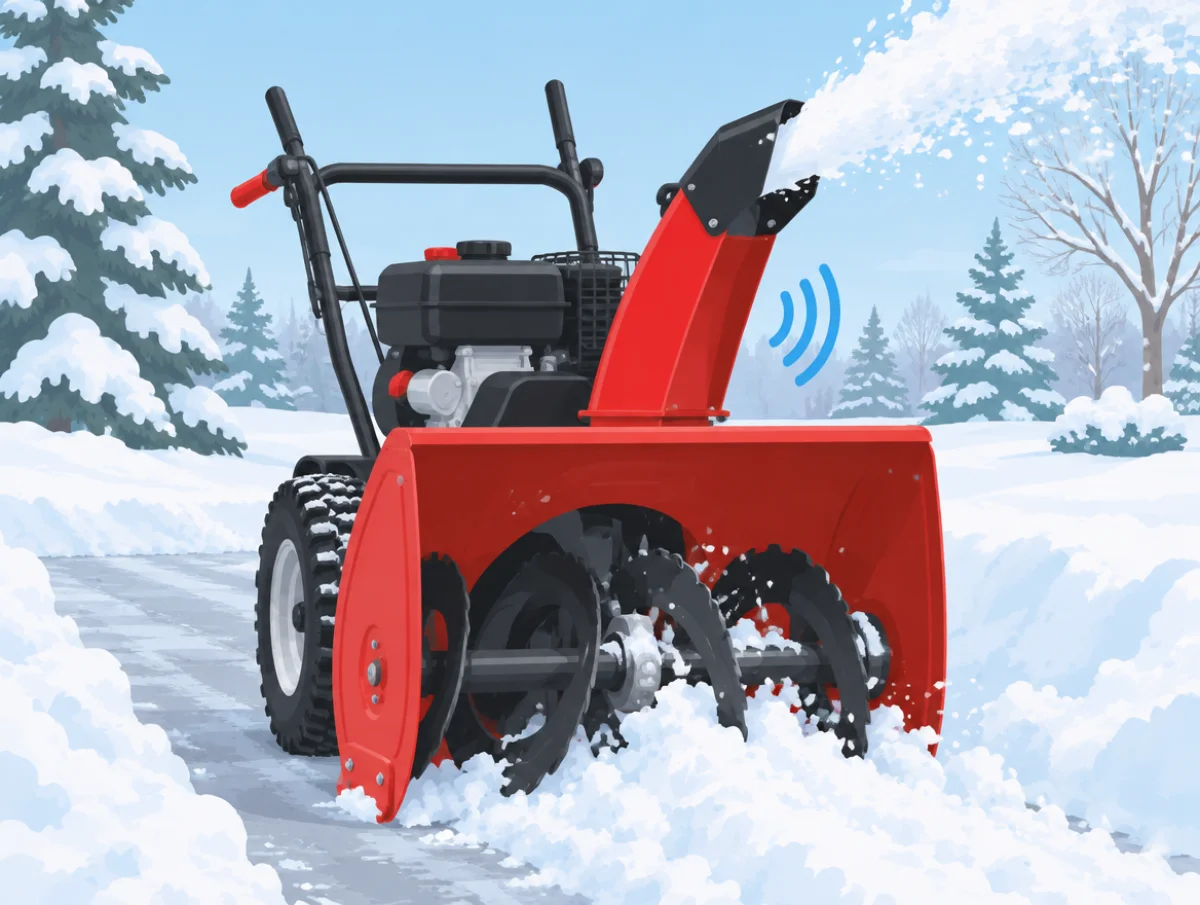
A snow blower is two noisy jobs in one machine: an engine or motor, and a belt driving an auger that chews through snow, ice and whatever else is hidden in it. Most of the sounds owners ask about come from that second job. A squeal points to a belt, a new shake to something loose or damaged, and a beep or a sudden drop in pitch on a battery model to an overload.
The makers quoted here are Toro, Ariens, Cub Cadet, Husqvarna, EGO, Honda and Snow Joe, read on November 17, 2026. Their operator's manuals did most of the work. Ariens's manual server would not answer that day, so its advice comes from articles on the Ariens website.
None of these makers uses the words "grinding" or "knocking" for a snow blower. Where an owner hears one, the closest entries in the manuals are the ones on vibration, foreign objects and worn parts, and that is how this page treats them.
| Sound | Cause a maker names | First step |
|---|---|---|
| Short squeal on a wet day | Belt slipping in wet conditions (Toro) | Run the rotor empty for 30 seconds |
| Squeal under heavy load | Worn belt that lost tension (Toro, Husqvarna) | Adjust the tension, or replace the belt |
| New rattle or shaking | Loose parts or a damaged auger (Cub Cadet, Husqvarna) | Stop, tighten bolts, inspect |
| Auger stops turning after a hit | Shear pin or shear bolt broke (Ariens, Honda) | Replace it with the correct pin |
| Louder exhaust | Damaged muffler (Husqvarna) | Do not run it until it is replaced |
| Pops or backfire under load | Engine fault (Honda) | Dealer inspection |
| Beeping on a battery model | Flat pack or overload (Toro) | Charge it, walk slower |
| Motor note drops on a battery model | Overload protection (EGO) | Slow down or narrow the path |
Why does my snow blower squeal?
A slipping belt is the usual cause of a snow blower squeal. Toro, Husqvarna, Cub Cadet and Ariens all trace slipping to a wet, worn, stretched or loosely tensioned drive or auger belt, and each one has a different fix.
Water comes first on a snowy day. Toro's Power Clear 721 manual says "The belt may slip (squeal) in wet conditions; to dry out the drive system, start the rotor and run it without a load for 30 seconds." Husqvarna's ST 324 manual has a related row for slow drive or poor discharge: "The friction disc is wet," with the remedy "Let the friction disc dry."
Wear is the other half. "After extended use, the drive belt may wear and lose its proper belt tension," Toro writes, and if it "slips (continuously squeals) under a heavy load," the fix is to move the upper end of the control bar spring to the hole farther from the pivot, then readjust the cable. Toro replaces a belt that is "worn, oil-soaked, excessively cracked, frayed, or otherwise damaged."
Adjust the belt, or replace it?
It depends on the machine. Husqvarna's ST 324, ST 327 and ST 330 manual says "The auger and traction drive belts are not adjustable. Replace the belts if they are damaged or begin to slip from wear," and recommends a qualified service center for the job, with both belts changed together.
Ariens leans the other way. In its performance article, a machine that throws snow poorly is "usually a symptom of a belt that doesn't grip the auger drive pulley effectively," and the advice is to adjust the auger clutch cable or the auger drive idler first: "Belts wear gradually, so try making the adjustments before replacing the belt."
Cub Cadet's 2X manual lists a loose or damaged drive belt when the machine will not propel itself, and a loose or damaged auger belt when it will not discharge snow. Honda's HSS724A manual sends a belt that is "worn, broken or not on pulleys" to a servicing Honda dealer.
Vibration, rattles and knocks mean stop
Abnormal vibration is the snow blower sound the manuals treat as most urgent. Toro, EGO, Husqvarna and Cub Cadet all say to shut the machine off at once and look for the cause before using it again.
EGO and Husqvarna print the same warning: "Vibration is generally a warning of trouble." Toro's version for the Power Clear 721 is "If the machine starts to vibrate abnormally, shut off the engine and check immediately for the cause." Cub Cadet adds the step most likely to be skipped: "disconnect the spark plug wire and ground it against the engine."
The troubleshooting tables agree on the first suspects:
| Manual | Causes it lists for excessive vibration | What it says to do |
|---|---|---|
| Cub Cadet 2X | "Loose parts or damaged auger." | Tighten all bolts and nuts; service center if it continues |
| Husqvarna ST 324 family | "Some parts are loose. The augers are damaged." | Tighten fasteners, replace damaged parts; service center if it remains |
| Husqvarna ST 324 family | Handles not locked, or loose adjustment lever nuts | Lock the handles, tighten the nuts |
That last row explains a rattle that seems to come from the handlebar, which Husqvarna files under "Excessive vibration / Handle movement" with the handle locks, not the engine, as the fix.
Bolts loosen over a season. Husqvarna's ST 124 manual asks owners to "Check shear bolts and other bolts at frequent intervals for proper tightness," and EGO's SNT2120AP manual gives the same instruction for "all bolts or fasteners."
A rattle in the exhaust is a separate problem. Husqvarna says "A damaged muffler increases the noise level and the risk of fire," and tells owners not to use the machine if the muffler is missing or damaged. For engine knocks and muffler checks in more depth, the lawn mower noise page covers the same small engines.
What happens when the auger hits something?
On a two-stage snow blower, the auger is held by shear pins or shear bolts that are designed to snap when it jams. Ariens says this protects the auger gearcase; the cost is an auger that stops turning until the pin is replaced.
Ariens's shear pin article describes the symptom: the machine feels like it is "pushing snow rather than processing it," or snow builds up outside either side of the auger housing. To confirm it, stop the engine, remove the key, disconnect the plug wire and look. "If you don't see the shear pin head or nut and you can manually spin the auger along the auger shaft, you broke a shear pin."
Honda's HSS724A troubleshooting table lists "Shear bolt(s) broken" and "Foreign object stopping auger from rotating" under "Won't blow snow." EGO's two-stage SNT2400 manual says its shear pins absorb "the instant-stall torque when the auger strikes obstacles" and "protect the gearbox and motor from damage." EGO stores two spares on the chute.
Use the right pin
Honda, Cub Cadet, Husqvarna and Ariens all insist on the correct part. Honda: "Do not replace shear bolts with ordinary hardware bolts." Cub Cadet names OEM part 738-04124A and says damage to the auger gearbox from using anything else "will NOT be covered" by the warranty.
Ariens explains why. A pin "that can handle more torque than your machine" risks "extensive damage to your snow blower," and overtightening the nut stresses the pin until it fails early. Its advice when the manual is not at hand is to finger tighten until the nut no longer spins freely, and no further.
After any strike, the manuals give the same order whether or not a pin broke. Toro: "After striking a foreign object, shut off the engine, remove the key, and inspect the machine for damage. Repair any damage before starting the machine."
Is a grinding or scraping sound normal?
No maker here describes a normal grinding sound, and none lists grinding in a troubleshooting table. The parts they do tell owners to watch are the scraper bar and the rotor blades or paddles, which wear against the pavement.
Toro's Power Clear 721 asks owners to inspect the rotor blades "Before each session." Once a blade edge has worn down to the wear indicator hole, "have an Authorized Service Dealer replace the rotor blades and the scraper." EGO's SNT2120AP manual replaces rubber paddles and rubber augers that are "worn, excessively cracked, frayed, or otherwise damaged."
Ariens's maintenance tips call scraper bars "somewhat sacrificial" because they scrape the ground by design, and its performance article adjusts a worn one down before replacing it. On a two-stage machine, its skid shoes set the gap: 1/8 inch spacers for paved surfaces and 1/2 inch for gravel, which keeps the housing off loose stones.
A grind that arrives with a stalled auger or a shake belongs with the vibration and foreign object advice above, so stop and inspect.
Popping, backfire and rough running on gas models
Honda treats backfire on a snow blower as a fault. Its HSS724A manual lists "Misfiring or backfiring under load" and "Afterburning (backfiring)" among symptoms to have inspected by an authorized Honda servicing dealer.
The other gas manuals describe uneven running rather than pops. Cub Cadet's 2X table, for an engine "running erratically" or "hunting or surging," lists running on choke, stale fuel, "Water or dirt in fuel system," a carburetor out of adjustment and an engine "over-governed," and sends the last two to a service center. Husqvarna's ST 324 table for an engine that "idles or runs roughly" adds a blocked fuel line and a carburetor that "needs to be replaced."
Fuel left over from last winter is the common thread. Both Cub Cadet and Husqvarna answer it the same way: drain the tank and refill with fresh, clean gasoline. Briggs & Stratton's account of backfire and afterfire in small engines, including what to do at shutdown, is covered on our lawn mower noise page.
Why is my EGO snow blower making noise?
An EGO snow blower that suddenly sounds quieter, then stops, is overloaded. EGO builds in overload sensing: the motor slows on its own, and the manual says you will hear its noise drop before it recovers.
The SNT2120AP manual puts it this way: "the motor will decrease the speed automatically and you will hear the noise level of the motor decrease." Slow your pace or narrow the path and the speed returns. If that does not work, the motor shuts off and the power indicator flashes orange. Remove the batteries, clear any snow or ice from the auger and deck, and restart.
The lights tell you more than the sound:
- Flashing red: battery charge is low and the auger stops.
- Shining orange: the snow blower is overheated.
- Flashing orange: overloaded; clear the auger and slow down.
- Red and green in turn: a communication fault for the EGO service center.
Battery heat is a separate cutoff. Above 158°F (70°C), EGO says the circuit "will immediately shut off the snow blower," with the battery's own LED flashing orange or shining red. A motor that runs while the auger stays still points to a worn or broken drive belt on the SNT2120AP, and to a broken shear pin on the two-stage SNT2400.
Beeps and clicks on other battery models
Toro's 60V MAX manual has a row for "The machine is producing a beeping sound." The causes are an uncharged battery pack, an overloaded machine and "another electrical problem," and if the alarm still sounds after the other fixes, Toro says to contact an Authorized Service Dealer.
A single click is normal. EGO says to push the battery in "until you hear a 'click'," and Snow Joe's 24V-X2-SB18 manual slides each pack down "until it clicks." No maker here describes a repeating click during use.
Snow Joe's rule covers everything else: if you "hear abnormal sounds or feel abnormal vibrations from the motor," stop, remove the battery, and contact an authorized dealer or its customer service line.
Ice and freeze-up after use
Ice is the cold weather cause on this list. Toro, EGO, Cub Cadet and Husqvarna all tell owners to run the snow blower for a few minutes after clearing so the moving parts do not freeze in place.
Toro's version: "Run the machine a few minutes after throwing snow to prevent freeze-up of the collector and rotor." EGO adds that the chute handle should be turned back and forth to break up ice, and warns "Do not attempt to operate the unit with frozen parts." Forcing frozen controls is out too: Toro and EGO both say to start the machine and let it run for a few minutes instead.
Honda's table lists "Auger frozen by ice" as a cause when the engine stalls as the auger clutch lever is pressed. EGO's lists the same cause for a battery machine that will not start; remove the batteries and use the clean out tool.
How loud is a snow blower, and when can you run one?
On maker declarations, a snow blower measures 80 to 86 dB(A) at the operator's ear. Those three manual figures cover two EGO battery models and the gas Husqvarna ST 124, collected in our quietest snow blowers guide.
That is loud enough for Husqvarna to say "Always use approved ear protection while you operate the product. Noise for a long period can cause noise-induced hearing loss." Our noise exposure calculator shows how long a given level can run before it adds up, and the noise distance calculator estimates what a neighbor hears farther away.
On timing, Snow Joe's manual tells owners to "respect the local laws and regulations regarding noise control" and to choose an appropriate operating time. Many towns treat snow removal differently from other power equipment, and the snow blower guide quotes three local codes that do.
When to stop and call a dealer
Stop for abnormal vibration, after striking an object, and for any sound or shake that a tightened bolt or a new shear pin does not cure. Makers send continuing vibration, belt replacement, backfire and repeated fault codes to a dealer.
The handoffs differ by maker. Cub Cadet and Husqvarna send vibration that continues after tightening to an authorized service center. Honda leaves worn or misrouted belts, and backfire, to its servicing dealers. Toro has an Authorized Service Dealer replace worn rotor blades and the scraper on the Power Clear 721, and handle an alarm that keeps sounding on the 60V MAX. EGO sends communication faults and unidentified faults to its service centers, and Snow Joe wants any abnormal sound reported.
Where to go next
For a quieter machine next winter, the quietest snow blowers guide ranks the maker figures that exist and explains why most brands print none. Owners of gas mowers and riders will find the same engine sounds, with belt chirps and blade strikes, in lawn mower noises explained.