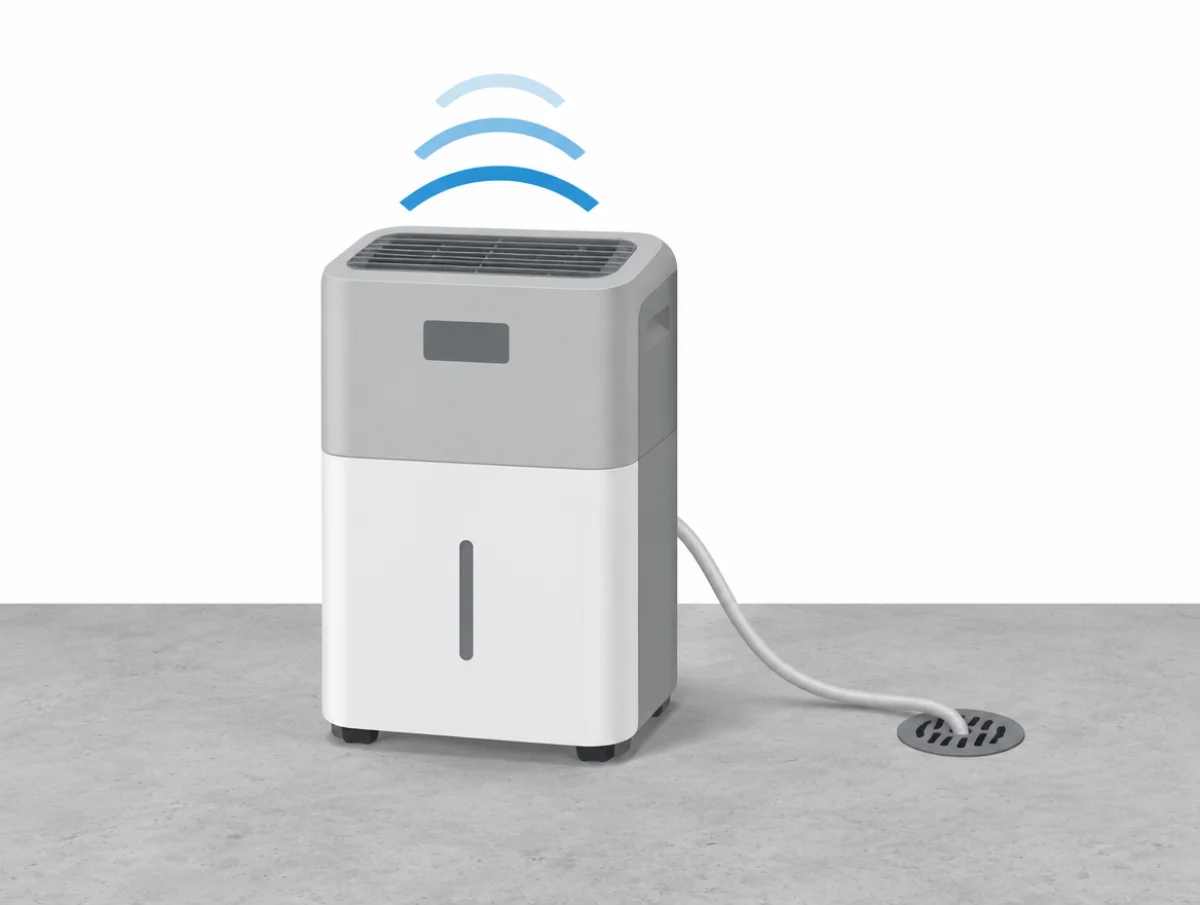
Frigidaire's FHDD2234W is rated 43 dBA on low fan and 49 on high. Six decibels, from one button.
Fan speed is the easiest change, but it is not the only one the manuals offer. How low you set the humidity, which mode you pick, the floor the unit stands on, the state of its filter and where the water goes all show up in the makers' troubleshooting tables, and whole-home units add a seventh: how they are ducted and mounted. Each step below is credited to the maker that prints it, drawn from manuals, spec sheets and help pages published by GE, Frigidaire, Midea, LG, Hisense, Honeywell, Danby, AlorAir, AprilAire and Santa Fe.
This page is about lowering a dehumidifier's normal running sound. To identify a rattle, gurgle or click first, start with dehumidifier noises.
What to try, from free to fiddly
- Pick the low fan speed or a Quiet mode.
- Leave Continuous, Max, Quick and Dryer modes off.
- Set a humidity level the unit can reach, so the compressor can rest.
- Stand it upright on a level, solid floor, off carpet.
- Leave the gap around it that the manual specifies.
- Clean the air filter on the maker's schedule.
- Fit a drain hose so the bucket alarm never sounds.
- On ducted whole-home units, have the installer add flex duct and isolation.
Low fan is the quietest setting
GE's owner's manual for its ADYR and APYR models is direct about it: "When the humidity has been reduced and quiet operation is preferred, set the fan control to Low." Hisense's DH5024K1W manual describes Low as the way to "Reach the desired humidity setting with lower sound level."
Frigidaire goes a step further with a Quiet mode. On the FHDD2234W it makes the unit "run in low fan speed for the whole time" while choosing a comfortable humidity by itself, according to the FHDD2234W guide. The spec sheet shows what each speed costs in sound: 43 dBA on low, 46 on medium, 49 on high, no measuring distance given.
You pay in drying time. "A higher fan speed will result in quicker moisture removal," Frigidaire notes, and GE reserves High "for maximum moisture removal". Reading GE's advice as a routine, a damp room gets high fan until it comes down, then low once it is there.
Modes that keep it loud
Anything that runs nonstop or locks the fan on high. Continuous modes keep the compressor going whatever the humidity.
| Maker and model | Mode | What the manual says it does |
|---|---|---|
| Midea Cube | Max | Runs continuously on High fan |
| Frigidaire FHDP5033Y | Quick | Continuous drying, fan fixed on Hi |
| Danby DDR050BSWDB | Dryer | Continuous drying on high fan, up to 10 hours |
| GE ADYR and APYR | Nonstop | Continuous at maximum dehumidification settings |
| Hisense DH5024K1W | Continuous | Runs nonstop; fan speed can be changed |
| Frigidaire FHDD2234W | Auto (factory setting) | Unit picks humidity and fan speed; neither can be changed by hand |
Check the auto mode on a new unit, because it may not let you pick the fan. The FHDD2234W leaves the factory in Auto, where "set humidity and fan speed can not be changed manually." Hisense's Auto Dry picks the fan speed itself and aims for 50%. In Danby's manual, fan speed "can not be selected in continuous or comfort mode." Switch to a manual drying mode first if you want low fan.
A reachable humidity target lets the compressor rest
Once the room reaches the setting, the compressor stops and the unit goes quiet for a while. Set the target too low, or choose Continuous, and those quiet spells hardly come.
Under a unit that "runs too much", Frigidaire's troubleshooting table names Continuous mode as one cause and offers a fix: "set a RH% higher level." For a starting point, GE suggests 45% or 50%, and the Honeywell TP series manual, published by the brand's licensee, calls 40% to 50% "A recommended healthy humidity level".
Honeywell describes the whole rhythm. The compressor stops once humidity sits 5% below your setting, the fan "will continue to run for up to 3 minutes to cool the motor", and drying starts again when humidity climbs 5% above it. Because the sensor can read 5% to 8% off, the unit may run a little longer or shorter than you expect.
Open doors keep it working. GE, LG and Frigidaire all list windows or doors open to the outside, and a room too big for the unit, as reasons a dehumidifier runs too much. And if you switch it off and straight back on, the compressor waits as long as 3 minutes before coming back, a delay Frigidaire and GE both build in.
Stand it level, on something solid
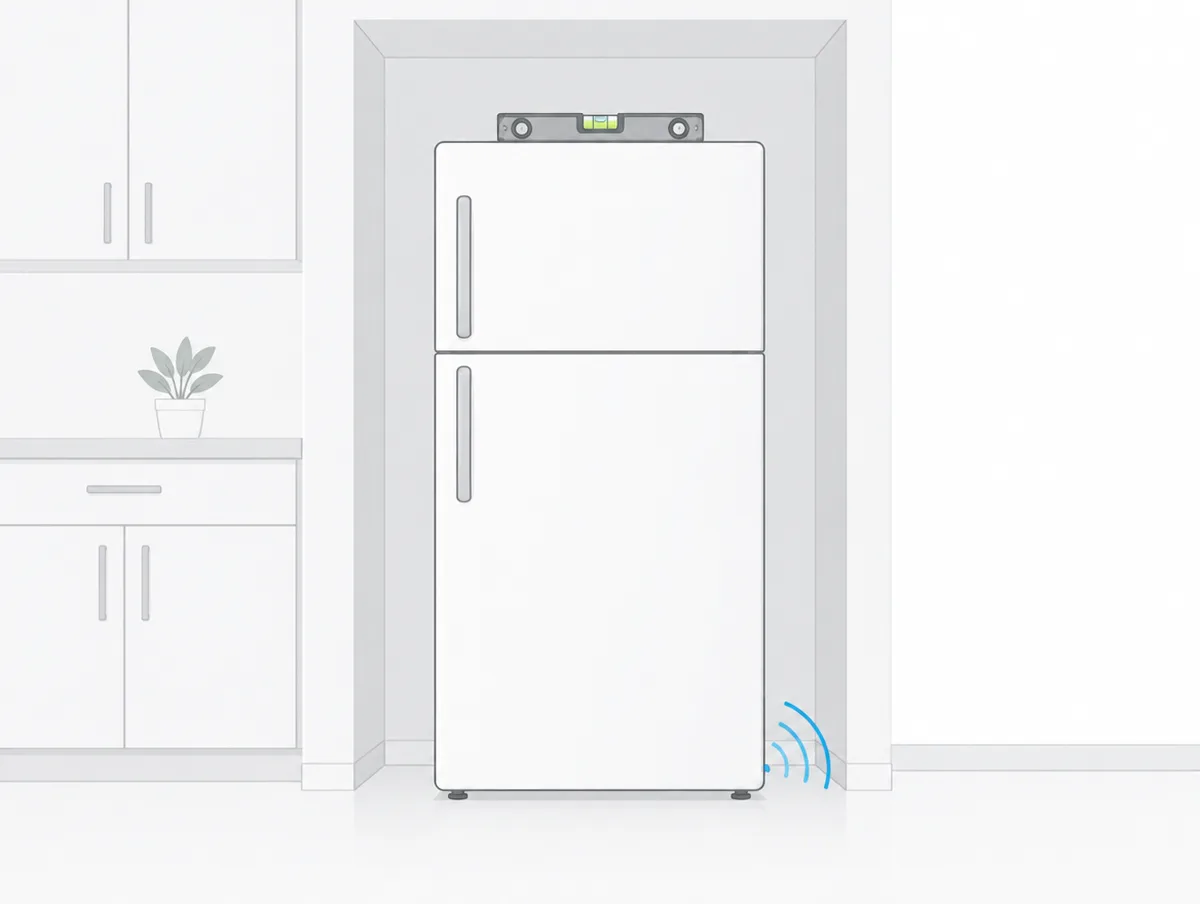
Every caster touching, the cabinet upright, space around the grilles. Danby, Midea, AlorAir and Frigidaire each connect an uneven or unstable footing to noise.
"On a flat, sturdy surface. Failure to do so could result in damage or excessive noise and vibration." That is Danby's installation rule. Midea's Cube manual has two entries under a unit that "makes a loud noise when operating": "The unit is tilted instead of upright as it should be" and "The floor surface is not level". Frigidaire's noise guide traces humming or vibration to a unit "not resting on the castors evenly", and AlorAir's FAQ has you confirm the unit "is placed on a firm flat ground" before you look at the filter.
Carpet is ruled out twice. It "can block air flow around the appliance", Danby says, and forcing casters across it can unbalance the cabinet. GE's units roll "only" on smooth, flat surfaces.
Clearance around the grilles
The manuals ask for anything from 6 inches (AlorAir) to 18 inches (GE). Airflow is the reason given every time; nobody claims the extra space lowers the sound.
| Maker and model | Clearance the manual asks for |
|---|---|
| GE ADYR and APYR | 18 inches on all sides |
| Honeywell TP series | 17.7 inches from curtains or furniture |
| Danby DDR050BSWDB | 16 inches at the air outlet and the front and back; 8 inches each side |
| Midea Cube | 8 inches on all sides, 16 inches at the air outlet |
| Frigidaire FHDP5033Y | 15.75 inches around the unit |
| Hisense DH5024K1W | 12 to 18 inches at the rear and sides, or above top louvers |
| Frigidaire FHDD2234W and LG LD series | 12 inches around the unit |
| AlorAir Sentinel Elite | 6 inches at the inlet and outlet |
Midea also wants the unit "away from any clothes dryer, heater or radiator", with nothing placed on top, which "would restrict airflow". For best results, the AlorAir Sentinel Elite manual suggests the middle of the room.
Do anti-vibration pads help a dehumidifier?
The portable manuals never mention pads or mats. Santa Fe is the only maker that calls for them, under its ducted Ultra98 and Ultra120 when they stand on a floor.
Attach the levelling feet "and use vibration pads and/or risers", the Santa Fe manual instructs, and do not set the unit on structural members without vibration absorbers or "unwanted noise may result." For portables the answer stays a level, solid floor with every caster down. A mat soft enough for the casters to sink into could tilt the cabinet, which is one of Midea's causes of loud running, and nobody tests or recommends one.
Why is a new dehumidifier so loud?
Two reasons. It may need to stand upright before its first run, and its first days are its busiest.
Shipping can leave the compressor oil out of place. AlorAir warns that a Sentinel Elite "may have been tilted or placed upside down during shipping", and resting it upright "stabilizes the compressor oil" over 24 hours. Frigidaire's rule is shorter: "Unit must be upright for one hour prior to operating."
Then comes a long first stint. GE has a new unit run continuously for 24 hours. Honeywell suggests 30% humidity at high fan for the first 2 to 3 days, until damp odors clear, before raising the setting, and LG allows 3 or 4 days to reach the desired dryness. A unit that settles down once the room is dry is doing what the manual describes.
Ducted units need one more step. Santa Fe tells installers to remove the compressor shipping tie, since leaving it will cause "EXCESS VIBRATION TO BE TRANSMITTED TO THE FRAME."
Does a dirty filter make a dehumidifier louder?
Yes. Midea and Danby list a dirty air filter under noise, and AlorAir's FAQ asks whether the filter mesh is jammed when a unit runs loud.
Cleaning schedules are close. About every two weeks for Midea, Frigidaire and Danby; GE and Frigidaire light a reminder after 250 hours of running; Honeywell says it depends on the room. Midea and GE both forbid running without the filter.
Two neighbors of the filter matter as well. The FHDD2234W guide has you vacuum the grille with a brush attachment, and for a rattle, Frigidaire's noise guide checks that "the bucket and filter cover are properly installed". Pull the plug before cleaning, as Frigidaire and Midea both require.
A drain hose ends the bucket alarm
It does nothing for the running sound, as far as any manual says. What it removes is the alarm and the full-bucket shutdowns. If the bucket is full or missing on a GE, "an alarm will sound for about 10 seconds". Frigidaire's FHDP5033Y beeps 8 times when the bucket comes out mid-run, and Danby's units beep 8 times and show P2 when full.
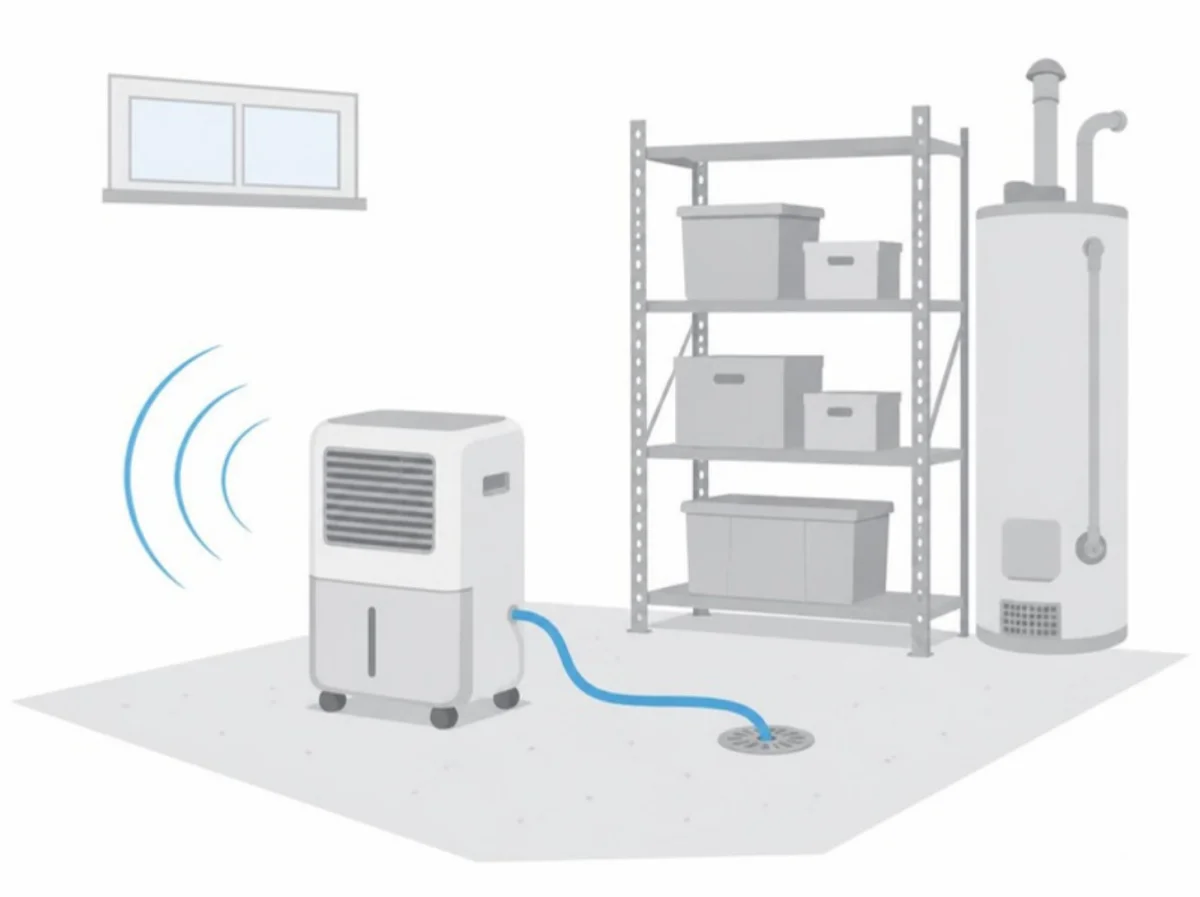
Gravity needs a clear fall. Danby's hose has to go "straight down from the back of the appliance" and be no longer than 6 feet. Frigidaire asks for a 1/2 inch or larger hose with "no kinks or elevations", and Midea suggests the end sit 4 inches below the connection.
A built-in pump brings its own sound. "The pump may generate a loud noise for the first 3~5 minutes of operation," Midea's Cube manual cautions. The pump on Frigidaire's FHDP5033Y runs only when the bucket fills. If there is a floor drain lower than the unit, a gravity hose avoids pump noise altogether.
Beeps and display lights
Honeywell's Sleep Mode dims the display, and after one minute "the top display will shut off" apart from the Sleep indicator. Nothing in that manual says Sleep changes the fan.
That is as far as any portable maker goes. The Cube "will make a beep sound to indicate that it is changing modes", and Midea gives no way to switch it off; none of the portable manuals offers a way to mute the bucket alarm or the button beeps. A drain hose remains the only way around the full-bucket alarm. How sleep and quiet modes differ from one appliance to the next is covered in sleep and quiet modes.
Whole-house and crawl space units are quieted at installation
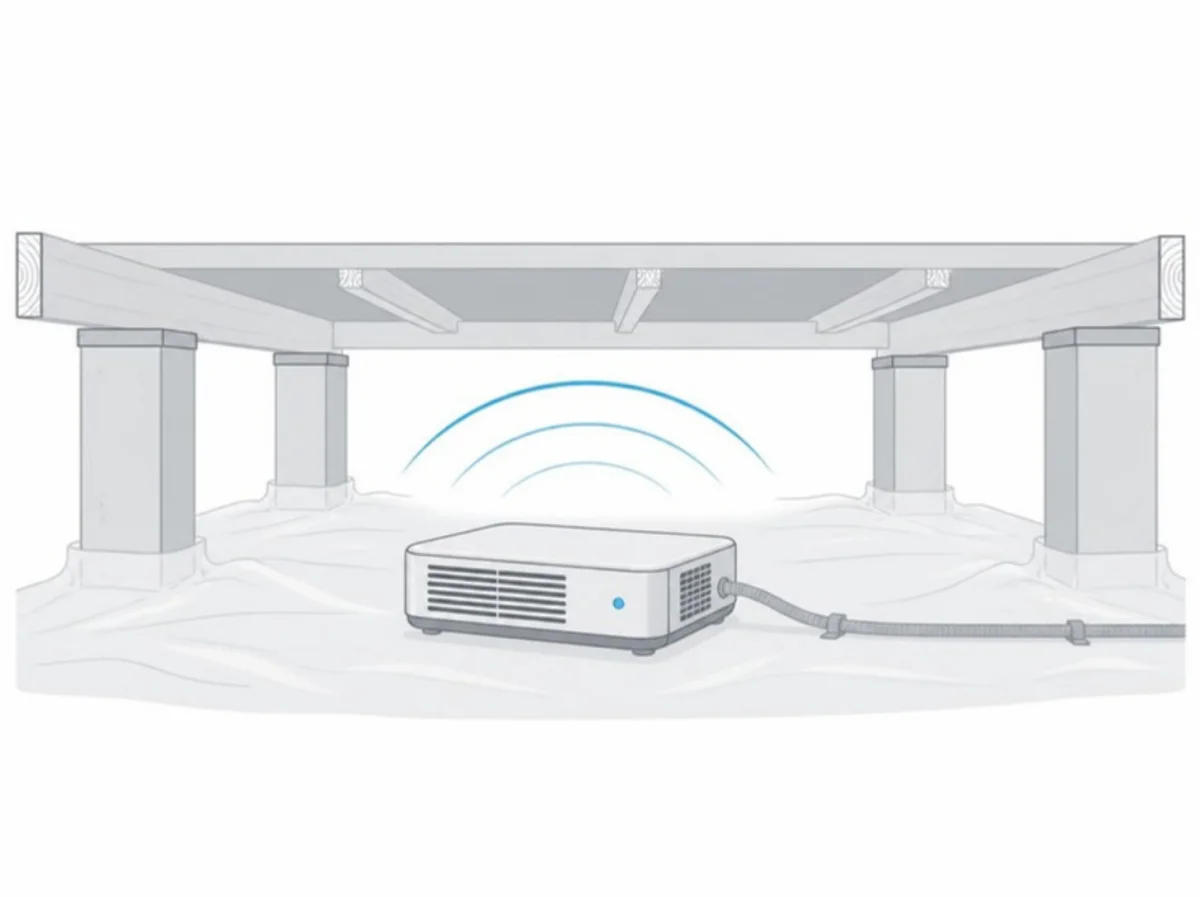
The work happens when the unit goes in: flex duct on the collars, ductwork on both sides, isolation from the house frame, and hanging the cabinet where that is allowed. Santa Fe, Honeywell Home and AprilAire write these steps for installers.
Santa Fe wants a short length of flexible duct at every connection to keep noise and vibration out of the house's rigid ductwork. On the outlet side, at least 8 inches of insulated flex duct, or some other vibration-isolating material, quietens the blower's air noise.
Honeywell Home's DR90 installation guide reads "To ensure quiet operation, do not place the device directly on the structural supports of the home", and recommends flex duct at the collars "to reduce vibration noise." Ductwork on inlet and outlet will "reduce the noise level of the dehumidifier," according to AprilAire's E070 manual, and both it and the E080 and E100 manual suggest suspending the unit in attics "to reduce noise transference."
The E050 sheet puts a number on the ducts: 54 dBA ducted, 57 dBA un-ducted.
All of this is contractor work. AprilAire, Santa Fe and Honeywell Home address these manuals to installers, and AlorAir sends owners to a qualified technician for repairs.
Things the manuals rule out
Boxing it in, a closet, anything on top, carpet, tipping it over. Most of the reasons come down to free air and an upright cabinet.
The FHDD2234W produces heat and "should not be operated in an enclosed small space like a closet." GE wants no curtains, blinds or furniture blocking the top or back, and Midea wants nothing on top.
Leave defrost alone as well. GE warns against any means of speeding up defrosting or cleaning beyond what it recommends. A fan running by itself while the compressor rests is often a defrost cycle, which dehumidifier noises explains.
If the unit gets knocked over, Midea's instructions are to switch it off and unplug it at once, check for damage, and call customer service if you suspect any.
When is a noisy dehumidifier a fault?
When the noise comes with a smell or smoke, or survives the floor, filter and bucket checks. LG, Midea, Danby and Hisense all tell owners to pull the plug for strange sounds with smells or smoke. "If the product makes a strange noise or emits a smell or smoke, pull the power plug out and contact customer service," in Hisense's version, and LG's manual, read through the Internet Archive copy after lg.com blocked automated requests, prints nearly the same line as Midea's.
Beyond that, the makers want a technician, not a screwdriver. Frigidaire's noise guide sends units installed within 30 days back to the installer and older ones to its service line. GE leaves maintenance and service to "technicians properly trained and qualified in the use of flammable refrigerants." The Sentinel units "should only be maintained and repaired by a qualified technician," AlorAir states.
How quiet can a dehumidifier get?
Portable compressor models in our guides carry figures in the 40s on low fan, Frigidaire's 43 dBA among them. AprilAire's whole-home units list 45 to 55 dBA ducted. None of them names a measuring distance.
hOmeLabs, which has product pages but no owner's manual on its site, answers "How loud is the dehumidifier when running?" for its 25 pint model with "This unit operates at just 47 dB". Its 40 pint pump model lists "a quiet 49 dB noise level". Neither names a fan speed.
A unit that is level, clean, on low fan, drained by hose and still too loud has run out of fixes. The answer then is a model with a lower published figure. For a sense of scale, the decibel chart puts those figures next to a fridge, a conversation and other household sounds, and dBA explained covers why two makers' figures rarely compare cleanly.
Picking a quieter model
The quietest dehumidifiers guide ranks portables by their makers' low and high fan figures, with separate picks for an apartment and a basement. Ducted units have the quietest whole house dehumidifiers and quietest crawl space dehumidifiers.
Every figure one maker prints sits on its brand chart: Frigidaire, Hisense, AprilAire and AlorAir. For the room itself, see the plans for a quiet basement and a quiet bedroom.