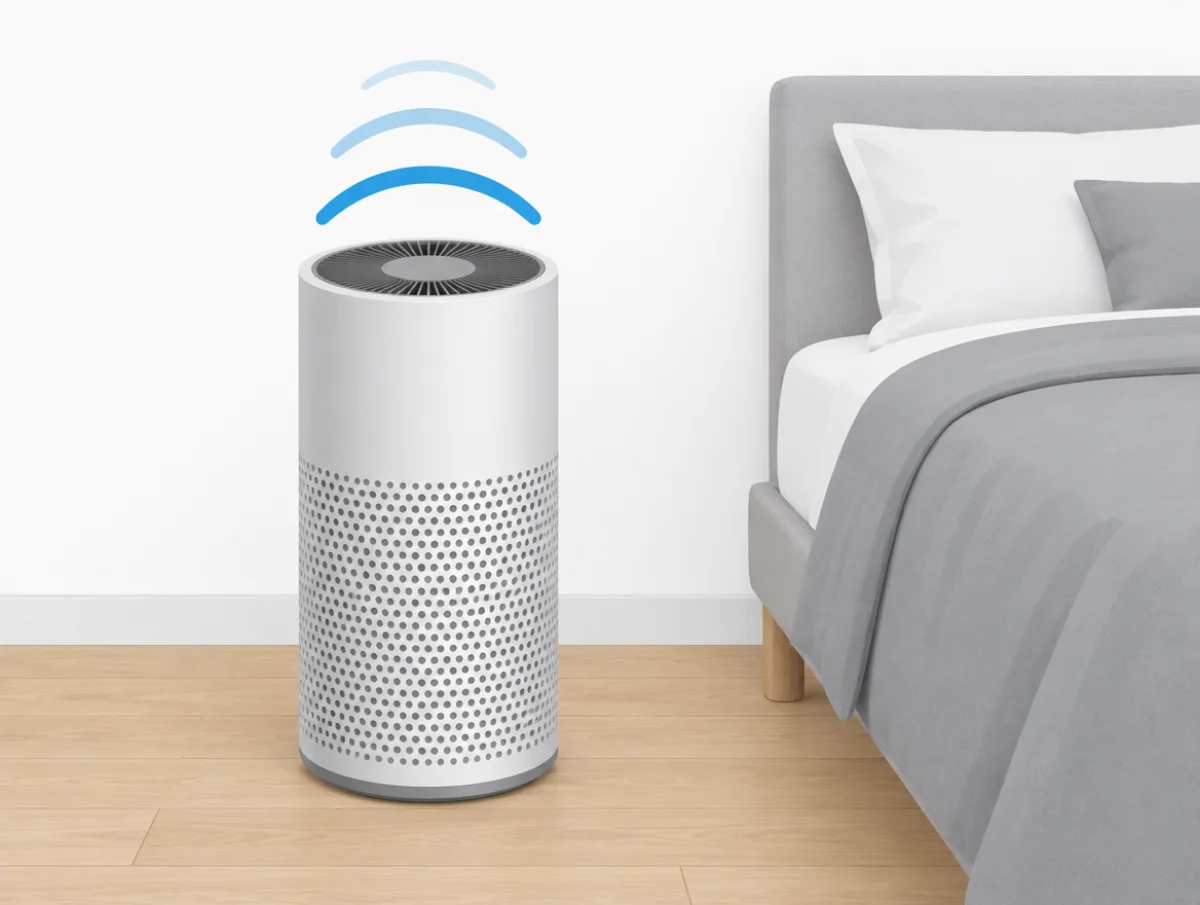
IQAir rates its Atem X at 15 dB(A) on speed 1 and 58 dB(A) on speed 8, both at 3.3 ft. Nothing else an owner can change comes close to that spread. Quieting an air purifier mostly means changing what it is asked to do: switch on sleep or night mode, stop auto mode from racing to its top speed after dark, turn down the lights and tones, leave space around it, keep the pre-filter clean, and choose a model big enough to idle.
The steps come from the manuals and support pages of Coway, Levoit, Winix, Blueair, Honeywell, IQAir, Dyson, Medify, Rabbit Air and Alen, ordered from a button press to a new purchase.
Clicks, rattles, grinding or a hum with the power off are symptoms, not settings. Our guide to air purifier noises works through those sounds one by one; this page is about lowering the ordinary sound of a purifier that works.
Six fixes, in order of effort
Each one either slows the fan, stops it speeding up, or lets it move the same air with less effort.
- Use sleep or night mode, or the lowest manual speed.
- Cap auto mode overnight, or lower the sensor sensitivity.
- Dim the display and mute the tones.
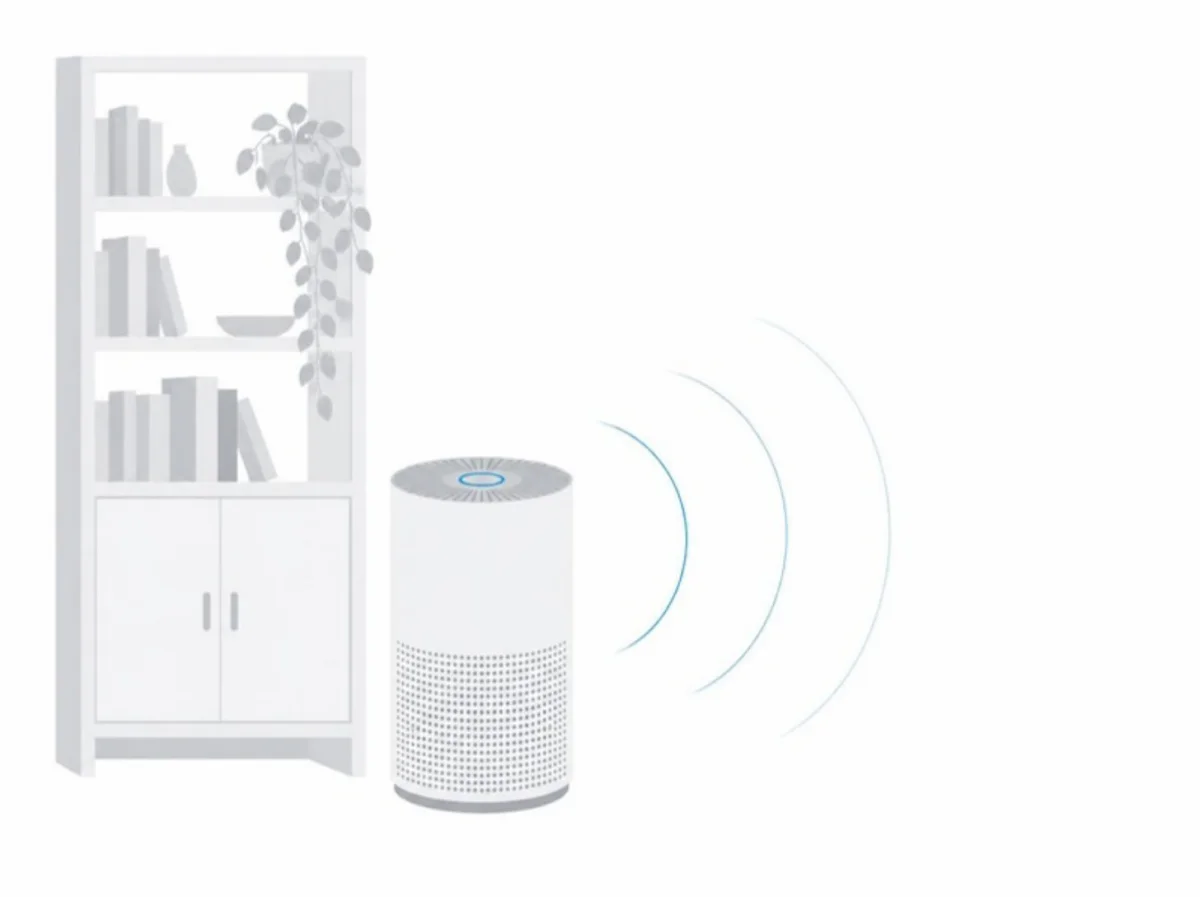
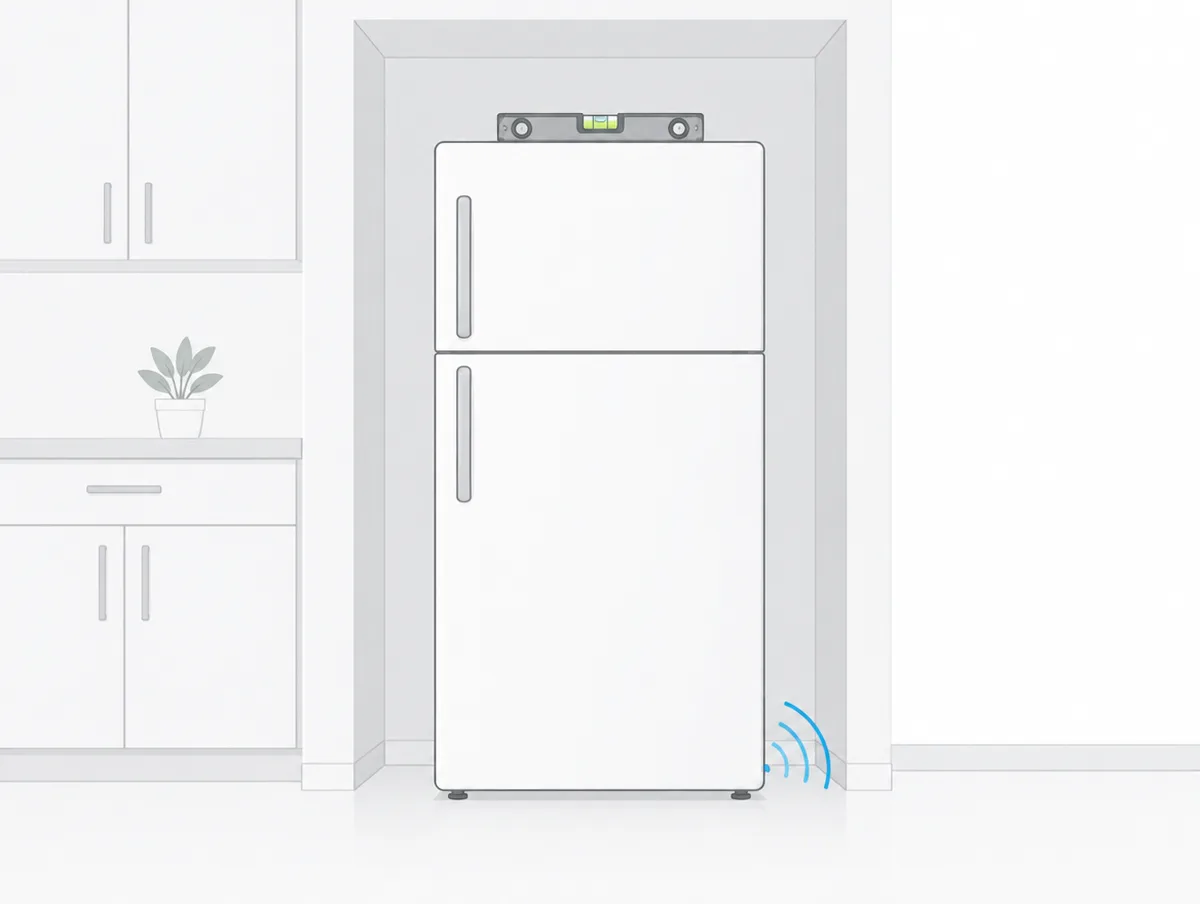
- Give it the clearance and the firm floor its manual asks for.
- Clean the pre-filter and replace the main filter on schedule.
- If it still has to run fast, buy a purifier rated for a bigger room.
The speed setting is the biggest lever
Across the published sheets, the lowest fan speed sits 13 to 43 decibels below the highest.
IQAir's spread is the widest with a stated basis, given as sound pressure at 3.3 ft and listed on our IQAir decibels page. Levoit's Core 300S-P manual prints a noise level of 22 to 54.5dB with no distance attached, while Medify's MA-40 spans only 40.5 to 53.3 dBA.
The slowest MinusA2 speed, which Rabbit Air's manual calls Silent, is listed at 25.6 dBA, and our Rabbit Air decibels page has all five speeds. Decibels are logarithmic, so a 30 dB gap is far bigger than it looks, and the decibel chart puts these figures beside everyday sounds.
What does sleep mode change on an air purifier?
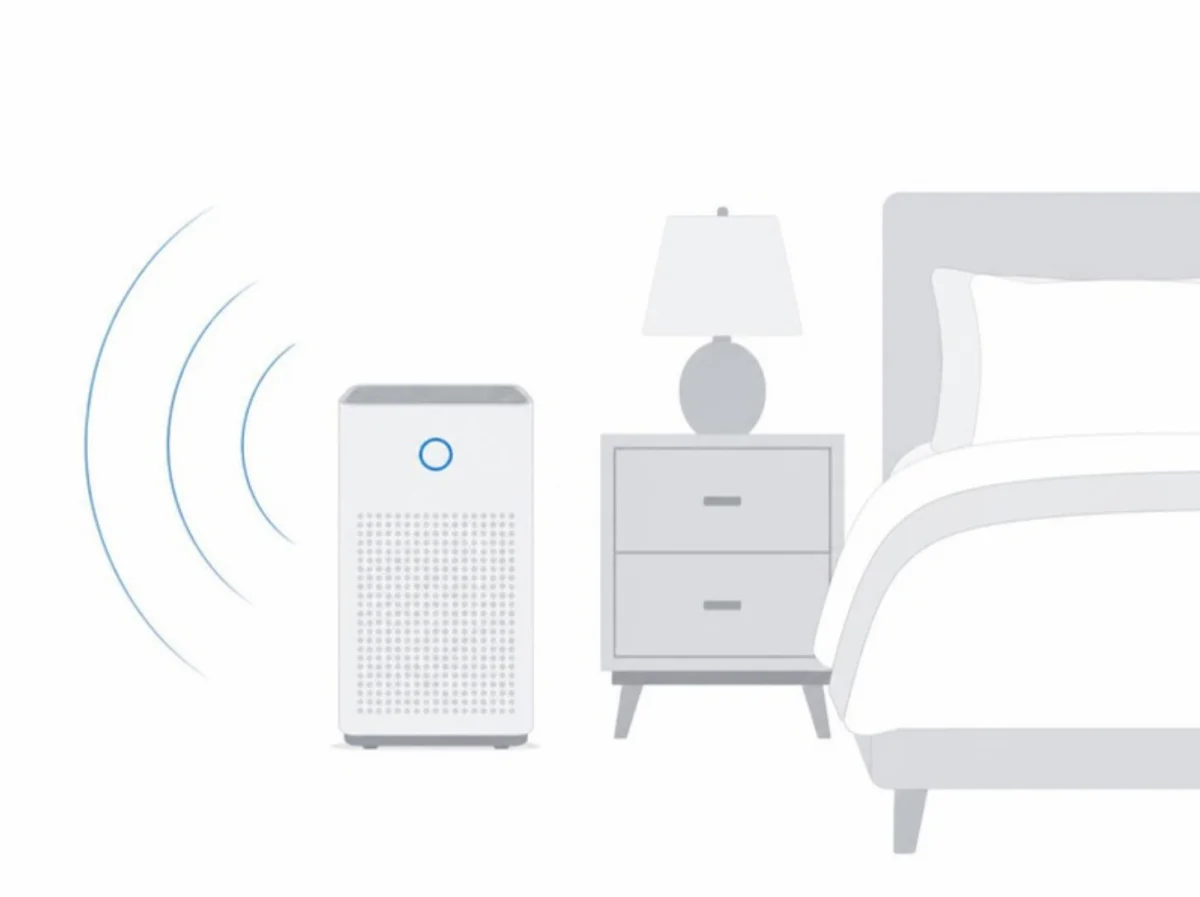
On most models it drops the fan below its normal lowest speed and switches the lights off or down. Levoit, Winix, Coway and Blueair all describe both. Medify, Alen and Honeywell differ.
| Maker and model | What the sleep or night setting does, per the manual |
|---|---|
| Levoit Core 300S-P | Fan speed lower than fan speed 1; display off after 3 seconds |
| Winix 5510 and A230 | Minimum speed, lower than Low; air quality light off |
| Coway Airmega Mighty2 | Lowest airflow speed; all display lights off except Sleep |
| Blueair Blue Pure 411i Max | Night mode is the lowest of four speeds, with fully dimmed lights |
| Dyson TP10 | Keeps monitoring, using only its quietest settings, with the screen dimmed |
| Medify MA-40 | Low fan speed with dimmed lights; 40.5 dBA, equal to its speed 1 figure |
| Alen BreatheSmart 45i | Lights turn off while the unit keeps working; no fan change stated |
| Honeywell HPA300 series | No sleep mode; a dimmer and a 2, 4 or 8 hour timer |
On the Core 300S-P, Sleep Mode "operates quietly by using a fan speed lower than fan speed 1." The 5510 manual from Winix puts its minimum speed below Low, "which will be nearly silent", and the Winix FAQ lists that setting as a fifth fan speed called Quiet.
Dyson does it differently. In Night mode the TP10 "will continue to monitor and respond to changes, but only using its quietest settings," according to its manual, with the screen dimmed. That is a capped auto mode, not a fixed speed.
Medify is the outlier. Sleep mode on the MA-40 "will operate on the low fan speed setting and dim the lights", and its technical data gives 40.5 dBA for Sleep Mode and for speed 1 alike. On that model, sleep mode saves light, not sound.
Light sensors can start sleep mode
Purifiers with a light sensor can switch themselves over. Winix, Coway and Rabbit Air each describe a sleep or dark setting that starts once the room has been dark for one to three minutes, and Levoit's EverestAir does something similar.
The thresholds in the Winix FAQ are exact. Sleep Mode can start when the room is darker than 2 lux for more than 1 minute and ends when it is brighter than 3 lux for over a minute, though the automatic switch "is not featured for A230 / A231".
Three minutes of dark in Smart mode sends Coway's Mighty2 to sleep. The Airmega 300 and 400 want clean air as well: sleep "operates when the room is dark and the air quality is Good(Level 1) for 3 minutes."
The MinusA2 from Rabbit Air turns on Sleep Lighting after three minutes of dark. In Auto Mode the fan then drops to Silent, but "Sleep Lighting will not override the fan speed" on a manual speed.
A bedside lamp left on can stop any of these light-sensing modes from starting.
Capping auto mode for the night
Auto mode answers its sensor, not the clock, so it can climb to full speed at any hour. Levoit and IQAir sell capped auto settings for that reason, and Dyson's Night mode works the same way.
Quiet Auto Mode, set in the VeSync app, "uses medium fan speed instead of the high or turbo fan speeds," according to Levoit's Core 400S-P manual. The EverestAir adds Light Detection: once the room is dark, auto "will not use the high fan speed or Turbo Mode", and the limit lifts when the lights come back on.
The Atem X manual offers three smart modes in IQAir's app and describes Quiet as "For noise-sensitive environments such as bedrooms." It stops at level 5 of 8, rated at 37 dB(A) against 58 dB(A) at the top, which takes the loudest part of the range off the table.
Dyson's auto takes another route. The TP10 "will pause when the target air quality has been reached", switching on again when the air gets worse. Whether a pause and restart disturbs you more than a steady low hum is personal. Try a night of each.
Turning down the sensor's sensitivity
Coway's Mighty2 and Rabbit Air's MinusA2 both let owners change it from the control panel, though neither presents it as a noise setting.
The Mighty2 has three levels, L1 "Sensitive", L2 "Standard" and L3 "Insensitive", set by holding the mode and information buttons for 3 seconds, and Coway suggests the change when the indicator "remains at very unhealthy (red) or good (blue) for more than two hours". The same manual's troubleshooting table notes that the sensor may sit in a spot where it cannot read the air, and suggests moving the purifier. On the MinusA2, the sensors "come preset at a standard sensitivity level as a default", with a low and a high level on either side.
A dirty sensor is the other suspect. Dust "affects the sensor's accuracy," Levoit warns, asking for a clean every 3 months; Coway's Airmega 300 and 400 want one every 2 months, and Rabbit Air every three to six months.
Dimming the lights and muting the beeps
Most models dim or switch off their lights from a button or app, and Coway's Mighty2 can mute its tones. Honeywell's HPA series powers up with its lights on HIGH every time.
| Maker and model | Lights | Sounds |
|---|---|---|
| Coway Airmega Mighty2 | Sleep mode turns the display off | Hold Speed and Light for 3 seconds to mute |
| Levoit Core 300S-P | Display Off button | No mute described |
| Blueair Blue Pure 411i Max | Brightness set from the buttons | No mute described |
| IQAir Atem X | Light button; three brightness levels in the app | No tones described |
| Alen BreatheSmart 45i | LO, HI or AUTO lighting | A chime confirms each touch |
| Honeywell HPA300 series | Dimmer button | No mute described |
The AUTO lighting setting on Alen's 45i "senses light levels and dims or turns off lights in a darkened room." Honeywell's HPA manual leaves no room for doubt: "The unit always turns on with the brightness on HIGH."
Other tones are one-offs: the MA-40 beeps once when plugged in and a Winix filter reset ends with a beep, but none of these manuals describes a repeating alert you would need to silence at night.
Where should you put an air purifier so it runs quieter?
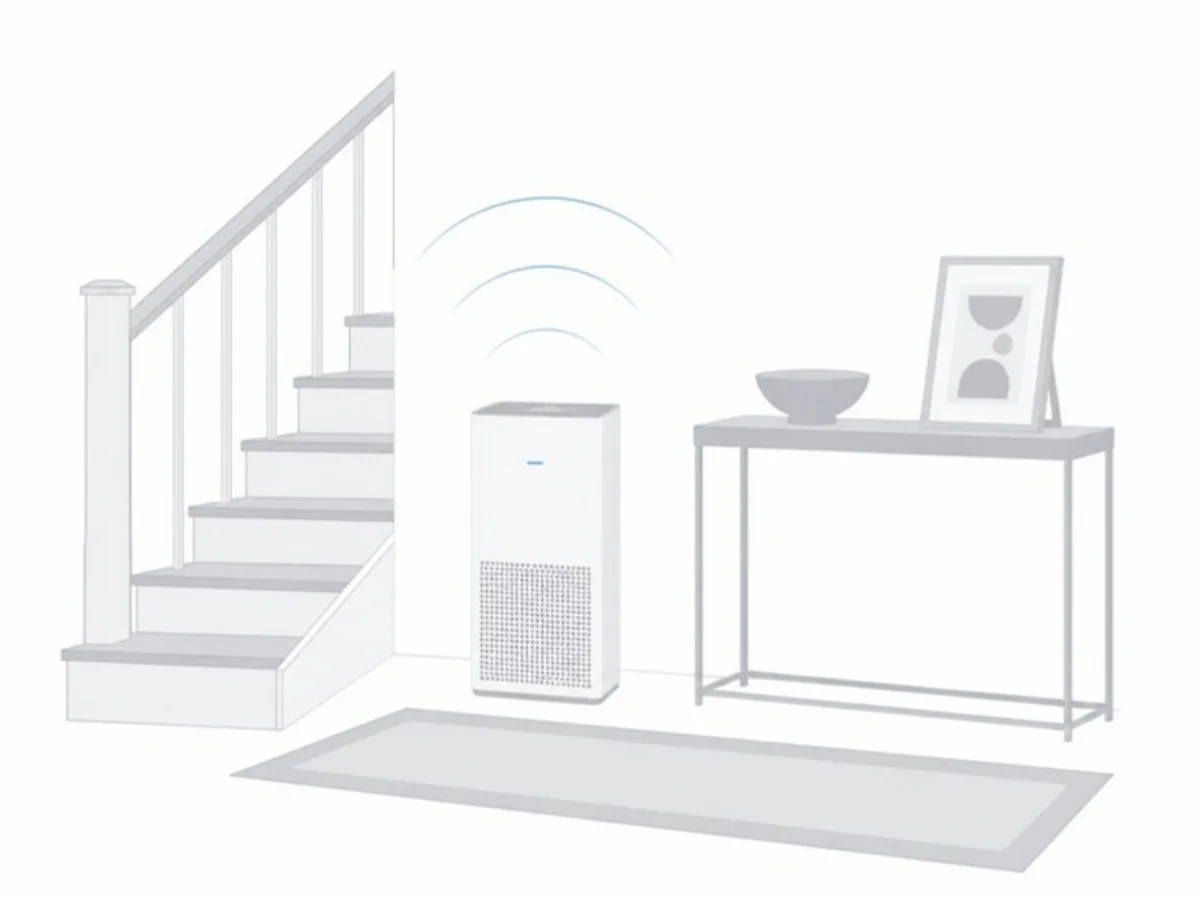
On a hard, level floor, with the clearance its manual asks for, usually 4 to 24 inches from walls and furniture. Those gaps are for airflow. Soft or sloping surfaces are what Winix links to noise.
| Maker and model | Clearance the manual asks for |
|---|---|
| Blueair DustMagnet | At least 4 inches (10 cm) from any object |
| Winix 5510 | 12 to 18 inches from walls |
| IQAir HealthPro XE | Diagram marks a minimum distance of 12 inches (30 cm) |
| Levoit Core 300S-P and 400S-P | 15 inches (38 cm) on all sides |
| Medify MA-40 | 20 inches (50 cm) or more from the air inlet to any wall or furniture |
| Rabbit Air MinusA2 | 2 feet in front of the outlet, 8 inches at the intake |
| Honeywell HPA series | Front facing away from the closest wall or furniture |
| IQAir Atem X | Can be placed directly against a wall |
"Flimsy or slanted surfaces may result in abnormal noise and vibrations," the Winix manuals print. Honeywell asks for "a firm, level and flat location", Alen rules out placing the purifier "on a soft or unstable surface such as a bed or sofa," and IQAir's HealthPro XE manual excludes soft furnishings too.
Walls are where the makers disagree. The Atem X "does not have to be positioned in the middle of the room," while Medify wants 20 inches "to ensure proper performance". Follow your model's figure rather than the strictest one on the list.
Among its tips for best performance, Blueair's DustMagnet manual also asks owners to keep the room's doors and windows closed while it runs.
Does a clogged filter make an air purifier louder?
It can, by Levoit's and Blueair's account, because the fan struggles for air.
Levoit counts increased noise among its signs that the filter needs replacing: the Core 300S-P manual names "Increased noise when the air purifier is on" next to weaker airflow and odors. IQAir explains the airflow side, since its rated air delivery "will decrease as filters load up with dust particles." In Blueair's 411i Max manual, clogged filters starve the motor of air, and the fix is to vacuum and wash the fabric pre-filter.
| Maker and model | Pre-filter | Main filter |
|---|---|---|
| Blueair DustMagnet | Wipe or vacuum weekly | Replace every 6 to 12 months |
| Winix 5510 and A230 | Clean every 14 days | Replace about every 12 months |
| Levoit Core 300S-P | Brush or vacuum every 2 to 4 weeks | Replace every 6 to 8 months |
| Coway Airmega Mighty2 | Vacuum or wipe every 2 to 4 weeks | Replace every 12 months |
| Honeywell HPA300 series | Replace the carbon pre-filter every 3 months | Replace every 12 months |
| Rabbit Air MinusA2 | Clean as the room's air quality requires | Replace the HEPA filter every 12 months |
| Medify MA-40 | No pre-filter step; clean the purifier every 6 to 8 weeks | Replace every 2,500 hours |
"None of the filters are washable," Honeywell states, so its pre-filter is a part you buy. Alen's 45i has a mesh prefilter on the filter's front face that "can be vacuumed to maintain efficient operation of the unit", with no interval given. A Winix pre-filter can be rinsed in room temperature water, then needs 24 hours or more of drying.
A new filter only helps if the wrapping comes off and it sits right; our noises explainer covers what Levoit and Blueair say about that. Cut the power before opening the filter door, as Coway, Blueair and Levoit each tell owners to.
Will a bigger air purifier run quieter?
Usually. A purifier rated for more than your room can clean it on a slower speed. No maker spells this out in so many words, but their room size ratings and air change figures add up to it.
Rated room sizes at Winix rest on 4.8 air changes per hour, and in a larger room "the ACH will decrease accordingly", with AHAM advising against going below 2. Blueair asks owners to use the DustMagnet "in a room that does not exceed the room size recommendation." Coway's Mighty2 troubleshooting table blames an indicator that stays red on a room that "may be too large for the purifier's capacity", and in auto mode a purifier that cannot catch up stays on its loudest speeds.
Read the room size claim carefully. The MA-40 is rated for 896 sq ft when the air is changed twice an hour and 377 sq ft at 4.8 changes, so the bigger number assumes the air is cleaned less often. Levoit's Efficient Auto Mode asks for your room size in the app and settles at "the fan speed best suited to the selected room size". Our quietest air purifiers guide explains the two-thirds sizing rule.
Noises that point to a fault
A sound that comes with a smell or smoke, something loose or caught inside, or a noisy fan: those go to service.
Unplug the purifier "if strange sounds, smells, or smoke come from the product," Coway instructs, and "All other servicing should be done by COWAY authorized service center." Alen's 45i manual gives the same order, and Honeywell's rules out using "any product that malfunctions".
The Winix FAQ allows one home check, turning the unit upside down to shake out an object, but "Do not try to open the unit". A noisy fan goes through the Winix warranty process. Each brand's fault list is in our guide to air purifier noises.
Guides for a quieter or larger model
If your purifier is set, placed and cleaned as its manual asks and still too loud at the speed your room needs, the remaining fix is a quieter or larger model, and our guides rank them by maker figures.
The quietest air purifiers guide reads each sleep and low speed figure for bedrooms. For bigger spaces there is the large-room guide; for shedding pets, the quietest purifiers for pets; and for a tight budget, the quietest under $100.
Brand pages for Levoit, Coway, Winix, Blueair, Medify, Alen, Dyson, IQAir and Rabbit Air list every current model's noise figure and the setting behind it. For the settings themselves, quiet and sleep modes compares them across appliances, and how quiet is quiet enough helps you pick a target level for a bedroom.
Honeywell's licence and the figures behind this page
Honeywell air purifiers are made under licence, and the HPA manual used here is hosted by HoneywellStore.com, which says it operates under licence from Honeywell. The decibel figures for IQAir and Rabbit Air come from our brand pages, which quote each maker's product pages. Dyson's TP10 manual is the US edition, and Winix's FAQ supplied its light thresholds and room size notes.