Three beeps repeated every 25 seconds with a flashing yellow light: on an Inogen Rove 6, that is the sound that wants attention. A steady compressor hum, a puff at the cannula with each breath and a single chirp at switch-on are all printed as normal, by Inogen and by CAIRE, Drive DeVilbiss and OxyGo.
The makers' list of trouble is short. An alarm pattern that keeps repeating, a low vibration or a harsh sound from the cabinet, and anything that comes with a change in how your oxygen feels. This page sorts the sounds using the user manuals for eight current portable and home concentrators: Inogen's Rove 6 and Rove 4, CAIRE's FreeStyle Comfort, VisionAire 5, Eclipse 5 and Companion 5, Drive DeVilbiss's 5 liter 525DS series guide, and OxyGo's OxyHome manual, all read on November 10, 2026.
Philips is missing because no English EverFlo manual turned up on its own servers, and ResMed's US oxygen pages returned not found when the buying guide was researched in October 2026. Inogen.com forwarded every request to Inogen's provider pages, which is where its US manuals here come from.
A concentrator is a prescription device. Your flow or pulse setting belongs to the clinician who wrote it, and nothing on this page asks you to change it; this is not medical advice. When a manual says to call someone, it usually means your equipment provider, the company that delivered and services the unit.
A running concentrator is never silent
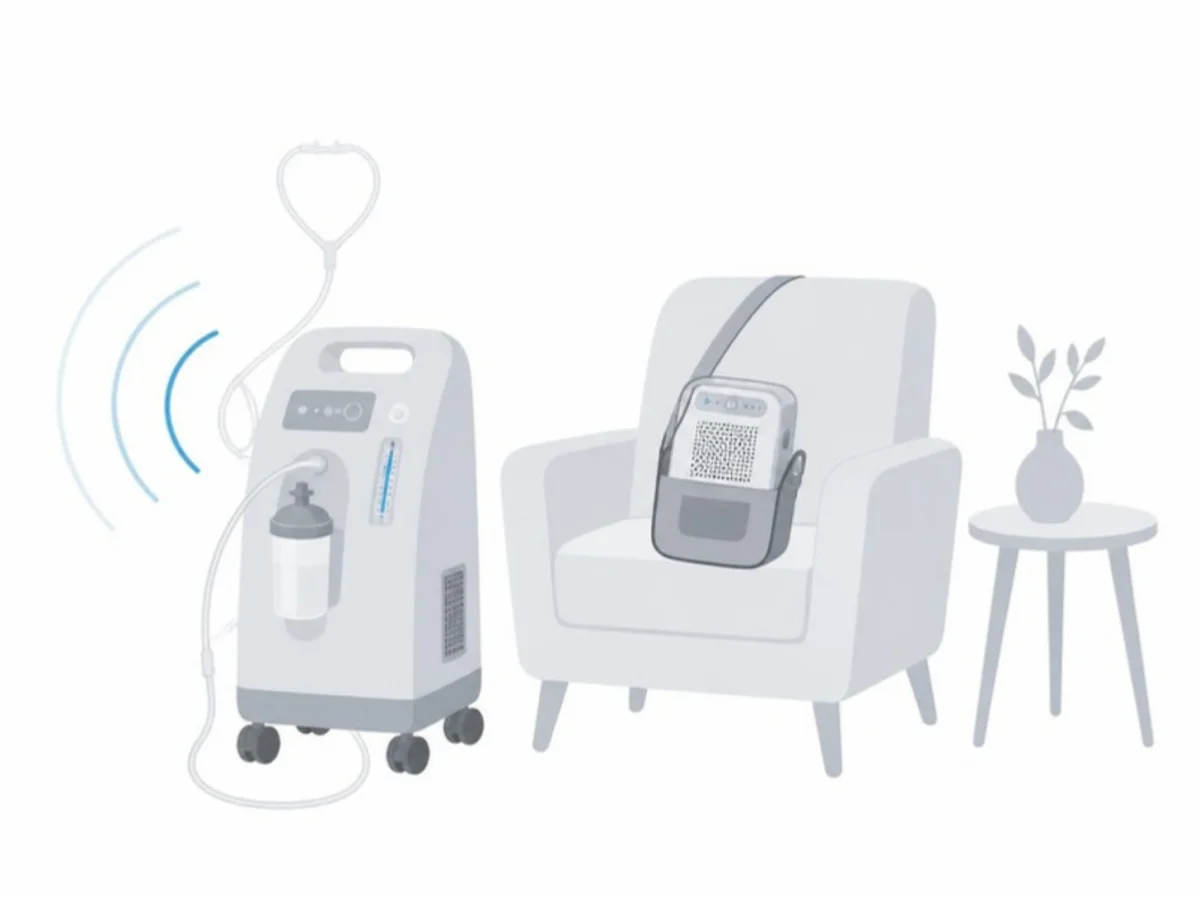
Every concentrator pulls in room air with a compressor and pushes oxygen to your cannula, and the makers expect you to hear it. A different setting even brings a different sound. "It is normal to hear a difference in sound as you change the flow setting." That line is in Inogen's Rove 6 manual, word for word in the Rove 4 manual, and in CAIRE's FreeStyle Comfort manual as well.
It describes a setting your prescriber chose, not one to experiment with. The Rove 6 follows it at once with "Set your concentrator to flow settings prescribed by your doctor" and "Too high or too low a rate may eventually lead to harm."
Pulse dose portables make a small sound at the cannula too. On the FreeStyle Comfort, "You should feel a puff of oxygen delivered through the nasal cannula each time you inhale." CAIRE's VisionAire 5 home unit gets a similar line: "You should hear or feel oxygen flow to the prongs of the nasal cannula."
The start-up beep is a self test
A beep at power on proves the alarm works. Drive DeVilbiss, CAIRE and Inogen all build one in, and on a Drive unit a missing beep is itself a fault.
Drive DeVilbiss's 5 liter instruction guide, for the 525DS and 525DS-Q, describes the panel lights coming on "and an audible signal will briefly alarm confirming that the LEDs and audible signal are functioning properly." If a light stays dark or "the audible alarm DOES NOT sound", the alert system is not working.
CAIRE's VisionAire 5 manual warns about the volume: at switch on, "An audible alarm will loudly sound for approximately 1 seconds." The FreeStyle Comfort settles for "A brief audible alarm" to show it has powered on. Hold the power button on a Rove 6 and you get "a single short beep", with another single beep when a battery is attached. The alarm system "is tested during the startup sequence", when the lights should show and you should hear "the audible alarm indicator chirp."
What do the beeps on a portable oxygen concentrator mean?
They signal a status change or an alarm, and the pattern gives the priority. "More frequent beeps indicate higher priority conditions," reads the Rove 6 manual, and a flashing light outranks a steady one.
The Rove 6 has four levels:
| Pattern | Priority | Examples in the manual |
|---|---|---|
| A single short beep | Informational | Switching to battery after losing external power |
| One beep, solid yellow light | Low | Columns due for replacement within 30 days; a slow start, with oxygen still below 87% two minutes in |
| Two beeps, solid yellow light | Low | Battery under 10 minutes; oxygen at 82% or less for 10 minutes; a "Service soon" message; battery or system nearing its temperature limit |
| Three beeps "repeated every 25 seconds", flashing yellow light | Medium | No breath detected; oxygen output below 50% for 10 minutes; battery or system too hot or too cold; system errors that shut the unit down |
CAIRE's FreeStyle Comfort spaces its beeps out instead. High battery temperature, high internal temperature and a high pressure or compressor fault each get one beep every 20 seconds, while no breath detected and low oxygen concentration get one beep every 10 minutes. A low battery warning is "1 beep, no repeat."
No-breath beeps point to the cannula
A portable stops sensing your inhale and starts to beep: after 60 seconds without a breath on Inogen's Rove 6, after 15 seconds on CAIRE's FreeStyle Comfort. Both look at the cannula first.
"Check that cannula is connected to concentrator, there are no kinks in tubing and the cannula is positioned properly in your nose," is Inogen's fix. CAIRE's is shorter, "Check cannula for kinks or leaks", followed by "If problem persists, contact provider."
The Rove 6 has a bell button that turns the audible part of this one alarm on and off. With it off, the unit still switches to timed pulses after 60 seconds, but "the repeating 3 beeps will not be produced", and the setting "does not impact the alarm functionality of any other device alarms". A separate button sets the alarm volume from 1 to 4.
Home units pair a beep with a colored light
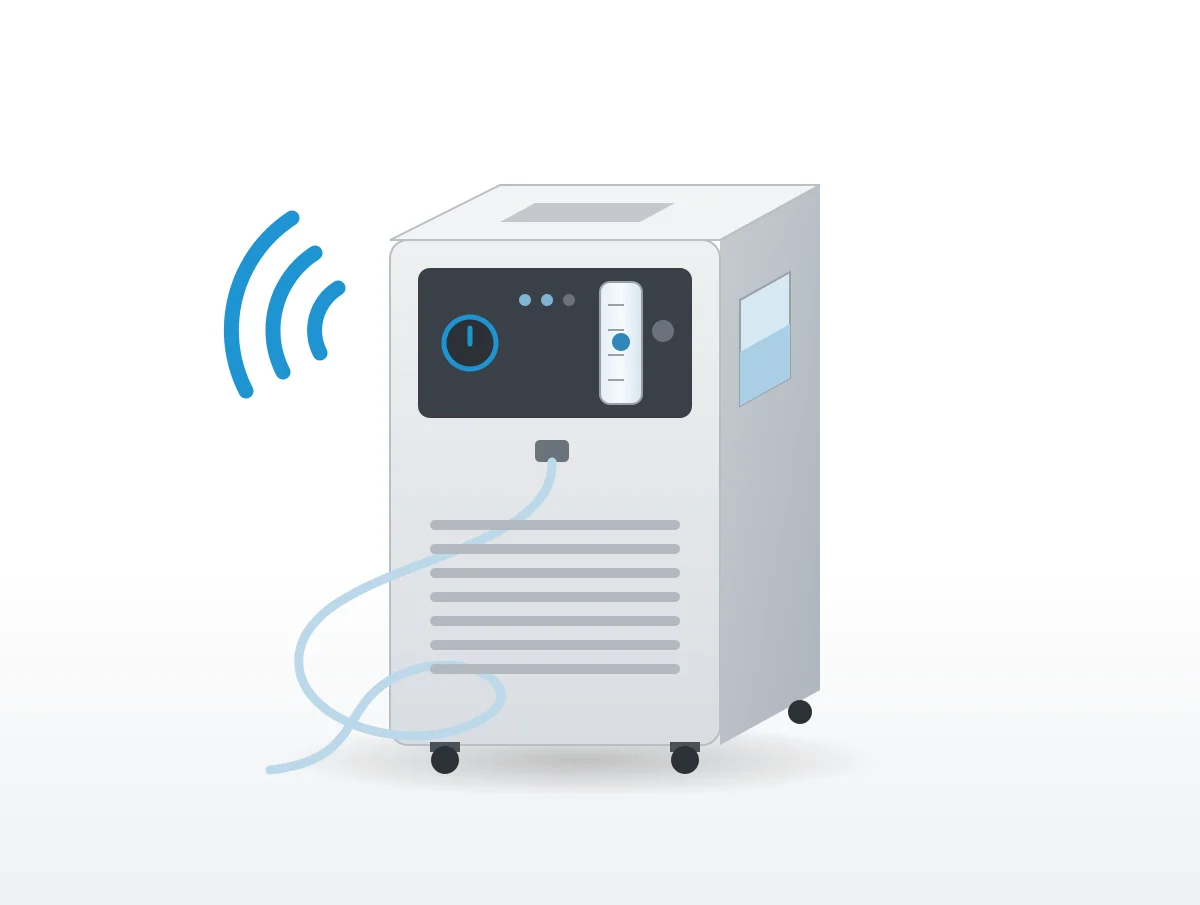
CAIRE, Drive DeVilbiss and OxyGo home concentrators use an intermittent beep and a yellow or red light, and the light names the problem: a power failure, low oxygen concentration, or a general malfunction such as blocked airflow or overheating.
"All alarms are low priority alarms," according to the VisionAire 5 manual. Its general malfunction alarm covers high or low tank pressure and high device temperature, and the fix list is practical. Open the flowmeter to at least the minimum. Check the cannula for kinks. Keep "at least 12" of clearance on all sides", and make sure the "external gross particle intake filter is clean and not clogged."
On Drive's 5 liter chart, a red Service Required light, with the audible alert "may be sounding", traces to blocked filter door vents, a blocked exhaust, a blocked or kinked cannula or tube, a blocked humidifier bottle, or a flow meter set too low. For that last cause the remedy is "Set flow meter to prescribed flow rate."
OxyGo's OxyHome manual defines "An audible signal (beep)" as "either a change in operating status or a condition that may need response". The low outlet pressure and power outage lights flash yellow every two seconds with an alarm, and the low purity light comes on with an alarm once oxygen drops below 82%.
A beep with no running sound means no power
"If the audible signal alarms but the unit is not operating, there is no power to the unit." Drive's chart starts with the plug, the wall outlet and your home breaker, then moves to the concentrator's own breaker button. The VisionAire 5 table agrees and adds: "If the circuit breaker trips again or the alarm continues to sound after the unit is turned on, contact your Equipment Provider."
Why is my oxygen concentrator making a vibrating or buzzing noise?
Of the four makers, only Drive DeVilbiss describes this sound, and it calls it a fault. "If an audible low-frequency vibration sound is detected, the unit is not operating properly." The troubleshooting chart lists "Audible low-frequency vibration sound is detected" with one cause, "Electronic Assembly Malfunction", and one remedy. Turn the unit off, then "Switch to your reserve oxygen system and contact your DeVilbiss provider immediately."
Inogen, CAIRE and OxyGo do not describe a buzz, rattle or vibration in their manuals. Their general rule, covered below, is to work through the troubleshooting table and call the equipment provider for anything it does not fix.
A high-pitched whine has no published explanation
Not one of the eight manuals describes a high-pitched whine, whistle or squeal from a concentrator.
The nearest guidance sits in a Drive DeVilbiss warning about electromagnetic interference: "if it is making unusual or harsh sounds, disconnect the power cord and discontinue use. Contact your home care provider." Explanations from forums or repair sites have not been borrowed to fill the gap. A new high-pitched sound is a question for your equipment provider, with your backup oxygen ready.
Why is my oxygen concentrator so loud?
Often because it is a continuous flow home unit, which the published figures place above pulse dose portables. CAIRE's Eclipse 5 does both, and its Eclipse 5 manual prints "48 dBA at 3.0 LPM Continuous Flow Mode; 40 dBA at 3.0 Pulse Dose Setting; 59 dBA while alarming."
Which mode you use is part of your prescription, so the gap explains the noise without offering a choice.
Among home units, CAIRE's Companion 5 manual prints "50 dB(A) at 2.0 LPM". Drive's 5 liter guide gives the standard 525DS 50.9 dBA at 3 LPM and the quieter 525DS-Q 46.7 dBA at both 3 and 5 LPM, both under ISO 80601-2-69. OxyHome gives only a ceiling, "≤45 dB(A)", with no flow rate named.
A unit that has grown louder than it used to be is on no one's normal list, and the route the makers print runs through the checks in the next section and then to your equipment provider.
How much space does an oxygen concentrator need?
About 12 inches all round for most home units, and at least 3 inches for CAIRE's smaller Eclipse 5. The distances exist to keep air moving and the unit cool, not to cut noise.
The VisionAire 5 should stay away from "curtains or drapes, hot air registers or heaters", with "all sides are at least 1 foot (30 cm) away from a wall or other obstruction", and "Do not place the unit in a confined area." The Companion 5 manual asks for the same 12 inches (30 cm).
Drive's guide gives two distances. In its warnings the unit sits 12 inches (30.5 cm) "away from any wall, draperies, or any other objects", on "a hard surface, avoid thick rugs or carpeting", while the setup step says "at least 6 inches (16 cm)". OxyGo splits the difference with "a minimum of 6 to 12 inches", and the Eclipse 5 asks for "a minimum of 3 inches (7.5 cm)".
Portables need open vents, even in the bag
"Air intake and exhaust must have clear access," Inogen insists, and "Always operate in an upright position."
When the Rove 6 rides in its carry bag, the instruction is to "Make sure both intake vents are visible through the open mesh panels on the sides of the bag and that the exhaust vent is visible from the open mesh panel on the front of the bag." The FreeStyle Comfort manual warns in capitals against "A RESTRICTED OR CONFINED SPACE (I.E., A SMALL CASE OR HANDBAG)", which can make the unit overheat.
Blocked vents turn up in the alarm tables as well. For its "System HOT" alarms, Inogen's fix is to "Ensure air intake and outlet vents have clear access and particle filters are clean". CAIRE's high temperature alarm reads "Ensure there are no blockages on any vents of the unit."
Can I move the concentrator farther from my bed?
Only as far as your tubing and alarms allow. The VisionAire 5 cannula "must be non-kinking" and can be used "for a total length of 25 ft. (7.6 m) max." Longer runs are a question for your provider.
Hearing it is the other limit. "Orient your concentrator in such a way that any auditory alarms may be heard," Inogen writes, and the Companion 5 manual says "Place the device such that the alarms can be heard." How far you can walk away "must be determined based on the surrounding noise level," Inogen adds.
Boxing in, covering or muffling a concentrator is suggested nowhere. Every manual here warns against blocking its vents, and CAIRE and Drive tie poor ventilation to overheating.
How often should you clean an oxygen concentrator filter?
Weekly, for most. Inogen, CAIRE and OxyGo set a once a week schedule for the intake filter, and their alarm tables name a dirty or clogged filter as a cause of overheating and malfunction alarms.
"The particle filters must be cleaned weekly to ensure the ease of air flow," the Inogen manual says, using "a mild liquid detergent and water", rinsed and dried "fully before reuse." The FreeStyle Comfort's air intake filters need cleaning "At least once per week", and "Your oxygen provider may advise you to clean them more frequently". OxyHome's foam cabinet filter "should be cleaned with warm water and mild detergent weekly", and the unit should never run without it "or while the filter is still damp." Drive asks owners to inspect the filter door vents "periodically, and wipe with a dry cloth as needed to remove dust."
None of these manuals links a dirty filter to a louder concentrator. They do say a blocked filter can set off an alarm, which is the sound you will actually hear, and CAIRE's FreeStyle Comfort manual adds "DO NOT OPERATE THE OXYGEN CONCENTRATOR WITHOUT THE AIR INTAKE FILTER IN PLACE."
When should you call your oxygen equipment provider?
When an alarm keeps sounding after the manual's checks, or the unit makes an unusual or harsh sound. If the maker says to switch to backup oxygen first, do that first.
CAIRE's VisionAire 5 manual is typical: "In the event of an alarm or you observe the Oxygen Concentrator is not working properly; consult the troubleshooting section of this manual. If you cannot resolve the problem, consult your Equipment Provider." The FreeStyle Comfort words it almost the same way. For "Intermittent alarm sounds", the VisionAire 5 table says to switch off, "use your reserve oxygen supply and consult your Equipment Provider immediately."
From the Rove 6 manual: "In case of an alarm, seek to address the issue and/or switch to a backup source of oxygen." Most of its alarm rows end with "contact your equipment provider". Where Drive's chart does not help, the instruction is to "switch to your reserve oxygen system and call your DeVilbiss homecare provider. Do not attempt any other maintenance."
Leave the case closed.
"The cabinet should only be removed by a qualified DeVilbiss technician," per Drive, and CAIRE says "Do not attempt any maintenance other than the possible solutions listed within this manual. Maintenance is the responsibility of the provider".
If you cannot hear the alarms at all, Inogen's caution is to "consult your clinician before using this device." Questions about a flow or pulse setting go to your prescriber, never to a noise fix.
How loud should an oxygen concentrator be?
Portables come in at 37.5 to 39.93 dBA at pulse setting 2 on the makers' figures, and 5 liter home units at roughly 39.5 to 51 dBA at 2 to 5 LPM. Each maker measures differently.
The quietest oxygen concentrators guide lays out the portable figures: 37.5 dBA for Drive's iGo2, 38 for Inogen's One G5, 39 apiece for Inogen's two Rove models, and CAIRE's "39,93 dB(A) ± 0,42 dB(A) @ 2" for the FreeStyle Comfort. Not all of them name a test method, so the guide groups them with care.
Alarms are built to be louder than the machine. The Rove 6 manual gives a "Typical highest alarm sound pressure of 67.5 dBA (Measured in the carry bag)", against a maximum system sound pressure of 54 dBA, and the Rove 4 lists a "Typical alarm sound pressure of 53 dBA", both measured at 1 meter per ISO 3744.
Sound pressure and sound power figures differ in kind, which sound power vs sound pressure and what dBA means explain. A lower number is no reason to change devices or settings without your prescriber and provider.
Other devices on the nightstand
The quietest oxygen concentrators guide puts the CAIRE, Drive, Inogen and OxyGo figures side by side, grouped by mode and test. A sleep apnea machine on the same nightstand has its own CPAP noises explained page and quietest CPAP machines guide, nebulizers have the quietest nebulizers, and quiet bedroom covers the other sounds that keep a room awake at night.