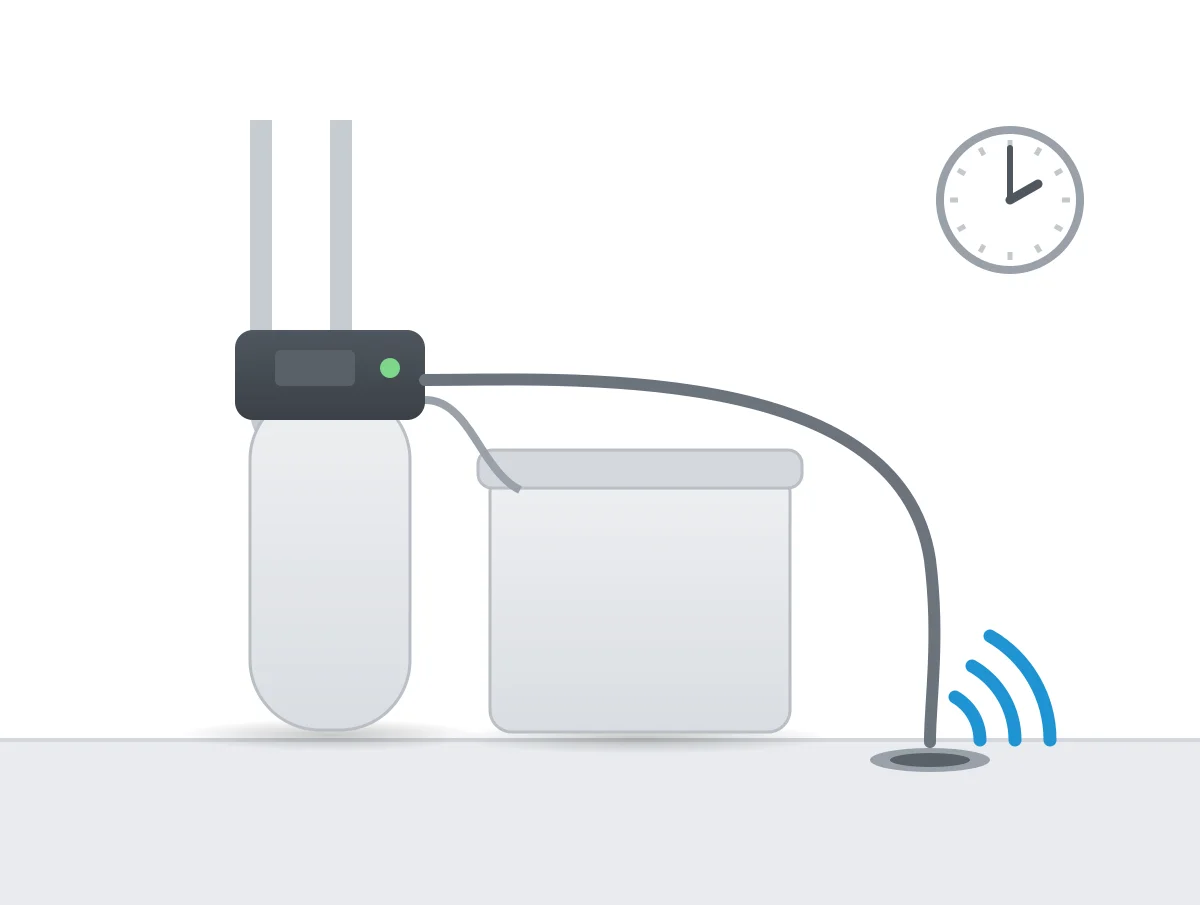
Two in the morning is when most water softeners clean themselves. GE, Morton and EcoWater all print 2:00 AM as the factory recharge time, picked because nobody is using water, and for an hour or two afterwards the softener pushes water through its resin tank and out to a drain. Moving water, plus a small motor stepping the valve between stages, accounts for nearly everything owners hear.
This page is built from owner's manuals, valve service manuals and help center articles published by GE, Kinetico, EcoWater, Whirlpool, Morton, Culligan, Pentair (for Fleck valves), Clack and Water Boss. Whirlpool, Morton and EcoWater run help centers with identical articles, so a line quoted from one usually appears word for word on the other two. Rheem was on our list, but its softener manuals turned up only on third party manual sites, so it is not quoted here.
Why does my water softener make noise at night?
Because the control is set to recharge then. GE, Morton and EcoWater controls start the recharge at 2:00 AM out of the box, and every recharge sends water through the tank and down the drain in stages.
The ESD2802 manual from EcoWater explains the choice: 2:00 AM "is normally a time of day when water is not being used in the household." Morton agrees that it is "a good time for the recharge to start in most households, because water is not in use." On Culligan HE controls, picking REGEN TONITE means the unit will "regenerate that night at 2:00 a.m. (or at the preset regeneration time)."
How long the noise lasts depends on the model. GE and Morton put a recharge at about two hours, and a Whirlpool help article on clearing salt bridges says its recharge "will take about 2 ½ hours." The Culligan HE owner's guide gives average recharge times of 57 to 78 minutes across its sizes, close to the 70 to 90 minutes a Culligan water specialist quotes on the company's regeneration explainer. Water Boss is quicker. Its manual's cycle table runs from 20:30 to 48:30 minutes, and the Water Boss FAQ claims a cycle "in as little as 15 minutes while conventional softeners can take nearly two hours."
The hour can be moved. On the EcoWater control the up and down buttons shift it "in 1-hour increments", and the same manual gives the reason for the small hours: "Hard water bypasses the softener if the household draws water during the recharge cycle." Hot water used during that window is a particular waste, because "the water heater will fill with the hard water", according to GE.
Some softeners recharge in the afternoon
Kinetico answers the noise question head on in its FAQ booklet: "This is perfectly normal. It's most likely the regeneration process when water flows through the softener so it can clean itself." Its softeners regenerate according to water use, "so this could happen at any time during the day or night."
Water Boss ships its controller the same way. Demand Mode "triggers a regeneration as soon as softening capacity is exhausted. This is the default," reads the Water Boss manual, and only Delay Mode waits for a set hour, 2 AM unless changed. The Fleck 5600SXT can run either way. A Meter Immediate control "regenerates the system as soon as the calculated system capacity is depleted," while a Meter Delayed control holds off until the programmed time, per the Pentair operation manual. Clack's troubleshooting table blames recharges at the wrong time of day partly on a valve set to "on 0", which it labels immediate regeneration.
Culligan adds one scheduled sound that is not a recharge. In Pre-Rinse mode the HE control waits until no water has flowed for a set number of hours, then "will cycle to the fast rinse position for the pre-set length of minutes and then return to the home or service position." If that mode is switched on, a short burst of drain water on a quiet afternoon is the control following orders.
A wrong clock shifts the noise as well. After a long outage, GE and Morton both warn that "regenerations may occur at the wrong time of day until you reset the clock to the correct time of day." Culligan's guide says daylight saving changes do the same thing, "causing the timer to run off-schedule."
The stages behind the sound of running water
GE lists five: "FILL, BRINING, BRINE RINSE, BACKWASH and FAST RINSE." Each one moves water at a different rate, which is why a recharge does not sound the same from start to finish.
Fill is quiet work: water flows into the salt storage area to make brine. During brining, "The nozzle and venturi create a suction to move the brine, maintaining a very slow rate to get the best resin cleaning with the least salt." Backwash reverses the flow, sending water "up through the resin tank at a fast flow rate" to flush sediment out, and the fast rinse that follows "flushes brine from the bottom of the tank, and packs the resin bed."
The drain hose tells you where in the cycle the softener is. In Morton's manual check, the brine position starts "A slow flow of water to the drain", and backwash should show "a fast flow of water from the drain hose." Whirlpool's venturi article describes the brine stage as "a small trickle of water draining", and a heavy flow at the very start as a sign "your softener has an extra Clean cycle set up." Culligan rates the peak drain flow of its HE models at 2.2 to 5.3 gallons per minute.
GE's troubleshooting chart has a row titled "Sounds you might hear". The cause listed is "Running water from the unit into a drain during recharge", and the answer beside it reads "This is normal."
Hissing and gurgling at the drain
None of the manuals or help articles behind this page names a hiss or a gurgle. They do describe the drain end, and that is where water noise reaches the room.
GE wants an air gap of one and a half inches between the hose end and the drain, "to prevent back flow of sewer water into the water softener," and adds: "Do not put the end of the drain hose into the drain." Pentair's version for Fleck is firmer: "Never insert drain line directly into a drain, sewer line, or trap." Water falling through that gap into a standpipe or floor drain is part of the design, not a leak.
Hose routing matters too. GE asks owners to avoid drain hose runs longer than 30 feet or lifted more than 8 feet above the floor, and Clack lists a "Drain line too long or too high" among the reasons a valve fails to draw brine.
Why is my water softener clicking?
Usually the valve motor. A small motor and gear train moves the valve from one stage to the next, and the makers describe both a motor sound and clicks as part of starting or stepping a recharge.
Whirlpool's own support steps begin with "Hold the Recharge button until you hear the motor start to turn". On Kinetico's non-electric units the manual recharge is done with a screwdriver, turning the valve screw "until you hear three to four clicks and water flowing through the lines." Clack's service manual explains the movement inside: the motor "is fully reversible (turns both ways) and changes direction of rotation to change the direction of piston motion." After a GE control is unplugged and plugged back in, "The motor may run for several minutes, as the unit resets."
Fault clicking looks different on the charts. EcoWater's table has a row for "Motor stalled or clicking", with the cause given as "Motor malfunction or internal valve fault causing high torque on motor" and the fixes as a new rotor and seal or a new motor and switch. Water Boss error E4 means "Gear teeth are not engaged, gear is stripped, or something is jammed in the valve." The Fleck control throws error 0 when "The valve drive took longer than 6 minutes to advance to the next regeneration position."
Clack's E3 error covers a motor that "ran too long and was unable to find the next cycle position", and one listed cause is "Foreign matter built up on piston and stack assemblies creating friction and drag enough to time out motor." Clicks at the start of a recharge and at each stage change are the drive doing its job. Clicks that repeat with an error code on the display are what these tables treat as a fault.
Water running to the drain after the softener was unplugged
A softener that loses power partway through a recharge stops where it is. The 5600SXT manual is direct about it: "If power fails during a regeneration cycle, the valve will remain in it's current position until power is restored."
The Clack WS1TT service manual puts the sound and the cause in one row. Under "Water running to drain", its first cause is "Power outage during regeneration", and the solution reads "Upon power being restored control will finish the remaining regeneration time. Reset time of day."
Reconnecting power is the step the makers describe. GE and Morton use the same sentence: "If the water softener was regenerating when power was lost, it will now finish the cycle." The Fleck control resumes "from the point where power failed", and Pentair adds that the valve system "should include all required safety components to prevent overflows resulting from a power failure during regeneration."
Pulling the plug to stop a recharge mostly postpones it. While the power is out, GE's control "will not regenerate", and a Fleck valve that misses a scheduled recharge "will queue a regeneration", which "Typically, this means that the valve will regenerate one day after it was originally scheduled." How long the clock survives varies: at least 48 hours on the SXT, 24 hours on the GE, "several hours" on the Morton.
Kinetico's booklet separates non-electric units from its Powerline models. A softener with no power cord has nothing to unplug, so its recharge noise turns up whenever the household's water use calls for one.
Drain water that never stops
A recharge ends. Drain flow that carries on for hours, or that runs while the softener should be supplying soft water, shows up in the Fleck, EcoWater, Clack and Water Boss troubleshooting tables as a fault.
Fleck's chart pins "Drain flows continuously" on a powerhead that "is not completing the regen cycle", foreign material in the control, or an internal control leak. EcoWater has the longest list for "water running to drain while unit is in the soft water cycle": a dirty or plugged nozzle and venturi, an "Inner valve fault causing leak", a plugged drain hose, a drain line and overflow line joined by a tee, pressure that is too low or too high, a dirty or broken brine float, and a leak between valve and resin tank. Clack adds a damaged seal and stack assembly, a piston failure and a drive cap that is not tightened properly.
The Water Boss manual has a row titled "Appliance Stays in Regeneration". One cause is the controller not pushed fully onto the drive end cap; others are a defective magnet disk, a foreign object in the valve, and "Broken valve assembly. Motor running."
Banging pipes near the softener
Whirlpool, Morton and EcoWater share one answer for this, word for word: "Have you noticed a hammering sound or banging sound near your softener? This is likely water pressure related."
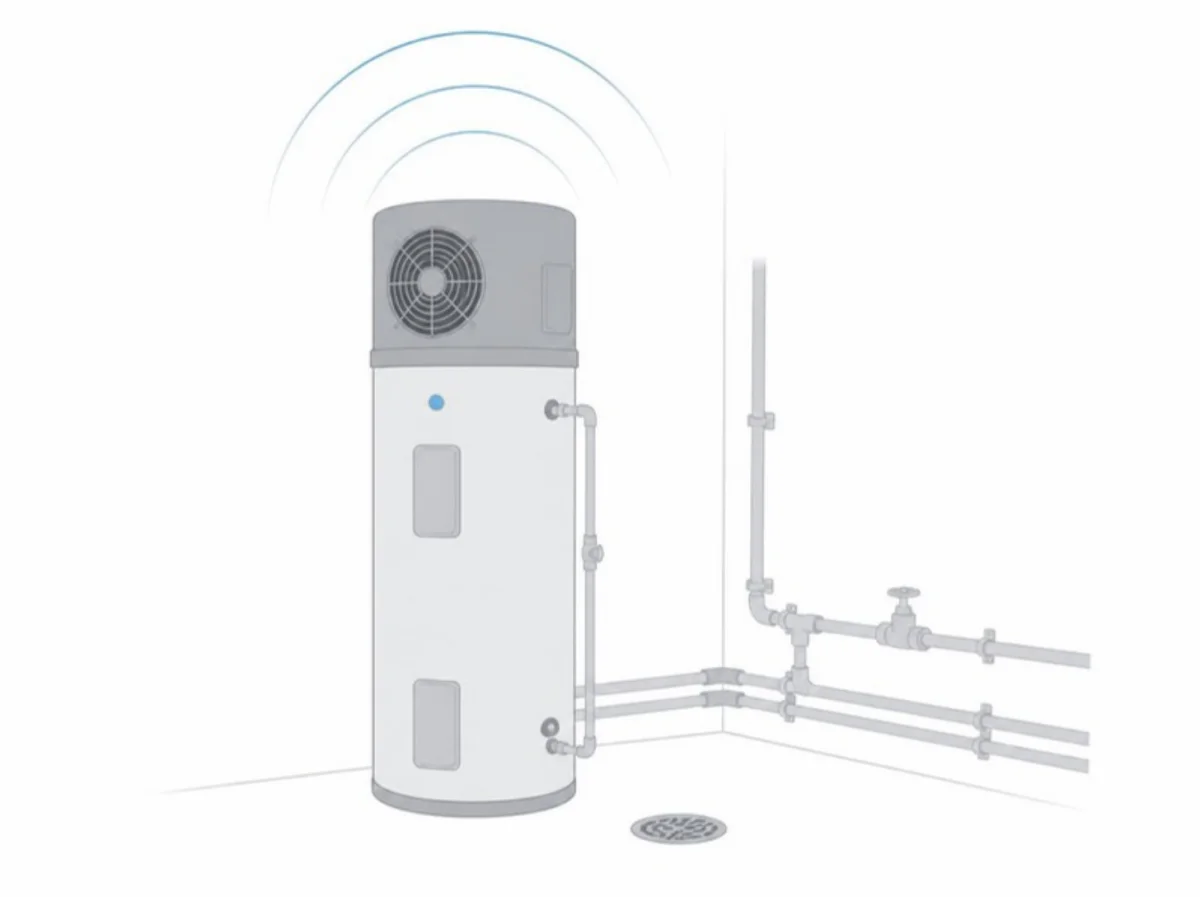
The Whirlpool version asks owners to find the source first. "It may sound like it's coming from the water softener but it could also be the nearby pipes or perhaps a water heater next to your softener." The fix it offers is checking the water pressure and, if needed, buying a pressure reducing valve. The Morton and EcoWater pages read the same.
EcoWater's ESD2802 manual gives the numbers: if daytime pressure is over 100 psi, add a pressure reducing valve in the supply pipe, and if it is low, raise well pump output to at least 20 psi. "Contact a licensed plumber." Fleck rates the 5600SXT for 20 to 125 psi. High pressure, EcoWater warns, "may cause inner valve parts failure."
Sounds from the brine tank
Most brine tank sound is water moving in or out. Water flows into the salt storage area during the fill stage, and later the venturi "produces a vacuum that pulls the salty brine water from the tank during a recharge", in Whirlpool's words.
The Fleck manual marks the end of that draw: "Brine draw is completed when the air check in the salt tank closes." When a valve fails to draw brine, Clack's table includes a "Regenerant line connection leak" and asks owners to inspect the line for an air leak.
Knocking on the tank is a test, not a symptom. To find a salt bridge, Whirlpool has owners rap the side from the salt line down: "If you get to the bottom and have a hollow sound, it's most likely a salt bridge," while a solid sound near the bottom points to a salt block. Kinetico's booklet links overfilling to bridging and asks owners not to fill a standard brine drum past 2/3 of its capacity.
Standing water is not automatically a problem. "Some water softeners normally maintain a visible amount of water in the brine tank," Culligan's troubleshooting guide explains, though a level that stays unusually high after a recharge can mean a restricted drain line, a blocked injector or brine line, a control valve fault or a float that is not working. Even the cover makes noise during these checks. Whirlpool's fill test calls it "normal for the plastic cover to produce some noise as it shifts and bends."
Beeps and alarms
On the GE GXSF30V and GXSH30V, a beep every 30 seconds is the salt warning. Once DAYS TO EMPTY drops to 15, "the alarm will beep every 30 seconds (from 8:00 AM to 8:00 PM)", and it stops as soon as any button is pressed.
Faults use the same timing. When the control detects an error code, "the alarm will beep every 30 seconds (from 8:00 AM to 8:00 PM) to signal that the softener requires service." EcoWater's Series 3700 beeps once when first plugged in, before its setup screens appear, according to the HydroLink Plus manual.
When do makers say to call for service?
When an error code comes back after a reset, when resin beads show up in the house water, or when the valve or motor cannot find its position. Water hammer and pressure problems go to a plumber instead.
GE's routine is to unplug the transformer, fix what can be fixed, and plug it back in; "If the problem is not corrected, the error code will reappear in 8 minutes." An "Err" on the display, a mechanical defect and resin in the drinking water all lead to "Call for service" in the GE chart. Morton uses the same eight minute check and a toll free help line. Pentair ends most Fleck error entries with "If the error reoccurs unplug the unit and contact technical support," and an error icon on the EcoWater 3700 means "Contact your dealer for service."
Culligan counts "Unusual sounds, system alerts or an error code on the display" among the signs a softener needs attention. Its HE owner's guide is written for trained service staff and states that installation, service and maintenance "should be rendered by a qualified and trained service technician." Kinetico owners can request service from their dealer through its app.
How loud is a water softener?
There is no decibel figure to quote. None of the softener manuals, service manuals or help articles behind this page prints a noise rating, so these softeners cannot be compared by sound the way dishwashers or refrigerators can.
What the makers give instead is timing. The noise comes during a recharge, by default in the early morning, and lasts from about 20 minutes on a Water Boss to about two hours on a GE or Morton. If the softener sits next to a bedroom, moving the recharge hour, or switching a Water Boss to Delay Mode, is the main lever these manuals offer.
Related reading
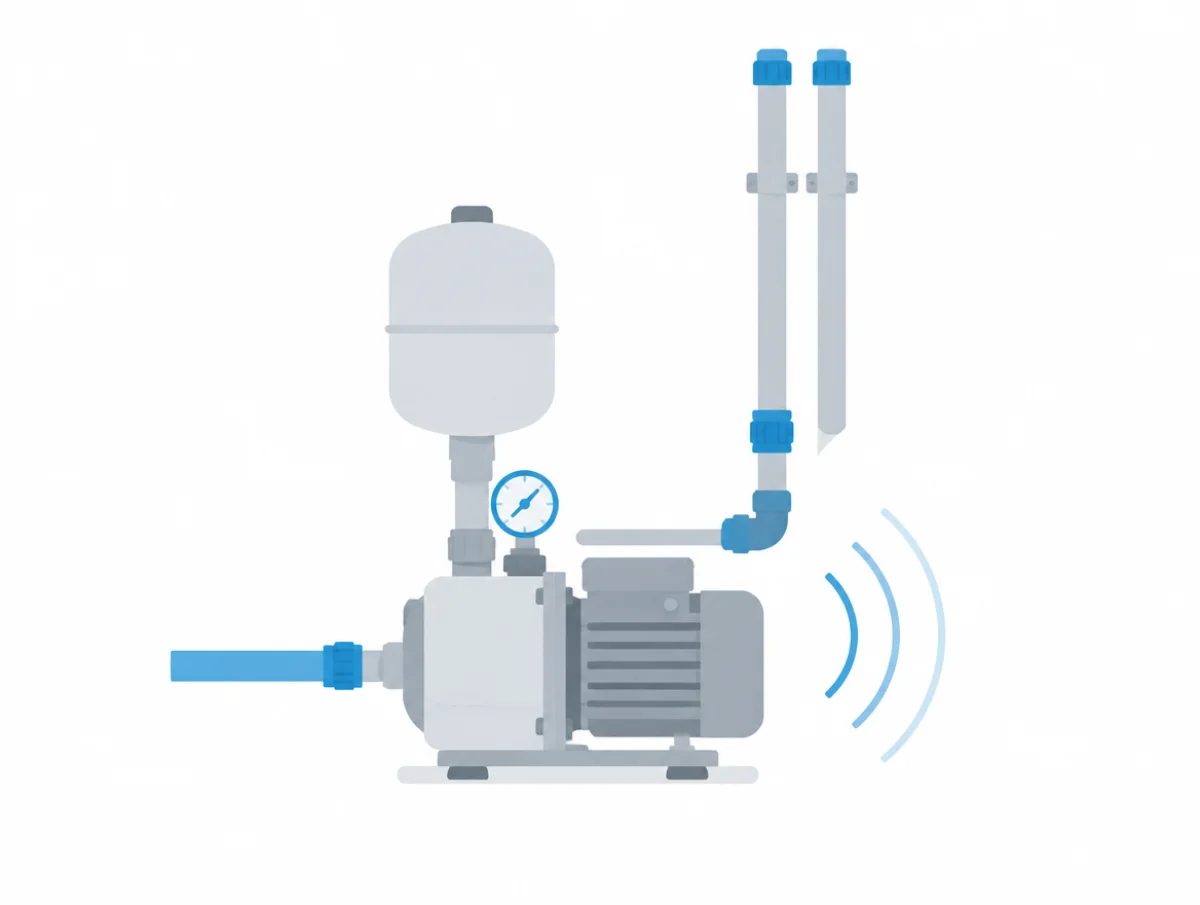
Softeners usually share a room with the rest of the water system. On a private well the well pump and pressure tank sit on the same line, and a water heater next to the softener is one of the banging sources Whirlpool names. Water hammer in the house pipes also turns up in our toilet noises explainer.
For low pressure from a well or a weak supply, the quietest booster pumps guide lists maker noise figures. If the softener lives with the furnace and pump in a basement, planning a quiet basement covers the room as a whole, and why your appliance got louder deals with machines whose noise crept up over the years.