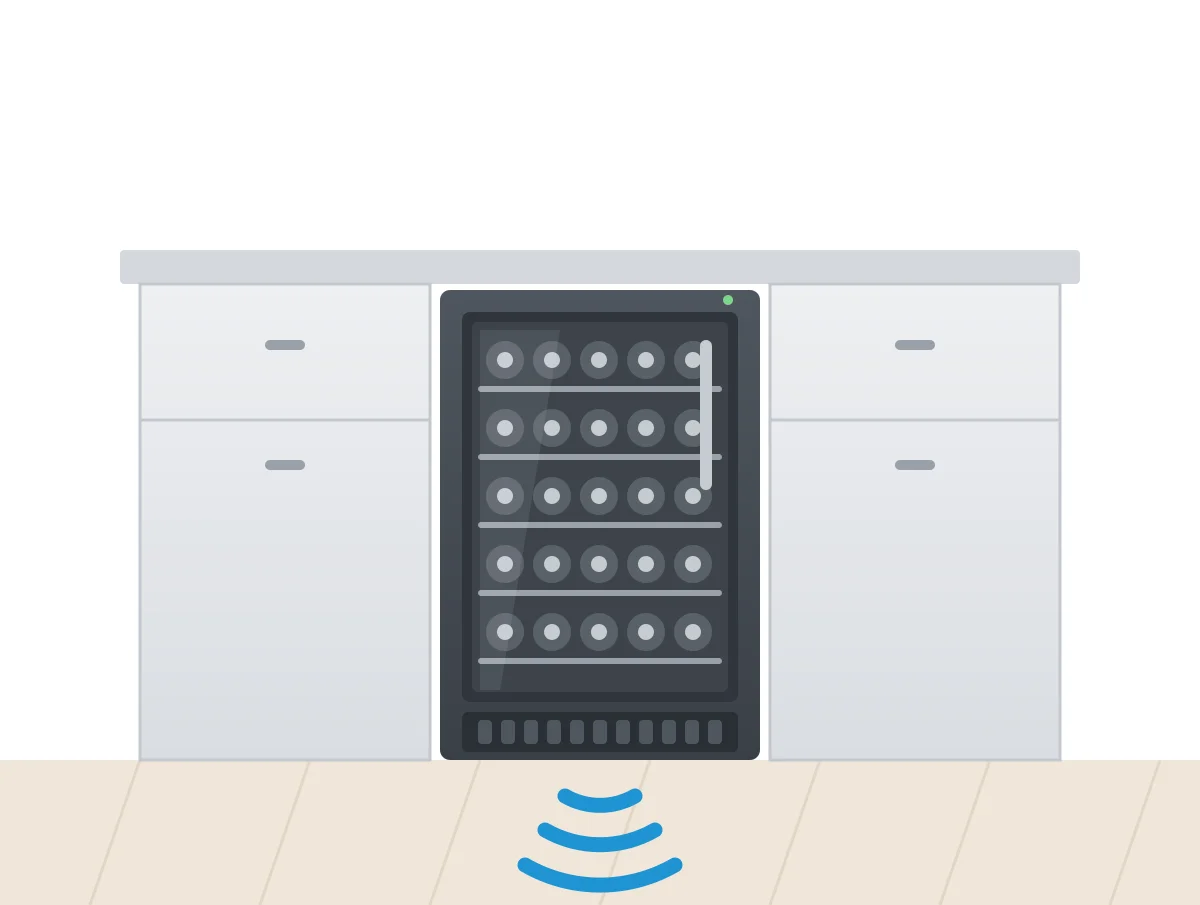
Wine coolers live in living rooms, home bars and kitchen islands, a few feet from where people sit, so a hum that would vanish behind a kitchen fridge gets noticed. Whynter ends the sound section of its BWR-462DZ manual with a line that sets expectations: "Please remember that the noise of the compressor and the coolant circulating in the system is unavoidable." Nearly every sound on this page sits on a maker's normal list. The exceptions are few, and the makers separate them clearly.
The material comes from manuals and support pages by Whynter, NewAir, Liebherr, Miele, Danby, EdgeStar (including its Koldfront thermoelectric cooler), Sub-Zero, KitchenAid, Frigidaire and Vinotemp, read on November 12, 2026. Summit's manuals sit behind a bot check we could not get past. GE and U-Line wine cooler manuals turned up only on retailer and archive sites, so neither maker is quoted here.
Mini fridges, freezers and full-size refrigerators have their own pages. This one covers the sounds specific to wine storage: dual zone valves, thermoelectric fans, and bottles that touch.
Compressor hum is loudest right after start-up
A compressor wine cooler hums whenever it cools, and the first minutes are the loudest. The Whynter manual puts it plainly enough: "Operating noise will be most audible immediately after the compressor comes on. It becomes quieter as the operating period continues."
Miele's KWT6322 manual spells the start-up sound "Brrrrr..." and explains that it "may get louder for brief periods when the motor kicks on." Liebherr ties the volume to the workload. Its UW 3710 and 3720 instructions list "Humming" as normal and add that "The volume depends on the cooling output."
What raises that output? Liebherr's examples include a running fan, "Freshly sorted food", "High ambient temperature" and a door "opened for long periods." For a wine cooler, the second item means a case of warm bottles loaded at once. Whynter asks owners not to "add large amount of contents at once," and Danby's FAQ explains that loading too many bottles in one go makes the display flash HI or LO for a while.
A pulsing or whining note can be normal too. KitchenAid's wine cellar help page traces a "pulsating or high-pitched noise" to "the compressor or fans as they adjust to optimize performance." EdgeStar's CWR361FD manual uses almost the same words for its "high efficiency compressor."
Why does a wine cooler click?
A single click when the compressor starts or stops is the control switching it. Miele's manual: "Clicking sounds occur whenever the thermostat turns the motor on or off." Liebherr calls it "Normal switching noise."
Dual zone models add a second click. Sub-Zero explains that its wine storage units "have a solenoid valve that clicks when it switches from cooling one section to the other (upper to lower or lower to upper)." On its Designer (formerly Integrated) models that valve "makes more of a grinding noise than a clicking sound." Both are normal operation. Liebherr's table has a matching entry, "Rattling or humming" when "Valves are active."
Cracks and pops are a separate sound with a separate cause: the cabinet changing size as it cools. KitchenAid puts them down to "Contraction and expansion of the inside walls," mostly as the cellar "cools down for the first time or defrosts." In the Frigidaire guide, the sound "will level off or disappear as wine cooler continues to run."
Gurgling, bubbling and hissing come from refrigerant
These are liquid and gas moving through the sealed system. Every maker that mentions them calls them normal.
The wording varies more than the cause. Whynter lists a "Gurgling sound, caused by the refrigerant flowing through the appliance's coils," and Miele writes it as "Blub, blub...." Liebherr splits the sound in two: "Bubbling and splashing" while "Coolant is flowing into the cooling circuit," and "Spitting and hissing" while it is "spraying into the cooling circuit." EdgeStar places the gurgle at the end of a run, "As each cycle ends."
Miele adds a detail that explains why new wine coolers can sound wetter than old ones. Its isobutane refrigerant (R600a), which Whynter uses too, "has, however, led to a slight increase in the noise level of the appliance," so you may "hear the coolant flowing around the system."
Water makes the rest. EdgeStar's manual mentions a splash as water runs "from the evaporator to the water bin." KitchenAid describes a gurgle on opening the door, "due to water equalizing in the drain tube as air is forced through the tube," and notes that it "is more common during times of high humidity." Sub-Zero names "a partially plugged drain tube" among the usual causes. If a gurgle starts suddenly and grows, that is the service case covered further down.
Is a thermoelectric wine cooler supposed to hum?
Yes. A thermoelectric wine cooler has no compressor, but its fans never stop, so a low, steady hum from the back is how it sounds when working properly.
The Koldfront TWR327SZ manual, published by EdgeStar, explains that "Humming noises may come from the inner and outer fans that are continuously running" and that "A low-pitched fan noise from the inner and outer fans is normal." The same manual wants "at least 5” clearance at the back, 4” at top and 4” at sides" and forbids building the cooler in "or behind a closed cabinet door."
Makers disagree about whether the type is quieter overall. Vinotemp's 2021 article argues that thermoelectric models "have fewer moving parts and are less noisy than compressor wine fridges." NewAir's own spec tables do not bear that out as a rule: the thermoelectric Shadow-T carries a 38 dB rating, while the 27 bottle AWC-270E, a compressor model, carries 35 dB. Neither figure comes with a distance or a test method.
Room temperature matters more here than with a compressor. Koldfront asks for a room "between 60 and 85ºF all year round," and Vinotemp warns that thermoelectric coolers "will not be able to cool efficiently when a room is too warm." A cooler that cannot reach its set point keeps its fans going hard.
Why is my wine fridge rattling or vibrating?
Most rattles come from the cabinet being out of level or touching something. KitchenAid names three sources for a wine cellar: refrigerant flow, "Items stored inside the refrigerator," and a cabinet that "is not fully leveled."
Miele's troubleshooting table is the most complete. Under "Rattling, clinking" it lists a cabinet that is not level, one "touching another appliance or piece of furniture," shelves that "are jiggling or are stuck," and "transport cord clips" still hanging on the back. Each has a fix you can do yourself, from adjusting "the screw feet underneath the appliance" to taking the clips off. EdgeStar adds that "Items stored on top of the wine refrigerator can also make noises."
Feet that are uneven or loose shake the whole box. On the AWR-520SB, NewAir traces vibration to a floor that is not level or feet "not correctly installed," and the fix is to check that the feet are "in the proper position and tightened securely." Danby's advice for unusual noises covers the same ground in a sentence: "Ensure the unit is level and not vibrating against any surfaces." Then it asks owners to clean the condenser fan and check for loose parts inside.
Frigidaire's guide wants all four bottom corners "resting firmly on solid floor" and gives the direction for its legs: "clockwise to lengthen and counterclockwise to shorten."
Bottles that touch will clink
Clinking glass is a problem only wine coolers have, and the fix is spacing. Miele's table pairs "Bottles or containers are touching" with one word of advice: "Separate them." Liebherr files "Clattering" from "Objects inside the appliance" as an "Error noise," one of only two in its table (the other is vibration from a poor installation), and asks owners to "Secure equipment parts" and "Leave a gap between items."
Wine makes the case for quiet on its own account. Miele writes that "Vibration and movement have a negative effect on the maturing process which can affect the taste of the wine," and asks owners not to stack bottles on top of one another on its wooden shelves. NewAir's storage guide tells owners to "Avoid heavy vibrations from motors."
One more source of rattle sits behind the cabinet. The power cord "must not come into contact with the back of the appliance," Miele warns, because vibration can damage it and cause a short circuit.
The room and the cabinet change what you hear
A wine cooler can sound louder than it is because of where it stands. Hard floors, open plans and quiet rooms all carry the sound.
Whynter is blunt about it: in an open-plan kitchen or a partition wall, "the level of operating noise will be heard more acutely. However, this is due to the surrounding architecture and not to the unit." EdgeStar writes that hard surfaces like floors and walls "can make the sounds seem louder than they actually are." Frigidaire's guide makes the same point about the room: "When the surrounding noise level is low, you might hear the system running."
Sub-Zero gives the most practical checklist. Verify the unit "is installed in an opening," that it "is not on stone, tile, or wood floor," and that the room "is not a study or very quiet place." It also allows that "Adding insulation to the sides of the unit may reduce the audible noise slightly."
Airflow decides how hard the cooler works. For freestanding use, Whynter suggests "5 inches (127mm) of space between the back and sides," and even built in, "the air vent at the front of the appliance must never be covered or blocked in any way." NewAir's NWC016SS00 is freestanding only and lists "insufficient ventilation" among the reasons it makes "too much noise." Vinotemp adds that a cooler starved of exhaust room "may begin to work harder," and that proper clearance stops it "vibrating against another surface."
How long should a wine cooler stand before you plug it in?
It depends on the brand and the model, from 2 hours to 24. Read the number in your own manual rather than borrowing another brand's.
The spread is wide even inside one company. NewAir asks for about 2 hours on the AWC-270E and 24 hours on the AWR-520SB and NWC016SS00. Whynter's BWR-462DZ wants "approximately 4 hours." EdgeStar's CWR361FD asks for 24 hours "to allow the compressor's oils to settle," while its Koldfront thermoelectric cooler asks for the same 24 hours for a different reason, so the temperature can "acclimate."
None of these makers ties the wait to noise. They tie it to the cooling system, and Whynter adds a limit for the move itself: the cooler should not be "turned up side down or unleveled greater than 45°."
When does a wine cooler noise need service?
A sound that is new, grows louder, or never stops is the main sign, along with a fan that stays noisy after cleaning. Sub-Zero's rule: if a noise "is new, gets louder over time, or does not go away, service may be needed."
Sub-Zero also offers a way to find a noisy fan. Open every door, and if the noise stops, close only the upper door of a wine storage unit. A noise that comes back with that door shut is the evaporator fan motor, a job for Factory Certified Service. NewAir's fan advice for the AWR-520SB is shorter: check for debris or obstruction, and "If not, contact the manufacturer."
EdgeStar sets a hard stop for both its manuals: "Immediately unplug the unit if it makes strange sounds, emits smells or smoke comes out of it, and contact customer service." Whynter's error table covers codes E0 to E7, which stand for a communication error, failed sensors, a failed defrost heater and a failed door switch, and its answer is "Call for service." Danby sends a cooler that still will not hold temperature after its checks to customer service.
Check the simple causes before booking a visit. Liebherr warns that if a fault turns out to be an operating error, "you will have to be charged for the costs incurred, even during the warranty period." Whynter's manual sums up where most odd sounds start: "Unusual noise is normally the result of improper installation."
Other fridge noise guides and quieter wine coolers
For a compact fridge in a dorm or office, see the mini fridge noises guide. Kitchen fridges are covered in the refrigerator noises guide and how to make a refrigerator quieter, and chest and upright freezers in the freezer noises guide.
To replace a loud cooler, the quietest wine fridges guide orders coolers by published decibel claims, starting with Summit's 32.4 dB built-in, and the NewAir wine cooler decibels page covers one brand from 35 to 45 dB. For cans as well as bottles, see the quietest beverage refrigerators; for a walk-in cellar, the quietest wine cellar cooling units. Before comparing any of those numbers, read the dBA explainer. A cooler that has grown louder with age may fit the patterns in why appliances get louder.